Classic Review: A Semester in the Life of a Garbage Bag

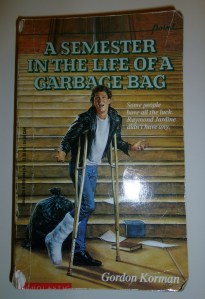
One of my favorite funny authors growing up (and still, to some extent) was Gordon Korman.  Several of his books still make me laugh out loud, after repeated reading.  One of my favorites, for its humor and its philosophy, is A Semester in the Life of a Garbage Bag.  Gordon Korman understands stress.

He’s also an author who proved just how awesome he is–I emailed him after I posted this review, and got a very nice email back!

***********************************

Every high school student should read this book.  Actually, everyone should read it, if only for the metaphor of the title.  A Semester in the Life of a Garbage Bagby Gordon Korman sounds utterly ridiculous–and it is.  It is a hysterical, hilarious, wonderful book.

My slightly battered, much-loved copy

But the title is actually remarkably profound.  It’s based on a one-scene reference (like To Kill a Mockingbird‘s title) when the main character describes a commercial for garbage bags.  The garbage bag is hooked up to a machine that keeps pumping in more and more pounds of pressure, and the smiling spokesman talks about how much pressure the bag is taking.  He keeps on cranking it up, while the poor bag is struggling to hold together.  Sound like high school to anyone?  Or life, for that matter?

The main character in the book is Raymond Jardine.  He has no luck.  Zero, zip, zilch.  His overriding dream is to somehow make it Theamelpos, an island in Greece which he is convinced grants extraordinary luck to all visitors.  Six students will be selected (methodology unknown) for a school trip this summer, and Jardine is determined to lie, steal, cheat, scheme, and connive his way into one of those six slots.

And that’s just the beginning of the story.  We’re guided through the book by the comparatively normal Sean Delancey, who is paired with Jardine for an English assignment.  Korman often takes the wise tactic of giving us someone relatively sane as a lead character, who can navigate us through the wild and wacky world of the book, where anything is possible.

Where it’s perfectly normal, for instance, for students to surf on trays down tables in the cafeteria–the temperature in the cafeteria is typically around 90 degrees, because the school is powered by the experimental SACGEN, which all the students know doesn’t work but which the school board is determined to insist is a great triumph.  That’s just one example of the world we find ourselves in.

The English assignment Sean and Jardine have to do together is a 30 page report on a poet of their choice.  Jardine is determined to pick a poet no one else will do (reasoning that if they pick a famous poet, another group will too, the teacher can compare the two reports, and his is bound to be worse).  Literally minutes before the deadline to choose, Jardine selects Gavin Gunhold, the author of “Registration Day.”  They rave to their teacher about how much they love Gunhold’s work, and find out later that he never wrote anything else, having died in a freak accident shortly after writing his only poem.  Their solution is start writing their own poetry in Gunhold’s style, using for inspiration words they pick at random from the encyclopedia.

As to Gunhold’s one original poem:

On registration day at taxidermy school
I distinctly saw the eyes of the stuffed moose
Move.

I’m not usually a fan of poetry, and I have probably quoted Gavin Gunhold more often than almost any other poet.

A Semester in the Life of a Garbage Bag is packed with memorable characters, funny scenes, and even an explosion or two.  You will get your money’s worth in laughs out of this book.  And surely everyone can relate, at least a little, to how Jardine feels about that garbage bag?
Author’s website: www.gordonkorman.com
Becoming a Geek Celebrity

I seem to be meeting a lot of geeks lately.  That sounds a little odd, but it does make sense–I’ve connected into a few different social circles that seem to attract geeks (and by the way, they all defy the stereotype about socially awkward, reclusive geeks).

It’s great fun, because we all have some of the same touchpoints, and the important ones are not the same as the important general pop culture ones.  You know–Star Trek, Star Wars, Firefly, certain board games, certain authors.  There are certain people too.  Neil Gaiman is apparently The World’s Coolest Author; not just because of his books, but he personally seems to be amazing.  George Takei is the Geek King of Facebook (follow him if you want to be in on all the geek memes).

And lately, Wil Wheaton is emerging as the Geek Celebrity.  Not for anything in particular–just for being a geeky celebrity.  I mean, besides a recurring role as himself on The Big Bang Theory, he has an online show focused on playing board games.  Really.

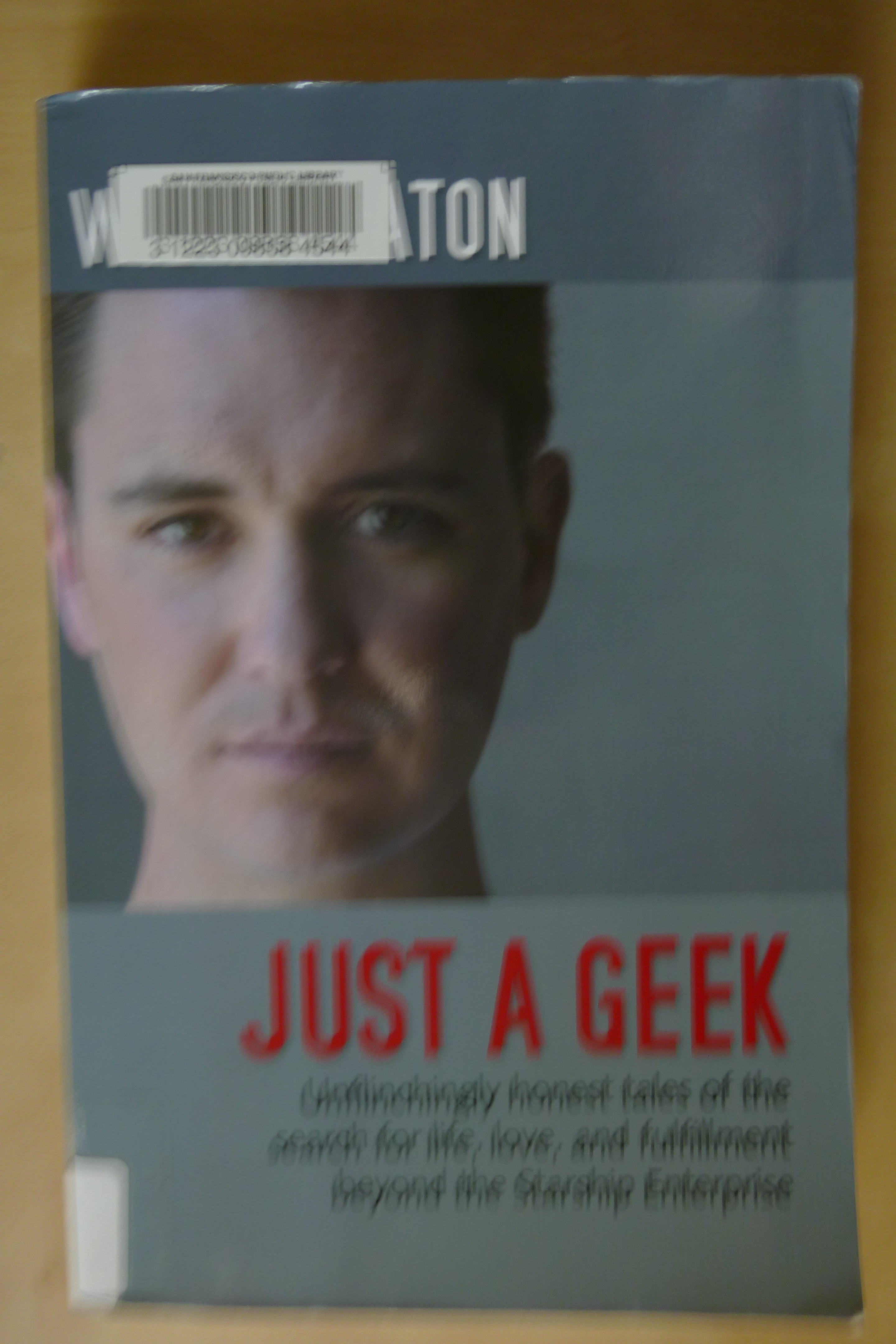
All this made me curious.  How did Wesley Crusher become the Geek Celebrity?  So I read Just a Geek by Wil Wheaton.  It would probably make him happy that I read it more because I’m curious about who he’s become lately than because of Wesley.  I never actively disliked Wesley, but I was never much of a fan either, so that wasn’t that big a draw.

Just a Geek is a memoir, but one that covers a very narrow period.  It’s a couple of years from roughly 2001-2002, and charts how Wheaton went from a washed-up celebrity trying to escape Star Trek to coming to terms with Wesley Crusher and publishing his first book.  This was published in 2004 so it’s hardly the complete story of how he got to the present (obviously), but it does describe the turning point.

Some sections of the book are lifted directly from Wheaton’s blog, and the feel of the entire book is much like that.  You do get the sense of Wil Wheaton sitting down to tell you about his life and his experiences.  In some ways, what has stuck with me the most is the raw honesty of it all.  He talks about being depressed or angry or disliking something, in a way that people (at least in public forums) usually don’t.  He talks about deep positive emotions too, especially being incredibly moved by Star Trek: The Experience in Las Vegas, stepping back on the bridge of the EnterpriseD.

If his intent was to convince people that he’s a regular guy, that’s definitely how he comes across.  We usually see only a couple of visions of celebrities, and this is neither.  Wheaton is not the self-destructing celebrity on the cover of Us Weekly, or the serene dispenser of wisdom that shows up on Parade.  He’s just a normal guy who’s a bit geeky.  Despite the title, the geekiness didn’t feel like that big of a focus to me–it was mostly “life as a struggling actor.”  But he did get an introduction from Neil Gaiman, so there are obviously geek connections here.

In a way I’m sorry to say that the most memorable parts did turn out to be Star Trek related.  The journey and personal growth are interesting, but my favorite parts involved other Star Trek celebrities; it happens in a few places.  Unless you’re really interested in Wil Wheaton, I wouldn’t read this without a working knowledge of Star Trek: The Next Generation and the actors involved (which, if you’re really interested in Wil Wheaton, you probably have anyway).  It’s not a consuming focus but it is spread throughout the book, and there isn’t always much context provided.  In a way, Star Trek IS the context of the book.

Since Wheaton is honest, I suppose I’ll be strictly honest too on my assessment.  I enjoyed the book.  It gave me what I wanted, which was some idea of how Wil Wheaton became a geek touch point beyond the Starship Enterprise.  But I didn’t love it and I don’t think I’ll run out to read something else by him.  I’m just not enough of a fan of his writing or of him–and it’s a very personality-driven book.  I should note there’s no reason for that.  It’s just one of those things, what-does-and-doesn’t-speak-to-you.

But I will be hoping for another Big Bang Theory cameo, and I will recommend the book–if you’re a geek.

Author’s Site: http://wilwheaton.typepad.com/

Other reviews:
Stainless Steel Droppings
Just a Writer Geek
Reading by Candlelight
Anyone else?

Saturday Snapshot: First and Last Books

I thought I’d share a couple of recent book purchases this week.

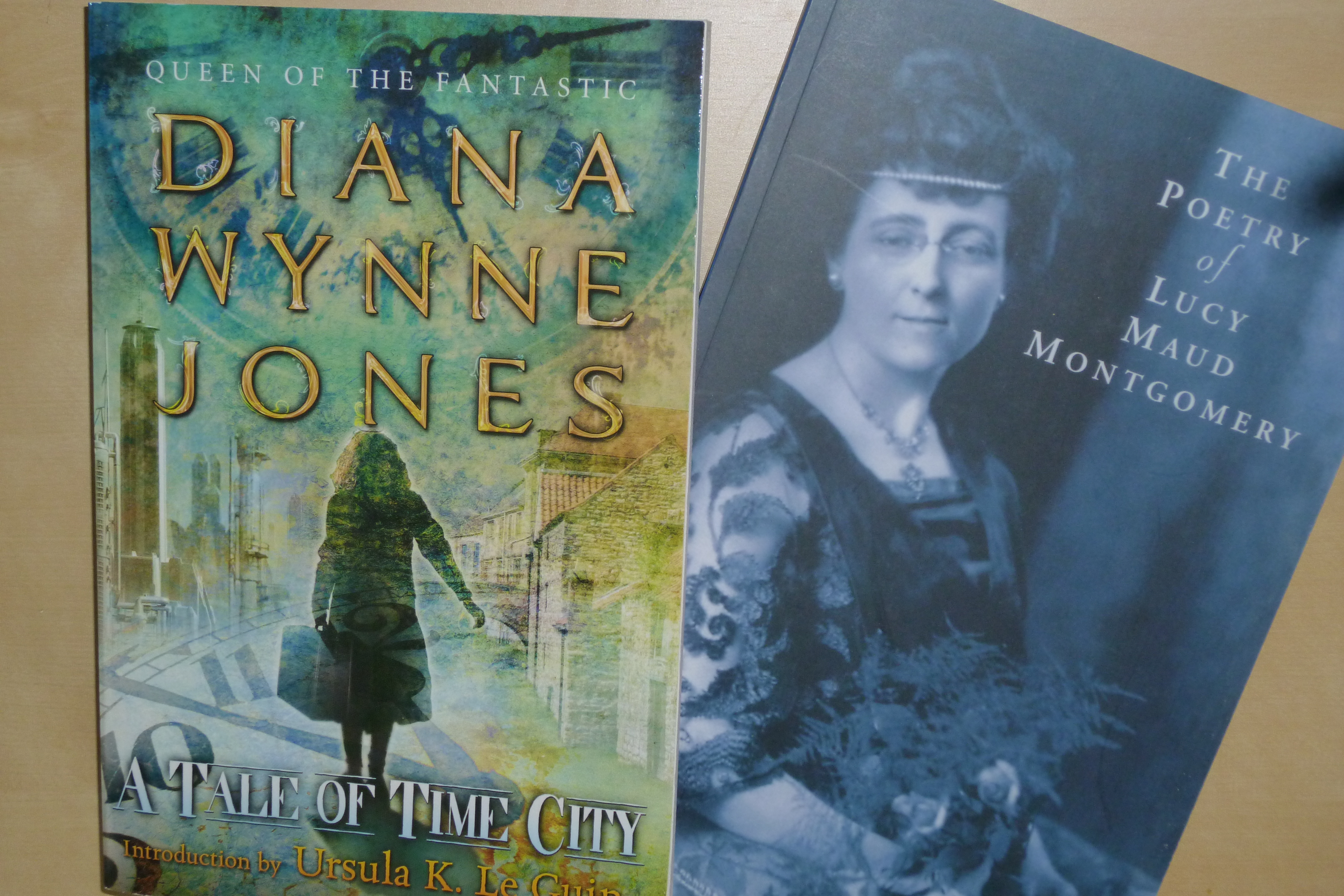
A Tale of Time City is one of the first Diana Wynne Jones books I ever read, and oddly enough, is the first of her books I’ve deliberately set out to buy.  I’ve read many, many of her books, but all from the library, and the only ones I own are ones I happened to stumble on at a library book sale, or got as a gift.  My collection is woefully small, and I thought I’d better do something about that–so I started by buying this lovely new edition of one of my favorites.

The Poetry of Lucy Maud Montgomery is my last L. M. Montgomery book.  I have read and own every other published book of her writing.  Novels, short stories, poetry, letters, journals, autobiography–I have it all.  This is the last one.  At least, until someone, somewhere, somehow decides to publish the 200-odd additional short stories that exist in an archive but are not currently available.  In the meantime, I’ll just have to have a bittersweet read through the last new-to-me book of L. M. Montgomery writing. Although the name makes me laugh–having read everything else, I’ve read her journals where she commented that she didn’t like having her full name written out.  Now I’m always amused when people do that!

Visit At Home with Books for more Saturday Snapshots!

Keep Flying with Firefly

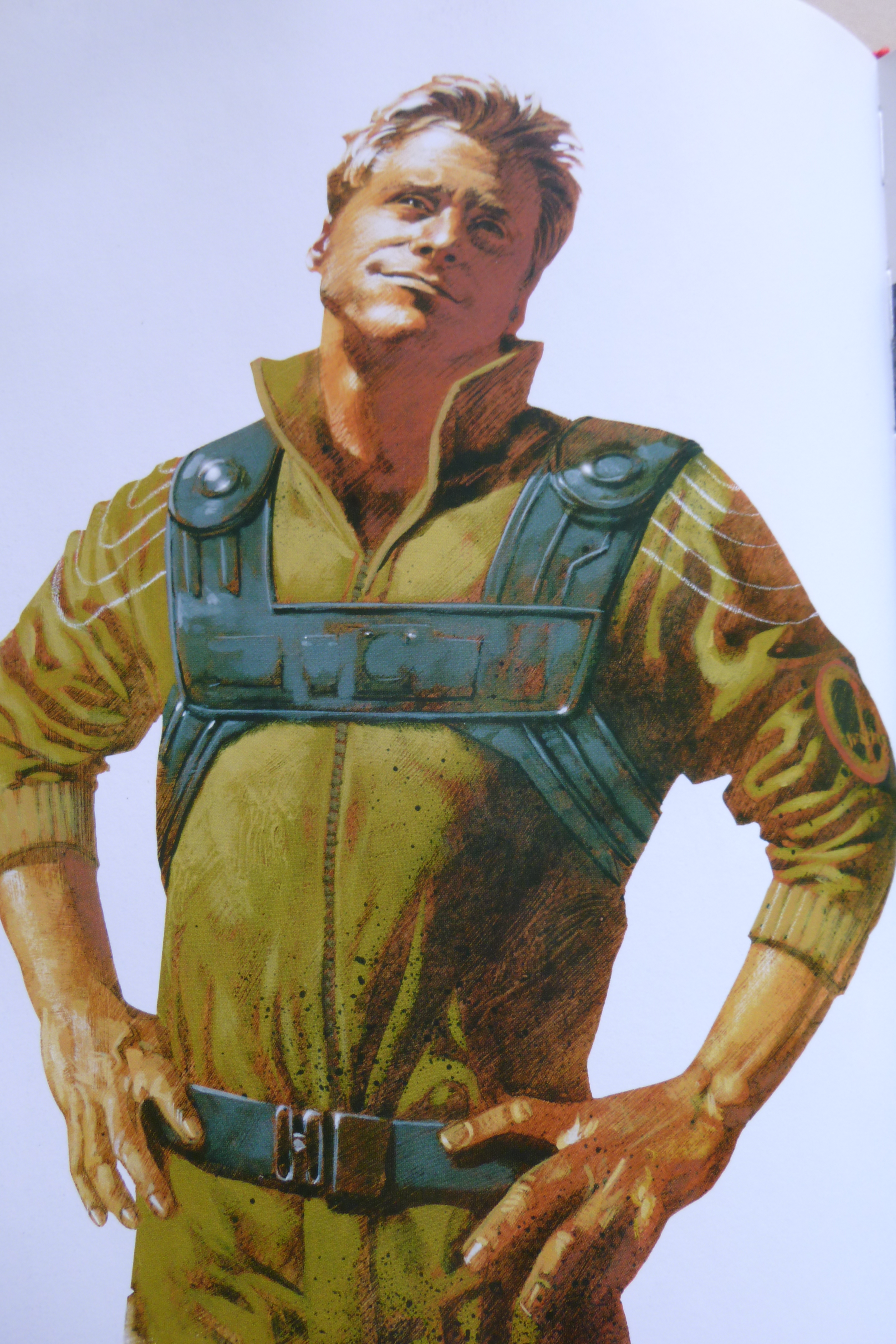
If you know anything about Joss Whedon’s Firefly, then you know that it ended much too soon.  There are 14 TV episodes and one movie, Serenity, and what exists is wonderful–but also makes it pretty clear that there was meant to be a much longer story arc, if only the show hadn’t been canceled.  With that context, you’ll understand why I was excited to hear there are Firefly graphic novels, written by Whedon.  Maybe some of those unexplained mysteries and lingering plot threads would be resolved!

So were they?  Well…yes and no.

To give you just a little Firefly context, it’s a space western, set in a future where humanity has left Earth and spread to new worlds–rich at the center, scraping along on the frontier.  Mal is the captain of Serenity, a Firefly-class spaceship, and leads a group of more-and-less misfits, theoretically merchants but not above smuggling or stealing–anything to keep flying.

Don’t read the graphic novels unless you’ve seen the show and the movie–there are spoilers, and possibly more important, there just isn’t much context provided in the novels.  So from here out, I’ll assume that you know the show.

The three graphic novels I read are Vol. 1: Those Left Behind, Vol. 2: Better Days, and The Shepherd’s Tale.  Don’t be fooled by the volume numbers–Better Days is chronologically first, though the plots aren’t directly related.

Better Days and Those Left Behind are essentially two new Firefly adventures, set between the TV show and Serenity.  In BD, the crew gets unexpectedly rich, and then has to figure out what to do when they aren’t scraping to get by.  My favorite part was seeing each character’s dream of what a better life would be.  And of course, complications ensue.  I found the ending confusing, though at least the poor plot conclusion is followed by a sort of epilogue with Mal and Inara that was sweet.  TLB is set closer to Serenity, and is mostly interesting because it explores why Inara and the Shepherd left the ship.  It does the most to fill in a missing chapter (though a couple more chapters wouldn’t have hurt!)

The Shepherd’s Tale had me the most excited.  I think he’s the one who got burned worst by the early cancellation of the show, because it’s obvious that he has a secret past they meant to reveal gradually–and then never had time for.  This book does reveal a lot–but left me wanting to know so much more.  There are some revelations, though at the same time some of it feels obvious once you hear it.  And I still don’t understand what exactly happened in “Safe,” when the Alliance seemed awfully respectful of him.

I do love the way TST is told, though.  It’s chronologically backwards.  We start at Serenity, then jump to a moment that could have been in the TV show, then jump to a moment before that and a moment before that…all the way back to childhood.  Each transition is tied together by a phrase or an action–Kaylee tells him, “You’re gonna come with us,” and from there he flashes to an earlier moment hearing that phrase.  It moves like memory, and it’s a neat way to tell the story–although it takes a little effort to follow.  I went through it again backwards after I got to the end.

I should also comment that I loved the artwork in BD and TLB.  There are beautiful drawings, and the characters look perfect.  TST is no doubt good artwork for its kind, but it’s a more minimalist, cartoon-style that doesn’t appeal to me as well.

All in all, if you like the series these are well-worth reading to get a couple more adventures and answer a few questions.  There are apparently a few more comics floating out there too, but I’m not sure how to get them and they don’t look like they’re going to resolve my remaining questions anyway.  You see, I still want more about the Shepherd’s past, and something post-Serenity to finally resolve the Mal/Inara romance, and also something to reveal that a certain character’s death was all a hideous mistake and never really happened.  Which is kind of where I was before I read these three.

Oh well.  At least I got a few more Firefly adventures.

Other reviews:
Ramblings of a Semi-Housewife
Stories Geek
Anyone else with a review, Firefly fans?

Quotable L. M. Montgomery

“The one all-important canon of literature: ‘Thou shalt not write a dull book.’ “

– Paraphrased from L. M. Montgomery