A Castle with a Mind of Its Own

What if a castle was alive?  That idea is the big draw for me in Tuesdays at the Castle by Jessica Day George.

The castle of the title would be a very confusing place to live, but it’s great fun to read about.  The castle doesn’t talk and it rarely takes immediate actions like slamming doors, but it has a clear presence.  And it has a habit of changing itself when it’s bored, or wants to make a point.  So rooms shift around, new towers appear, and you never quite know where you’re going.  The castle also arranges and furnishes the rooms of its inhabitants to make some none-too-subtle points.  People the castle likes gets lovely rooms, while people the castle hates find their rooms getting increasingly smaller and more unpleasant.  The castle has to approve of each king and heir, and changes their rooms to reflect its feelings.  It’s all a wonderful concept.

We wander the castle with Celie, the youngest princess and the castle’s favorite.  The feeling is mutual; Celie’s greatest goal is to create an atlas of the castle (which strikes me as quite impossible, but good for her for trying). The plot gets into motion when Celie’s parents and older brother are ambushed on a journey and disappear, presumed dead.  Celie, her sister Lilah, and her brother (and crown prince) Rolf have to band together when conspiracies between the royal council and a foreign prince threaten their kingdom.  Fortunately, Celie and her siblings have the castle on their side…

This is a cute book aimed at a fairly young audience.  The characters are likable and well-defined, if not terribly complex.  Lilah is quite proper, Rolf is striving to live up to his role, and Celie is creative and daring and determined to fight back.  She’s a good heroine who I think younger readers will very much identify with and enjoy.

The plot moved along well, although the ending did feel ultimately a bit contrived and convenient.  Still, it’s the kind of happy ending I want from a kids’ book, so that’s a fairly mild complaint.

The castle was my favorite part.  The rest was a pleasant but not particularly striking kids’ fantasy novel.  The castle was the unique bit, and I’d love to see more stories with this setting!

I think this would be a great read for younger readers, and it’s fun for older readers too, if you’re looking for a light story without a great deal of depth.  It wasn’t irritatingly and unreasonable shallow, as some books are, but it does feel like it’s targeting kids.  Which is okay–it was a fun read!

Author’s Site: http://jessicadaygeorge.com/

Other reviews:
Charlotte’s Library
Raiding Bookshelves
Once Upon a Twisted Tale
Anyone else?

Going Postal Group Read, Week Two

It’s Week Two of the Going Postal Group Read!  Here’s the discussion for the next hundred pages of the book:

1)      Pratchett has done some lavish setting descriptions by now, notably the Post Office but also rooms at Unseen University, and other places around Ankh-Morpork.  What’s your favorite one?

I was unusually struck by Pratchett’s setting descriptions in this book–I don’t remember that so much in other Discworld books, though that may also be a product of re-reading and noticing new things.  I love the descriptions of the mountains of letters in the Post Office.  That’s such a fantastic, over-the-top image.  I also loved Pelc’s study, especially this bit: “It was a wizard’s study, so of course it had the skull with a candle on it and a stuffed crocodile hanging from the ceiling.  No one, least of all wizards, knows why this is, but you have to have them.”

2)      In Chapter 7, Moist waxes poetic about the personal nature of letters versus clacks.  This could easily be looked at as email and other online communication versus paper letters.  Do you agree with Moist, or does he exaggerate?  And just for fun, what’s the best piece of paper mail you ever got?

I of course appreciate the speed and convenience of email and other electronic communication, but I do rather regret the demise of paper letters.  I think it’s mostly for their lasting power.  You can talk about the personal-ness of paper letters, but an email can be personal in its contents.  However, I like that paper letters can be saved, and looked at again later.  I suppose emails can be too, but they usually aren’t.  I like letters as history, which they seem to be in a way that emails aren’t.

Best paper mail I ever got…  Certainly the most amusing was when a friend sent me a black spot.  We have a bit of a thing for pirates.  The most glee-inducing letter was when Geraldine McCaughrean sent a personal reply to my letter to her.  VERY glee-inducing!

3)      Share your favorite quotes and moments from this section of Going Postal.

Look, [Moist] said to his imagination, if this is how you’re going to behave, I shan’t bring you again.

Re: the Posthumous Professor of Morbid Bibliomancy at Unseen University:

“Why’s he ‘posthumous’?” Moist asked.

“He’s dead,” said Pelc.

“Ah…I was kind of hoping it was going to be a little more metaphorical than that,” said Moist.

“Don’t worry, he decided to take Early Death.  It was a very good package.”

“Oh,” said Moist.  The important thing at a time like this was to spot the right moment to run, but they’d got here through a maze of dark passages and this was not a place you’d want to get lost in.  Something might find you.

Looking forward to reading others’ thoughts!  Please link your posts below. 🙂

A Mermaid and a Princess

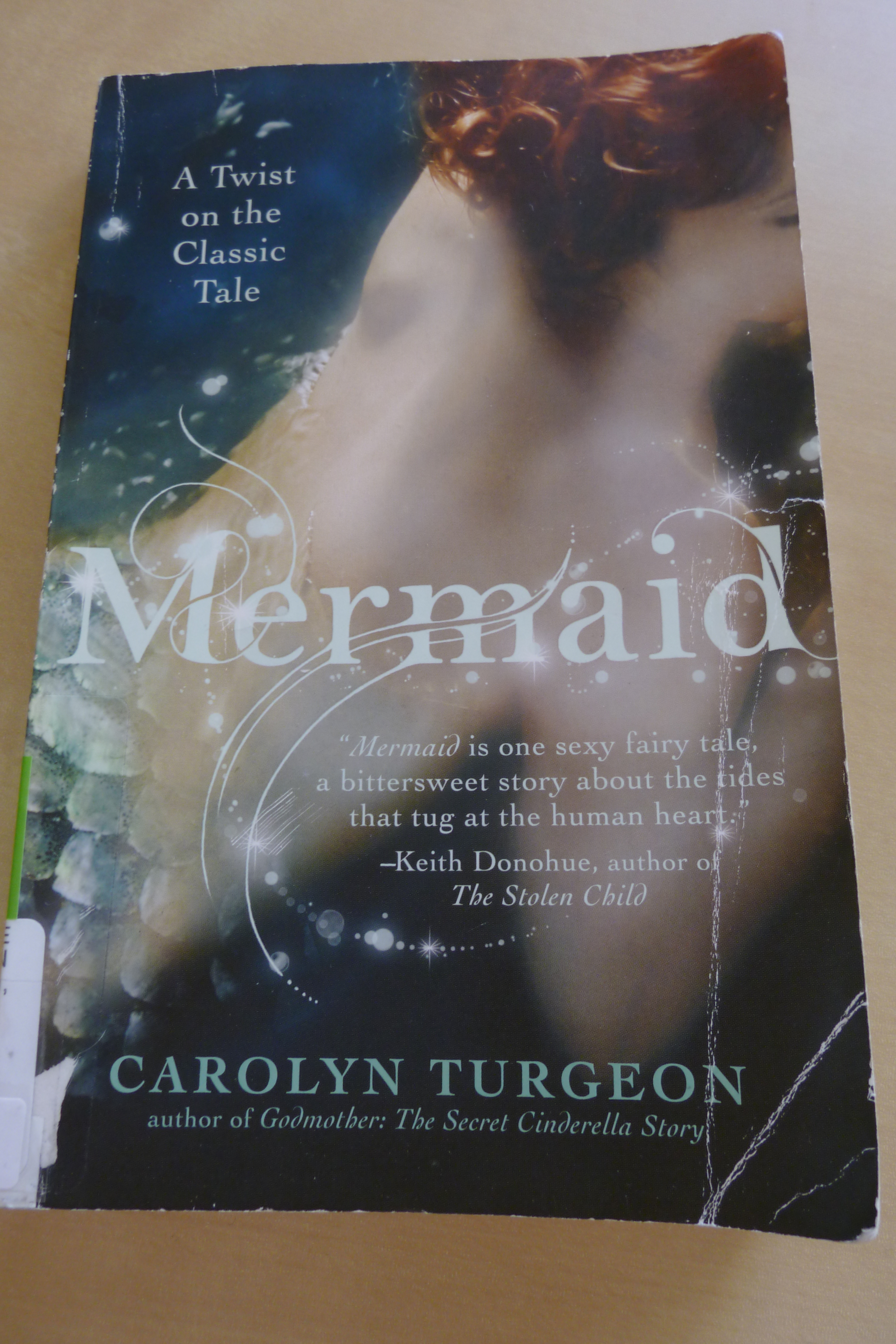
Since it’s hard to ignore Disney while talking about fairy tales, perhaps I should begin by saying that this is not a review of The Little Mermaid.  It’s not a review of Andersen’s fairy tale either, but that’s a closer relative.  Mermaid by Carolyn Turgeon is a re-imagining and expansion on the Andersen tale, with all the dark parts retained and deeper characters developed.

The original story is about a mermaid princess who falls in love with a human prince.  She gives up everything and goes through torture to gain legs and be with him, only to lose him to a human princess in the end.  This book looks at the story through the eyes of both the mermaid and the human princess, bringing an added dimension to the tale.  It’s definitely an adult version of the fairy tale, both for the sensuality and for the torment the mermaid goes through.

The story opens when Princess Margrethe, hidden at a convent to protect her from her country’s enemies, sees a mermaid drag a human man onto the shore below.  Mermaids are mythical creatures in this land, and Margrethe is drawn in by all the magic that the mermaid represents.  She feels sure that the mermaid brought the nearly-drowned man to her for a reason, and is shocked when she finds out the handsome stranger is the prince of an enemy country.  Meanwhile, Lenia the mermaid princess has always been fascinated by the land, and now can’t stop thinking about the man she rescued.  She seeks a way to be with him, while Margrethe looks for a way to prevent war.  Unfortunately, they’re both sure that destiny is calling them to the same man.

Margrethe and Lenia are the center of this book, telling their stories in alternate chapters.  While they’re both in love with Prince Christopher, the dynamic between the two women has in some ways a stronger emotional impact.  Margrethe especially is drawn to the magic and mystery that Lenia represents.  I very much enjoyed Margrethe’s character.  She’s not a passive princess, but rather one who sets out to arrange destiny herself.  She doesn’t wait for the prince or get dropped on him by her father, but rather actively orchestrates events, even when that means taking risks and making difficult choices.

Lenia is an intriguing character as well, with her divided longings for both the sea and the land.  She also takes active steps (literally and metaphorically) to take the destiny she wants.  She goes through far more torture than Disney’s Ariel.  She gives up her voice, but not as a pretty ball of light–instead her tongue is cut out.  Once she gains feet, walking inflicts terrible pain.  All this is in the original, and wasn’t too gruesome…but definitely dark!

Christopher is a handsome, reasonably charming prince, though less complex than the two women.  It would be easy to not like him, because in some ways he does take advantage of Lenia once she arrives on shore.  However, I actually found myself not holding that against him.  While I don’t think it was particularly admirable, I do think he was operating from a culture where there’s an expectation about relationships between princes and commoner girls, and it simply never occurred to him that Lenia wouldn’t have that same understanding.  And he does show quite a bit of loyalty to her at points in the story.

I was not totally satisfied with the ending, and it’s a little hard to explain without spoilers.  In some ways it tied up too neatly, with characters deciding they can accept things they previously couldn’t, and yet in other ways it didn’t give me quite the happy romantic ending I wanted.  The whole premise is set up so that someone has to be disappointed, and instead of giving a happy ending to one girl and a tragedy to the other, we ended up with an ending where both are kind of settling…which works, but I think I might have preferred something a bit sharper.

Still, this was a very solid retelling of Andersen’s story.  I recommend reading the original first, and then picking up this one for all its added depth and details.

Author’s Site: http://carolynturgeon.com

Other reviews:
Anita Book
Postcards from Asia
Fairy Layers
Anyone else?

A Humorous Reflection on Death

Today is Friday the 13th, and I’m currently hosting a Discworld reading challenge–so there’s really only one appropriate topic today.  Death.  Specifically, Pratchett’s character of Death.

There are several books with Death as a major character, and you can trust him to make at least a cameo in most of the books.  He looks rather as you might expect Death to look, a skeleton with a dark hood and a scythe.  Despite appearances, he isn’t really a frightening character.  Death never kills anyone; he appears as a guide when someone has died, which I think is an important distinction.

And did I mention also that Death is frequently extremely funny?  He talks IN ALL CAPITAL LETTERS, so you always know when he’s arrived.  He’s both insightful and a little baffled by humanity, he takes pride in his work, and he seems to be well-meaning as a rule.  One way or another, whether its telling knock-knock jokes or explaining that he really can’t take off his mask, even his briefest appearances tend to be wonderful.

The two Death-focused books that stand out the most for me are Reaper Man and Hogfather.  In the first, Death’s bosses decide he’s going soft and fire him.  He goes off to find a new job on a farm, while elsewhere no one’s dying anymore…  One of my favorites bits of the book is when he’s out cutting wheat (with a scythe, of course).  The woman who owns the farm notices that he’s very fast, but is cutting the wheat one stalk at a time.  She asks why he doesn’t cut a swathe at once, and Death is horrified.  That would be wrong–every stalk must die in its own time, with individual attention.

Hogfather is Pratchett’s Christmas book.  The Discworld’s Santa Clause equivalent goes missing (more or less) and the fabric of mythology and belief begins to unravel–despite Death’s best efforts to fill in.  This is largely focused on Death’s granddaughter, Susan.  You see, Pratchett’s Death has a family.  He has an adopted daughter, who got married and had a daughter.  Susan desperately wants to be normal, but that’s difficult when she’s inherited some of her grandfather’s talents.  There’s a movie version of Hogfather that’s very good; Susan is played by Michelle Dockery, who you might know as Lady Mary from Downton Abbey.
In other Discworld books, if a character dies you can pretty well expect Death to turn up to guide them to whatever awaits.  And odd though it may sound, it’s always fun when Death arrives.

Following a Talking Cat to a Secret Country

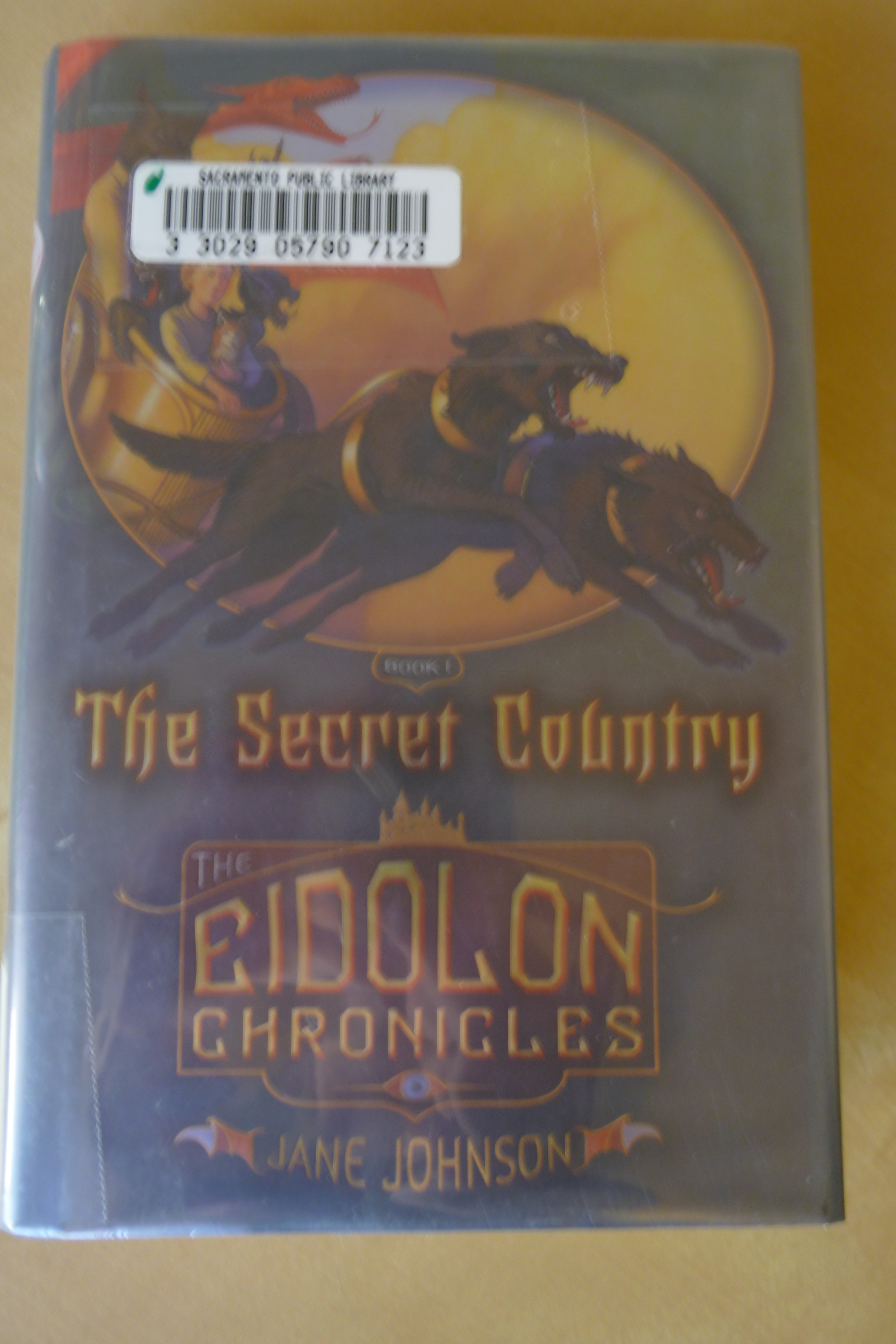
I read The Secret Country by Jane Johnson years ago–at least, I have to believe my book list when it tells me I did!  It was a book that I really couldn’t remember anything about (which is rare), except just one scene.  I decided to pick it up again, so that I could decide whether to read the rest of the books in the Eidolon Chronicles, as part of my goal to finish partially-read series.

Even though this obviously didn’t make much impression the first time 😉 I enjoyed reading it this time through.  It’s a fun kids book of a particular type–ordinary young boy confronted with magic and called upon to save a magical world.  In this case, the boy is Ben, who buys a cat at the pet store when the cat starts talking to him, demanding to be taken home.  The cat, Iggy, explains that he’s from Eidolon, also called the Secret Country, which is being threatened by an evil would-be king.  Part of the problem is that their queen is missing…and guess who turns out to be the prophesied prince.

I think talking cats always win the day.  I’m a cat person, and I’m writing a novel with a talking cat, so I’m biased–but snarky, funny cats who say out loud everything we know cats are thinking all the time…always going to be great.  I also thought Iggy had a surprising amount of depth, as a “great explorer” who knows he isn’t really very good at his profession.

Ben is a likable if somewhat generic hero, and he’s surrounded by interesting magical creatures (besides Iggy, there’s a selkie and a dragon).  Together they have to battle some truly nasty villains, and I like the way people in our world turn out to be villains in Eidolon–and they turn into horrible and creepy monsters when they change worlds.  I’m also hoping that later books in the series will have more on Ben’s sister, who so far had a very small part but has potential.

One side-note on a random point–I can’t decide whether or not to enjoy the Neil Gaiman reference when Ben is reading the Sandman comics.  I mean…yay, Neil Gaiman reference!  But at the same time, Ben is WAY too young to be reading Sandman (as is the target age group of this book).  That series was too twisted for me, and Ben is a kid.  If you’re going to reference Neil Gaiman, make it an age-appropriate book.

On the whole, a light but enjoyable read.  I am left with a question, though–the scene I thought I remembered wasn’t actually here!  I don’t think I read later books in the series…so I’m left with a mystery memory.  Does anyone remember a scene like this?  There’s a big fantasy battle, and in the middle of it a boy throws his lucky stone at the villain to protect a girl (a sister or a friend, I don’t remember), and the stone turns out to be some long-lost magical item of power.  Ring a bell with anyone?

Meanwhile, I do plan to finish out this series–maybe the scene will still pop up in a later installment after all!

Author’s Site: http://www.janejohnson.eu/

Other reviews:
The Alchemist’s Arcanabulum
Okbo Lover
Anyone else?