An Experiment in Understanding

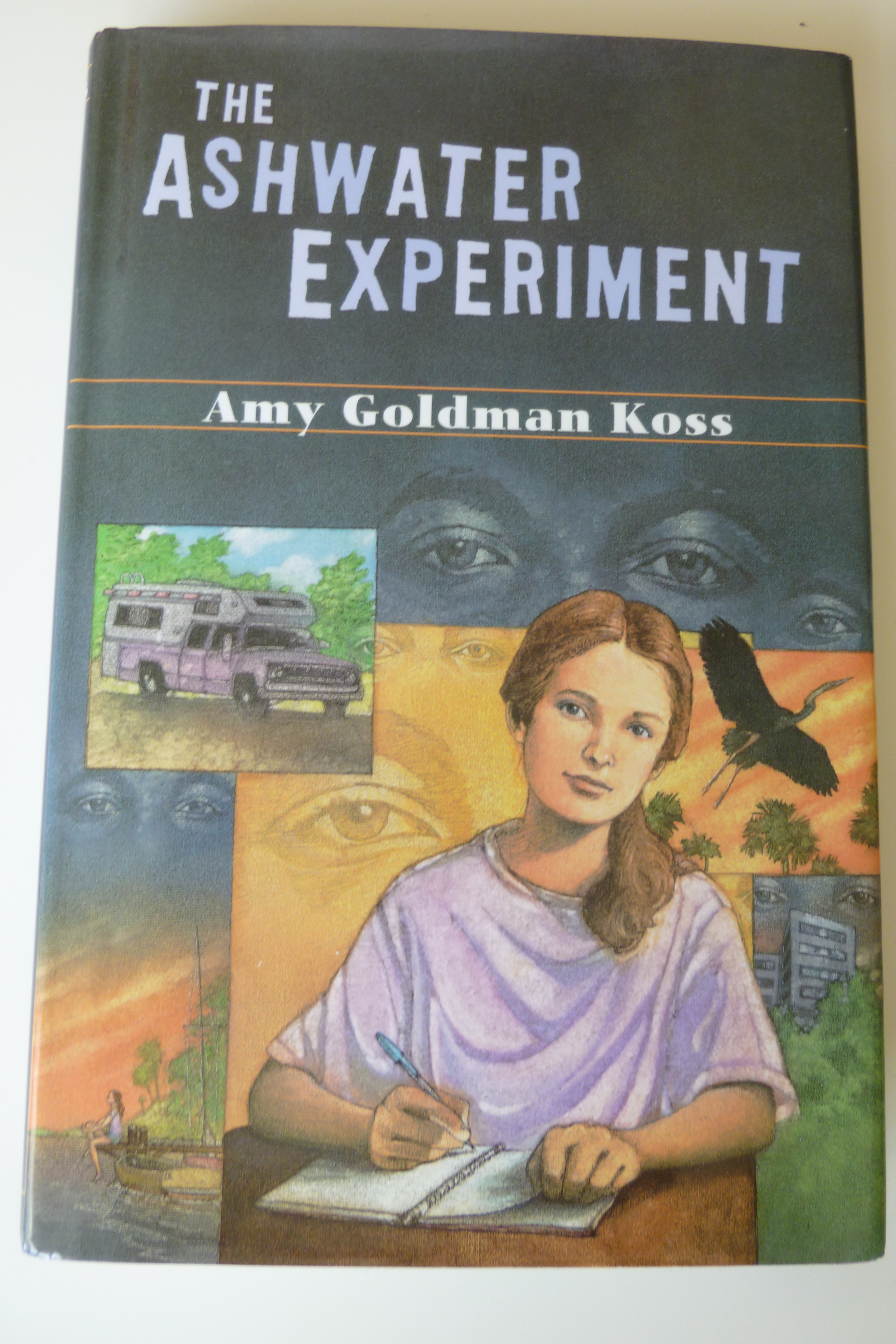
Have you ever felt that you’re not quite like anyone else around you?  I’m guessing most people have felt that way at some time or another–and that feeling is at the center of The Ashwater Experiment by Amy Goldman Koss.

Hillary wonders if she’s the only person who’s real.  You can hardly blame her for feeling disconnected from the people around her.  She and her parents wander the country in their RV, selling trinkets at craft fairs and never staying anywhere long.  By seventh grade, Hillary has been to seventeen different schools and is firmly settled in her pattern of never making ties to anyone.  So when she finds out her parents plan to stay in Ashwater for nine months–longer than they’ve ever stayed anywhere–Hillary feels trapped.  That’s when she comes up with the Watchers.

What if she’s really the center of an experiment?  Part holodeck and part Truman Show, she imagines that the world she experiences is really created just for her, with nothing existing outside of what she can see in that moment.  At first it’s easy to imagine–everywhere she goes has always seemed to have a pattern, with the same kind of people at every school.  As she stays longer in Ashwater, though, people start to seem more real than ever.

I’ve read this book before, and in the past I think it was Hillary’s imaginary (but sometimes so real-feeling) game about the Watchers that struck me.  This time, that seemed more like a sidenote.  It’s a very interesting sidenote–but the heart of the story for me on this read was Hillary’s feeling of being different, and of her gradually increasing understanding for the people around her.

When she first meets the kids at her school, she easily classifies them and easily sees them as stock characters.  As she gets to know them, she finds unexpected depth to Cassie the bookworm, Serena the society queen, and Brian the class clown.  Even the more minor characters, like Serena’s mother or Cassie’s grandmother, the nasty girl who resents Hillary and even Hillary’s own parents and grandparents, are eventually revealed to have their own problems and motives and complexities.  No one is simple.  And we all feel different sometimes–paradoxically, it’s a feeling we often have in common.

This is another one of those books that reminds me just how good and how deep a YA book can be.  It definitely is YA (or even Juvenile), appropriate for young readers and focused on young adults.  Hillary is in seventh grade, and she has seventh grader concerns: whether the girls at school like her, how well she’ll do on the math competition, whether her parents are weird.  But the larger feelings Hillary struggles with are really universal, and there’s a depth that makes this appealing–even though seventh grade was a long time ago for me.

Author’s Site: http://www.amygoldmankoss.net/

Other reviews: I couldn’t find any!  Why has the world not taken note of this book?  If you know of a review, tell me!
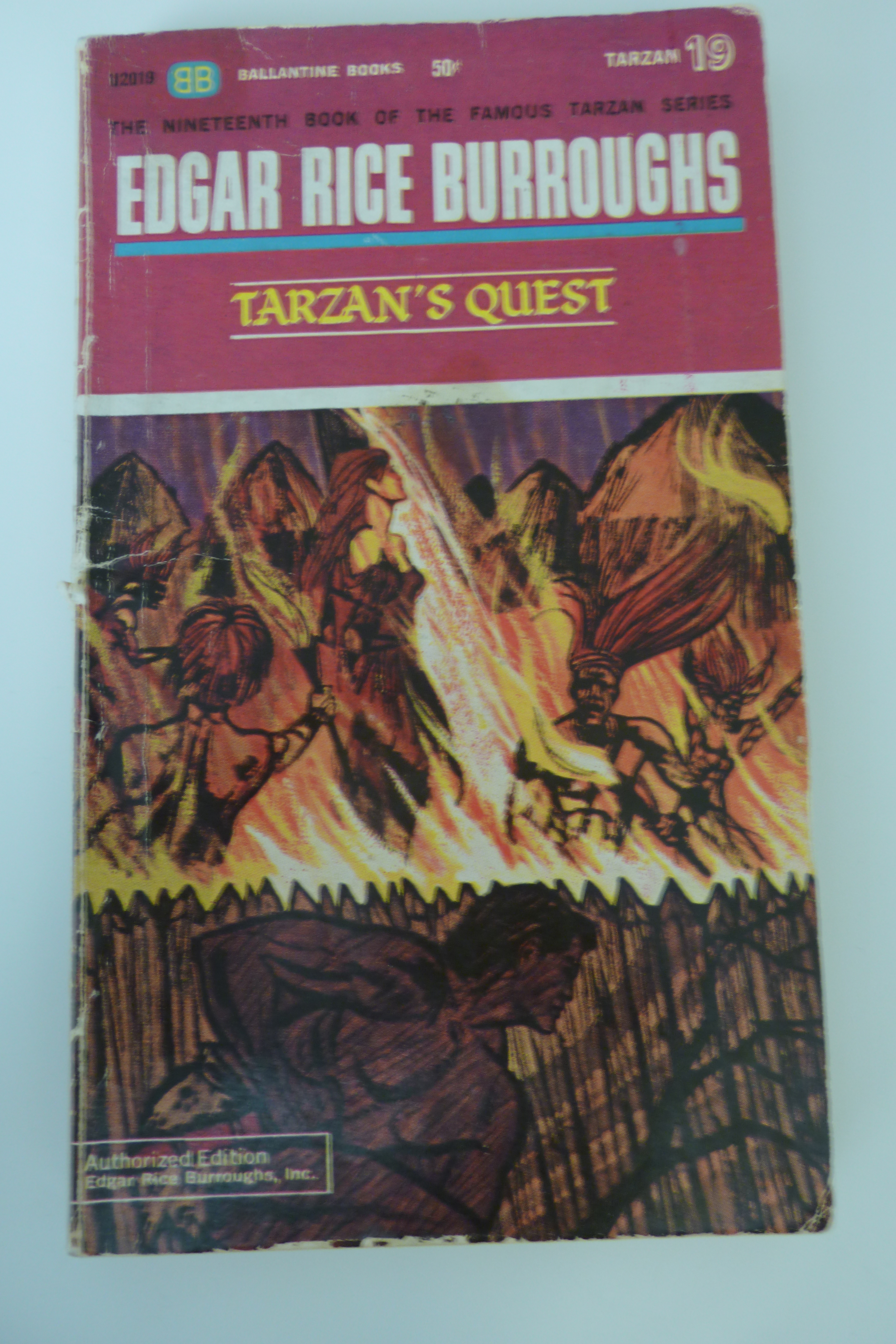
Tarzan and an Unexpected Jane

I’ve read over 40 books by Edgar Rice Burroughs, so it’s really saying something when I say that he managed to surprise me in Tarzan’s Quest, my most recent foray into his world.

Tarzan’s Quest is the 19th book in the Tarzan series, and as you might guess, by that point (a lot earlier, actually) they were all starting to look alike.  Burroughs’ usual plotline is “girl gets kidnapped or is otherwise in distress, hero rushes to her rescue.”  The Tarzan books often like to also throw in an element of “questing through the wilderness, usually to find a lost civilization.”  To some extent, this is another book of the usual pattern.

It opens with Jane in London.  She and Tarzan are married, but currently apart–he’s off in Africa, and she’s about to fly to meet him.  She ends up traveling with friends, a delightfully flighty society woman and her nasty husband.  They’re caught in a storm and forced to make an emergency landing in the African jungle.  Meanwhile, Tarzan is out swinging through the trees with his pet monkey, Nkima, looking for a mysterious tribe who has reportedly been kidnapping girls–and who may have the secret to eternal life.

Tarzan’s story is pretty much the usual Burroughs fare.  It’s Jane’s story that surprised me–and Jane herself.  This was #19, and as far as I know Jane had dropped out of sight since #8 or thereabouts.  We only knew she was still alive because Tarzan heroically resisted the advances of all the beautiful princesses from lost civilizations who fell in love with him.  Suddenly Jane’s back, and as a very different character.  This Jane is actually capable.

Burroughs sets Jane up as a contrast to her flighty society friend, Kitty, who screams and moans and can’t handle anything at all in the jungle (and to be fair to her, it’s probably a more realistic reaction to the situation!)  Jane takes charge of her lost band, goes clambering about in trees, makes a bow and arrow out of the materials at hand, tracks prey by scent, and shoots down a leopard.  It’s all kind of amazing.

Admittedly, in some ways it’s bad storytelling because this is never how Jane was before.  She’s been lost in the jungle in previous stories and survived, but she seemed to be subsisting rather than excelling.  She’s been married to Tarzan for 18 books, but in all the previous books she’s been very much the fine Lady Greystoke, whose husband happens to have this odd thing for the jungle.  I probably should object to her sudden metamorphosis into the jungle girl–except that it’s so fun!  The Jane in this book is actually an appropriate match for Tarzan, able to embrace the jungle-side of his personality, not just the Lord Greystoke part.  Plus, it’s so hard to find a capable heroine in Burroughs that I will applaud whatever I can get.

Jane’s story also involves a quite brutal murder which is not something I expect in Burroughs.  Blood, yes, always, but the victim and the circumstances here are very different than the usual Burroughs swordplay.

The serum for prolonging life is also an interesting element here.  It’s treated fairly lightly by the characters, but seems to be Burroughs’ rather belated solution to Tarzan and Jane never aging.  They have a grown son by book 4, but then go on seeming no older than 30 for the next twenty books.  Perhaps we shouldn’t assume the books take place chronologically in the same order they were written.  Very few give any indications re: time period, and placing this one early on would certainly explain that age issue.

On the whole, it was a fun Burroughs adventure, and Jane’s character made it stand out from some of the others.  If you’re curious about it, don’t feel obliged to read the previous 18 books first.  The first five are best read in order, and after that it doesn’t much matter–and once you’ve read the first two, I think you could jump to any book from #6 on.

Other reviews:
Jcomreader
Not surprisingly, not many out there.  Let me know if you find another!

After Waking the Princess

What happens after the hero kisses the sleeping princess?  It’s far more complicated than “they lived happily ever after,” especially when the hero is from the modern world and knows nothing at all about swinging swords or fighting evil witches!

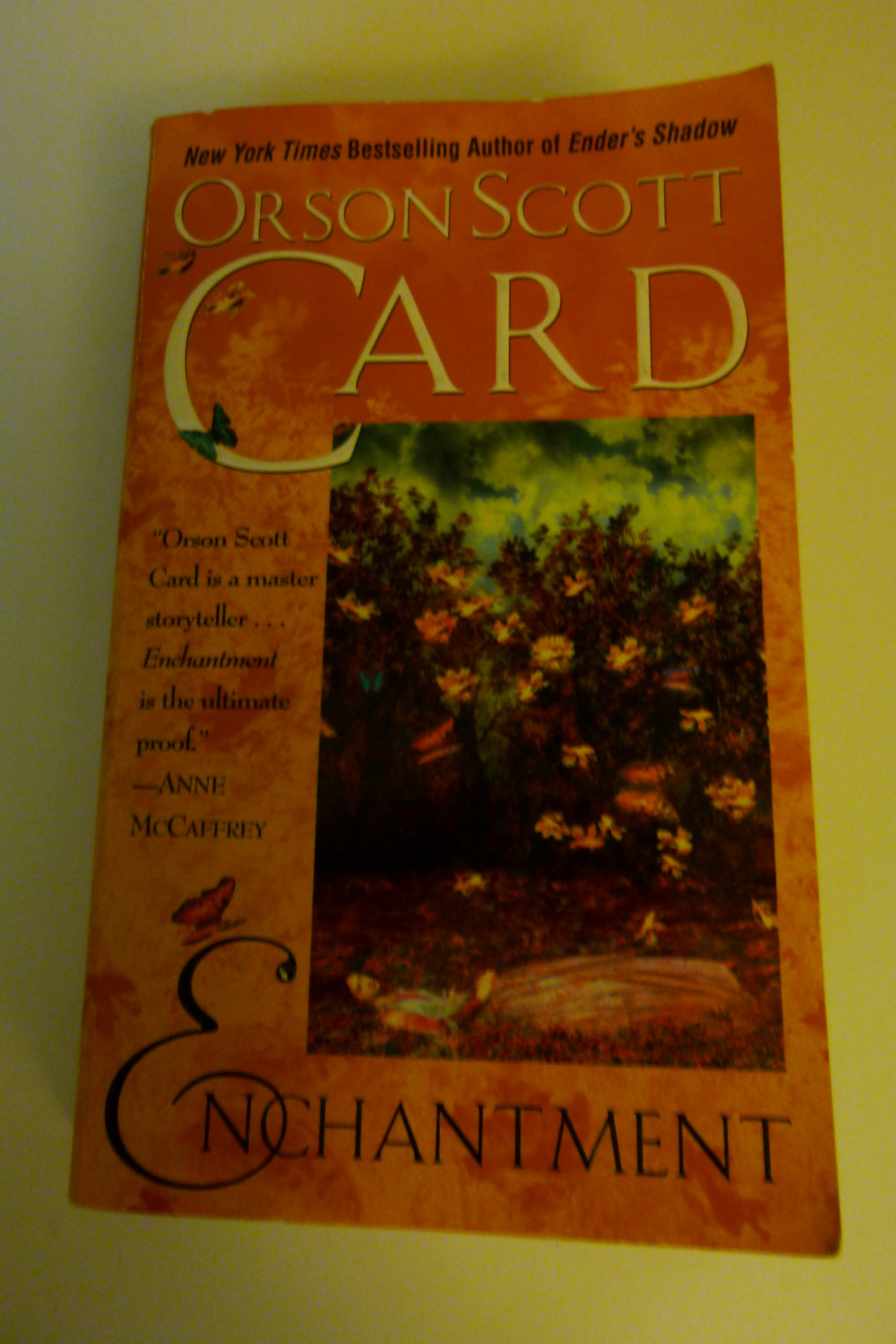
Enchantment by Orson Scott Card was my second book for the Once Upon a Time Challenge, and it also goes towards my Dusty Bookshelf challenge.  Abridged background: I picked it up at a book swap my book club did, I think roughly last summer.  I picked it up because, well–Orson Scott Card!  At the time I actually hadn’t read anything by him, but I had been hearing about Ender’s Game forever (which I did finally read).  I was also intrigued by the plot summary: as a child, Ivan sees a sleeping princess in the forest one day, and runs away.  But then years later, he comes back…

That was all that was in the summary, and it turns out to be only the very beginning.  It also wasn’t clear until I turned to Page One that Ivan lives in the modern world.  He’s from Eastern Europe, though his family emigrates to America when he’s a child.  He returns to Ukraine to work on his dissertation on fairy tales, and ends up drawn to a clearing in the woods, where he finds the sleeping princess he had convinced himself he imagined.  He fights the bear guarding her and wakes up Katerina, a princess from the 9th century.  He ends up back in her time, where the imminent threat of Baba Yaga is just part of his troubles.

I love the concept of this one.  It gets at some great questions about the original fairy tales, and points up a fundamental problem usually ignored–the man waking the sleeping princess is not necessarily at all suitable to be king, or to marry the princess!  Ivan goes through a lot of trials trying to deal with the society of the time, from his lack of prowess with a sword to disconcertingly different views on nudity.  I especially liked it that Ivan goes into this with a scholar’s knowledge–his focus is old fairy tales, so he knows how the stories work, a fair bit about the history, and also what Disney says about it.  One of my favorite moments is when he arrives in Katerina’s village and is trying to reconcile what he’s seeing with his historical knowledge, and with Disney’s Sleeping Beauty.

I did have some trouble getting into this book.  The beginning is spent on Ivan and his life in the modern world; it’s necessary, but it also dragged a little.  It picked up when he woke up Katerina.  I liked the part in the past (although I think I liked the IDEA a little more than the actual handling of it).  The book really got good for me when Ivan and Katerina come back into the modern world (slight spoiler, but it’s only halfway through).  Besides how interesting it is to watch Katerina deal with the modern world, there are some fascinating revelations about Ivan’s family and, perhaps most important, the story gets much more focused on the fight with Baba Yaga.

The characters didn’t make a huge impression on me, good or bad.  Katerina and Ivan’s relationship was ultimately satisfying, although at times I thought Card was a little heavy-handed about it.  They spent much of the book misunderstanding each other, and there was a little too much of “Oh, I thought he meant THIS but what if he meant THAT and in that case maybe I’ll feel THIS way instead of THAT way…”  Less explanation and analysis probably would have been preferable.

Despite being a fairy tale, this is definitely an adult book.  It’s adult-level writing, and also Baba Yaga has a thing for torture.  There isn’t huge detail, but there’s enough.

On the whole, a good book.  I liked it.  I didn’t love it.  I don’t plan to keep it because I don’t see myself as likely to revisit it–but it was good to read once.

Author’s Site: http://hatrack.com

Other reviews:
Breathing Fiction
Wynter Adelle
Semicolon
Anyone else?

Viewing the World Through Wolf Eyes

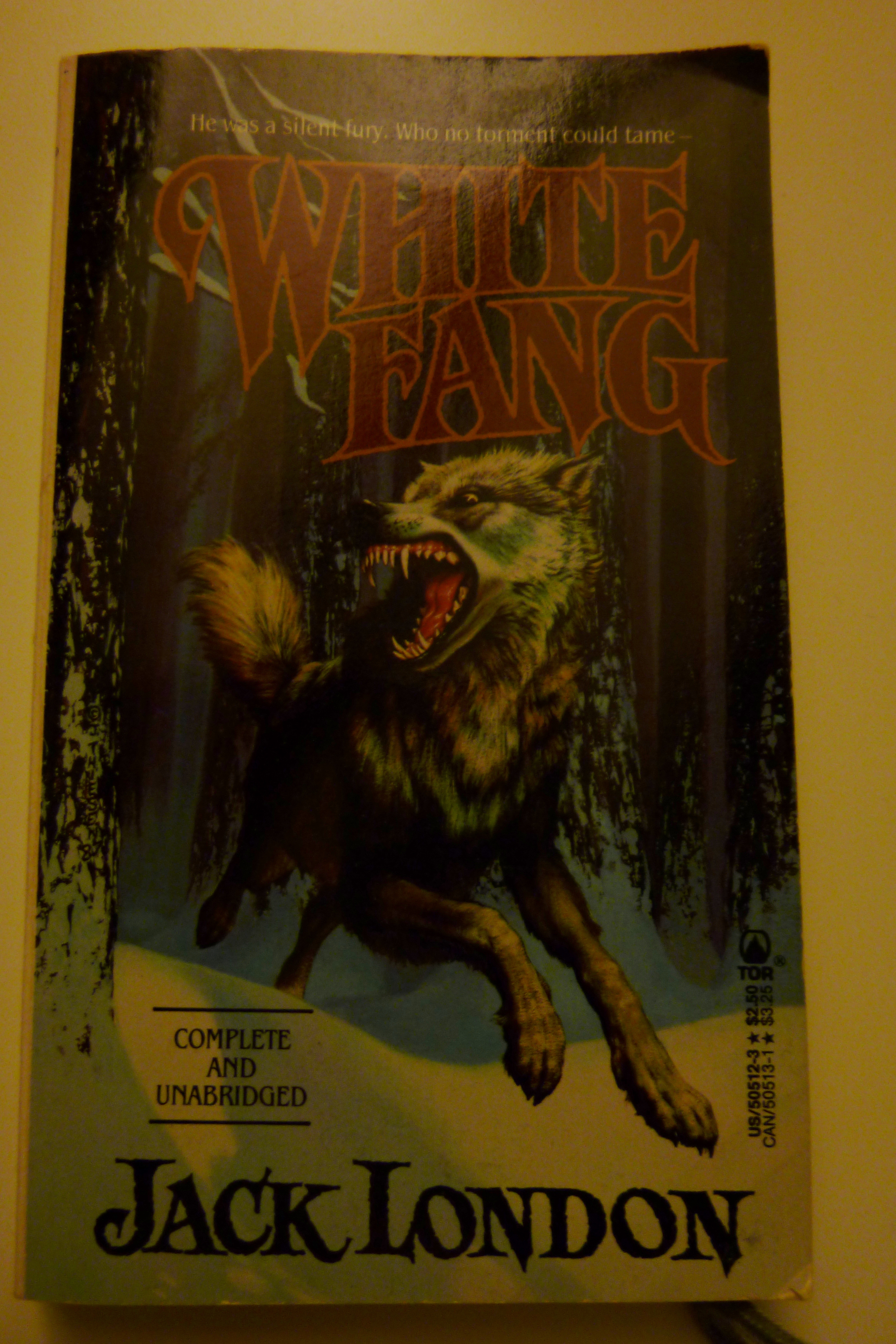
I’ve been making some good progress on my Dusty Bookshelf Challenge recently, and tackled another one: White Fang by Jack London, the opposite number to The Call of the Wild, which I read for my Classics challenge last year.

Background about the dustiness:

How long has it been on my shelf? Since summer, 2011, I forget exactly when.  Call it six or eight months.

I almost never buy unread books, so how did I get it? I bought it absurdly cheap at an estate sale, along with a copy of Call of the Wild.

Now that I’ve read it, am I keeping it? No.  I wanted to read Jack London’s two most famous books, and I’m glad I have–but this is the end of the road for Mr. London and me.  I don’t see myself as likely to read this a second time.

White Fang is in the same mold as The Call of the Wild—the story of a dog in the harsh Klondike.  White Fang takes the story in the opposite direction; instead of house pet to wolf, White Fang is a wolf who becomes a house pet.  Though it’s still an immensely grim, sometimes disturbing book, I think that trajectory gave it much more hope, and made me like the book better on the whole.

White Fang starts out as a wild wolf cub, and I really enjoyed his growth as he learns about the world.  London did an excellent job showing the world from a wolf’s point of view.  Many books are from an animal’s perspective, but they mostly personify the animal.  Other than simple things like a talking mouse having a weakness for cheese, most animal characters tend to be humans in animal form, as far as their mind and view on the world works.  White Fang really looks at the world differently, understands things differently, learns differently.  I don’t know anything about animal psychology, but London has created a convincing picture of how a wolf thinks.  White Fang lives by the maxim of “eat or be eaten” and all other animals are classified accordingly.  He sees humans as “gods,” their power demonstrated by the size and solidity of their dwellings.

White Fang leaves the wild when his mother, half-wolf and half-dog, returns to the Indian tribe who had domesticated her.  White Fang’s first master is an Indian, who is stern and hard but usually just.  White Fang is a solitary creature who doesn’t get on with other dogs.  His world is a hard one, but this portion still felt less disturbing than similar passages in The Call of the Wild, because White Fang seems to be suited for this world.  It’s hard, but he knows how to cope, and even to thrive.

Unfortunately, about halfway through the book, White Fang passes out of the hands of his Indian master and over to a white man, the “mad god.”  This is by far the most disturbing part of the book, as the mad god is cruel and horrible, forcing White Fang into dog-fighting.

It’s a bit of a spoiler, but such a relief of one I’ll give it away anyway—White Fang is eventually rescued from the mad god by the “love god,” the first master who shows him kindness and wins his undying loyalty in return.  The whole book takes a far more positive turn at that point, and ends more happily than The Call of the Wild.

I was curious about London’s two best-known novels, and they’re both good books for what they are.  They’re really not my type of book though, too harsh and grim for me, positive ending notwithstanding.  I’m glad to have read them both, but I don’t see myself as likely to read more London in the future.

Other reviews:
My Literary Leanings
Old Books By Dead Guys
Read in a Single Sitting
Anyone else?

Quotable Lemony Snicket

“Never trust anyone who has not brought a book with him.”

– Lemony Snicket