Persuaded to Read More Austen

Somehow–and I don’t really know how–I went all the way through a BA in English without being assigned any Jane Austen.  I’ve been trying to rectify that gap in my reading history, first with Pride and Prejudice and then Sense and Sensibility.  I picked up S&S because it was the most familiar title after P&P, and I did like it well enough though I wasn’t enamored.  Then several more Austen-familiar friends told me I had to read Persuasion–so I recently gave it a go.

Persuasion came in for me somewhere in between, not as good as Pride and Prejudice but better than Sense and Sensibility.  I learned my lesson from S&S and watched a movie version (1995) first, to help me get some grounding on who all the characters were.  This may have slanted my impressions somewhat, although mostly I think it was helpful.  Austen employs a large cast of characters related to each other in complicated ways, and it helped coming into it with some idea of how everyone fit together.

I had a little trouble with Austen’s language–some of her sentences are extraordinarily convoluted, so that I had to go back to the beginning and try again to follow their thread.  Like I’ve found with other authors, though, the more I read the easier it gets, so this was mostly only a difficulty in the beginning of the book.

This is largely a character-driven story, making it a little hard to give a plot description.  In a way, it’s a Cinderella story, about a Cinderella who mislaid her prince.  When Anne Elliot was 19, she was engaged to Captain Wentworth, splendid in every way except for a lack of fortune.  Lady Russell, a dear family friend, persuaded Anne to break off the match.  Eight years later, Anne is still single, disregarded and a bit downtrodden by her horrid father and two sisters.  You can even cast Lady Russell as the Fairy Godmother (if a slightly misguided one) who sees Anne’s value and wants to help her.  Such is the situation when Captain Wentworth comes back into Anne’s life and social circle, and then the question becomes whether she still loves him and, even more in doubt, whether he still loves her.

That sounds fairly straight-forward, but there are subplot romances, a couple other suitors for Anne, and a lot of going about making social calls in one place or another.

I enjoyed the characters–Anne is a complex, sympathetic heroine.  She’s under less societal threats than Elizabeth Bennett, whose whole family would collapse if the daughters didn’t marry well (or at least, her mother thought so).  Anne has Lady Russell as her refuge, and maybe that’s just as well.  Her desire to marry Captain Wentworth really seems to be about him, not societal pressures (which is not at all to criticize Lizzie’s attachment to Mr. Darcy, just observing context!)

And while I don’t want to give too much away–let’s just say that there is a final romantic conclusion, as seems to be usual in Austen, and she actually gave us more dialogue for a change!  Instead of narration along the lines of “and he expressed himself on the occasion as sensibly and as warmly as a man violently in love can be supposed to do” (which has me wishing to know what Mr. Darcy said), we actually get a quite beautiful declaration-of-love letter, and some real talking.  Probably still less than most authors would have done (sigh) but more than seems to be Austen’s norm.

One thing that struck me in this book was the question of servants.  I came to this book directly after watching Downton Abbey, which shows the life upstairs and the life downstairs with equal care and interest (and my favorite character is Anna, the head housemaid).  Persuasion is strictly the life upstairs.

Anne’s father is a baron of some sort.  He’s fallen on financially difficult times, but he is still determined to keep up the proper status.  He must have servants.  Anne’s snobbish elder sister cannot possibly be cooking or cleaning or probably even doing her own hair.  But servants aren’t mentioned at all!  They’re not even walk-on characters.  Finally halfway through the book, that snob sister decides not to hold a dinner party in Bath, because they have less servants at their lodgings than they used to have at their manor house, and that would be embarrassing.

Coming right off of Downton Abbey, I wondered a great deal about these completely disregarded people who really must be there but aren’t noticed by anyone.  It almost feels like a modern book where you wouldn’t bother to mention that a character has a refrigerator.  Of course they have one.  Of course Austen’s characters have servants.  Why say more about them?

That was my own particular quirky reaction to the novel.  On the whole, I did enjoy it, and it was nice to meet another cast of Austen characters–once I worked out who was who!

Other reviews:
Fyrefly’s Book Blog
It’s All About Books
Becky’s Book Reviews
And no doubt many, many others.  Suggestions?
It Was a Dark and Stormy Night

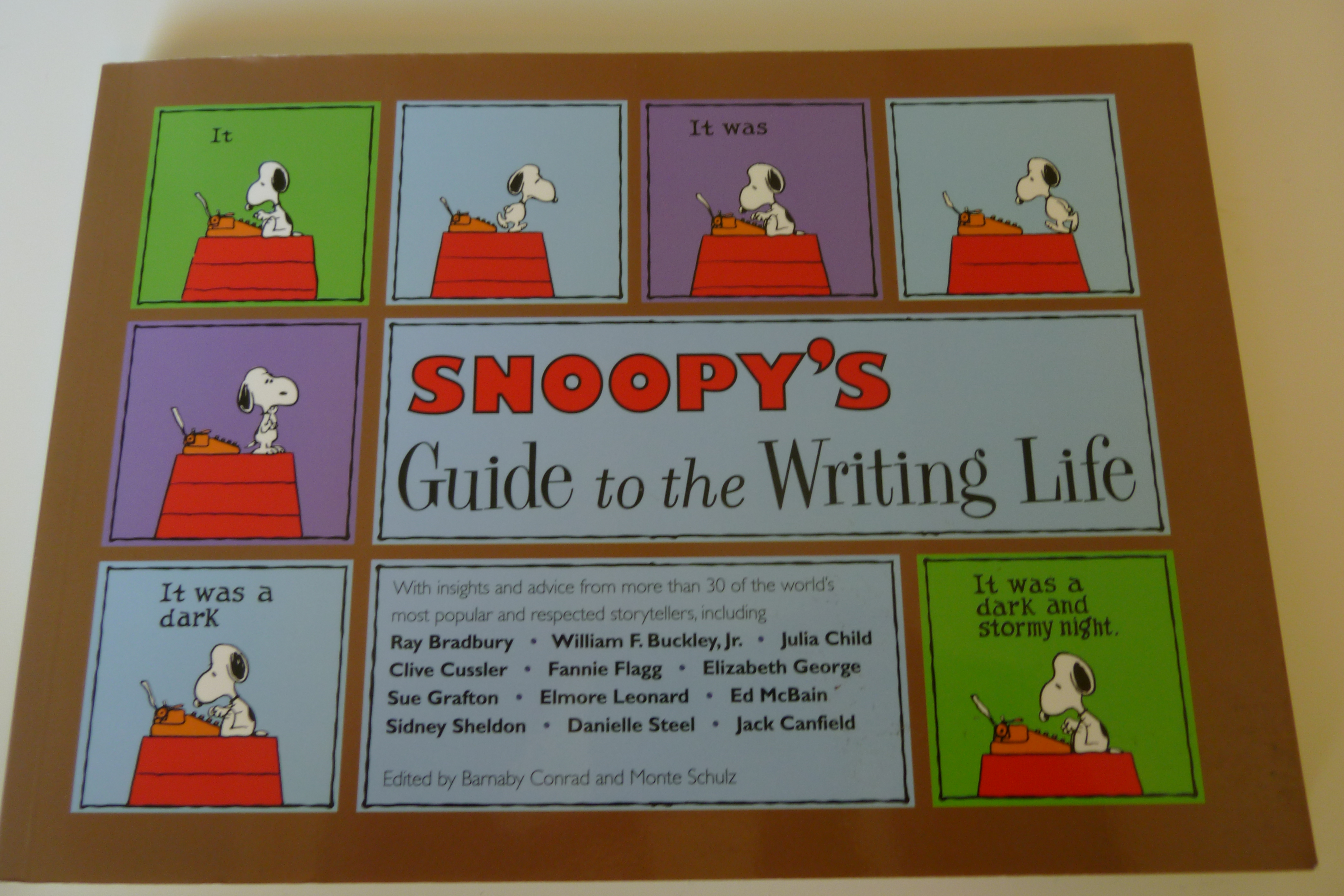
Everybody loves Peanuts, right?  And I don’t think you can love Peanuts without loving Snoopy.  Snoopy has long been one of my favorite comic strip characters, mostly because of his wonderful flights of imagination.  Enjoying writing as I do, you’d think I’d jump at Snoopy’s Guide to the Writing Life, edited by Barnaby Conrad and Monte Schulz.  So there’s a bit of mea culpa here when I admit that this was a Dusty Bookshelf Challenge book.

How long has it been on my shelf? I honestly don’t know.  It’s been sitting on a rarely-visited bookshelf for what feels like always and must have been at least a few years.

I almost never buy unread books, so how did I get it? I don’t know…somehow I got it, and I don’t remember how, so I hope it wasn’t a gift from someone who reads my blog!

Now that I’ve read it, am I keeping it? Yes, mostly because the comic strips are so fun.  More on that in a moment.

I’m counting this one for my Nonfiction Challenge too, because it’s certainly not a novel, and there’s enough text that I don’t think it has to be considered a comic strip collection either.

As Snoopy fans know, the famous beagle aspires to be a famous author.  Thus the iconic image of Snoopy sitting on top of his doghouse, typing “It was a dark and stormy night” on his typewriter.  This book brings together numerous writing-related Peanuts strips, with brief writing advice from 32 authors.

The book starts a bit slow, or maybe just takes too long to get going.  There’s a foreword from Monty Schultz (Charles Schulz’s son) and an introduction from Barnaby Conrad, both about Charles Schulz and writing.  The topic is interesting, but I think they would have done better to have one of them write, or to maybe move one essay to the end.  It’s too much on one subject, while we’re waiting to get to the main event.

But once we do get to the main event, the Peanuts strips and the writing advice, it’s a lot of fun.  I don’t think any of the writers put something down here that was life-changing for me, but they have good advice about writing and publishing, or sharing their writing adventures or the adventures of other writers they’ve known or admired.  I’m always interested in other writers’ processes and experiences.  Some of the advice ties directly into a particular Peanuts script, which is especially engaging.

The best part of the book, though, was the Peanuts comic strips.  It’s all about a beagle tapping away at a typewriter, and yet Schulz managed to get at essential truths of the writing life, and be very funny besides.  It may be an odd thing to say about an aspiring writer beagle, but Snoopy’s experiences are universal.  The struggle to begin, the difficulty of finding the right word, the well-meaning but ill-placed advice from others, the love of your own words even when you know (or suspect) they’re not very good.  Who hasn’t written something awful that nevertheless made them laugh, making it very hard to let go of?  Snoopy does a whole series of really horrid puns at one point: Edith had refused to marry him because he was too fat.  “Why don’t you go on a diet?’ a friend suggested.  ‘You can’t have your cake and Edith too.”

Some of my favorite strips are when Snoopy tries to sell his stories, and keeps getting vast numbers of dreadful rejection slips.

Dear Contributor, we have received your latest manuscript.  Why did you send it to us?  What have we ever done to hurt you?

Dear Contributor, we are returning your worthless story.

Dear Contributor, we’ve seen better writing on license plates.

In my experience, agents and editors are actually extraordinarily polite in their (form) rejections, but Schulz has still captured what it feels like!  And Snoopy’s responses are spot-on too.

Dear Editor, why do you keep sending my stories back?  You’re supposed to print them and make me rich and famous.  What is it with you?

I’m also a bit amazed by the level of the literary references in some of these strips.  Snoopy frequently aspires to be Leo Tolstoy, and there are references to Thomas Hardy, F. Scott Fitzgerald, Little Women, Moby Dick, Ben Hur…  Peanuts is wonderful proof that comic strips can be intelligent and insightful–and funny, of course!

In some ways, this book really is more of a guide to the writing life than to writing.  I don’t know that I learned much about writing, but it was good to see that even Snoopy experiences the same ups and downs of the writing life!

Peanuts website: http://www.peanuts.com/

Other reviews:
1st Writes
Perpetual Folly
The Trendsetter
Anyone else?

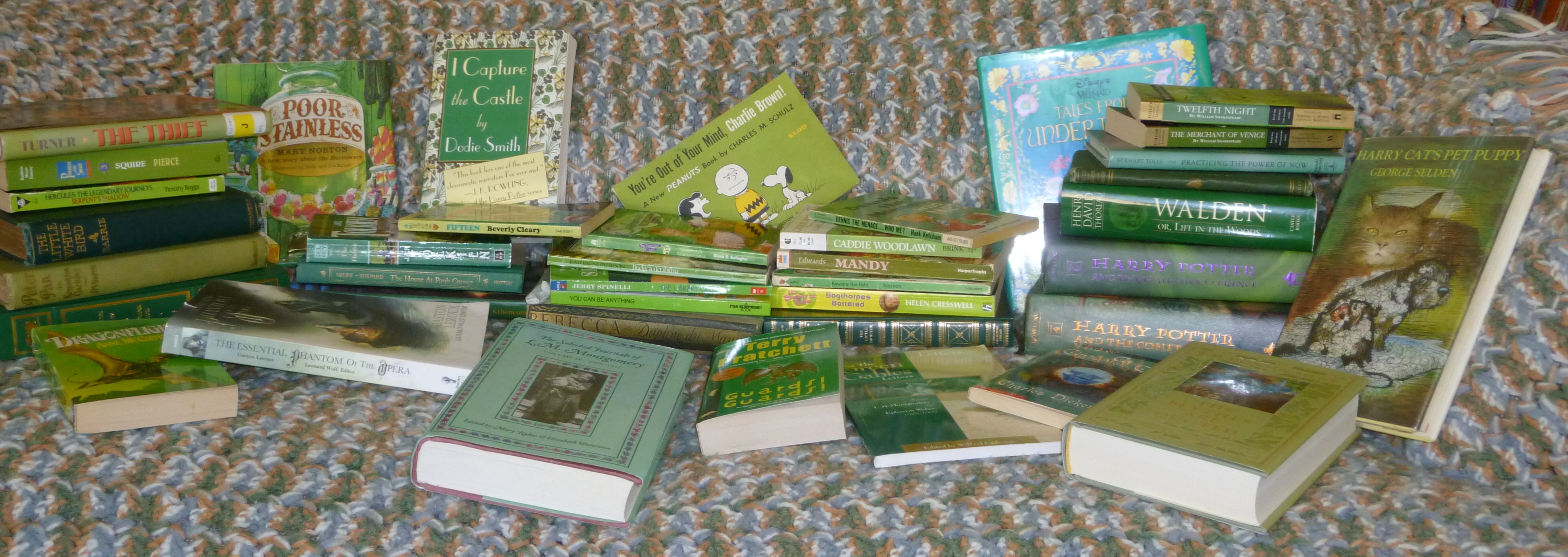
Saturday Snapshot: Forty Bookish Shades of Green

Just for fun for St. Patrick’s Day, forty shades of green pulled from my bookcases.

I love how eclectic the books ended up being, when I selected them by something as random as color–everything from Walden to Peanuts, Beverly Cleary to Terry Pratchett to William Shakespeare.  I guess you can’t judge a book by its spine!

Visit At Home with Books for more Saturday Snapshots.

Quotable Neil Gaiman

“Short stories are tiny windows into other worlds and other minds and other dreams.  They are journeys you can make to the far side of the universe and still be back in time for dinner.”

– Neil Gaiman

Investigating the Mystery of the Phantom of the Opera

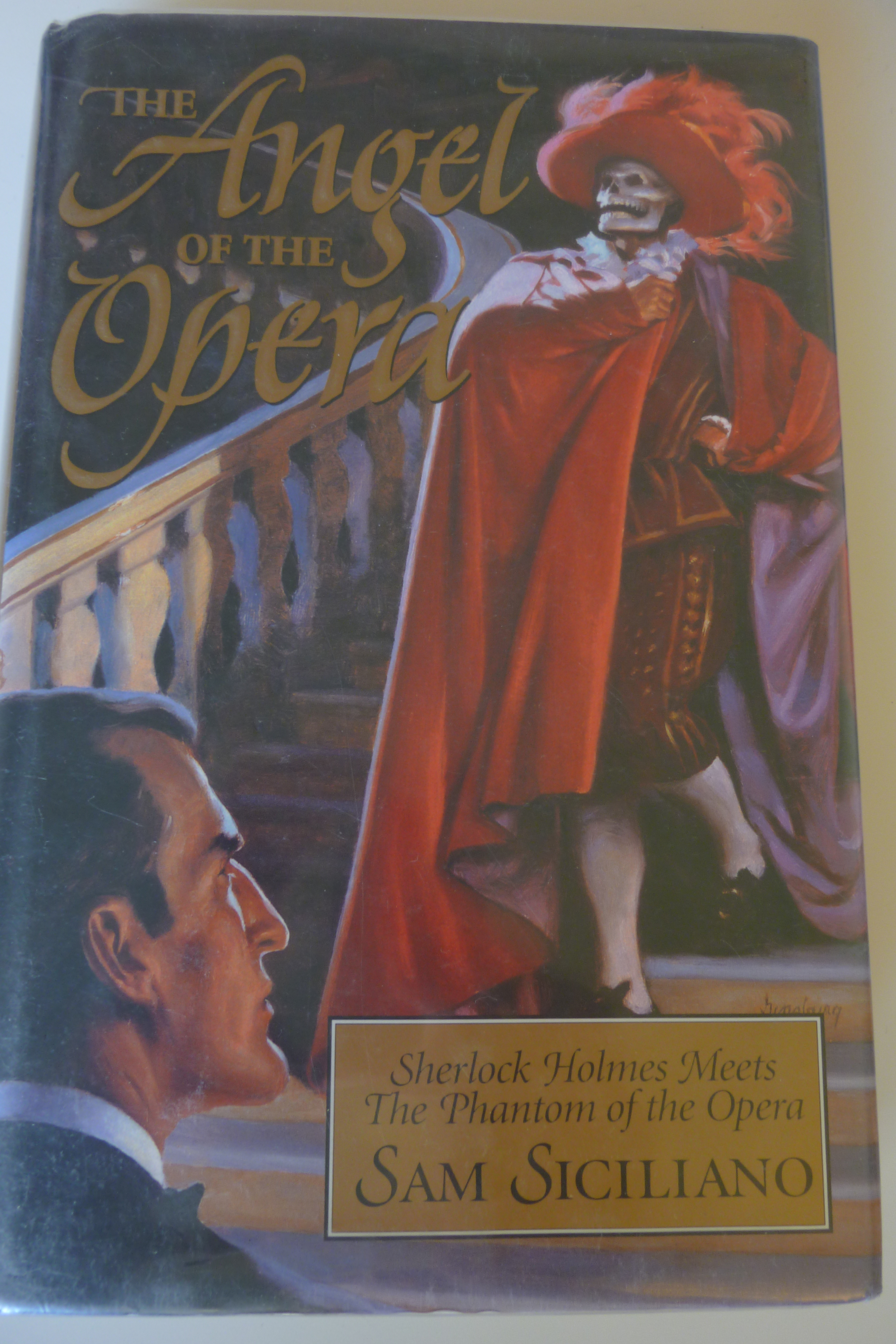
My January post about the Phantom of the Opera inspired me to buy and reread Sam Siciliano’s Angel of the Opera.  I last read it six or seven years ago, but I find my feeling toward it was much the same this time–and it’s an odd, odd feeling.  When I look at the disparate elements of the book, I dislike far too much.  And yet somehow, taken as a whole, I enjoyed the book.  Baffling!

It may be the premise.  Sherlock Holmes meets the Phantom of the Opera; I love both of them in their original forms, so it’s hard to resist a cross-over.  People I tell about this seem to have trouble picturing the two stories coming together, but it actually makes a certain amount of sense.  The premise is that the managers of the Opera are deeply distressed by this Ghost business (as they are in every version), and decide to hire a very famous London detective to come investigate–Mr. Holmes.  Holmes arrives in Paris and goes exploring through the Opera in an effort to work out the mystery of the Phantom.  Siciliano also makes much of Holmes’ love of music (which is an element in Arthur Conan Doyle) and that ties things together in an extra way too.

If only that clever emphasis on Holmes’ love of music had been part of a broader, equally clever portrayal of Holmes.  But there’s where we begin to have problems.  This book begins very, very badly.  Watson has been booted from the scene and we have a new and original narrator, Holmes’ cousin, Henry Vernier.  The second sentence of the book reads, “My purpose at the time was to reveal the real Sherlock Holmes as corrective to the ridiculous fictional creation of John Watson.”

Ouch.  I mean, really, ouch.  Henry goes on in this way for a couple of pages, maligning poor Dr. Watson and discounting Watson and Holmes’ friendship, then peppers the rest of the book with occasional caustic references to Watson and his writing, both from Henry and, even more painfully, from Holmes.  It’s always a chancy business trying to write another author’s characters, and frankly, if you’re going to attempt it, you had better approach the original with a great deal of respect, bordering on reverence.  It’s hard to believe that Siciliano even likes Doyle’s stories.

The particularly stupid part is that I don’t think all this added anything or was at all necessary.  Henry is pointless as an original character.  He fills exactly the same role as Watson, right down to being a doctor, and I nearly forgot at times that he wasn’t Watson.  Other than a fear of heights and occasional musing about whether he ought to marry a girl he’s been courting, he has very little personality to add.  And Holmes is almost Holmes, but not quite.  Siciliano plays around a bit, and not to Holmes’ advantage.  His attitudes towards women and religion are mucked about with, and his deduction skills are not shown to any great advantage.  He doesn’t do much of the “I saw a telltale clue and drew 14 conclusions from it” that Holmes is so well-known for.  He does figure out a lot about the Phantom, but it all seems like fairly obvious details–although I admit, Holmes doesn’t have my advantage of familiarity with some 14 versions of the story to help him along.  Anyway, the whole thing ultimately comes off like Siciliano realized he couldn’t quite write Doyle’s Holmes, or that Doyle’s Holmes didn’t quite fit his novel, and decided he’d better come up with an excuse for the differences.

He does better with the Phantom side of things. This is plainly based on Leroux, not Webber–Raoul’s brother is in the story (delightfully awful), Meg Giry has dark hair, several minor characters from Leroux are at least mentioned, and there’s just an overall atmosphere of Leroux.  That actually may be my favorite part.  Siciliano brings the Opera, with all its confusing passages and dark cellars, to life in a wonderful, fascinating way.  It really may be the atmosphere that carries this book more than anything else.

The Phantom characters were better handled than the Holmes ones too.  Siciliano wrote what is probably the most annoying Raoul I’ve ever seen (which is saying something) and his Christine is a nice mix of well-meaning and flighty childishness.  The managers, Carlotta and Madame Giry are well-portrayed.  And I thought he did well with the Phantom (although we don’t see him as more than a shadow until two-thirds into the book).  He’s dark, complex, a musical genius, and I actually really enjoyed Holmes’ insight into the Phantom.  And points for getting his name right–Erik.  Such a simple thing that is so rarely done correctly.  Siciliano does slip on one character–like Watson, he maligns the poor Persian, who was the most heroic figure in Leroux but here is dark and villianous and (metaphorically) drenched in blood.

The plot is all right.  Holmes and Henry poke around on the edges of the plotline of The Phantom of the Opera, trying to unravel the mystery.  Siciliano doesn’t really add much, but neither does he do any harm to it.

So–decent plot, well-done Phantom characters, excellent atmosphere, poorly-done Holmes, pointless original narrator.  And there is one more original character who absolutely gives me fits.  There’s a mostly-irrelevant prologue, where Holmes and Henry are tying up an unrelated case, and in the midst of it they get a telegram about the Paris Opera situation.  The main point, though, seems to be to introduce Susan Lowell.  She lives in Wales, is half-British and half-Indian, and is despised by society for her mixed-race status.  She’s all alone in the world.  She’s very beautiful, but for a variety of reasons has always thought that she was very ugly.  And she’s completely brilliant musically.  Is this obvious enough yet?  It gets better.  She’s blind.

Well now.  A novel with a musically-brilliant deformed man features a completely superflous musically-brilliant blind girl.  I wonder where that could possibly be going?  Honestly, I am all in favor of the Phantom getting over Christine, and if that means writing a new character to suit, fine, no problem, go to it.  But at least be a bit more subtle about it!  I also think it oversimplifies to assume that falling in love with a blind girl would solve all of the Phantom’s problems.  I’m convinced that Erik’s problem is not really that he’s ugly–it’s that he knows he’s ugly, and is convinced of his own unworthiness as a consequence.

But that is a long and complex discussion.  Suffice to say here, this book would be better off and far less obvious without the prologue or the epilogue–even if that meant leaving off a basically happy ending.

So where do I wind up in the end?  I don’t know.  I like some parts of this book.  I dislike a lot of very key parts.  And I enjoy it overall.  Draw your own conclusions from that.  I hear there’s another Holmes-meets-the-Phantom book out there, and I am definitely going to check that out to see if it does any better!

Author’s Site: http://samsiciliano.net/

Other reviews:
Better Holmes and Gardens (I love that title!)
My Den
Anyone else?