The Playwright from Stratford

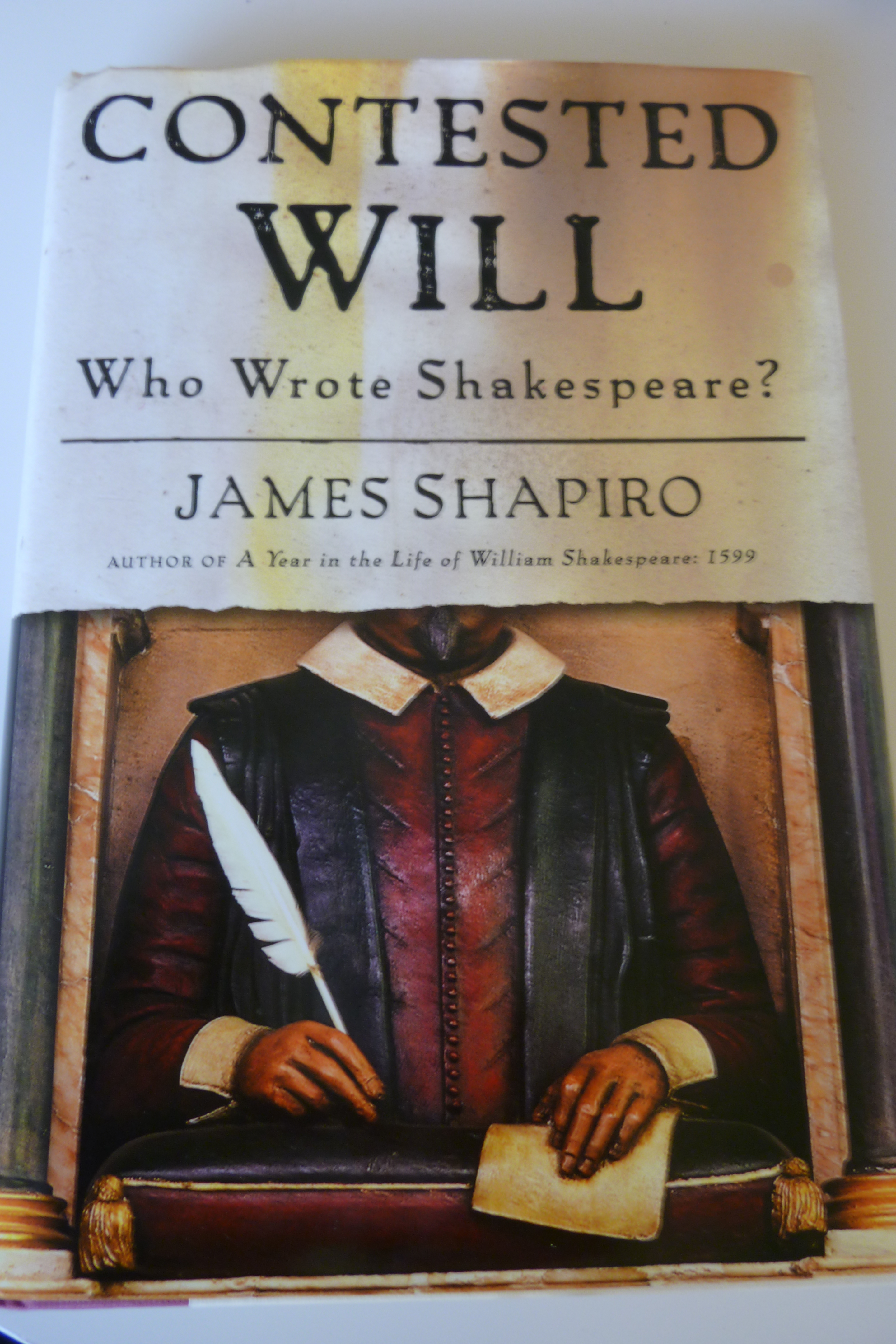
I recently tackled my first Nonfiction book of the year for the Non-fiction Non-memoir Challenge, and it conveniently addressed my Dusty Bookshelf challenge too.  The book: Contested Will by James Shapiro.  Clever little pun there, as it’s a book about the Shakespeare authorship question.
Back-story for the Dusty Bookshelf challenge:

How long has it been on my shelf? Since Christmas, 2010, so a little over a year.  Erm.  I am SLOW about getting to nonfiction.

I almost never buy unread books, so how did I get it? As noted, Christmas.  It was a gift.

Now that I’ve read it, am I keeping it? Probably for the moment, though it could go in some future, panicked, “I have no shelf space” purge.

Considering the subject of the book, I should probably start by discussing biases.  I’m a Stratfordian, meaning I think the man from Stratford wrote the plays–that is, I think Shakespeare really was Shakespeare.  Shapiro is a Stratfordian too, which may be one reason I liked his book; it doesn’t hurt when you agree with a conclusion.  But that wasn’t the only reason.  It was a very engaging, scholarly but entertaining look at the history of the authorship question, and of cultural attitudes towards Shakespeare, his plays, and writing on a broader level.

Shapiro takes us through the history of the authorship controversy, starting with early impressions of Shakespeare and how the authorship question first arose.  He looks in-depth at two chief contenders for the role of secret author, Francis Bacon and the Earl of Oxford.  He then concludes with a section on the evidence for Shakespeare really being Shakespeare.

It’s a scholarly book that isn’t at all dry.  Shapiro examines the people who were involved in pushing opinion one way or another.  Many are recognizable names, like Mark Twain (a Baconite) and Sigmund Freud (an Oxfordian).  Many proposed extraordinarily entertaining theories.  The Baconites wanted to read codes and ciphers hidden in the plays, and came up with things that make The Da Vinci Code look simple and rational by comparison.  The Oxfordians tend to push for vast conspiracies hiding the true identity of the playwright.

For myself, I’ve always been a Stratfordian because the arguments against the man from Stratford seemed so flimsy, and Shapiro has reinforced that feeling.  There seem to be three chief arguments, and they’re all frequently examined throughout Contested Will.

1) Shakespeare didn’t have enough education – This discounts the very solid grammar school in Stratford at the time, which had a curriculum more like a university philosophy degree than the grammar schools we think of.  It also discounts the possibility of self-education, and, most importantly, the capability of genius.  To say that Shakespeare couldn’t write his plays because he didn’t go to university is to say that Abraham Lincoln couldn’t write the Gettysburg Address and Mozart couldn’t have begun composing at four years old.

2) Shakespeare didn’t have the right life experience – Shapiro discusses extensively how people first started viewing Shakespeare’s writing as autobiographical.  This was fascinating, exploring the different cultural expectations over the centuries and the amazing amount of fiction people come up with about what Shakespeare “must” have known/felt/thought/lived.  In Shakespeare’s day, autobiographies were virtually unheard of, and the expectation was not that playwrights were drawing on their own life experiences.  As to the supposed extensive knowledge Shakespeare would have needed, of court life, falconry, geography, foreign languages and so on, I might concede this point if anyone claimed he had lived in Stratford all his life.  But he didn’t–he lived in London, the metropolis of his day.  If he didn’t speak French, he could find a Frenchman to help him out.  He could learn what he needed to, and let’s not forget he wasn’t perfect: he did have sailors land on the shore of Bohemia, a land-locked country.

3) There aren’t records of Shakespeare as a playwright – There are actually frequent contemporary references to Shakespeare as actor and playwright, which Shapiro highlights at length in the last section of the book.  We don’t have Shakespeare’s papers and manuscripts, but apparently no one went looking for them until the 1800s.  Shakespeare died in 1616 – by the time scholars were trying to find his papers, all the witnesses were long since dead, and even his direct family line had died out.

Shapiro paints a fascinating picture of scholarship over the centuries, showing how cultural understandings of different times changed the views on Shakespeare.  A couple of trends emerge.  One is a tendency to deify Shakespeare, to make him and his plays impossibly insightful and profound.  They are insightful and profound.  But 400 years of scholarship and analysis endows them with so much insight that of course people question whether a glover’s son from Stratford could possibly be that brilliant.  No one could be that brilliant, if he had really intended even half of what people have read into the plays.  (And the frequent attack on him as a glover’s son smacks of classism too.)

The second trend that keeps showing up is the desire of scholars to make Shakespeare look like themselves.  I’ve noticed this before.  I had a college professor (female) who was convinced that Shakespeare was a woman.  Not Queen Elizabeth–some unidentified, well-educated, multi-lingual, upper-class woman (because there were a LOT of those in Elizabethan England…)  The tendancy seems to be for scholars to project how they want Shakespeare to be, and then go look for someone who fits the part.

I’m sure this book is much better if you already have a solid knowledge of Shakespeare.  It’s in-depth, and Shapiro goes for the details more than the broad strokes.  But if you like the details, the last section of the book is great fun, when he gets into the evidence for Shakespeare writing Shakespeare.  It’s almost a collection of anecdotes about Shakespeare’s life in London, the players he worked with, the other writers he knew…I really enjoyed the glimpses of Shakespeare’s life.

So in the end, I ended up more firmly convinced in my stance as a Stratfordian.  For one thing, the theories of the other groups seem so poor (and often funny), it bolsters the man from Stratford’s claim.  For a second thing, I like the man from Stratford.  I like the glover’s son who went to the big city, became an actor and a playwright and rose to fame, who wrote great art but also wrote according to the constraints of actually putting the plays on, who responded to the muse but also intended to make some money.  But then, I’m a mix of artist and pragmatist in my writing–so maybe I’m projecting onto Mr. Shakespeare too!

Author’s Site: http://www.jamesshapiro.net/

Other reviews:
Vulpes Libris
Steep Stairs Review
California Literary Review
Any others I should link to?
Quotable Walt Disney

“There is more treasure in books than in all the pirate loot on Treasure Island.”

– Walt Disney

Talking to Animals, Fighting Monsters

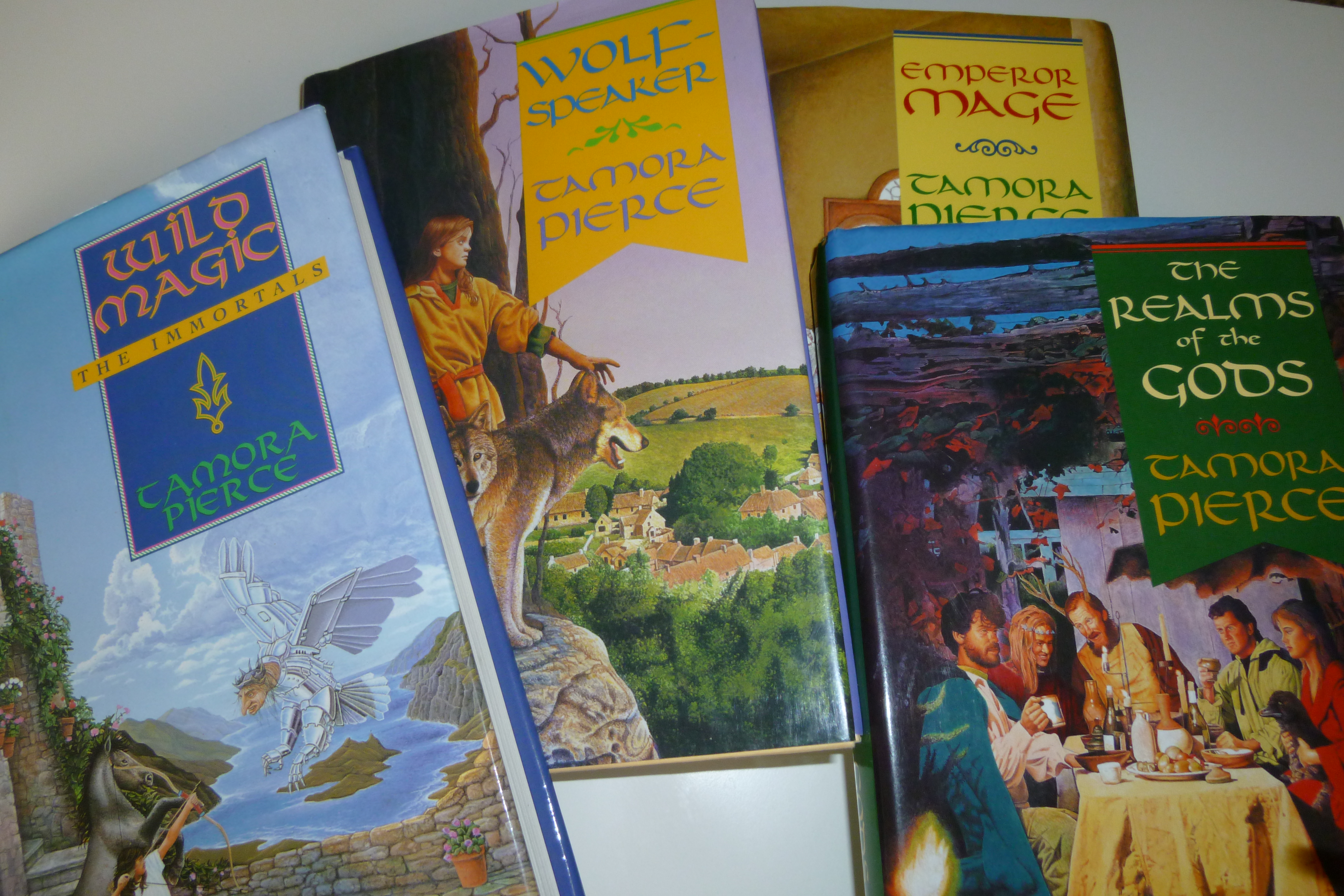
It’s not one of my reading challenges, but I have a personal goal this year to re-read Tamora Pierce’s Tortall books.  I’ve been reading her new books as they come out, but it had been years since I read the older ones.  I re-read the Song of the Lioness quartet in January, and it really is just unutterably wonderful.  In February, I re-read The Immortals quartet–and that’s my subject today.

The Immortals quartet is always referred to in my mind as the Daine books.  The main character is Veralidaine Sarrasri, an orphaned girl who discovers that her “knack with animals” is actually powerful magic.  She comes to Tortall (the setting of Song of the Lioness); she finds a job caring for horses for the Queen’s Riders, and finds a mentor in the magician Numair Salmalin, who helps her learn to use the wild magic that lets her talk to animals.  Meanwhile, the realm is threatened by strange magical creatures, who were locked in the Divine Realm 400 years before and are now escaping.  These are the immortals–they can in fact be killed, but will live forever if they aren’t killed.  Many of the creatures are in league with Emperor Ozorne of Carthak, who seeks war against Tortall.  Daine and her friends, human, animal, and even immortal, have to unite to defend against the threat.

The quartet opens almost ten years after the end of Song of the Lioness.  Many of the major characters from the first quartet come back in supporting roles here, and I LOVE seeing Alanna, George, Jonathan, Thayet and all the rest back again, and finding out what they’ve made of their lives.  The new characters are good too.  Numair is great fun and often quite funny–at one point he’s turned to stone, breaks free of the spell, and asks the spellcaster to do it again so he can try to break out again.

Daine is a lovely heroine as well.  She grows a lot, both as a person and in her magic.  Her magic develops, finding new abilities in every book.  At first she can only talk to animals; then she learns to inhabit their minds, then to change shape herself.  She also starts out very friendless, hesitant to trust anyone, absorbed only in her own life, and grows into relationships and a position of importance in the world.  She also grows in her understanding of the immortals, realizing over time that they’re more than just monsters.  She does find a place among very important people very quickly, which feels a little contrived–but only a little.  It’s mostly justified by circumstance, and also by what I know of the characters.  Queen Thayet’s friendliness to a strange girl from another country has more to do with Thayet than with Daine.

Other than Daine and Numair, the other characters that stand out the most to me are the animals and the immortals.  Daine has at least one animal sidekick in every book.  In the first it’s her horse, Cloud, who feels she has to take care of Daine and keep her from doing anything foolish.  By the second book, Daine has adopted Kitten, a baby dragon.  There’s also a wolf pack in that one, and a squirrel I just love.  In the third book there’s a tiny monkey, and the fourth book introduces the darkings, inkblot-like creatures who are surprisingly adorable.  And there’s Rikash, a Stormwing–half human, half metal bird–who brings Daine to see that even Stormwings, one of the most vile of the immortals, are more than just monsters.

These are in many ways more fantastical books than Song of the Lioness.  There’s certainly magic in the first quartet, but it feels different.  Magic is more like a tool, one Alanna uses or that her enemies use against her, or it comes up as part of rituals.  For Daine, magic is a way of life.  She’s constantly using her magic one way or another, her closest friend is a magician, and she’s always fighting magical creatures.  It creates a different feel; in some ways it may make Daine a little harder to relate to, although it’s certainly a lot of fun to read about.

I love this quartet, although I will acknowledge it’s not quite on a level with Song of the Lioness.  A few times there were point of view switches that bothered me, especially in the beginning of the first book, and sometimes the characterization seemed just a touch off–people weren’t saying things I thought they ought be saying.  Those are relatively minor, though, and I mention them only because I know this was written after Song of the Lioness, and it makes me wonder if that quartet has issues too, only I’m so swept along by the characters and the plot that I don’t notice them!

A bigger issue in The Immortals is the romance.  I don’t like it.  I’m sorry to people who are fans of it, but I just don’t.  I don’t want to give spoilers but…I will say Daine ends up with a character who is in all four books, but their relationship is very different in the first two books.  In the third there are a few hints of something, but everything could very easily and reasonably be interpreted according to the earlier basis of their relationship.  And then in book four there’s suddenly a romance.  And I just don’t like it.  It’s a particular kind of romantic story arc that almost never works for me.

But don’t be put off by that.  Because whatever the minor issues of the books are, they’re still wonderful to read.  I won’t say they changed my life, but they’re certainly another great example of a strong female lead in fantasy, and there’s a good message about everyone having strength and value.

Author’s Site: http://www.tamora-pierce.com/

Other reviews:
My Advice to Avoid Being Laughed Off the Page (includes spoilers)
Kathy Takes on Books
The Sleepless Reader
Tell me about yours!

Quotable Mason Cooley

“Reading gives us someplace to go when we have to stay where we are.”

– Mason Cooley

A Maybe-Monster, and a Monster-To-Be

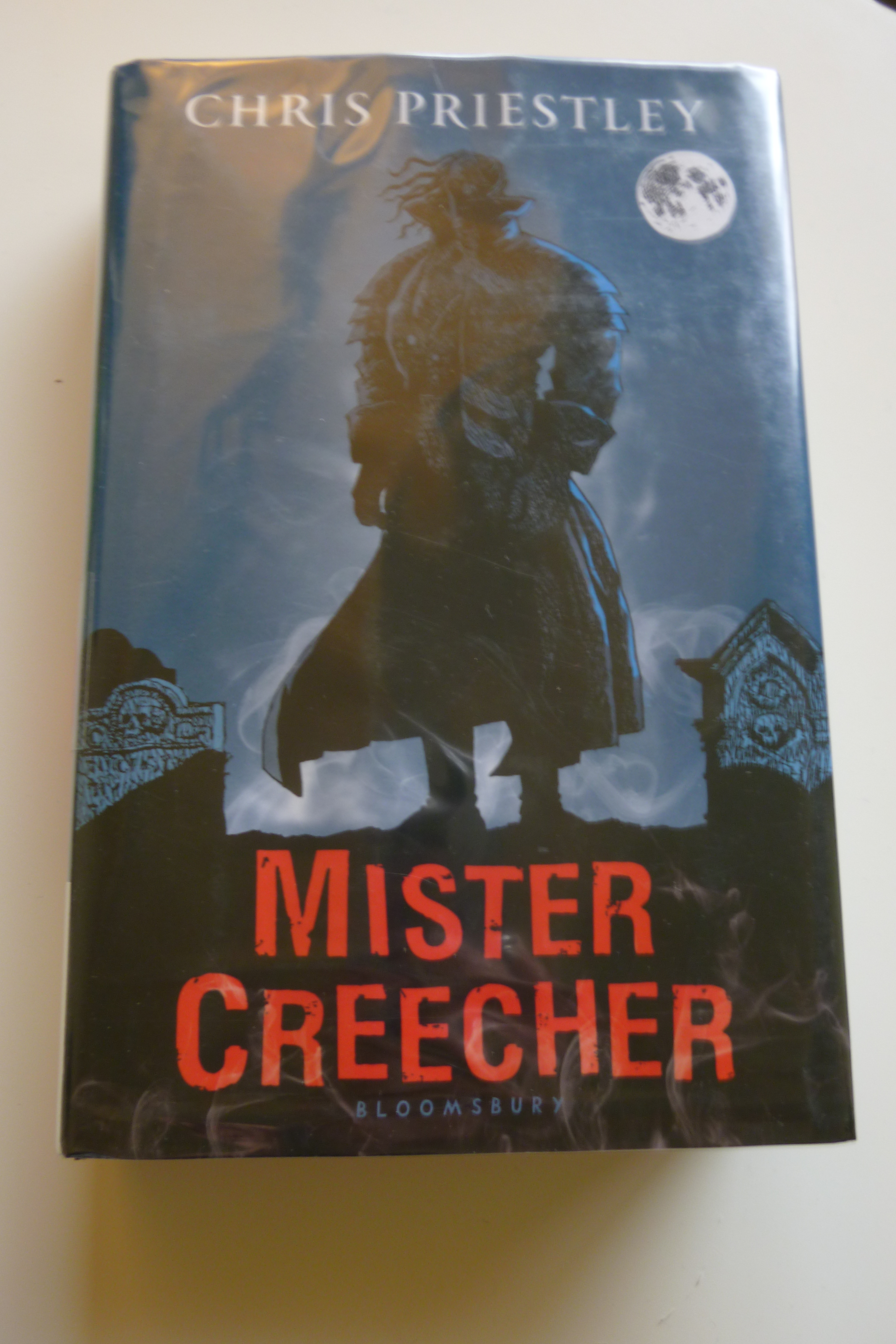
Mister Creecher by Chris Priestley, like Wicked, is another novel that takes characters from a familiar source and reimagines parts of their lives.  I read this one with the Sci Fi Experience in mind, although the library stuck a “Horror” sticker on the spine.  I guess it’s either–or both.

It’s a story about Frankenstein’s creature (see what Priestley did with the title there? 🙂 ), midway through Mary Shelley’s Frankenstein.  The story is from the point of view of Billy, an orphan pickpocket on the streets of London, who one dark night tries to pick the pockets of a dead body–only to have the body get up.  Billy and “Mr. Creecher” are thrown together by circumstances briefly, and then because Creecher wants Billy’s help to follow someone–Victor Frankenstein, who has promised to build Creecher a mate.  Partially through fear and partially through avarice, Billy finds himself pulled into a situation that is far stranger and darker than he expected.

This was an odd reading experience, because I enjoyed it while I was reading it.  And then I thought about it afterwards and decided the whole thing didn’t really work.  Most of the book is about the wary friendship that grows between Billy and Creecher.  It’s about Billy growing out of the scared pickpocket he was, and, we hope, into a better life.  Except…

Slight spoiler here.  I won’t tell you details, but I will tell you that both the friendship and Billy’s growth make an abrupt U-turn in the last portion of the book.  In a way it’s necessary–the creature’s tragedy is that he’s alone.  He has to be alone.  Having a genuine friend just won’t work.  And Billy turns out to be from another piece of classic literature, which is very clever–except that it means I’ve spent a whole book getting to like someone, who eventually grows up to be a character I’ve always hated (and still do).  I just don’t know how to feel about that.  Perhaps it was meant to be a new look at two monsters from literature.

Another problem is that this book is only the middle part of Frankenstein.  Nothing really happens except for following Victor Frankenstein around England.  So if the book isn’t about the creature finding a friend, and if it isn’t about Billy growing into a better person, and if it doesn’t cover any of the major events of Frankenstein…what IS it about?  And that, much as I enjoyed reading it while I was reading it, is the question I can’t answer.

It’s too bad, because I loved the premise.  I’ve read Frankenstein, and even though I really liked it, Victor is one of the few first-person narrators I’ve ever absolutely hated.  Frankenstein from a different point of view, especially one more sympathetic to the creature, sounds great!  I’m just not so sure about where the book actually decided to go.

On the positive side, for most of the book Creecher and Billy were both very good characters.  I’m impressed by how Priestley handled the creature.  I thought it was very true to the original, who was complicated.  It would be easy to either make him nice and purely sympathetic, or to make him the shambling, near-brainless mute of the movies.  Instead, Priestley kept him complicated.  He’s very intelligent, well-spoken, and is even reading Jane Austen at one point.  He’s deeply saddened that everyone rejects him, and he longs for companionship.  At the same time, he has a serious temper that is easily aroused, and when he’s angry, he thinks very little of killing people.  Complicated, and very well-drawn.

Billy is complicated too–he’s had some really, really rotten luck in his life, but he’s also not totally a victim in his circumstances.  He was forced into a thief’s life because he had no other options, but he also enjoys robbing people, and he isn’t too scrupulous about it (he’s really not Robin Hood).  He’s thrilled that Creecher is the perfect thief’s assistant, and actually pushes Creecher into helping him rob people.  One of my favorite moments of the book was when Billy is feeling upset about something, and Creecher asks him if he’d feel better if they robbed someone (answer: yes).  Billy has a complicated relationship with Creecher too, as his feelings fluctuate frequently.  Billy has some cynicism and some darkness, but mostly he’s sympathetic.  I will tell you that the person he turns out to be is NOT.

Maybe this was meant to be a kind of Anakin-Skywalker-to-Darth-Vader story, the birth of a villain instead of the birth of a hero.  But most of the book didn’t seem to have Billy on that trajectory, and when he did finally turn to the Dark Side, so to speak, it felt more contrived than not.

One thing that was fun about this book–Mary and Percy Shelley have cameos, and were probably the happiest people in the novel.  They were a fun little addition.

But really, the whole book was enjoyable–until I try to make any sense out of the wandering plot and the bizarre character turns.  We had a raging debate last month about my issues with Ender’s Game.  I have a feeling less people have read Mister Creecher, but if you have, and if you know what it was about, please let me know!

Author’s Site: http://chrispriestley.blogspot.com/

Other reviews (I actually found a LOT):
Bride of the Book God
The Excelsior File (contains spoilers!)
Becky’s Book Reviews
Shelly’s Book Blog
SisterSpooky
And there are others–let me know if one of them is yours and I’ll add it!