Chasing Ducklings

I’ve been getting very little writing done at the park lately.  I try to go over there every Saturday morning; on nice days I write by the pond, on nasty days I go into the library to write (there’s actually a library in the park–how cool is that?)  Lately, the weather has been nice–but the pond has been distracting.  You see, it’s duckling season.

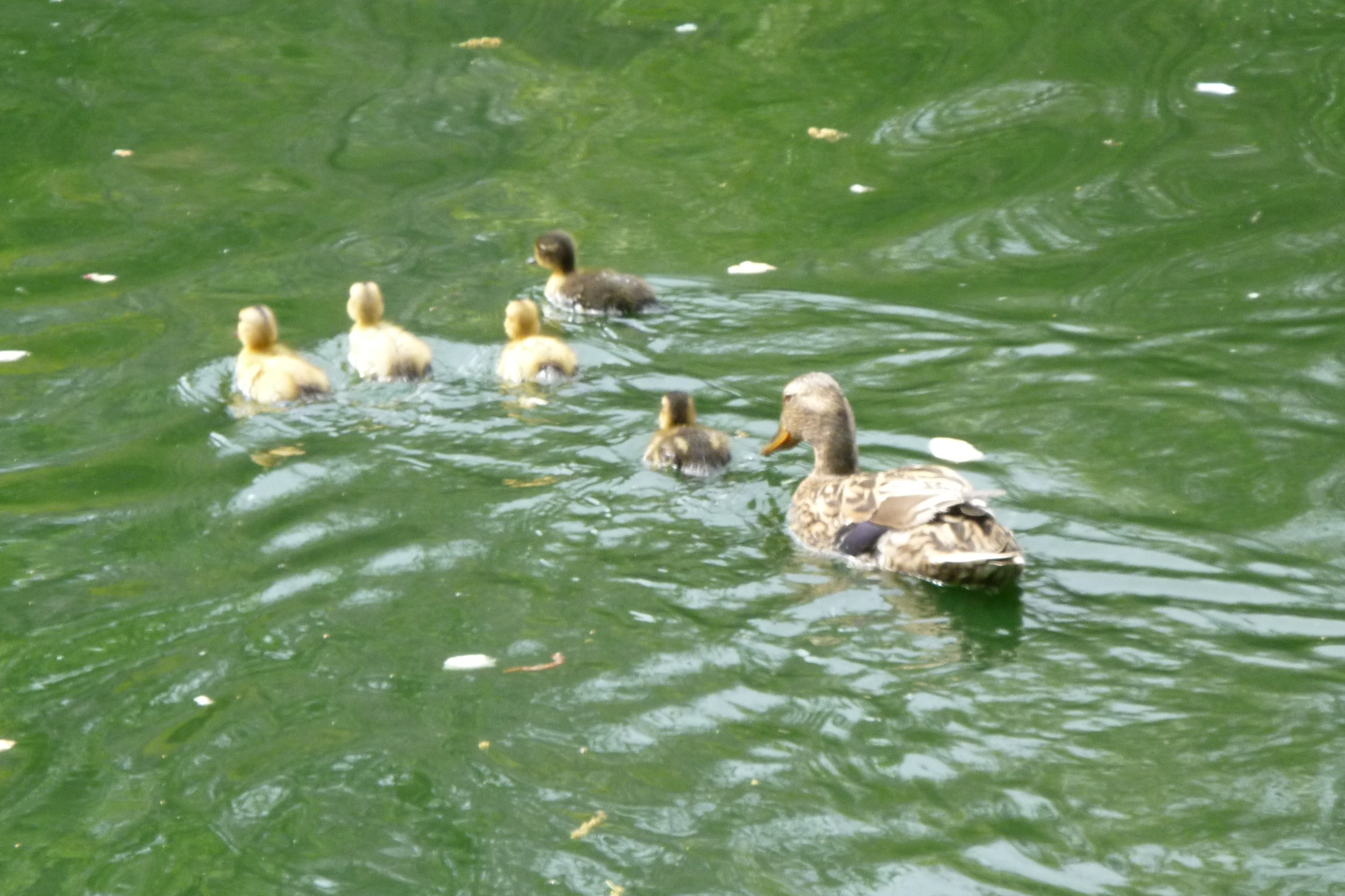
I’ve been spending a fair amount of my writing time watching little fuzzy balls of fluff float around the pond.  I’ve identified two families with babies.  There’s a single mother duck who was chasing six children around on a recent Saturday, and two-parent family with a mere two off-spring.

All of this duck-watching does in fact lead to a book review!  Because the duck-watching very naturally led me back to Make Way for Ducklings by Robert McCloskey.
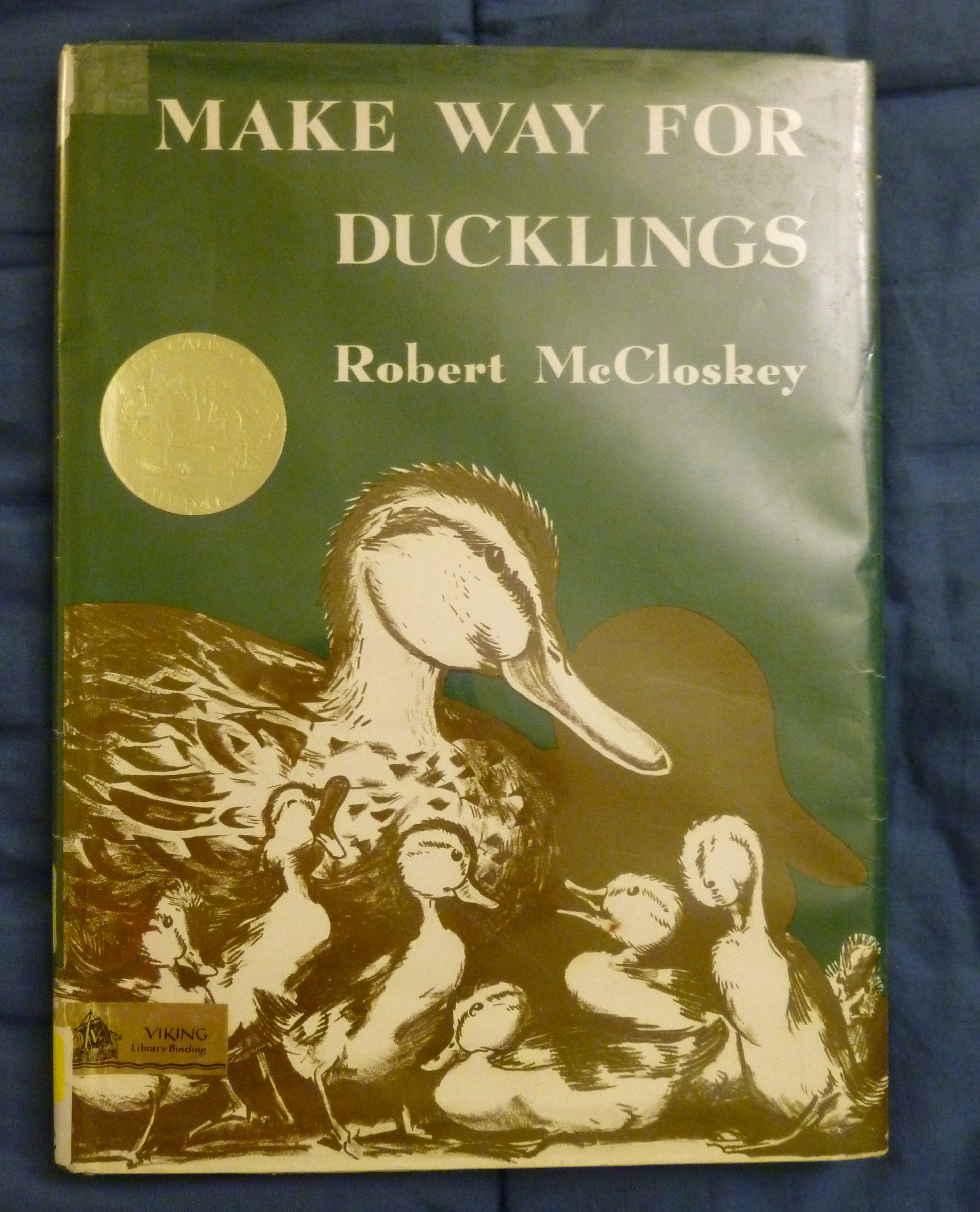
I love the artwork of this book.  I think that’s really why I wanted to reread it, to look at the cute duckling drawings.  McCloskey’s ducklings have longer necks than mine (maybe they’re older?) but they’re just right for fuzziness.

Although I’ve yet to see the ducklings at my pond walk in a neat line like McCloskey’s.  Mama Duck seems to spend most of her time herding ducklings around.  They stray off in all directions, and every so often one realizes it’s gone too far away, panics, and has to be rescued.  They start cheeping, and sometimes they go shooting over the water back to the rest, while other times I’ve seen Mama Duck go after a strayed duckling.  It’s adorable to watch, but I think it would be exhausting to be a duck mother.
Back to Make Way for Ducklings.  I admit I was a little disappointed by the plotline.  I remembered the ducklings’ journey as a bit more epic.  Then I went back to the story to find it’s only a couple of blocks.

But it may be silly to discuss whether the plot of a picture book is sufficiently epic.  It was cute, and well-worth a visit just for the drawings.  If you know any ponds with ducks near you, you might want to visit them too–there could be ducklings to distract you too!
Stealing Words

After two people, unrelated to each other, both recommended The Book Thief by Markus Zusak, I decided I ought to give it a go.  I’m not sure what I expected.  Possibly Fahrenheit 451 meets The Sting, with a little Diary of Anne Frank.  And maybe even a touch of Terry Pratchett, considering Death is the narrator.

It really wasn’t any of those.  It was the story of Liesel Meminger, a German girl living outside of Munich during World War II.  The book opens with her younger brother’s death, and Liesel being passed over to foster parents by her mother.  The story follows Liesel’s bonding with her foster family, and with Rudy, a neighbor boy and her best friend.  It also follows as she learns to read.  She does steal books, but it’s not really the organized crime or defiance of Nazi book-burning that some of the plot summaries of this book suggest.  It is about the power of words, though, and how certain books come to define Liesel’s life.

I liked the The Book Thief, but it is an overwhelmingly bleak book.  The single word that most comes to mind is grim, especially in the later sections.  There are happy moments, sweet moments…maybe even one or two funny ones (though this is emphatically not Terry Pratchett, despite Death narrating).  And yet there’s such bleakness.  Poverty is set against a backdrop of oppression, with a lot of Heil Hitler-ing for good measure.

I thought of a funny moment–Death reflects at one point that if everybody starts in on “Heil Hitler” in a crowd, it would be really easy to cause injuries from the arm movements, if you happen to be standing in the wrong place.  He’s not sure if it’s happened–all he can say for certain is that it’s never killed anyone.

But despite that,  it’s a bleak book.  If this was a movie, I think it would have to be in black and white.  Or else use a trick Tim Burton likes, of making color movies that are gray and washed-out, as though the world is perpetually overcast.  Think of Sweeney Todd or Sleepy Hollow.

I enjoyed the characters, especially Liesel’s adoptive father; Rudy, the neighbor boy who becomes her best friend; and Max, the Jewish man who hides in Liesel’s family’s basement.  I was also impressed by the portrayal of Liesel’s adoptive mother, who grows a lot as a character.  I don’t think it’s that she grows as a person–I think it’s that we see new sides and depths to her as the book progresses, so that even though she started out seeming completely horrible, by the end I was kind of fond of her.

The Book Thief has apparently been classified as Young Adult sometimes and for adults at others.  I think it could be YA, but older YA.  It’s not so much for any particular moment as for all that bleakness, and some of the darker plot turns.  It has “adult themes,” I suppose.

But it is a very good and complex book.  Just be careful that you don’t read it when you’re already feeling down about the world!

Author’s site: http://www.randomhouse.com/features/markuszusak/

Revisiting Diana Wynne Jones

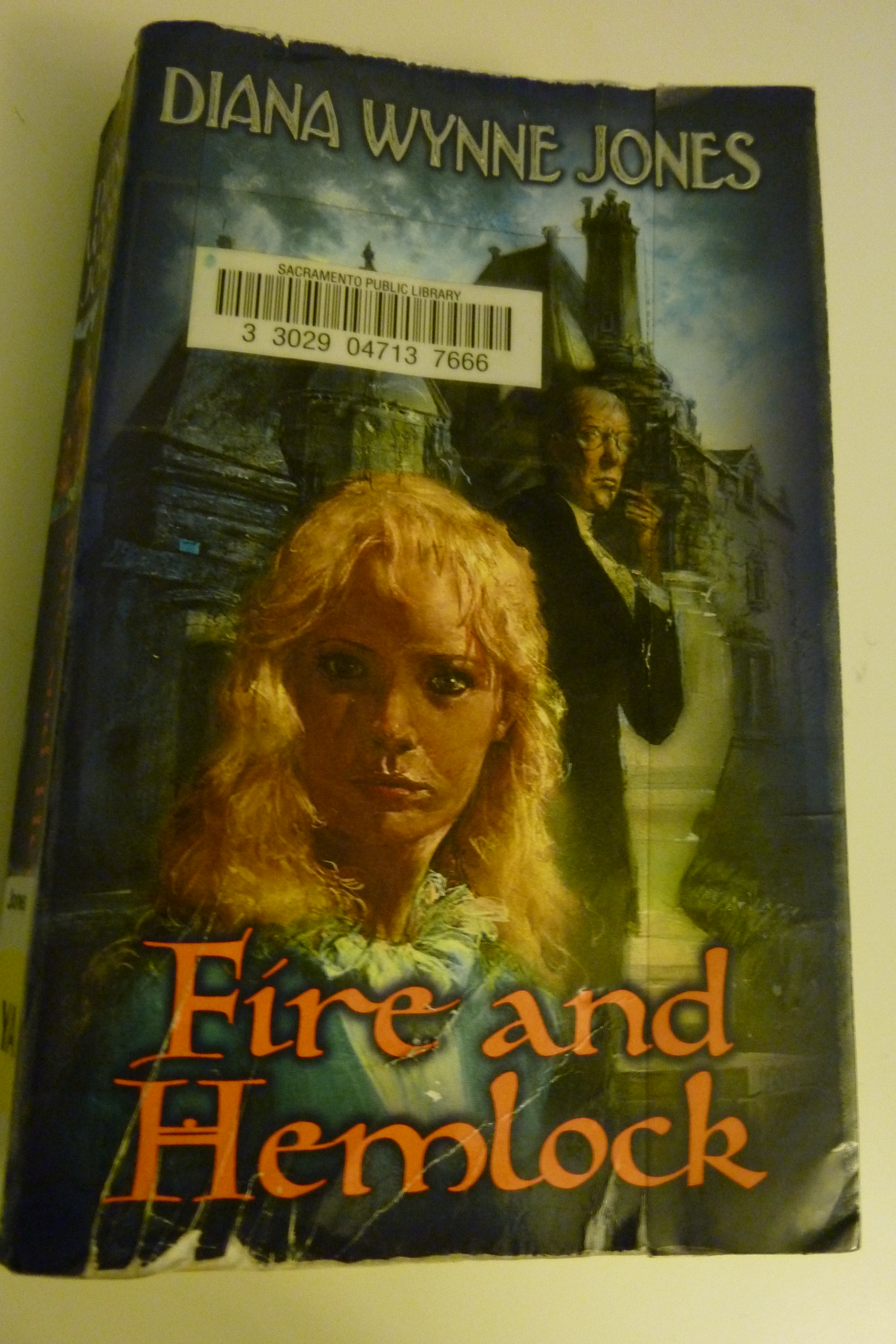
After Diana Wynne Jones’ death a few weeks ago, I–like many people–wanted to go back and read some of her work.  I decided to revisit Fire and Hemlock.  This was a reread, and I selected it in part because I had some trouble with it the first time around–but thought at the time that I might like it better on a second read.

This book is a bit difficult to describe without giving things away.  It begins with Polly, who is 19 and looking at a book of fantasy stories.  One of them, a story about a man with two sets of memories, triggers a series of hidden memories for her.  The book jumps back to when Polly was ten, and moves forward exploring these hidden memories.  They start when Polly gate-crashed a funeral at the mysterious Hunsdon House next door to her grandmother’s, and met Tom Lynn.

At this point I ought to describe Tom; this is also where I had trouble the first read-through.  Ten-year-old Polly views Tom as much, much older than her, and Diana aids and abets this impression for the reader.  I think he’s described as “stooped” at some point, he definitely is described as having an “elderly hairstyle,” and he’s a recently-divorced cello player.  None of this says “young man” to me.  The divorce alone would probably make me assume thirties at least, and everything else had me putting him as minimum mid-forties, and only the relatively young-sounding ex-wife would keep me from assuming he was much older.

I’m about to reveal what was probably supposed to be a twist–so I’m sorry for a spoiler, but it was a twist that thoroughly derailed me, and I would’ve done better had it been spoiled.  Hundreds of pages in, we find out that Polly as a child was a very poor judge of age, and Tom was much younger than she led us to believe.  This becomes important to the ending, which is why I had such trouble the first time.  This time I really tried to implant in my mental image the idea that he was young, to the point that I was mentally chanting “he’s twenty, he’s twenty” on occasion.  Later evidence in the book suggests he was probably early twenties.  So if you read this, keep that in mind–it might help.  And pay no attention to the cover, it has a horrible depiction of Tom.

Back to the plot.  Tom and Polly, despite their not-quite-as-big-as-I-thought age difference, become fast friends, making up stories about their alter ego selves who are heroes in training.  It all becomes more fantastical when the stories they make up begin to come true.  Meanwhile, the Leroys, who own Hunsdon House and include Tom’s ex-wife, have some kind of sinister hold on Tom, and continually warn Polly away.  Nineteen-year-old Polly has to solve the mystery, and determine what happened four years previously that changed, not only her memory, but apparently actual events.

I’m not really sure what kind of review this is.  Because I really enjoyed the book.  There’s so much in here that’s wonderful–characters, mystery, fantastic adventures, humor.  And yet…the end doesn’t quite pull together for me.  The basic mystery is cleared up, there’s essential resolution, but I feel like an extra twenty pages explaining what just happened would be very helpful.  I love Diana Wynne Jones’ books–love, love, love them–but every so often one of them is more convoluted and confusing than the others.

So I guess it’s a mixed review.  I recommend it…but if you try reading it, remember–he’s young!

Author’s Site: http://www.dianawynnejones.com/dwjflash.htm

And official fansite: http://www.leemac.freeserve.co.uk/

Bookish Hostilities

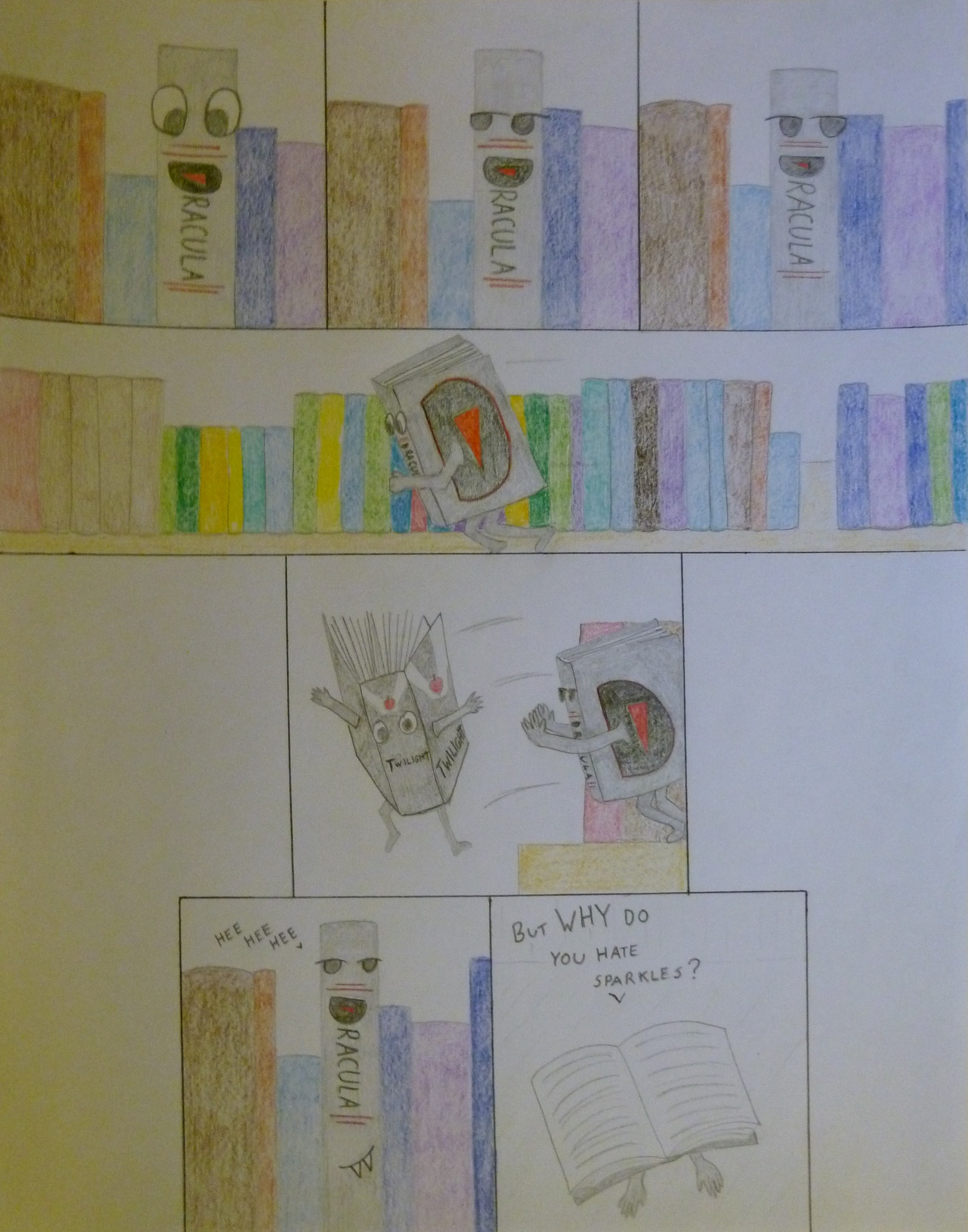
Some backstory on the inspiration for today’s Fiction Friday–I was talking with a friend last week about e-readers, and she was explaining a problem with hers.  I don’t pretend to understand exactly how it all works, but apparently she had downloaded books from one source, and now it was refusing to let her download another source’s books.  This led me to comment that my paper books had never objected to sitting next to each other…which led us into a conversation about books elbowing each other off of the shelves…which led quite natrually to this comic I couldn’t resist drawing…

In the interest of full disclosure, perhaps I should confess that I did actually enjoy Twilight (in a WHY AM I ENJOYING THIS? kind of way) and Dracula has been sitting on my To Be Read pile for way too long…but quite apart from my own preferences, I can easily imagine the books engaging in hostilities!  Do you have any books that would hate each other?

A Treasure in a Warehouse

My library had a warehouse sale recently, and I came home with ten new books (for $12.50!  I love my library.)  It was a glorious sale.  There are few things better in book buying, for me, then stumbling across a J. M. Barrie book that isn’t about Peter Pan and looks like it’s from 1900 (although I can’t find a publishing date on it!) and then realizing that the librarians will let me take this treasure home to keep for a mere two dollars.  Lovely.  But almost as good is finding a book I’ve been meaning to get around to buying for, I don’t know, three years, and that one can go home right now for only a buck.

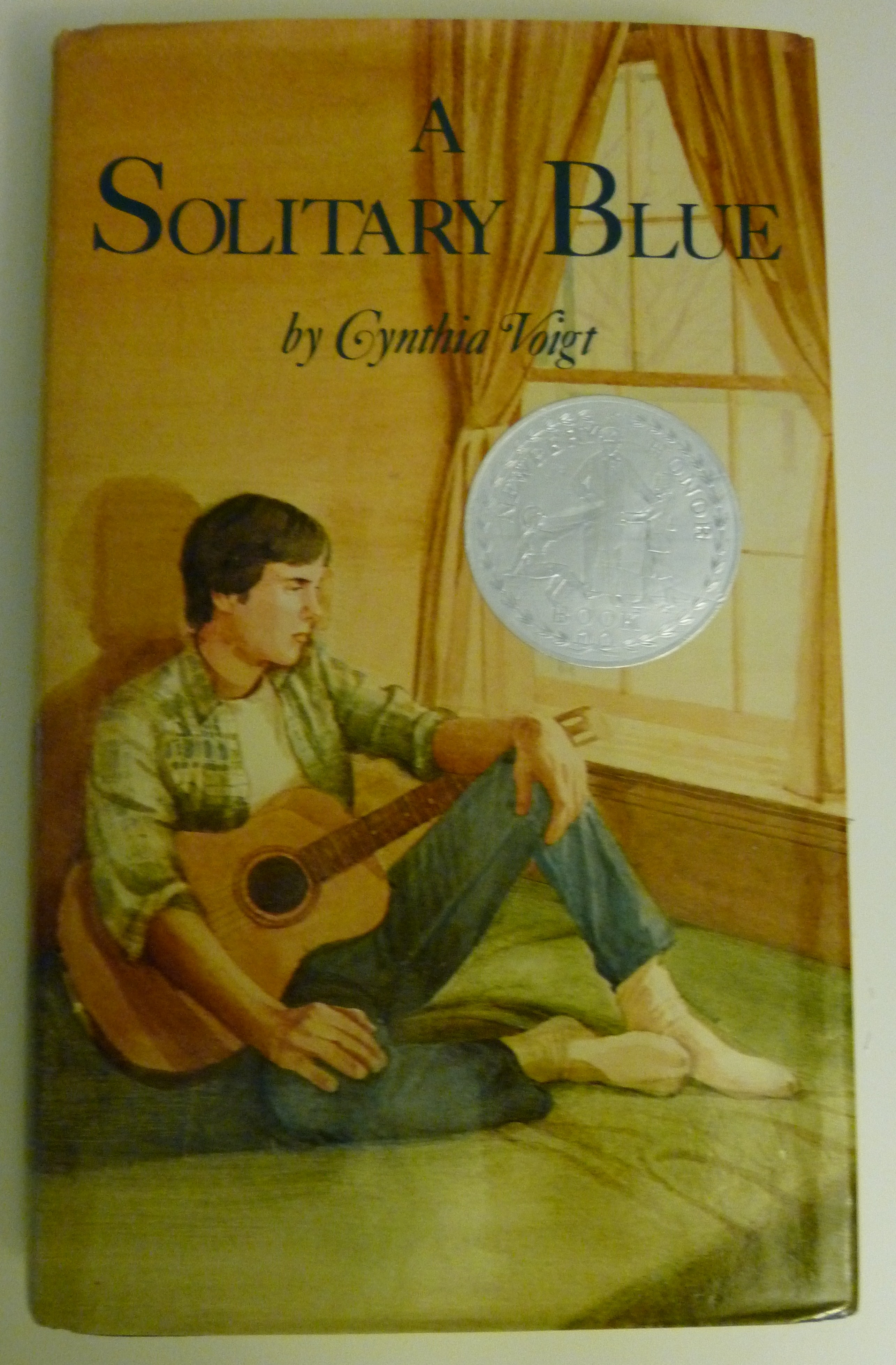
That book I’d been meaning to buy was A Solitary Blue by Cynthia Voigt.  I started reading it the same day I bought it.  I really don’t know why I took this long to purchase it (except possibly because brick-and-mortar bookstores never had it when I looked, and I was wary of buying on Amazon because I didn’t want to inadvertantly end up with a particular edition I knew I didn’t like).

A Solitary Blue is a wonderful, beautiful book.  I love the way Voigt writes about emotions.  A friend who went to the sale with me asked what the book was about, and I flailed a bit trying to answer.  I had read it before, that wasn’t the issue, but it’s much more a character-development book than a plot-driven one.

Here goes a best-attempt at “what it’s about.”  Jeff’s mother, Melody, is beautiful and charming and fascinating–and she walked out when Jeff was seven years old.  As Jeff grows up, we watch the development of his relationship with his father, a very reserved college professor, and with Melody as she moves unexpectedly in and out of his life.

It’s Jeff’s thoughts and feelings that make me love this book.  When he’s small, his mother is the center of his world.  Voigt writes wonderful descriptions about how Jeff feels around her.

“Jeff watched and listened, basking in his own feelings: of being with his own mother, who wrapped her love around him; of being–strange as it seemed–home, where he was welcome; of waking up to a world where his help was needed to right what was wrong; of lying on soft grass under trees hundreds of years old beside walls that his ancestors had built; of being logy with the perfumed heat of the day.”

When Jeff gets older, he sees through Melody’s charm to realize how irresponsible and self-absorbed she really is–and the descriptions of how he feels in his disappointment and betrayal are beautiful too.

“He felt so bad–sorry for himself, and angry at himself for losing her–and helpless.  He didn’t know what he should have done, what he could have done.  He felt as if he had been broken into thousands of little pieces.  Broken and then dropped into some dark place.  Some dark place where he was always going to stay.”

I think the reader sees through Melody sooner than Jeff does, so we can see the tragedy coming.  But, despite some sad parts, it’s an ultimately positive story, as Jeff learns and grows and comes out of both the sun of Melody’s approval, and the darkness of her disregard.

The title refers to a blue heron, a bird Jeff sees alone on an island one day, and which becomes symbolic for Jeff himself, and for a few other characters too.

A Solitary Blue is part of a larger series, but I think it could stand alone.  The larger series is about the Tillerman family and their friends, and the Tillermans have only a supporting role in this one.  I recommend the rest of the series too, but this one is my favorite.

Author’s site: http://cynthiavoigt.com/