Learning to Be a Wizard

Today’s review is a book about a boy who goes away to a school to learn to be a wizard.  At the school, he makes a few close friends, including a freckled, red-headed boy.  The school is run by a kind older wizard.  The conflict of the story arises with an evil wizard who was a co-founder of the school who was cast out for being, well, evil.  The hero turns out to be the fullfilment of a prophecy to fight the evil wizard.

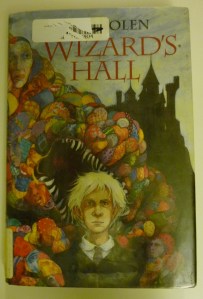
And if at this point you think I’m talking about Harry Potter…I’m not!  I’m actually talking about Wizard’s Hall by Jane Yolen.  I’ve no idea whether J. K. Rowling has ever read it, and would not dream of commenting…except to note that Wizard’s Hall came first.

Wizard’s Hall is about Henry (yeah, the name’s interesting too) who casually mentions to his mother one day that perhaps he’ll be a wizard.  Next thing he knows, his mother has wiped the smudges off his nose, told him that the most important thing is to try, and sent him out the door to walk to Wizard’s Hall.  After that, it’s the story of Henry trying to figure out whether he really belongs at Wizard’s Hall–and, of course, how to fight the evil wizard too.

Henry is pretty swiftly renamed–everyone at Wizard’s Hall has a special name, and they’re all plants, like Hickory and Gorse and Willoweed.  Henry becomes Thornmallow, “prickly on the outside and squishy on the inside.”  I think he’s a bit more squishy than prickly, in an earnest, well-meaning sort of way.  I’ve actually been known to define characters in other books like this–I have a soft spot for tough characters with good hearts, who can sometimes be described as prickly on the outside and squishy on the inside.

Wizard’s Hall is a lot shorter than Harry Potter–133 pages, instead of, I don’t know, 4,000?  It doesn’t have the same elaborate world or the multi-book epicness.  But it is a very good book about a wizarding school, and about trying to find your place.

Author’s Site: http://janeyolen.com/

Sleeping Beauty, Awake and Fighting

What if Sleeping Beauty didn’t turn out the way all those fairies at her christening intended?  That’s one element–and my favorite–of Spindle’s End by Robin McKinley.

There’s a line in The People the Fairies Forget when Tarry wonders what christening-gifted people would be like without the enchantments.  How does it change a person to be enchanted to be compassionate?  In my book, Sleeping Beauty is only a minor character, and is about what you’d expect her to be like if you’ve ever read Charles Perrault.

But Rosie isn’t.  Rosie is Sleeping Beauty in Spindle’s End, and is wonderfully NOT what she’s supposed to be.  She has long eyelashes and fair skin and golden hair, but she keeps the hair cut short so it doesn’t have the chance to fall into ringlets (and ends up a fuzzy, curly mass).  She hates dancing and embroidery, so it doesn’t matter that she’s enchanted to be good at them.  Her laugh may resemble a bell, but it must be a very large and unusual bell.  And most importantly, she is wonderfully, obstinately, stubbornly herself.  She’s not at all sure she even wants to be a princess, and she’s not going to just take a curse lying down.

McKinley does in Spindle’s End some of my favorite things about retold fairy tales.  We all know this story–princess cursed to prick her finger and die, fairies carry her off into the woods to keep her safe, spindles get destroyed, etc.  But she’s retold it with lots of clever, unexpected, practical twists.  What was Sleeping Beauty’s relationship with those fairies, considering they’re the only family she’s ever known?  Does she have her own plans for her life?  What’s it like to get princess-ness dropped into your lap one day?  And how do all those christening gifts turn out?

The gifts are wonderful, Rosie is wonderful, and the fairies–very practical fairies who are human-sized, don’t shed sparkles, don’t have wings, but do some impressive magic–are wonderful too.

I hate to say it, but one reservation here–I’ve never found the romance wonderful.  There is one, but it’s never felt right to me.  I’ve read this at least twice, so the most recent time I knew the romance was coming.  I really, really tried to see it coming, to anticipate it and wrap my head around it, but…while there are one or two cute moments, on the whole it just didn’t feel right.

It may be me.  It’s the kind of romance I often have trouble with.  Sometimes books like to create a friendship between a girl and an older man, which then turns into a romance when the girl grows up.  Once in a while it works for me.  Usually it doesn’t.  (On that subject, as a minor spoiler to the unwritten sequel of Red’s Girl, Red and Tamara are never going to be romantically involved.  Ever.)

But don’t let this turn you off the book.  Because honestly, I think Rosie’s relationships with her “aunts” (the two fairies) and her best friend are the more important ones than the romance, and they’re all very good.

And I love practical fairy tales.  The book opens with some lovely pages about how magic works in this country, and it’s this fantastic combination of total fantasy mixed with practical details about how people go about living their lives with this magic around them.  Magic sort of accumulates around cooking pots, for example, and fairies have to disenchant them every so often, by laying a finger on them.  Absent-minded fairies tend to have burn-scars on their fingers.  And when the evil fairy’s curse goes out, a decree is issued to lop off the tips of the spindles on all the spinning wheels.  How much more reasonable than burning every spinning wheel, and decimating the cloth industry!

My particular fairy tale retold is all about pulling out the most absurd bits of fairy tales and having more practical-minded characters try to work around them.  But I love retold fairy tales that work around those more absurd bits and make them make sense.  And I so enjoy McKinley’s rational, funny, sweet retelling of “Sleeping Beauty” that is the original story…but not quite the way Perrault told it.
Much Ado About Shakespeare

Last Saturday, along with being Holy Saturday, was Shakespeare’s birthday.  It’s one of the very few historical dates I know (other than “yesterday, December 7th, 1941, a date which will live in infamy.”  Oh, and Titus Oates’ birthday–March 17th.)  But Shakespeare’s birthday is one I memorized.  In college, I had a Shakespeare class that happened to meet on April 23rd.  I brought cookies.  🙂

My love affair with the Bard goes back to high school, where I was a charter member of my school’s Shakespeare Society.  A lot of my best memories from high school involve Shakespeare (or Johnny Depp, but that’s another story!)  So I was definitely instrumental in my book club selecting a Shakespearean play last month.  Not solely responsible, but I was one of the ones who pushed.

Which is how I ended up rereading Much Ado About Nothing recently, and remembering why this is my favorite Shakespearean comedy.  It’s a great gateway play for people not very familiar with Mr. Shakespeare.

The story follows two romantic couples.  There are Claudio and Hero, whose romance takes a dark turn when Hero is falsely accused of wanton behaviour (and Claudio, the cad, believes it).  And there are Beatrice and Benedick, both known for their wit, who are continually baiting each other.  Their friends decide that they’d be perfect for each other, and set about on a plan to make each believe the other is madly in love with them.

My favorite scenes in the play are the gulling scenes, when each group of friends stages a conversation for the eavesdropping Beatrice or Benedick.  This preference may in part be because I performed in each of those scenes in my high school’s Shakespeare Festival.  But they really are brilliant comedy.

I was particularly noticing on this recent read-through how little Shakespeare gives in stage directions (though there is that one immortal stage direction in A Winter’s Tale: “Exit, pursued by a bear”).  It leaves a lot open to interpretation.  It doesn’t say that Benedick knocks over the potted tree he’s hiding behind at this point–but he can.

More significantly, many lines change completely by whether you believe the speaker is serious.  Was Don Pedro really proposing to Beatrice?  Are Benedick and Claudio really friends at the end?  You can go too far believing characters don’t mean what they’re saying, but there is room for reasonable interpretation–which makes the plays even richer.

If you’re at all interested in Shakespeare, try Much Ado About Nothing.  I recommend the Folger Shakespeare Library edition–good footnotes, and they put them on the facing page, which I find easier to read.  If you don’t feel up to reading Shakespeare, watch the Kenneth Brannagh version.  Excellent, although I can’t remember if he knocks any trees over.  I think I do recall some splashing about in a fountain though…

Sensible and Sensitive–If Not Altogether Clear

A different sort of book today–if you’ve read my posts about my reading challenges for the year, then you’ll know that one of my goals is to read more classics.  Despite a college preparatory high school and an English major undergrad, there are a lot of classics I have somehow missed.  High on the list are Austen and the Brontes.  Somehow I was never assigned any of them (unless you count a seventh-grade book report on Pride and Prejudice, but even that I think I picked myself from a list of suggestions).

I reread Pride and Prejudice some months ago, and found out that Austen is not nearly as challenging as the impression given to my twelve-year-old self.  I shouldn’t have waited so long to pick her up again!  I enjoyed Pride and Prejudice–it’s quite funny in spots, very memorable characters (Elizabeth Bennett and Mr. Darcy!  Need I say more?) and the society was fascinating.  Although I did want to shake Jane when she didn’t give us dialogue in the final romantic scene…

After Price and Prejudice, I recently tried Sense and Sensibility for the first time.  The society was still interesting, maybe even more so.  What would it be like to spend all your time simply traveling about and living in other people’s houses, sitting around having tea or going shooting (depending on your gender) and to expect to live on your inheritance or your interest entirely?  Earning money seems to be out of the question.  And the endless societal rituals…although sometimes I think the boundless rules for interaction might almost make things easier, like knowing all the rules to the game and what it means whenever anyone does something.  The book was funny in spots too, sometimes because of the boundless societal rules.  All that said, though, I can see why Pride and Prejudice is Austen’s more popular book.  I wasn’t as attracted to the lead characters in Sense and Sensibility, for one thing, but the chief dilemma for me was the romances.

You see, there are two triangles in this one, one for each of the two sisters, Elinor and Marianne.  Marianne is the one represented by “sense”–emotive and dramatic to an extreme.  Elinor, by contrast is, well, sensible.  The trouble is, Elinor is so sensible and restrained that, when she fell in love, I couldn’t tell she’d done it.  Her romance begins earlier in the book, while Marianne’s (which is abundantly obvious when it happens) doesn’t come along until later.  So I was left for chapters trying to figure out which of the vast cast of supporting characters actually mattered.  I enjoyed the book more in the second half, after I’d worked out the two triangles and could see what plot threads I was following.  But it took some time to get there.

I watched the 1995 movie version after reading the book, and decided I should have handled things in the opposite order.  It would have been so much easier to discern the romances in the movie–when Hugh Grant walks onto the scene, you know he’s an important character!  The movie held up very well, even though I watched it immediately after reading the book (which doesn’t usually serve movie versions well).  I thought it was a faithful retelling, and the cast alone is impressive: Emma Thompson, Kate Winslet, Hugh Grant, Alan Rickman, Hugh Laurie…it’s just too bad they didn’t get Judy Dench into it somewhere; I thought all British movies based on classics required Judy Dench.  But no matter, it was a very good movie.

And it was a good book too, though I think I’ll like it better if I ever reread it, and already know which characters to pay attention to.  I have a new policy with my classics reading, to watch a good movie version first.  So far I’ve tried it with Jane Eyre, and found the book much easier to read because I watched the Orson Welles/Joan Fontaine version first.  And I ended up staying up late reading because I knew a good scene was coming and wanted to get there…

I can recommend Pride and Prejudice entirely, and Sense and Sensibility with a few reservations.  But possibly not at twelve years old, considering it did scare me off for a while…

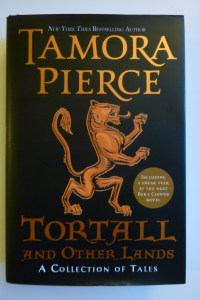
Meeting Old Friends, and New, in Tortall and Other Lands

When I did my end-of-year round-up of reading, I also mentioned the book I was most looking forward to in 2011: Tortall and Other Lands, by Tamora Pierce.  I finished it recently, and was pleased to find that it didn’t disappoint.

I admit I was a little worried about that “Other Lands” part of the title.  I was hoping she wouldn’t throw us one Tortall story, and then write about unfamiliar places for the rest of the collection.  But I should have had more faith–she gave us a great collection with a high number of stories in Tortall (or nearby countries), and the ones that were in other lands were good ones too.

The book is probably most appealing to people who already know Tortall, as several of the stories, especially the longest ones, revisit characters we’ve already met.  For fans of The Immortals series, Kitten the baby dragon gets her own story.  For fans of her Trickster series, we get to read a story about Nawat, Aly and their children.  Other stories feature minor characters from other books, or at least recognizable creatures–the Darkings, wonderful, funny inkblot-like creatures, are back in force.

The non-Tortall stories didn’t make a huge impression on me, but I remember them as enjoyable.  And how do you create a world as vivid in twenty pages as has been created in, let’s see, going on 18 books now.  Two of the stories, the last ones in the book, are set in the…well, I hate to say “real world” because it seems insulting to these other so vivid worlds, but let’s say the world you and I (I assume!) live in most of the time.  One was, I think, the first non-fantasy thing I’ve ever read by her–and I’ve read everything (really–I just checked her website bibliography to make sure!)  The other was a fantasy in the present-day, and darker than most.  A small warning that I think this one had an older target audience than most.

That story led me to an interesting observation on the distinction between Juvenile (or perhaps young YA) and higher level YA or adult fiction.  For the younger readers, people will still be shot by an arrow, but it will be in the shoulder, or just a vague, unmentioned place that may cause death.  In older-level books, you’re more apt to have someone be shot in the eye.  Or really any specific, gruesome location.  I never thought about that as a distinction before, but I think it’s true.

But I digress.  So watch out for “Huntress,” it’s dark.  And I highly recommend “Nawat” and “The Dragon’s Tale” and “Lost.”  And really all of the collection, but those three were my favorites.  And I enjoyed a little snippet of background on how Tamora Pierce wrote The Song of the Lioness quartet to begin with.

I would have loved a short story about Alanna, the heroine of The Song of the Lioness, but no such luck.  I’ve been hoping for a story about Alanna and her squire–they’re in The Protector of the Small series, and seem to have had wonderful adventures–but I’ll have to go on hoping for that.

No matter.  It’s a wonderful collection all the same.  If you’ve read my gushing earlier post about Tamora Pierce’s books, I’m sure it doesn’t surprise you that I felt that way!  A fun note also–that best friend I mentioned in that post, who I met because we both were reading Tamora Pierce, loaned me Tortall and Other Lands.  So we’re both still reading her, almost ten years later.

Author’s Site: http://www.tamorapierce.com

…and Blog: http://tammypierce.livejournal.com/ Just discovered this while I was writing this review!  (I swear I’ve tried to find a blog by her in the past…) Kind of thrilled to discover it.  🙂  And to discover that she uses her cat as her avatar…