Sleeping Beauty’s Sister, Questing Through Fairy Tales

I decided to give E. D. Baker another chance.  She wrote the highly disappointing Frog Princess–but I was so intrigued by the premise of The Wide-Awake Princess, I decided to try it anyway.

The story is about Sleeping Beauty’s younger sister, Annie.  She’s immune to magic (in fact, she nullifies it around her), so when the entire castle falls asleep, she stays awake.  She goes in search of princes to kiss her sister, picking up a handsome guard for a traveling companion.

To give Baker due credit, she’s really good at ideas.  I mean, the princess kisses the frog and turns into a frog–that’s brilliant.  The chancy part is what she does with the ideas.  Fortunately, this book was packed with clever ideas, and the follow-through was an improvement on The Frog Princess.

While out looking for princes, Annie encounters elements from half a dozen other fairy tales–Hansel and Gretel, Snow White and Rose Red, Rapunzel, the Princess and the Pea, even the Frog Prince.  They’re all a little bit tweaked, mostly in clever ways, and the fast flow of them all keeps the book interesting.

My main reservation towards the book was a lack of depth.  The major characters had some development but were not very complex, and they didn’t seem to feel anything very deeply.  As an example–all the royals, including Annie’s family, are magically enhanced from christening gifts.  Since Annie nullifies magic, they all become less beautiful, less graceful and so on while around her (again–brilliant idea).  As a result, Annie is forbidden to touch her family, and they never hug or kiss her.  In Susan Kay’s Phantom, the Phantom has the exact same problem, that his mother refuses to kiss him.  For him, it’s a deeply scarring situation, causing him real pain as a child, and on into adulthood.  Annie, on the other hand, seems to be a little wistful on the subject.  (Really–her mother never touches her–that should be painful!)

To some extent it’s apples and oranges–Phantom is high drama, this is a children’s comedy.  But characters in comedies can still feel things.  And children’s books can have depth–the end of The House at Pooh Corner has real pathos, and Abel’s Island is about a character’s existential crisis.

Then there was the treatment of life-threatening situations.  Characters choose to plunge into danger without much motivation.  And while in dangerous situations, Annie is never afraid.  She’s uncomfortable, irritated, occasionally worried, but not afraid.  It got to the point where I was rooting for her to get scared some time, just to prove that she’s human.  I love feisty heroines, but even Alanna (a lady knight dubbed the Lioness) gets scared sometimes.  I don’t care how light your story is meant to be, your characters still have to be believable according to human nature.

But the ideas were really good.  The plot was fine.  Annie, despite not having much depth, is a fun character, and her love interest is a good guy.

In the end, it’s a fun story.  Just don’t expect it to be more than that.

Author’s site: http://www.edbakerbooks.com/
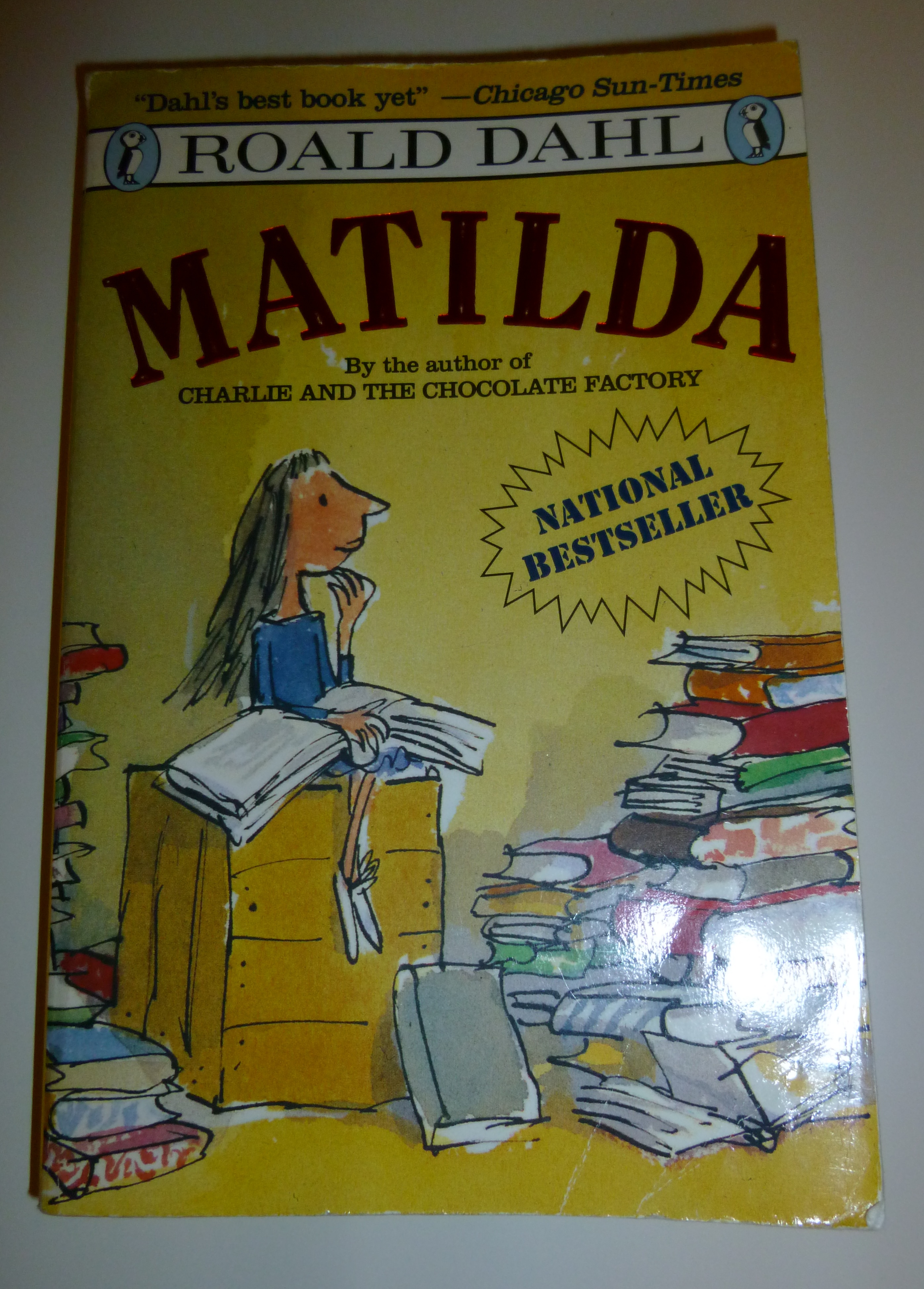
An Outrageous Tale from Roald Dahl

The books transported her into new worlds and introduced her to amazing people who lived exciting lives.  She went on olden-day sailing ships with Joseph Conrad.  She went to Africa with Ernest Hemingway and to India with Rudyard Kipling.  She traveled all over the world while sitting in her little room in an English village.

And while sitting in an apartment in California, I traveled to an English village with Roald Dahl.  The quote above is from Matilda, Dahl’s wonderful story of a very brilliant little girl.  Matilda loves books, teaching herself to read at the age of three, despite her horrid, neglectful parents who care only about television.  Matilda first shows her spirit through pranks on her parents (retaliation for their treatment of her) but really comes into her own when she goes to school.  Matilda discovers the extent of her own powers as she faces down the terrifying headmistress Miss Trunchbull, to defend her beloved teacher, Miss Honey.

Matilda must be one of those books everyone’s read, right?  If not, get thee to a library!  🙂  It’s a delightful book with Dahl’s full ability to spin out a fun and wild tale.  Everything is taken to an extreme: Matilda reads Dickens at the age of four, and Miss Trunchbull swings little girls around by their pig tails.  But that’s the comic fun of it.  Matilda’s incredible abilities make her entertaining, while her sweetness and unawareness of her brilliance make her a lovable character.  And if Miss Trunchbull was an inch more realistic, this would be a terrible book.

The handling of Miss Trunchbull, and to a lesser extent Matilda’s parents, was particularly interesting to me last time I re-read Matilda.  Maybe it’s because I just read another book about a neglectful and abusive parent–but that one was a serious treatment of the subject, and very much a drama.  Matilda is, of course, a children’s comedy.

Matilda’s parents are portrayed as being dreadful and nasty, but they don’t cause any real harm.  They don’t starve Matilda–they just make her eat TV dinners all the time.  Matilda’s mother leaves her home alone while she’s out playing bingo, when Matilda is only four.  Instead of getting hurt or kidnapped, Matilda cheerfully trundles off to the library.

At school, Miss Trunchbull never hits any children–she just picks them up by their ears, or forces them to eat monster-size chocolate cakes.  She does shut children into a cabinet, but we never see that, we only hear about it.  There’s a discussion at one point on how Miss Trunchbull can get away with everything.  Matilda explains it, “Your story would sound too ridiculous to be believed.  And that is the Trunchbull’s great secret…Never do anything by halves if you want to get away with it.  Be outrageous.  Go the whole hog.  Make sure everything you do is so crazy it’s completely unbelievable.”

I think that’s Dahl’s great secret too.  You can write about dreadful things–this is, really, a story about child abuse–but be outrageous and it becomes funny instead of disturbing.  It couldn’t really happen, it has no grounding in reality, and so it’s not upsetting.  The only time Miss Trunchbull’s actions approach reality is in her treatment of Miss Honey–and that’s what finally comes back to get her.

Whatever Dahl’s secret is, it works, and he’s given us a fun and funny story with entertaining and memorable characters.

Scented Flowers and Lucky Frogs

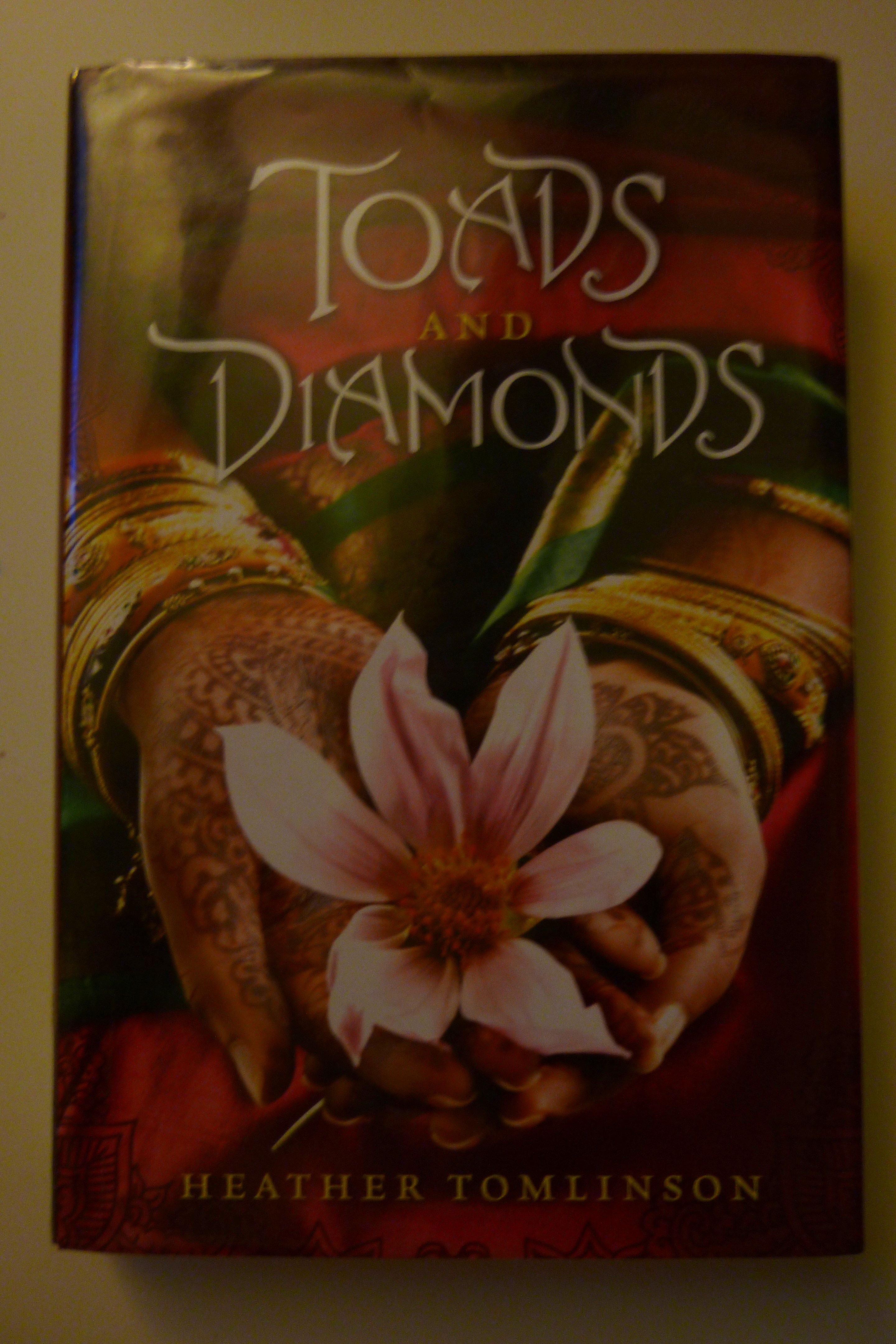
When you see a title like Toads and Diamonds on the shelf, you know you’ve found a re-told fairy tale.  I was trying to remember the title of the original–it turns out it’s usually known as “Toads and Diamonds” too (or “Diamonds and Toads”), although Perrault called it by the not at all descriptive title, “The Fairies.”

Whatever you choose to call it, the story is about two sisters (sometimes step-sisters), who each encounter a magical woman.  One sister is enchanted to drop flowers and jewels from her mouth whenever she speaks.  The other speaks, and drops toads and snakes.  Either one definitely creates a lot of opportunity for bizarre results!  I’ve read some other versions of this, and usually authors like to play with whether the enchantments are really blessings or curses.

Toads and Diamonds by Heather Tomlinson follows this trend, but does so in masterful fashion.  It follows two sisters, Diribani and Tana, who live in pre-colonial India (with some fictionalizing) and are struggling to make ends meet since their father’s death.  They’re devout followers of a fictional, polytheist religion which I think loosely resembles Hinduism.  They each encounter the goddess Naghali; Diribani begins speaking jewels, and Tana drops reptiles.

From the beginning, though, there’s a twist on the usual presentation–in their culture, certain frogs and snakes are considered lucky or even blessed.  Right from the start, it’s not so clear which sister is blessed and which is cursed.  As the story goes on, both girls find both benefits and drawbacks to their magical gifts.

I liked the character development here, as each sister comes to terms with her gift and learns about herself and her role in the world in the process.  They tell the novel in alternating chapters of limited third-person narration.  This is handled very deftly, because even though Diribani and Tana are separated for much of the book, Tomlinson keeps the two parts of the story feeling connected.  Part of that is thematically, but it’s also that each sister keeps thinking about the other, so the reader keeps being reminded of the connection.

My favorite part of this book was the atmosphere.  The Indian culture is vivid and colorful, and the details are excellently handled.  I don’t think Diribani ever speaks a jewel or a flower without a mention of what kind it is.  Potentially that could drag, but it’s not dwelled upon, just quickly described, so that you have constant images of lilies and rubies and orchids dropping past.  Tana’s snakes and frogs are described too, and we also hear about clothes, food, scents…  I love the descriptions of colors.  Rather than saying that a rug is orange and red and tan, it’s described as mango and ruby and apricot.  It brings it all much more to life, with an exotic flare.

I enjoyed seeing a familiar fairy tale put into a very different setting, especially one so vividly realized.  Highly recommended!

A Servant’s Magic

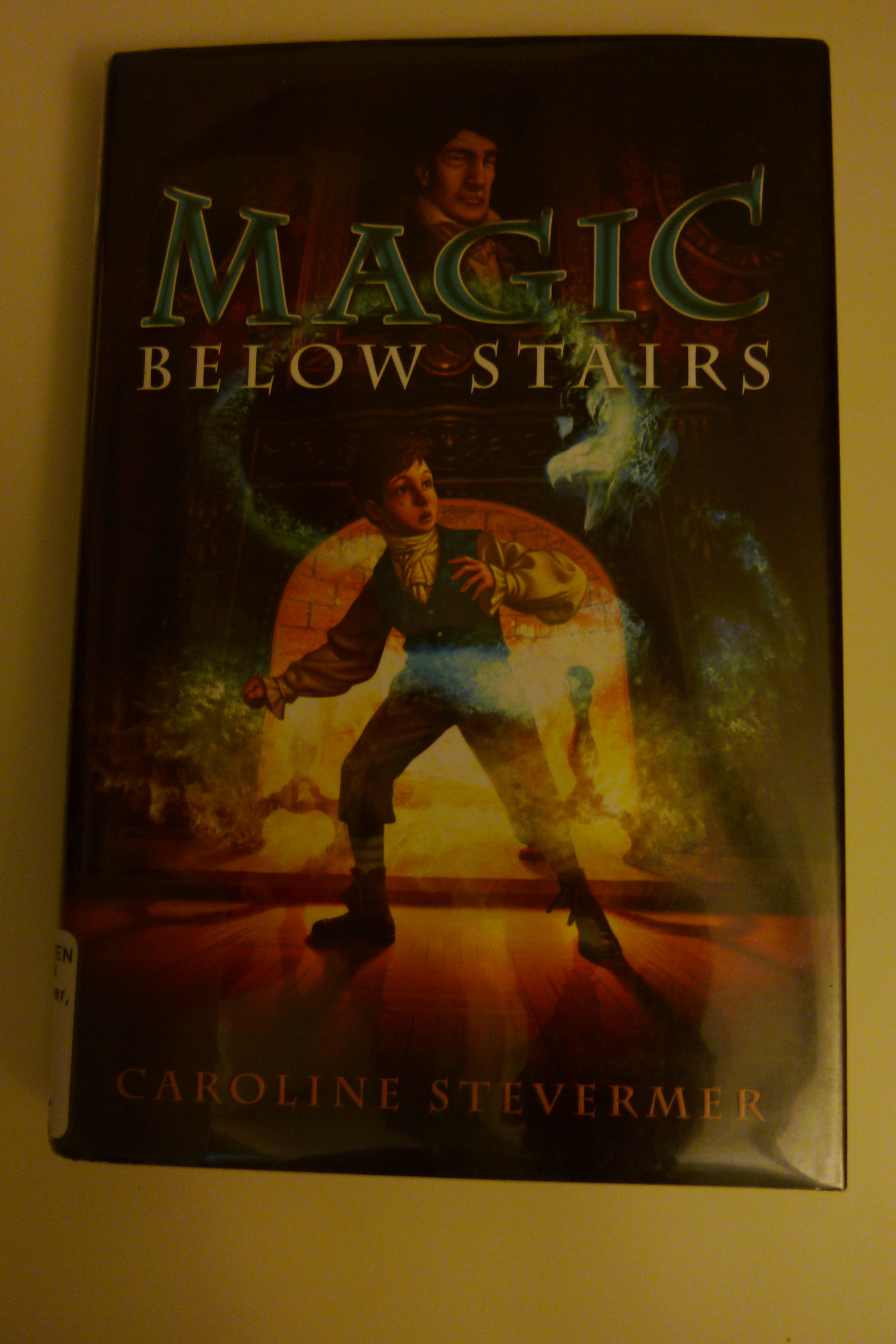
I love the Sorcery and Cecilia series by Patricia C. Wrede and Caroline Stevermer, so I was excited to stumble across a companion book recently.  Magic Below Stairs by Caroline Stevermer revisits the world of the series from a new point of view.  You don’t need to have read the rest of the series to enjoy this one, though I think it would add more meaning to some parts.

The series is about two women, Kate and Cecilia, who marry a couple of magicians, Thomas and James (respectively!)  They’re aristocracy of some sort; Magic Below Stairs comes from the other side of the social strata, and focuses on Frederick.  He notices strange happenings at the orphanage where he lives, and discovers that their cause is Billie Bly, a house brownie.  Billie Bly has attached himself to Frederick, and when Frederick is chosen to join Kate and Thomas’ household as a new servant, Billy Bly comes too–which Thomas does not appreciate at all.  Meanwhile, there’s also a nasty curse lying in wait.

This actually felt oddly like a Diana Wynne Jones book.  You have the earnest young boy, the absent-minded magician, and a looming threat.  And it’s all set in a grand English manor.

Stevermer’s website tells me this is set in Victorian Britain.  I’m not good at all at keeping straight different eras of British history (unless you give me an actual event to measure by–the Battle of Trafalgar, say, or the life of Shakespeare), so I just knew this was set somewhere back in the past when manor houses had entire staffs of servants hard at work below stairs.  Part of the fun of this book is seeing the world from that perspective.  This is especially true because this isn’t a book about the oppressed lower classes, which you do see sometimes.  The servants here actually seem a fairly contented lot who are fond of Thomas and Kate.

Saying that this reminded me of Diana Wynne Jones is a high compliment, of course.  🙂  This is a fairly short book without a huge amount of depth, but it’s a fun read with good characters and some nice humor at times.  And if you try it and enjoy it, you should definitely go on to the longer and more complicated Sorcery and Cecilia books!

Author’s Site: http://members.authorsguild.net/carolinestev/

Short Stories Near the Enchanted Forest

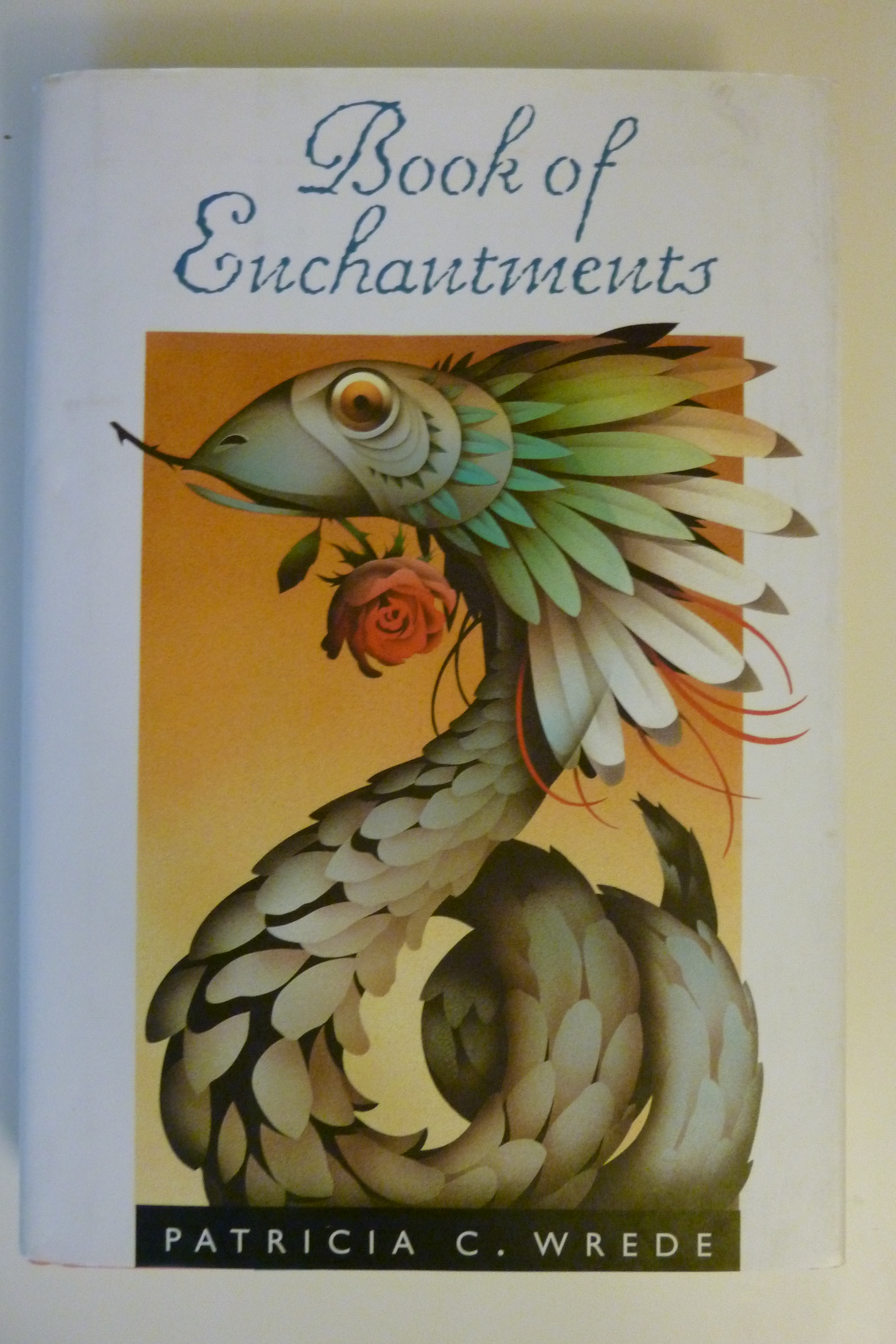
You may know that I’m a big fan of Patricia C. Wrede’s Enchanted Forest Chronicles.  I just recently bought another of her books–Book of Enchantments.  It’s a collection of short stories, and I’ve lost track of how many times I’ve read the library’s copy.

When it arrived in my mailbox, I went down the Table Contents.  I could vividly remember all but two stories, matching my memories to the titles–and I’m usually not good at remembering things like titles, especially when I haven’t read the book in probably a couple of years.

It’s a wonderful collection of stories.  They all deal with magic, but they vary widely in subject, setting and tone.  Some are funny; some are eerie; some are haunting.  And obviously, they’re memorable.

“Rikiki and the Wizard” has a fable-like quality to it, about Rikiki the blue chipmunk god, who’s obsessed with nuts (as a chipmunk naturally would be!)  “The Lorelei” combines a perfectly ordinary, modern student bus trip with the dangerous power of a siren.  “Cruel Sisters” and “Stronger than Time” both reimagine old fairy tales, bringing darkness but also more human characters.

Two of the stories are related to the Enchanted Forest Chronicles.  One, “Utensile Strength,” actually features major characters from the series, which is delightful simply in itself.  Combine familiar characters with a magical weapon called the Frying Pan of Doom, and I really don’t know how you could go wrong.  “The Princess, the Cat and the Unicorn” is less directly tied into the series, but it makes up for it by being amusing and lovely and a bit romantic.  It’s set in a magical kingdom where nothing goes quite right: “The magic carpet had a bad case of moths and the King’s prized seven-league boots only went five-and-a-half leagues at a step (six leagues, with a good tailwind).”  It has all the charm of the Enchanted Forest Chronicles, gently poking fun at how fairy tales are supposed to be.

Two of my favorites (aside from the two above) are very different from each other.  “The Sixty-Two Curses of Caliph Arenschadd” is about a caliph who works his way through a list of curses whenever anyone displeases him.  Most of the curses are funny, like turning people green or giving them monkey paws.  The story centers on the daughter of the Caliph’s grand vizier, who has to figure out a way around the worst curse of all.

“Roses by Moonlight” is set in the present day.  Adrian, a teenager, is unhappy with her life, jealous and resentful of her perfect younger sister Samantha.  One night a mysterious woman invites her for a walk in the garden, and Adrian finds herself in a rose garden she never saw before.  Adrian realizes that each rose she smells gives her a vision of a different future.  The woman tells her that she may pick one rose…  There’s something haunting about the idea of a garden of possibilities, letting you see all that could be, and then giving you the chance to choose your life by reaching out and plucking a flower.

But obviously they’ve all stuck with me to a greater or lesser extent.  Try the book–maybe they’ll stick with you!

Author’s Site: http://pcwrede.com/index.html