Questing with the Once Upon a Time Challenge

If you’re a regular visitor, you probably know a couple of facts about my reading: I love fairy tales retold; and I’ve signed on for a number of reading challenges this year.

With those facts together, it seems a natural that I would jump on the Once Upon a Time reading challenge being hosted right now by Stainless Steel Droppings.  And I was intrigued when I first heard about this a month or so ago.  But I hesitated.  I had just gone on a rampage of fairy tale retellings in the previous month, and I felt I needed to explore some other books for a while.  And since this particular challenge only runs for about three months, I didn’t feel ready to commit when I wasn’t sure when I’d want to come back to the land of fairy tales.

Well…I’m feeling the fairy tale vibe again.  So I’ve decided to get on board with the challenge too!

Since the timing is different for this one, I’m going to keep it as a separate post from my others.  Also, it’s more complicated!

The Once Upon a Time Challenge has a variety of quests, and now that I decided I’m in, I decided to jump for several of them:

Quest the First: Read five books that are fantasy, fable, fairy tale or mythology.  Half of what I read is fantasy, so it would be silly not to join up for this one!

Quest the Second: Read four books, one from each category.

Quest the Third: Quest one or two, plus reading or watching A Midsummer’s Night’s Dream in June.  Love Shakespeare–so in for this.

Quest on Film: Watch any movies or TV that also tell stories fitting the categories.

The challenge runs from March 21st to June 20th, throughout spring.  I’ll let you know how it goes!

Sleeping Beauty, Awake and Fighting

What if Sleeping Beauty didn’t turn out the way all those fairies at her christening intended?  That’s one element–and my favorite–of Spindle’s End by Robin McKinley.

There’s a line in The People the Fairies Forget when Tarry wonders what christening-gifted people would be like without the enchantments.  How does it change a person to be enchanted to be compassionate?  In my book, Sleeping Beauty is only a minor character, and is about what you’d expect her to be like if you’ve ever read Charles Perrault.

But Rosie isn’t.  Rosie is Sleeping Beauty in Spindle’s End, and is wonderfully NOT what she’s supposed to be.  She has long eyelashes and fair skin and golden hair, but she keeps the hair cut short so it doesn’t have the chance to fall into ringlets (and ends up a fuzzy, curly mass).  She hates dancing and embroidery, so it doesn’t matter that she’s enchanted to be good at them.  Her laugh may resemble a bell, but it must be a very large and unusual bell.  And most importantly, she is wonderfully, obstinately, stubbornly herself.  She’s not at all sure she even wants to be a princess, and she’s not going to just take a curse lying down.

McKinley does in Spindle’s End some of my favorite things about retold fairy tales.  We all know this story–princess cursed to prick her finger and die, fairies carry her off into the woods to keep her safe, spindles get destroyed, etc.  But she’s retold it with lots of clever, unexpected, practical twists.  What was Sleeping Beauty’s relationship with those fairies, considering they’re the only family she’s ever known?  Does she have her own plans for her life?  What’s it like to get princess-ness dropped into your lap one day?  And how do all those christening gifts turn out?

The gifts are wonderful, Rosie is wonderful, and the fairies–very practical fairies who are human-sized, don’t shed sparkles, don’t have wings, but do some impressive magic–are wonderful too.

I hate to say it, but one reservation here–I’ve never found the romance wonderful.  There is one, but it’s never felt right to me.  I’ve read this at least twice, so the most recent time I knew the romance was coming.  I really, really tried to see it coming, to anticipate it and wrap my head around it, but…while there are one or two cute moments, on the whole it just didn’t feel right.

It may be me.  It’s the kind of romance I often have trouble with.  Sometimes books like to create a friendship between a girl and an older man, which then turns into a romance when the girl grows up.  Once in a while it works for me.  Usually it doesn’t.  (On that subject, as a minor spoiler to the unwritten sequel of Red’s Girl, Red and Tamara are never going to be romantically involved.  Ever.)

But don’t let this turn you off the book.  Because honestly, I think Rosie’s relationships with her “aunts” (the two fairies) and her best friend are the more important ones than the romance, and they’re all very good.

And I love practical fairy tales.  The book opens with some lovely pages about how magic works in this country, and it’s this fantastic combination of total fantasy mixed with practical details about how people go about living their lives with this magic around them.  Magic sort of accumulates around cooking pots, for example, and fairies have to disenchant them every so often, by laying a finger on them.  Absent-minded fairies tend to have burn-scars on their fingers.  And when the evil fairy’s curse goes out, a decree is issued to lop off the tips of the spindles on all the spinning wheels.  How much more reasonable than burning every spinning wheel, and decimating the cloth industry!

My particular fairy tale retold is all about pulling out the most absurd bits of fairy tales and having more practical-minded characters try to work around them.  But I love retold fairy tales that work around those more absurd bits and make them make sense.  And I so enjoy McKinley’s rational, funny, sweet retelling of “Sleeping Beauty” that is the original story…but not quite the way Perrault told it.

Illusory Seagulls?

Continuing the spiritual theme this week, I thought I’d look at a couple of novels with a spiritual element: Jonathan Livingston Seagull and Illusions: The Adventures of a Reluctant Messiah, both by Richard Bach.  They’re both good stories as stories, and have some good philosophy too.

Jonathan Livingston Seagull is about a seagull who’s obsessed with flying.  While all the other seagulls lurch around and squabble over fish, Jonathan trains and practices to become a better and better flier–perfecting speed flying, diving, and soaring up above the clouds.  When he dies, he finds himself in another place with other seagulls, who also love to fly, and goes on learning–eventually coming back to Earth to teach more seagulls to fly.  It’s a story about a bird and flying, but it’s also about rising above the world to realize your own value–and everyone’s value as a unique, special individual.

Illusions is the story of a miracle worker (literally–no tricks) who can’t stand the crowds and the fame, and heads off in a biplane to travel from town to town, giving rides: three dollars for ten minutes in the air.  The narrator is another pilot in the same line of work, and the story is about what he learns about life and the world while he flies around with the retired miracle worker.

Bach goes a bit too New Age for me at times (especially Illusions), so if you happen to read one of these, don’t assume I agree with everything!  🙂  He has a lot of good thoughts too, though, and these are some of the few books I’ve gone through with a highlighter, to note favorite lines.  They’re short books, so maybe I’ll keep it a fairly short review too, and just give you some of my favorite quotes…

Jonathan Livingston Seagull:

“How much more there is now to living…We can lift ourselves out of ignorance, we can find ourselves as creatures of excellence and intelligence and skill.  We can be free!  We can learn to fly!

“The only true law is that which leads to freedom…There is no other.”

Illusions:

“In the path of our happiness shall we find the learning for which we have chosen this lifetime.”

“The bond that links your true family is not one of blood, but of respect and joy in each other’s life.”

“Argue for your limitations, and sure enough they’re yours.”

No problem is so big that you can’t run away from it.
You are quoting Snoopy the Dog, I believe?
I quote the truth wherever I find it.

“If you will practice being fictional for a while, you will understand that fictional characters are sometimes more real than people with bodies and heartbeats.”

“Don’t be dismayed at good-byes.  A farewell is necessary before you can meet again.  And meeting again, after moments or lifetimes, is certain for those who are friends.”

Okay, not so short.  I got on a roll with Illusions.  And one more note, for the writers out there–I heard somewhere that Bach received 44 rejections trying to sell Jonathan Livingston Seagull.  It went on to be a #1 bestseller.  So don’t let rejection slips make you argue for your limitations!

Not Evangelina Angelica Juliana Lianora

A month or so ago I posted the first chapter of an incomplete novel, and got some really nice responses, in comments and elsewhere–which is lovely, but I feel sorry now that I can’t share the rest!  Drat that “incomplete” aspect of the thing, and the fact that I still don’t quite know what to do to keep the action going for a major chunk of the book.

But I thought I could at least give you chapter two, which explains who my main character is–rather than leaving you only knowing her as “Not Evangelina Angelica Juliana Lianora, princess of Beaumont.”  It doesn’t resolve everything–it is, after all, only chapter two of what would be a novel, if I could work some things out–but it answers some of the chief mysteries that chapter one presented.  I hope you enjoy!  And if I keep thinking about it, maybe I’ll figure out what to do to write the rest…

********************************

Chapter Two: Maggie

            Her name was Maggie.  Not Evangelina Angelica Julianna Lianora, as she had told Michael, but just Maggie.  Marguerite, technically, but Maggie for day-to-day.

            Lina had always called her Maggie.  One would likely expect a princess to treat her maidservant with some degree of informality.  Maggie had always thought it was a mark in Lina’s favor that she was willing to be called by an informal name too—rather than Evangelina Angelica Julianna Lianora, which both girls agreed was simply too long to be convenient for regular use.  Besides, it was hard to be formal with someone who, on more than one occasion, you had gone splashing through mud puddles with in childhood.  Full names had been used (by Lina’s nurse and Maggie’s mother, which only added to one woman) after those occasions.

            By the time they were both nineteen, they were focused on more important matters than mud puddles.  Matters like Lina’s engagement to the King of Gaicaveen.  Continue reading “Not Evangelina Angelica Juliana Lianora”

A Fascination with the Phantom

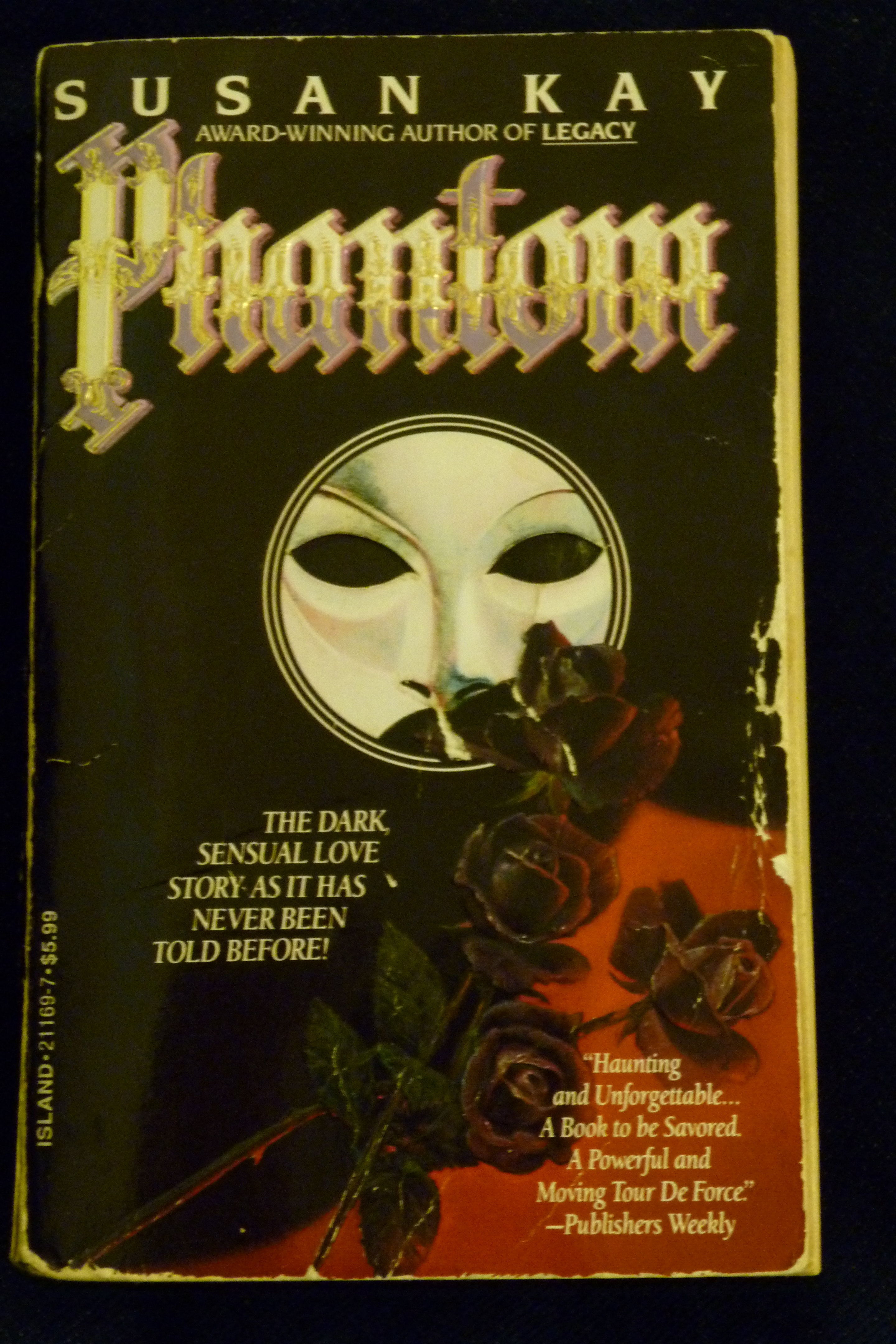
Today happens to be my birthday.  🙂  In honor of the occasion, I’ve decided to give myself over to emotive waxing on, run the risk of demonstrating a foolish attachment, and review one of my very favorite books: Susan Kay’s Phantom.
Technically it’s Phantom: The Novel of His Life by Susan Kay, but the convention is to always call it Susan Kay’s Phantom.  Maybe so that it can be put in a list with “the Claude Rains Phantom” or “the Lon Chaney Phantom” or “the Webber Phantom.”

I have a small (okay, enormous) obsession with The Phantom of the Opera.  I’m fascinated by the lead character: a brilliant musical genius who lurks in the shadows and, despite being a brilliant musical genius, is utterly convinced of his own unworthiness because he thinks he’s ugly–and by conventional standards he is, but I think the more imperative point is that he thinks he’s ugly.  I’m actually not that interested in the romance with Christine; it’s Erik, the Phantom, I’m fascinated by.  And I’m fascinated by exploring all the different versions, and how they’ve retold the plot and especially the character.  In this version he’s more arrogant–in that version he’s more shy–this version makes him more clearly a villain–that version emphasizes the romance.

And Susan Kay’s Phantom is one of the most fascinating of all the fascinating different versions.  Maybe it’s because the Christine romance is really just one part.  The book starts from before Erik’s birth and goes all the way to past his death.  With different parts of the book told by different characters, we follow the Phantom through childhood, to a gypsy freak show, to Italy where he learns from a master architect, to Persia and, finally, to the Paris Opera House.

For a long time this was out of print, and used versions averaged around $75.  So you see I’m not the only one with a considerable attachment here.  Fortunately for everyone, it’s been reprinted.

It’s beautiful, it’s tragic, it’s even funny and heartwarming at times.  The writing is amazing, rich and lush.  It reminds me a bit of Daphne du Maurier.  I feel I know all the characters personally.  There are few characters–maybe none–in fiction that I hate more than I hate Erik’s mother.  And there are few characters I’m more–here I go with that word again–fascinated by than Erik (and here I mean specifically this version).  Kay walks an amazingly fine line; he’s a very dark character, but just when he gets too dark,  something happens to make me love him again.  For example, things get bloody in Persia, and then some sweet bits turn it around again.

I found it a very emotionally intense book–not in the sense that it was a heavy subject matter, but that I was so drawn in.  And that may be the explanation for what might sound strange, after all this waxing on: I’ve only read it once.  I’ve flipped through it often–I’ve reread passages–I’ve marked all my favorite quotes–but I’ve never actually sat down and read it again.  I think it’s that I have to have a certain amount of emotional distance to a book before I feel I want to pick it up again.  If it’s too fresh, I don’t feel an urge to reread–it’s still there in my brain and there’s no reason to reread until it’s left.  And Susan Kay’s Phantom left such an impression that it’s still here in my brain.

It’s also saved the lives of a lot of spiders.  There’s a brilliant metaphor in here, relating Erik to a spider (and I so wanted to shake Christine for failing to see the connection).  Ever since reading this, I haven’t been able to bring myself to kill a spider–because “it’s not the spider’s fault that it’s ugly.”  So I’ve trapped a lot of spiders in glasses and released them into the wild instead.

I’d like to give you more quotes, but most of my favorites wouldn’t make any sense without a lot of context.  How do I explain why I melt into a puddle when Erik tells the Daroga, “Take care, mon ami.  Your tiresome health has become very dear to me.”  Or the incredible, heartbreaking power of “Please, God, let her love me and I’ll be good forever” and why I really, really want to yell at him, “No, no, don’t go up on the rooftop to pray, it’ll end badly!”

See, I knew I’d end up sounding crazy if I tried to review this book.  Here we go, one quote to demonstrate the wonderful language and convince you there’s something at the base of all this exhuberance: “My mind has touched the farthest horizons of mortal imagination and reaches ever outward to embrace infinity.  There is no knowledge beyond my comprehension, no art or skill upon this entire planet that lies beyond the mastery of my hand…  But as long as I live, no woman will ever look on me in love.”

One rational note: I seem to be straying from the young adult books this week, as this one isn’t YA either.  Probably appropriate for older young adults–things do get bloody in Persia, and there are some dark moments throughout.  The Phantom’s life is a tragic one.

But fascinating.  So very fascinating.