Books to Travel with

When I travel somewhere, I try to bring books set in the place I’m going, or at least reflective of the place.  I’m heading to London and Paris in September, so I’m looking for some good British and French novels!  I have a few ideas, but I thought I’d put the question out there for ideas.

A Tale of Two Cities occurred to me as an obviously appropriate choice, except that reading Dickens requires a bit too much effort for a vacation read.

I know I want to read some Sherlock Holmes.  I have a volume of the Complete Stories, but I haven’t actually read all of them.  I won’t be bringing that particular volume (much too heavy for travel!) but I plan to pick up a book of stories from the library.

I want to read something by Agatha Christie, but I’m not sure what yet.  I’ve never read her and I’ve been meaning to for ages.  She’s one of those authors you hear about, and L. M. Montgomery enjoyed reading her, and she shows up in an episode of Doctor Who!

I plan to re-read The Little White Bird by J. M. Barrie, because it’s set in Kensington Gardens and I’m staying two blocks from the Gardens–deliberately, because I’ve read The Little White Bird before.  It’s all rather circular, really.

But that still leaves me woefully short of books for a two-week trip!  Any suggestions?

Saturday Snapshot: Visiting Book Characters

I’ve mentioned before that I love visiting places that figure in books, and I’ve been lucky to do that fairly often.  Once in a great while, I get to visit a character from a book–sort of!

These are the original Winnie-the-Pooh characters, the dolls owned by Christopher Robin Milne, A. A. Milne’s son.  Rabbit and Owl were slightly more imaginary, and Roo was lost in an apple orchard around 1925, but you can go visit Kanga, Tigger, Edward Bear, Piglet and Eeyore at the New York Public Library.  There’s a lovely display in the children’s section.  You can’t see it in this picture, but Eeyore’s tail really is held on with a tack!

This is the Peter Pan Statue in Kensington Gardens, which is where Peter ran away to when he left home.  I don’t actually know those two little girls, but they happened to be there when I snapped the picture and I liked how it came out.  And I’m fascinated by the base of the statue–I see something new in it every time I look at it.

There aren’t very many bookish characters available to be visited…but at least there are plenty more bookish places I still want to go…

See more Saturday Snapshots on At Home with Books!

Off to Neverland, with Fairies

Long-time readers know that Peter Pan is one of my favorite books.  You might also know that I often have trouble with new writers telling stories about beloved characters.  So Gail Carson Levine’s Fairies series is a slightly dicey situation, with one of my favorite authors writing based on one of my favorite books.  If it had gone bad, it all would have been immensely sad.

So it’s a good thing that it’s a good series!  It’s very much a kids book, but it’s a sweet read.  I just read the last book as part of my challenge to complete more series.  This one is basically a stand-alone, so you could choose to start here if you like.  I started this series so long ago (2006!) that I don’t even remember my thoughts when I began, if I was worried about whether it would work.  But I remember I liked the first two books, and I can talk about why I think they do work.

As you might have already surmised, the series is not so much about Peter as it is about Tinkerbell, and a host of other fairies who live in Neverland.  Shifting the focus makes it easier for a new author to step in.  Barrie only gave us a few hints and glimmers (or should I say flashing lights?) about fairies, so Levine can build up a more complex world without contradicting what came before.  In the first two books, Peter Pan himself is just referenced, and he’s only a supporting character in this third one.

The first two books introduce us to Levine’s Tinkerbell, an emotional but well-meaning fairy who loves to tinker with metal objects.  It’s not the image people usually have of elegant Tinkerbell–but it’s exactly what Barrie said about her, and explains her name.  We also meet other fairies, like Rani, who loves water, and Vidia, a nasty fairy who loves to fly fast.

Knowing the characters would certainly provide more context for book number three, Fairies and the Quest for Never Land, but you could start here because the book really focuses on Gwendolyn, a descendent of Wendy, whose female ancestors have been flying off to Neverland with Peter ever since.  Gwendolyn can’t wait for her turn, especially when Wendy’s “kiss” (the acorn a confused Peter gave her) gives her tantalizing visions of the island.  Peter does eventually arrive, and when she gets to Neverland Gwendolyn rushes off to look for fairies.

That’s both the strength and the weakness of the book.  Gwendolyn gets to meet all the fairies, and their guardian, Mother Dove.  It’s lovely to find out about society in Fairy Haven, and to watch Gwendolyn learn what her own talent is as she struggles to be accepted by the fairies, and then to help them when a terrifying dragon is accidentally released.  It’s a sweet story, exciting in spots, rather cute throughout.

My trouble, actually, is Peter.  As long as he wasn’t in it at all (or just in a passing reference), I didn’t miss him–so the first two books were fine in that way.  But when he’s in it a bit, suddenly it bothers me that Gwendolyn seems to have no interest in him at all.  Likewise, Peter has very little interest in Gwendolyn (and keeps calling her Wendy).  Peter’s arrogance and forgetfulness are very well-established so I don’t fault the character portrayal.  But the magic of Peter appearing at the window to take someone to Neverland…well, part of it is a Cinderella story, that the special person sees you and chooses you and says that you’re special too.  Peter didn’t seem to think Gwendolyn was special at all.  I guess that’s all right, since what she really wanted was for Tink to think she’s special…but I think Peter’s special so it bothered me!

But that was mostly a side issue, a kind of absence of something that I thought should be there.  What actually was there was good.  It’s not Barrie’s Neverland–it’s a bit homier and a bit more practical.  But it’s not painfully not Barrie’s Neverland either.  And to be fair, the cover says it’s about “Disney Fairies,” so I suppose it doesn’t have to be based on Barrie at all, when it’s really coming from another source material.  With that in mind, Levine has actually written something that’s impressively accurate to Barrie, when she probably didn’t need to be at all.

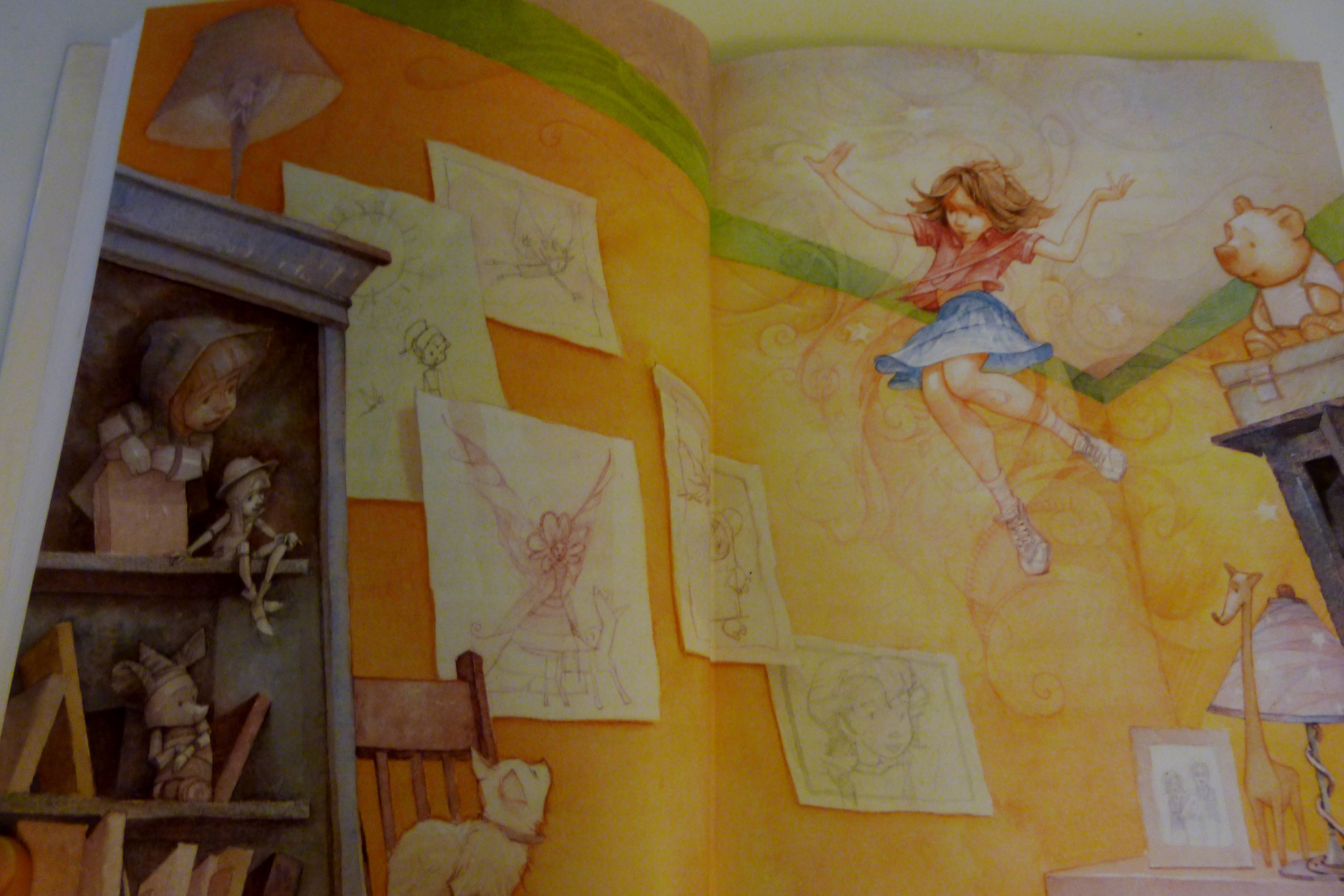
I would be remiss if I didn’t comment on the illustrations.  David Christiana did the illustrations for the entire series and they are absolutely beautiful.  There are many full-page illustrations (or two-page, and even one fold-out!) and they add a wonderful dimension to the story.  I like the book, but it’s actually the illustrations that are making me tempted to buy it!

This isn’t one of my favorite Levine books, but it is a fun look at Neverland from a different angle (even if sometimes a little TOO much that angle!)  This is a simple, sweet, fast read–I’m glad I finished the series, because it was a lovely book and when I did finally read it, it only took me a day!

Author’s Site: http://gailcarsonlevine.com/

Other reviews:
Reading All Year Long
Shannon Messenger
Confessions of a Book Habitue
Yours?
Favorites Friday: British Children’s Fantasy Classics

I think there was something in the water in Great Britain near the beginning of the last century.  Fairy dust, perhaps, because that’s when so many of the great classic children’s fantasy books were written.  There’s something about them, a style, a flavor, a spark, that marks them out as part of that group.

I doubt many titles or authors on this list are new to you–they are, after all, classics–but still, here’s my list of favorite writers of British children’s fantasy classics, noting their most famous books.  Some books are earlier and some are later, but all have that particular flavor.

In no particular order:

  1. P. L. Travers – Mary Poppins series
  2. Edith Nesbit – Five Children and It, among others
  3. J. M. Barrie – Peter Pan
  4. Frances Hodgson Burnett – A Little Princess and The Secret Garden
  5. Lewis Carroll – Alice in Wonderland and Through the Looking Glass
  6. Kenneth Grahame – The Wind in the Willows
  7. Charles Kingsley – The Water Babies
  8. George MacDonald – The Princess and the Goblin and The Light Princess
  9. A. A. Milne – Winnie the Pooh

And #10, Honorary Mention, is L. Frank Baum, who wrote the Oz series (and many others that are just as good).  He was American, not British, but somehow contrived to write books with that same magical flavor.

There must be classics I’m missing–what are some of your favorites?  And are they sprinkled with the same fairy dust?  🙂 I hope so–I’d love to find more!

A Window in Thrums

I bought A Window in Thrums because L. M. Montgomery recommended it to me; she mentioned it in her journals.  She mentioned a lot of books she read in her journals, and since this one was by J. M. Barrie I decided to try it.  But this isn’t a book review, this is a Fiction Friday post.

I recently wrote about books as objects, especially pieces of history, and mentioned my copy of A Window in Thrums.  It’s a good story, but one of the most interesting aspects of my copy is the inscription on the flyleaf: “For Grandma from Mary Eunice, December 25th, 1898.”  I don’t know who Mary Eunice or her grandmother were, since I bought the book used online only a few years ago.  But shortly after buying it, I decided to write a story imagining who they might have been, and who else might have owned the book over the years.

************************************

A Window in Thrums

            “Do you think Grandma will like it?” Mary Eunice asked, hugging the book to her chest.

            “Of course she will, dear,” her mother said firmly, continuing briskly down the row, eyes on the baskets of fruit for sale.

            Mary Eunice frowned, the frown of a girl just old enough to start questioning firm parental assurances.  “But will she really like it?” she persisted, hurrying after her mother.  “I want her to like it because she really likes it, not just because it came from me.”

            Her mother absently picked up an apple, put it down, and went on to the oranges.  “There’s never anything really fresh this time of year,” she muttered.

            “But, Mother, will she?”

            “What?  Oh, the book.  Yes, of course, you know she likes Mr. Barrie’s novels.”

            “That’s true,” Mary Eunice said thoughtfully, feeling reassured.  She watched her mother walk down the row but stayed where she was, to look at the book in her hands.  She enjoyed the proud thrill of ownership for at least the twelfth time in the last ten minutes since they’d walked away from the bookstore.  It was the first book she’d ever bought with her own money.

            Mary Eunice thought it was the prettiest little book she’d ever seen.  The cover was dark blue, with silver curls and swirls and a scattering of pink flowers.  The spine was the same, the back pale gray, the pages crisp and white.  Mary Eunice ran her fingers lightly across the silver title stamped on the cover: A Window in Thrums.  She checked on her mother, saw she hadn’t gone very far, and carefully cracked open the book.  She turned a few pages and found Chapter I.

            “On the bump of green round which the brae twists, at the top of the brae, and within cry of T’nowhead Farm, still stands a one-storey house, whose white-washed walls, streaked with the discoloration that rain leaves, look yellow when the snow comes.”

            Mary Eunice stopped reading with a puzzled frown and closed the book.  “Oh well,” she whispered to it, “I still think you’re the prettiest little book I ever saw, even if I don’t know what a brae is.  And Grandma likes Mr. Barrie’s writing.  That’s what matters.”

Continue reading “A Window in Thrums”