TGKA: Star Trek Into Darkness

star-trek-into-darkness-benedict-cumberbatch-posterFor the past couple months for the Sci Fi Experience, I’ve been following the story of Khan Noonien Singh through books and television.  My main goal for The Great Khan Adventure was to follow the original arc, but just for fun I decided to wind up with a rewatch of Star Trek Into Darkness.

The story centers around a hunt for a fugitive terrorist.  When the Enterprise successfully captures him (sort of) on the Klingon homeworld of Kronos (which used to be Qo’noS…), they learn that he’s a genetic superman from the 20th century who has been in cryogenic sleep.  Khan is dangerously charismatic, with an alarming story about corruption in Starfleet.

I enjoyed this movie the first time around, with reservations—and I enjoyed it the second time around, with bigger reservations.  On this go-around, I found myself very focused specifically on Kirk (Christopher Pine) and Khan (Benedict Cumberbatch), probably because this viewing followed directly on all that other reading and watching I’ve been doing.

Remember how in Wrath of Khan I had to fight the urge to feel too sympathetic towards Khan?  Well…this Khan was a lot darker and a lot more violent and I was pretty clear that I don’t like him at all—but he was still a MUCH more compelling character than Kirk.

My big issue with the movie, really, was Kirk.  It may in part be because, without question and unequivocally, TOS Kirk (William Shatner) is my favorite Star Trek captain.  He always had a streak of arrogance, but I love him because he really is as good as he thinks he is.  Reboot Kirk, on the other hand, seems to be far more arrogant and far less competent.

I was trying, really, to figure out what exactly Reboot Kirk did that was good in the movie.  (Spoilers ahoy!)  He starts out by breaking the Prime Directive (saving Spock and an intelligent species, true) which bothers me less than that he failed to get away with it, because TOS Kirk always knows exactly how to bend the rules in just the way to pull it off.  Reboot Kirk then sets out to capture Khan, nearly gets his landing party killed by Klingons (I’m pretty sure TOS Kirk would have talked them around, or maybe challenged the Klingon Captain to single combat), and only catches Khan because Khan chose to surrender.  Reboot Kirk goes on to bring Khan over to the Vengeance, and then lets him take control of it.  Khan neutralizes (with questionable means) the threat of Admiral Marcus, is taken out by Spock, and still nearly destroys the Enterprise.  Kirk successfully saves the ship, but meanwhile Khan crash-lands into San Francisco (a major population center!), to then be caught by Spock.

About the only accomplishment from Kirk was rescuing the Enterprise, which happened at the same time that the villain was taking out San Francisco and presumably killing thousands of people.  On the whole…not a very impressive track-record for the hero of the movie.  Especially for a man who runs rough-shod over good advice from virtually every other character, and is quite confident that he knows all, understands all, can achieve all, and is a marvelous gift to Starfleet and the galaxy.  Ahem.

Meanwhile, Reboot Khan is pretty far removed from TOS Khan (Ricardo Montalban), but in a way that worked much better than the changes to Kirk.  Reboot Khan’s history is thoroughly glossed over and he definitely doesn’t resemble the Sikh prince of Cox’s trilogy…  But he does carry the strong sense of superiority, the loyalty to his crew, and the conviction that he’s meant to rule over the lesser beings of the galaxy.  I missed Marla in this incarnation, as well as the sense of the benevolent (yet ruthless) leader he was trying to be in Cox’s trilogy.  What we did get was a sense that Khan really is smarter, faster and stronger than anyone else.  Not necessarily wiser, but in some ways he seems more like a genuine superman than the TOS version.  In fact, he’s arrogant—but he really is as good as he thinks he is.  The problem isn’t the arrogance so much as the contempt he feels for everyone else.

He’s far too violent for me to feel much sympathy for him, but he’s still an extremely fascinating character, with a lot of the charisma that was sadly lacking from Reboot Kirk.  I’d quite like to see more stories with this character, especially if he could be less violent but still just as brilliant, arrogant and eminently capable.

Oh wait, that’s the BBC’s Sherlock

So much for comments on the hero and the villain–and perhaps I’ll just leave it at that.  For a fuller discussion, check my original review.  I still stand by it, although the lack of professionalism bothered me less (that’s not acceptance, just resignation) and I noticed a few more plot holes (exactly how do you blow up a starship in orbit of Earth and expect to get away with it?)  I definitely still feel there wasn’t enough McCoy.

And so ends The Great Khan Adventure.  It was a fun and very geeky ride, and as I believe the Vulcans like to say, I found that the whole was greater than the sum of the parts.  Cox’s books were inspired by the TV show and movie, and the books in turn brought more depth to the shows and the movie.  Now how about the adventure continues in the next movie, with a return of Khan and maybe an introduction of Marla McGivers?  I’d be excited. 🙂

Buy it here: Star Trek Into Darkness

TGKA: Star Trek: The Wrath of Khan

khan-posterThis year for the Sci Fi Experience, I’m off on The Great Khan Adventure, tracing the story of Khan Noonien Singh through books and movies. So far I’ve watched a few episodes of Star Trek: The Original Series, and read Greg Cox’s Khan trilogy (Eugenics Wars: Volume One  and Volume Two, and To Reign in Hell).  Getting down to the end of the Adventure, I spent New Year’s Eve watching The Wrath of Khan, The Search for Spock and The Voyage Home.

To Reign in Hell ends almost precisely where The Wrath of Khan begins.  Chekov and his new captain, Terrell, beam down to Ceti Alpha V (thinking it’s Ceti Alpha VI–DON’T ask) looking for a test planet for the Genesis Project.  There they encounter Khan and his followers, who, with the help of mind-twisting eels, take over their starship and set out to pursue Khan’s quest for revenge against Kirk.  Meanwhile, Kirk and friends are aboard the Enterprise with a crew of trainee cadets.  They rush to investigate when an urgent call comes in from Carol Marcus, reporting that someone is trying to steal Genesis, a device to “create life from lifelessness.”

It was fascinating (to coin a phrase) watching this movie directly after reading To Reign in Hell.  There’s so much more room in books than in movies for details and background and character expansion.  Don’t get me wrong, The Wrath of Khan is a great movie, full-stop, period.  However–To Reign in Hell, despite some flaws, provides so much context and insight and character details.

For instance: we get a story on why Khan’s wearing that glove all movie, not to mention why he’s wearing a Starfleet emblem.  Joachim becomes a fully-fleshed character in the book; in the movie, you know him as Khan’s lieutenant, and the only one in Khan’s crew being paid for dialogue.  His name doesn’t come up until the very end of the movie, but I figured all along that he had to be Joachim, based on the book.  In the movie Khan references his wife twice but never actually says her name; presumably he means Marla (and I see no reason to think otherwise) but by comparison, the book makes her a major character and explores their romance.

Of course, the order of creation is a little odd in that Cox watched the movie and then wrote the backstory–but I think that worked, because I felt like I got more from the movie when I was keeping Cox’s backstory in mind.  Strangely enough, I’m not sure it would have worked the other way.  Reading the book, I occasionally thought I might be getting more from it if I had watched the movie recently–but after watching it, I think that might have made the book feel more forced.  Since the movie was fuzzy in my head, I didn’t get every single reference in the book, which, based on how many I noticed when I did watch the movie, might have become a bit much while reading…

Stranger yet, all this backstory and Khan-focus made me feel, well, strangely sympathetic towards him as a character.  Don’t get me wrong, I know he’s a terrible person, and I dearly love Kirk, Spock and McCoy…but Kirk did strand him on Ceti Alpha V and poor Marla got killed and it was all really, really awful and you can see how a person could lose it a bit at that point…even if Khan’s reaction is rather beyond the stretch of justification.

Ah well, a purely reprehensible villain wouldn’t be very interesting.

It also felt rather strange when the events of The Wrath of Khan set up the next two movies–and yet Khan never gets mentioned again.  Granted, Kirk has other things on his mind, but still.  Khan seems to have loomed bigger in the audience’s mind than in the characters’.

Another interesting sidenote: I’ve been complaining ever since Star Trek Into Darkness came out that these people are not qualified to be crewing a starship, and I find Wrath of Khan justifies the complaint.  Imagine if, at the end of the movie, Saavik was made captain and the trainee cadets were handed officer positions and told to go exploring.  That’s basically what happens at the end of the 2009 movie!!  Mumble mumble implausibility grumble…

On that subject, after watching the three classic movies and Khan-a-la-Ricardo-Montalban, I plan to finish up the adventure with a rewatch of Into Darkness and Khan-a-la-Benedict-Cumberbatch…which ought to be interesting directly after Wrath of Khan.  Stay tuned!

Buy it here: Star Trek II: The Wrath of Khan

The Girl on Fire

Catching FireI was a little bit late to see Catching Fire, second movie in The Hunger Games saga, but I finally caught it this past weekend.  I was deeply curious about this one, and hopeful–in a way.  If you recall my reviews of the books, I liked the first one only to be disappointed by the second and, to a much greater extent, the third.

However–while I’m normally against Hollywood making big changes when they adapt a novel, in this particular case, I suspected that they might choose to change things in a way that I would end up liking much better…and so far Catching Fire seems to be bearing that out.

Catching Fire continues the story of Katniss Everdeen (Jennifer Lawrence), who survived the deadly arena of the Hunger Games in part by selling the Capital on her tragic love story with fellow Tribute, Peeta Mellark (Josh Hutcherson).  Sinister President Snow (Donald Sutherland) doesn’t buy it, and warns Katniss that any wrong move from her will be a danger to her family.  In truth Katniss is torn between Peeta and her best friend, Gale (Liam Hemsworth), and terrified by the rumbles of uprisings throughout the districts, from people who are looking to her to be a symbol.  Danger becomes more immediate when special rules are announced for this year’s Hunger Games–past Victors will be returned to the Arena, meaning Katniss and Peeta will have to face 22 particularly smart and deadly opponents.

Long plot summary, because there’s a lot going on!  The movie manages a nice balance, though, between all the many crises pulling at Katniss.  In some ways she becomes reactive, confronting each crisis (whether it’s Gale kissing her or a crowd shouting) as it comes–but it’s a thinking reactive, where I get the sense that she’s trying her best to deal with everything.  It’s so overwhelming that she has to confront each item as it comes.

I find I liked movie-Katniss better than book-Katniss for this installment.  It may be the thinking part of her reactive-ness.  In the book I got frustrated with Katniss’ lack of decisive action–her inability to choose between the two guys, her ambivalent feelings about the growing revolution.  The movie tells essentially the same story, but the telling is just a hair different, making me feel that Katniss really is trying.  That she’s doing her best in an incredibly difficult situation, torn between sympathy for the people in the districts, fear for the consequences of an uprising, fear for the people she cares about…

The romantic triangle went a touch differently too; where in the book she simply didn’t seem able to feel anything definite about Gale or Peeta, the movie emphasizes that she’s too scared and overwhelmed to think about romance (very reasonably so!!), only to realize in key moments of crisis that she may care too much about both guys.  The movie also balances the romance well, in that it didn’t feel like a distraction from the larger life-and-death questions.  As Casablanca puts it, “it doesn’t take much to see that the problems of three little people don’t amount to a hill of beans in this crazy world.”  Except they do, when you might be about to lose one of those people.

Gale was in the movie only briefly, but somehow emerged better than he did in the book.  Peeta, on the other hand, didn’t do much in this one even though he was in it more.  He’s clearly struggling with having stronger feelings for Katniss than she has for him, and beyond that, I didn’t get much of a feel for him at all.

Some of the supporting characters, though, were wonderful!  Crazy Effie Trinket (Elizabeth Banks), with her ridiculous outfits and superficial concerns, actually won me over.  Especially when she talks about how she, Peeta, Katniss and Haymitch are a team.  Effie really is superficial, but somewhere under there she has a good heart.  Haymitch (Woody Harrelson) was great as well, still a cynical drunk but showing strength and insight too.  And Stanley Tucci as Caesar Flickerman was once again absolute perfection–a beaming, shining picture of a game show host, laughing and enthusiastic and so, so unflinching as he talks about death and murder as though it’s entertainment.

Rue, even though she died in the last installment, was still such a heartbreaking presence in this one.  The most wrenching moment was when Katniss is in Rue’s district, speaking about what Rue meant to her.  I love that the three-fingered salute becomes a symbol of the revolution.  Alongside Rue, this Hunger Games gives us Mags (Lynn Cohen), an old woman Haymitch describes as a wonderful lady.  Katniss has some lovely sweet moments with Mags, which I think do a lot to soften some of Katniss’ more hard-edged, survivalist moments in other places.

All in all, I’m quite hopeful about where the next movie(s) will go–although, I was hopeful when I finished the second book too!  But the reason I’m expecting better things comes down especially to the last two seconds of the movie.  Katniss has just received devastating news and begins to cry–but then she blinks, and stares directly into the camera with absolute, steel-eyed determination.  It is, quite frankly, what I wanted and never got in the entire third book.  So I am very interested to see what Hollywood plans to give us next…

Murder by Phone

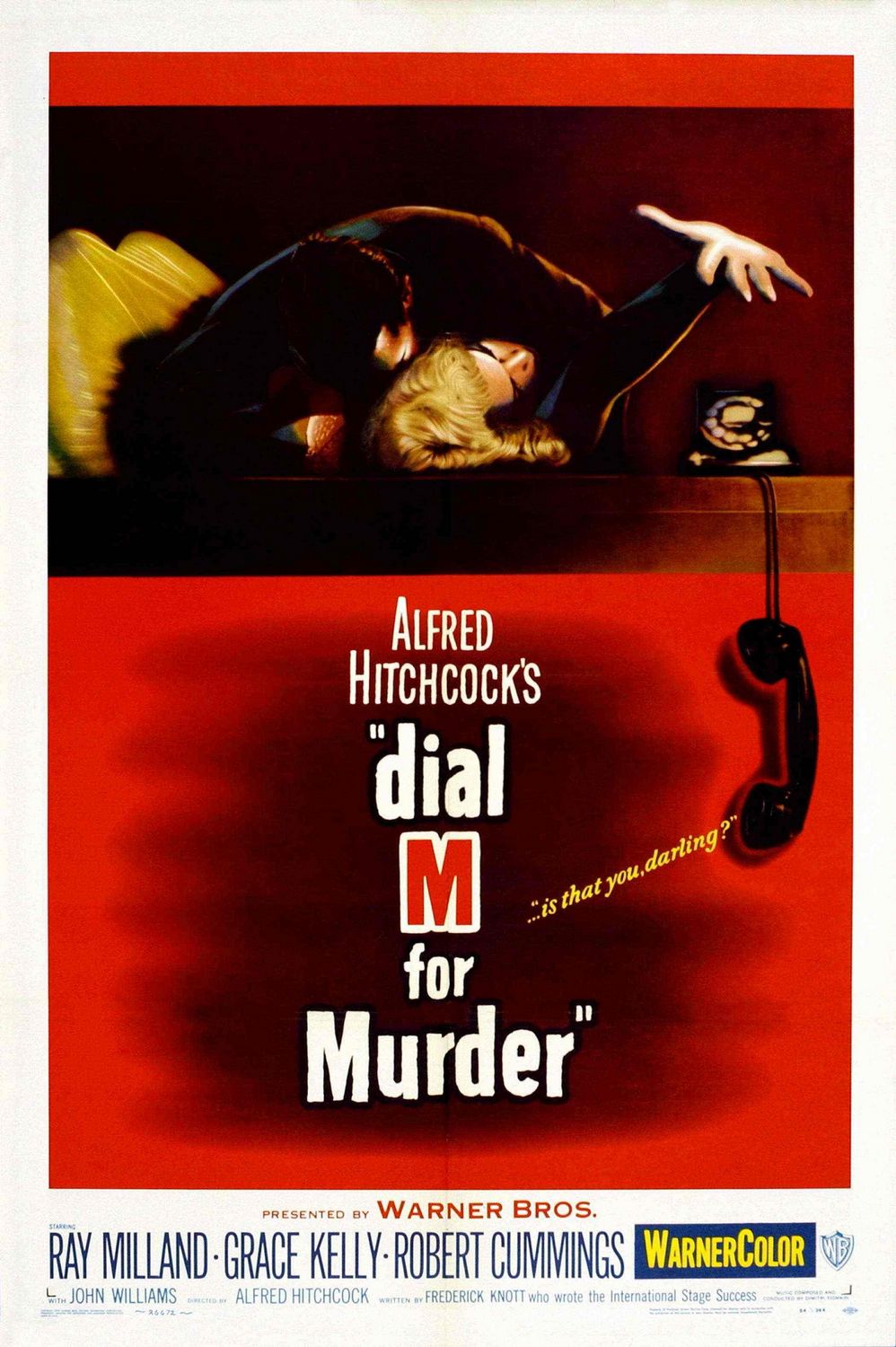
dial_m_for_murder_xlgI’ve been watching a few more Hitchcock movies that I didn’t get to during Readers Imbibing Peril–most recently, Dial M for Murder (1954), a suspense puzzle about pulling off the perfect murder.

Grace Kelly plays Margot, whose husband Tony (Ray Milland) has discovered her affair with crime writer Mark Halliday (Robert Cummings).  Margot has decided to stay with her husband and believes her affair is still a secret–but Tony has decided to murder his wife and believes he has the perfect plan to pull it off.

This is another excellent Hitchcock movie where the suspense is all in the subtle details, and in knowing the chilling significance behind apparently harmless conversations.  The attempted murder is a more dramatic action sequence, but the rest of the movie is mostly people talking to each other.  Originally a play, Dial M for Murder takes place almost entirely in one apartment–only I never really noticed that until the documentary extra feature pointed it out.  The tension and the engagement are so good that the movie never feels close or confined.

Grace Kelly plays the (not entirely innocent) victim, but the point of view of the movie is mostly her husband, Tony.  We get out of his view at the beginning and the end, but for most of the film we’re going through the story with him.  It’s an interesting angle to follow the story of a murder from the murderer’s perspective, especially as he’s a particularly suave and intelligent murderer.  He rarely betrays tension or worry, and seems to be totally in control of the situation at nearly every moment.

The movie plays out like a puzzle, with Tony first laying out exactly how he plans to arrange the murder–then watching to see whether it works–and how Tony devises new solutions when parts of the plan go awry.  He’s so clever and so in command that it’s hard to imagine how he could eventually be caught…  The conclusion is ingenious, if a bit far-fetched–but I’m willing to go along with it!

Other reviews:
Folding Seats
Flickering Myth
Canadian Cinephile
Anyone else?

Buy it here: Dial M for Murder

Aim for the Stars

2014sfexp400It feels like we just finished the last reading experience from Stainless Steel Droppings (because we did!) but it’s already time to start thinking about the Sci Fi Experience (not that I’m complaining…)  The Experience runs from December to the end of January, a low-pressure, high-fun invitation to enjoy some science fiction.

Sci Fi is a genre I love more than I actually read, so I always value the push to pick up something with phasers or hyperdrive in it!

I didn’t intend this, but my plans this year all center around rereads, as I have quite a few sci fi books I’ve been itching to revisit.  I’ve been meaning to reread The Masterharper of Pern by Anne McCaffrey ever since our Dragonflight group read for the last Sci Fi Experience.  Masterharper Robinton is one of my very favorite characters, yet I barely remember the book centered around him!

I also plan to reread the Timothy Zahn Thrawn Trilogy, landmark books in the Star Wars universe that I have not read recently enough.  If I feel particularly inspired, I might go on to the two follow-up books, which I haven’t read before.

Sci Fi Experience 2013My biggest planned event for the Experience this year centers around my favorite sci fi franchise of all–Star Trek.  I’m going to take this opportunity to finally make an attempt at a reading and viewing experience I’ve been thinking about doing for a long time.

I’m calling this (tongue in cheek!) The Great Khan Adventure.  Likely you’ve heard of Khan Noonien Singh, arguably the greatest villain of The Original Series.  There is a wonderful, meticulously researched trilogy of books by Greg Cox centered around Khan, presenting an alternate history of the 1960s through 1990s, and then exploring Khan’s time in exile.  I’ve watched or read all the pieces of the story at different times–but I want to attempt to put it all together.

Cox ties together several episodes and characters from different strands of Star Trek, so I plan to start by watching those as base material: Spaceseed, Operation: Earth, Tomorrow Is Yesterday, Requiem for Methuselah, and DS9: Little Green Men.  Those are the episodes I remember as relevant from my last reading; I’ll add others on if I find more relating as I go through the books.  Next of course, a reread of the Cox trilogy, wrapped-up by The Wrath of Khan (which may lead me to The Search for Spock and The Voyage Home, just because).  Then I’ll probably throw in Star Trek Into Darkness as a why-not add-on.

So–Pern, Star Wars and Star Trek.  I’m looking forward to visiting some of my very favorite science fiction universes, and I hope you’ll come along for the voyage!