Saturday Snapshot: With Love, Michael Crawford

I had very exciting mail this week…

But before I get to that, let me tell you a story, if I may.  I’ll give you the short version.  About eight years ago, a friend loaned me a copy of Leroux’s Phantom of the Opera, and a CD of Webber’s musical.  I wasn’t all that into the book, but I liked the soundtrack.  And so an obsession was born.

A couple years after that, after a lot of delving into Phantom versions and who-knows-how-many times through the soundtrack, another friend suggested I find Michael Crawford’s other CDs.  Crawford was the original Phantom in London and Broadway, and his is the voice on the soundtrack.  As my friend suggested, listening to his other CDs would be like listening to the Phantom sing other songs–and it was!  And so a new obsession was born.

I now have all of Crawford’s CDs because, well, he’s amazing.  Somewhere along the way I stopped hearing the Phantom when Crawford sang and started hearing Crawford when the Phantom sang…if that makes any sense!

Recently I had an opportunity to mail an item in for a personalized autograph.  And so, exciting mail arrived this week…

Michael Crawford Autograph

I could have had my Phantom soundtrack signed…but I suspect Crawford signs a lot of Phantom CDs!  And I wanted this one anyway, because it’s my favorite.  Or to be more precise, the last song on the CD, “A Piece of Sky,” is mind-blowing, life-altering, unbelievably amazing.

So I’d say that’s the most exciting mail I’ve had in, hmm, a long time.  Couldn’t resist sharing!

Have a wonderful weekend, and visit At Home with Books for more Saturday Snapshots!

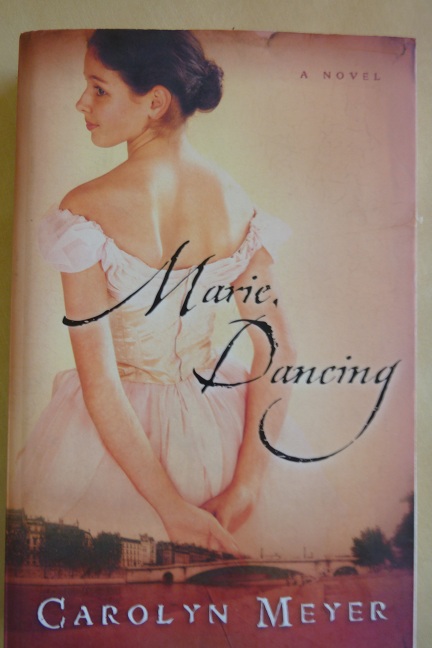
Marie, Dancing

Marie, DancingI think we all know I’m a fan of the Phantom of the Opera…and I’d be lying if I said that wasn’t the primary reason I wanted to read Marie, Dancing by Carolyn Meyer.  It just happens to be set in the Paris Opera House around 1880, the same time as the Phantom.  But besides that, the book also plays to my interest in Impressionist art, and in Paris in general, and in stories about strong young women.  The book only shares a setting with Leroux and there are no Phantom references at all…but there is a good story and a lot of information about the Company of the Paris Opera.

Marie and her two sisters are ballet dancers at the Palais Garnier.  The story opens when the painter, Monsieur Degas, selects Marie to be his model for a sculpture he has in mind–the sculpture that will become The Little Dancer, Aged Fourteen.  Degas and his art are just one part of Marie’s story, as she struggles with her family’s poverty and tries to make choices about her future.

Marie lives in a very, very different world than Christine Daae.  Unlike Leroux’s spooky thriller, this is a gritty, realistic book.  Marie’s problems are real and serious, with never enough food, a mother who drinks too much absinthe to forget her pain, and an older sister who aspires to become a rich man’s mistress and thinks Marie should do the same.  The book is not depressing exactly, but it is a glimpse at the harsh reality behind the elegant forms of the dancers.

Marie does love to dance, and she has dreams of becoming a great dancer.  The book is not really about dancing though–that recedes more and more as it goes on, and becomes more about Marie’s family, her struggles, and a romance–lest you think it’s all grim!

From the point of view of a Phantom fan, this definitely gave me some different angles on things.  It gave me more basic information about life at the Opera House than anything else I’ve read, and was utterly eye-opening on the subject of money.  I never appreciated just how much money 20,000 francs a month (the Phantom’s salary) really is, until Marie sighed with envy over the salary of the higher-level dancers–6,800 francs a year.

The sections with Degas were particularly interesting.  There are occasional references to specific sketches or paintings, and I think I recognized some famous ones!  Mary Cassatt is also present as a supporting character, and I loved the glimpses of the history of Impressionism.

I would have liked more description of the setting–the Opera House is gorgeous, and yet other than a few bits here and there, I didn’t get much sense of it.  But even if appearances were somewhat lacking, Marie’s world came vividly to life.

If you’re interested in dancing, and particularly the Paris Opera, this is a very good slice of historical fiction, unflinching but not unremittingly grim either, and the characters and plot are both engaging.  And you’ll look at Degas’ Little Dancer in a whole new way!

Author’s Site: http://www.readcarolyn.com/

Other reviews:
The Estella Collective
That’s all I found!  Anyone else?

Buy it here: Marie, Dancing

Saturday Snapshot: Knick-Knacks

I like everything I own to have a story.  That doesn’t extend to, say, my shampoo or silverware, but it does include my knick-knacks.

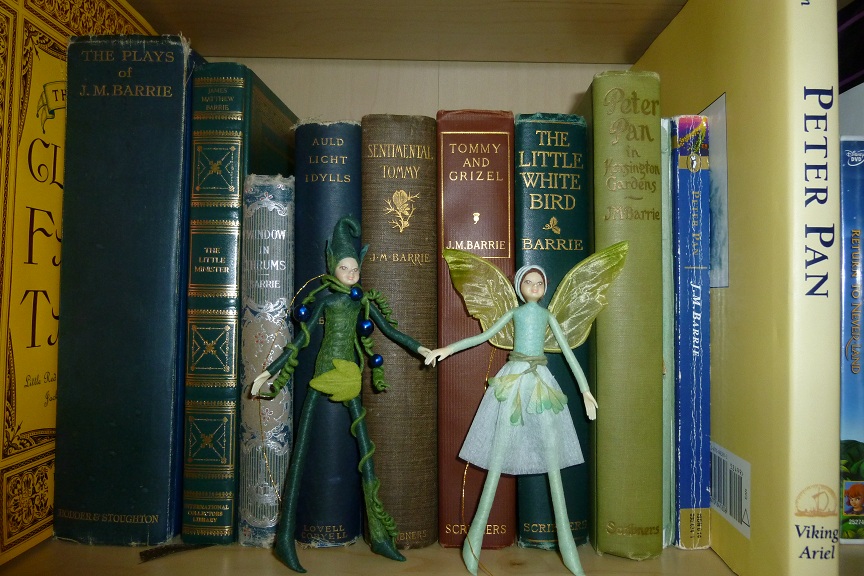
Shelf - Barrie Fairies

I saw these adorable fairies for sale in Covent Gardens.  Having just spent a week wandering around Kensington Gardens with fairies on my mind, I couldn’t resist.  Naturally I keep them in front of my J. M. Barrie collection.

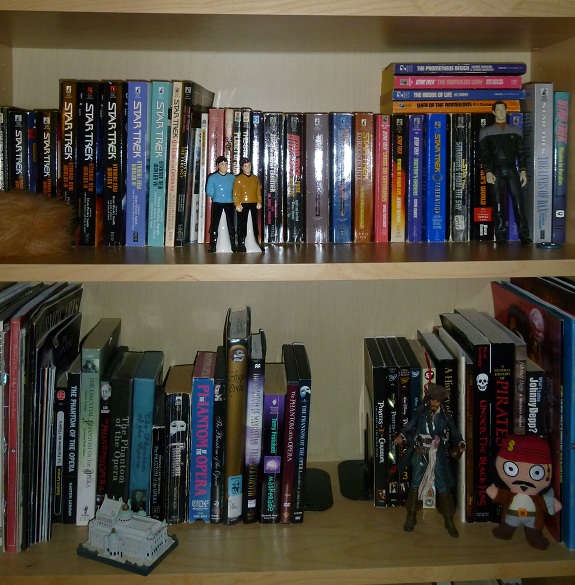
Shelf - Fandom

Here you see the result of some of my fandoms…my shelf of Star Trek books also houses Trevor the Tribble, Kirk and Spock salt-and-pepper shakers, and a Data action figure that I bought at my first ever job, at KayBee Toys (for the record, I don’t recommend working in a toy store for the Christmas season).

On the next shelf, my Phantom collection, with a model of the Paris Opera House, and then my Pirate collection.  I bought the “solemn” Captain Jack action figure because the grinning one was terrifying (really), and I managed to get a Captain Jack Happy Meal toy without actually buying any food at McDonalds.

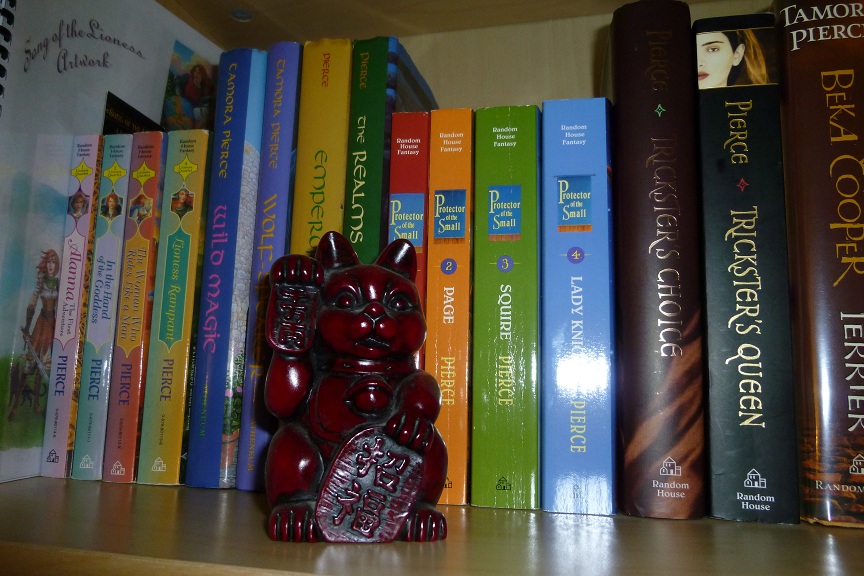
Shelf - Lucky Cat

A less obvious connection here…but I have a Lucky Cat figurine that I bought in Chinatown in San Francisco, and it’s on this shelf because Keladry, heroine of the Protector of the Small quartet, has a collection of Lucky Cat figures.

Those are my cleverest book-and-knick-knack combinations…but perhaps I’ll share other knick-knacks another day! 🙂  Do you have any with fun stories?

Visit At Home with Books for more Saturday Snapshots!

The Private–and Public–Life of Elizabeth I

LegacyI think you know that I love Susan Kay’s Phantom.  But I won’t gush on about it (for the third time); I mention it only as context for why I decided to read Susan Kay’s Legacy.  And to acknowledge that I set the bar unattainably high for this book.  I didn’t really expect it to be another Phantom–but can you blame me for hoping?  Well, it wasn’t another Phantom (but nothing is) and while it was good, in the end I feel a bit…mixed.

There are actually some resemblances between the two books.  Just as Phantom explores the life of the Phantom of the Opera, from pre-birth to post-death, Legacy explores the life of Queen Elizabeth I, from Anne Boleyn’s first flirtation with King Henry VIII, all the way up to Elizabeth’s death.  We follow Elizabeth from a precocious child to an adrift young girl, to a clever woman in mortal peril from shifting politics, to a masterful queen, to a legend (or even a goddess) in her own time.  And we see the various men who orbited around the Virgin Queen.

While the focus is on Elizabeth, just as it was always on Erik, Legacy has a wider-angle lens.  Phantom has a scope across decades and continents, but Legacy plays with the intrigues of courts and the ups-and-downs of European history for nearly a century.  Kay spent 15 years writing Legacy and it shows, in good ways and bad.  It’s obviously meticulously researched, and while I appreciate and am impressed by the historical details…it also means that it’s a book about history as much as it is about Elizabeth.  So if you like British history (and I do), this is masterfully presented–but it also removes us from the characters to some extent.

The characters are also difficult.  You may tell me that the Phantom of the Opera should not be relatable–but Kay’s version is.  Legacy is populated by the royal court of England, and almost without exception they are self-serving, conniving, power-driven individuals with very little loyalty and few qualms about selling one another out for political advantage–even if the one they’re sacrificing is a sibling or a wife.  I fully believe this is based in real history so I’m not claiming it’s not plausible–but it doesn’t make for a group of characters that I’m going to get attached to.

The book is interesting all the way through, but it was a good 300 pages (or about halfway) before I much started caring about anyone.  I did eventually care about Elizabeth, and about the two most constant men in her life–childhood friend and quasi-husband Robin Dudley, and chief advisor Lord Burghley.  They’re the two people Elizabeth comes closest to having genuine relationships with, and I think that fact goes a long way towards my caring about all three.  The third man in Elizabeth’s life is the Earl of Essex, but you’ll have to wait quite a while for him to arrive!

Part of the difficulty getting engaged with the characters may have been the point of view.  Phantom alternates first-person narration, so you always know exactly who’s talking to you.  Legacy is omniscient, or a frequently-changing third-person limited (I have trouble telling those two apart) so we’re not as grounded in any one character.  The center is Elizabeth, but we get her story from constantly shifting eyes.

And there’s a lot of narration telling us the history.  The book isn’t dull history, or entirely history–there are romantic moments and moments of high drama and emotional tension.  But there’s also a lot of history.  Often very interesting history…but somewhat heavy history too.

The end of the book is ultimately quite sad, and if you know the course of Elizabeth’s life, that’s inevitable.  Because it’s history, I don’t think it’s giving much away to say she starts to lose her grip by the end.  Kay tells it well and it’s moving–although I realized that the end of Phantom is heart-breaking, tragic and beautiful, while the end of Legacy is just sad.

So the final verdict?  It’s a masterful piece of historical fiction–but be prepared that you have to be just as interested in the historical as in the fiction if you pick up this book.

Other reviews:
QG’s Book Reviews
The Misadventures of Moppet
A Girl Walks into a Bookstore
Rosebush Maze (also offering Phantom comparisons)
Confessions of an Avid Reader (who felt there was not enough history…so opinions may vary!)
Whew, popular book!  Anyone else?

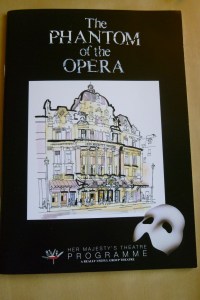
Phantom at Her Majesty’s Theatre

Last week I did a theatre review of Les Miserables in London.  This week, I’m sharing about my trip to see Phantom of the Opera.

Seeing Phantom for me is different than seeing any other play, because I’ve seen it so many times.  I never just watch; I analyze and compare.  I’m convinced that this is really the strength of live theatre, because I swear it’s a different play every time.  I admit this may in part be me reading into things…but since I always look for the same interpretation (because I have my own ideas for the characters), if it was all in my head, it wouldn’t come out different every time!

Counting the filmed 25th anniversary performance, I’ve seen seven performances by six different Phantoms, and I’ve yet to be bored.  I saw the play for the first time on my previous trip to London, and that’s still the best performance I ever saw (though I admit the new-ness may have been a factor).  With that in mind, I was excited to see it in London again.  And it turned out to be one of the more complex and unique performances I’ve seen–which makes this review half an exploration of different interpretations of the play.

I assume everyone roughly knows the plot: the Phantom is a musical genius living below the Paris Opera House, hiding a facial deformity behind a mask.  He falls in love with soprano Christine Daae, and clashes with the management of the Opera and Christine’s childhood sweetheart, Raoul, the Vicomte de Chagny.  The Andrew Lloyd Webber musical is one of the best-known versions of the story–and the musical is wonderful.

I got to the theatre early, as I always do.  My seat wasn’t as good as I had for Les Mis, but it’s another small theatre, so even though I was back pretty far, that was still only the twelfth row.  Although I did spend an inordinate amount of pre-show time wondering if the overhanging balcony would block my view of the Phantom on the rooftop (it didn’t, at least not badly).  This is what comes of seeing a play seven times–you think about these things.

The Phantom was played by Marcus Lovett, and it struck me as a very different performance.  First, his voice didn’t sound like other Phantoms I’ve heard.  I’m not musical enough to know the proper terms to describe it–good singing, certainly, but sort of deeper and broader somehow, with an element of thunder.  It made me wonder in the early scenes how he was going to handle “Music of the Night,” which absolutely must be sung intimately.  For me, Phantom performances live and die by that song.

Lovett ended up carrying the song fine–but it was different.  This was the first time I’ve seen a Webber Phantom who didn’t really seem to be in love with Christine.  The crazy thing is, the interpretation seemed to work (mostly).  I’ve always thought the Phantom was making a mistake falling in love with Christine, but I’ve also always believed that he deeply, passionately loved her.  This one didn’t seem to.  His real interest was the music.  It was the first time I believed a Webber Phantom when he said he had brought Christine below the Opera House to sing.

When you jump from that idea, “Music of the Night” isn’t a seduction at all, it’s a celebration of the music.  It’s all about, come see the night and experience my music.  Of course, some lines like “only then can you belong to me” are pretty unambiguous, but it still felt like that was his secondary, possibly long-range idea.  All he really wanted was for her to be a part of his music, and I don’t think he’d object if it became something else…but that’s not the primary goal.  After all, the last line of the song is not “I love you,” it’s “Help me make the music of the night.”  Which can obviously be metaphorical…but in this performance, it felt literal.

That interpretation kept working for the rest of Act One.  In the morning, after “Music of the Night,” the Phantom’s not mooning over Christine, he’s having a perfectly delightful time writing his music.  After she yanks the mask off, he has a meltdown and then starts singing about his longings–for heaven and for beauty.  It never actually specifies how she fits into that picture.  There is the one line, “fear can turn to love,” but it almost feels like an add-on.  The entire sequence with his disruption of “Il Muto” is all about making the performance of the music better.  On the rooftop, does the Phantom feel betrayed because Christine and Raoul kissed, or because she said nasty things about his face and is planning to run away and not sing anymore?  The ultimate line about the Phantom’s betrayal is not “I gave you my heart,” it’s “I gave you my music.”

So obviously I was having a wonderful time watching all of this–and analyzing.  But then the interpretation falters a bit in Act Two.  I started to lose the thread of the Phantom’s motivations.  The more I think about it, mostly it should work–he’s still focused on Christine’s singing at the Masquerade, and on being the Angel of Music at the graveyard.  It wasn’t coming across as clearly, though, and then I don’t know at all what to do with “Point of No Return,” most especially the Phantom’s “All I Ask of You” reprise, or parts of the finale.  Which are all kind of important.  I still think it’s an interpretation with value, though–because it works for so much of the play.

Christine had similar across-act issues at the performance I saw.  I swear, in Act One she was a schemer.  Disclosure: I want Christine to be a schemer.  She’s that or an idiot, and I like the idea that she’s plotting.  But I don’t think it was all in my head either.  She was a little too gleeful yanking the Phantom’s mask off, and she was definitely playing Raoul on the rooftop.  The lines are there, and the way they were being delivered–I was convinced she was manipulating him.  (I’ve always thought that “order your fine horses” is not an appropriate response to “Christine, I love you” in that scene).

But then we came back from the interval, and Christine spent all of Act Two terrified, and I just didn’t know how reconcile that.  Christine can absolutely be weaving plots in Act Two (a secret engagement?  really?), but this Christine just seemed too frightened.  There was a very strange moment in “Point of No Return” when Christine and the Phantom are struggling, and I honestly couldn’t tell who was trying to get away from whom.  I know that seems like it should be obvious, but with Act One’s portrayal of the characters, it really wasn’t.

So I found the characters brilliantly different in Act One, but then mostly reverted to something more standard in Act Two.  That was a bit disappointing, though it was still very effective portrayals as the play went on.  Just a little inconsistent.

On to other characters…my favorite, after the Phantom, is Meg Giry.  I make a habit of watching her during production numbers.  This was the most social Meg I can remember seeing.  She was talking to people in the background of several scenes, like the opening sequence, or “Masquerade.”  I really wanted to know what she was saying!  Unfortunately, my lip-reading is not that good.  An odd moment in the “Finale”…she did come across as smarter than Raoul, but they dropped the line when she tries to go with them below (and I love that line!  It’s important!)

Raoul made almost no impression on me, I think because I was so distracted by Christine and the Phantom.  There was an unusually angry Raoul in the recent 25th anniversary performance, and I wondered if that was a new standard in London, but it doesn’t seem to be.

The managers had good comedic timing, as did Piangi and Carlotta.  Piangi was obviously wearing padding and Carlotta wasn’t old enough, but their acting was good.  And Piangi struggled mightily to get on his elephant in the opening scene, which is always my favorite moment for him.

The music is always wonderful, the singing and the orchestrations, and the costumes are splendid and elaborate.  Don’t watch the chandelier rise at the beginning because you’ll be blinded–and it always falls with wonderful drama at the end of Act One.  If you’re in London or anywhere else where Phantom is playing, I highly recommend it–as I suspect will come as no surprise to anyone!  I know I had a wonderful time watching Phantom for the seventh time.