Aim for the Stars

2014sfexp400It feels like we just finished the last reading experience from Stainless Steel Droppings (because we did!) but it’s already time to start thinking about the Sci Fi Experience (not that I’m complaining…)  The Experience runs from December to the end of January, a low-pressure, high-fun invitation to enjoy some science fiction.

Sci Fi is a genre I love more than I actually read, so I always value the push to pick up something with phasers or hyperdrive in it!

I didn’t intend this, but my plans this year all center around rereads, as I have quite a few sci fi books I’ve been itching to revisit.  I’ve been meaning to reread The Masterharper of Pern by Anne McCaffrey ever since our Dragonflight group read for the last Sci Fi Experience.  Masterharper Robinton is one of my very favorite characters, yet I barely remember the book centered around him!

I also plan to reread the Timothy Zahn Thrawn Trilogy, landmark books in the Star Wars universe that I have not read recently enough.  If I feel particularly inspired, I might go on to the two follow-up books, which I haven’t read before.

Sci Fi Experience 2013My biggest planned event for the Experience this year centers around my favorite sci fi franchise of all–Star Trek.  I’m going to take this opportunity to finally make an attempt at a reading and viewing experience I’ve been thinking about doing for a long time.

I’m calling this (tongue in cheek!) The Great Khan Adventure.  Likely you’ve heard of Khan Noonien Singh, arguably the greatest villain of The Original Series.  There is a wonderful, meticulously researched trilogy of books by Greg Cox centered around Khan, presenting an alternate history of the 1960s through 1990s, and then exploring Khan’s time in exile.  I’ve watched or read all the pieces of the story at different times–but I want to attempt to put it all together.

Cox ties together several episodes and characters from different strands of Star Trek, so I plan to start by watching those as base material: Spaceseed, Operation: Earth, Tomorrow Is Yesterday, Requiem for Methuselah, and DS9: Little Green Men.  Those are the episodes I remember as relevant from my last reading; I’ll add others on if I find more relating as I go through the books.  Next of course, a reread of the Cox trilogy, wrapped-up by The Wrath of Khan (which may lead me to The Search for Spock and The Voyage Home, just because).  Then I’ll probably throw in Star Trek Into Darkness as a why-not add-on.

So–Pern, Star Wars and Star Trek.  I’m looking forward to visiting some of my very favorite science fiction universes, and I hope you’ll come along for the voyage!

Blog Hop: Favorite Genre(s)

book blogger hopThis week’s Book Blogger Hop question: What is your favorite genre? List two of your favorite books in that genre.

Well…I’m pretty sure you all already know the answer to that question!  So to make this more interesting, I’m going to list favorite genreS, and try to find a couple of favorite books in those genres that I may not have mentioned frequently before…

Fantasy: The Blue Girl by Charles de Lint and A Tale of Time City by Diana Wynne Jones

Science Fiction: A Fighting Man of Mars by Edgar Rice Burroughs and Enchantress from the Stars by Sylvia Engdahl–and also Star Trek: First Frontier by Diane Carey and Dr. James I. Kirkland and Star Wars: The Thrawn Trilogy by Timothy Zahn

Historical Fiction: Bloody Jack series by L. A. Meyer and The Mischief of the Mistletoe by Lauren Willig

Classics: Rebecca by Daphne du Maurier and Huckleberry Finn by Mark Twain

Whew, it’s harder than I expected to think of third and fourth favorite books–I’m so used to going to the top two for this sort of question!

Your turn: what’s your favorite genre and favorite book within it?  Don’t feel obliged to come up with your third favorite if you’d rather just share #1!

Wrapping Up the Sci Fi Experience for 2013

13sfexpIs February over already?  I don’t know about you, but January lasted forever and then I blinked and February was gone.  That means it’s time to bid farewell to another year of the Sci Fi Experience, hosted by Carl from Stainless Steel Droppings.

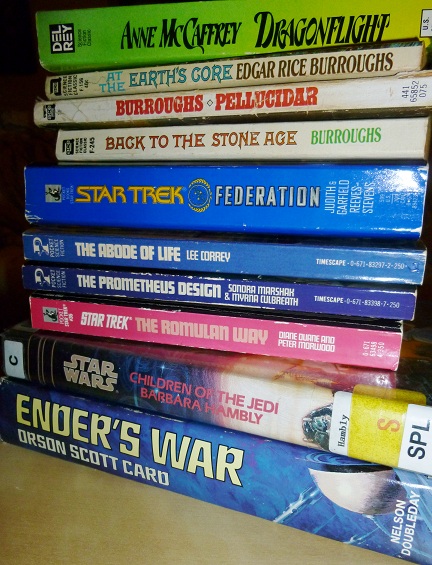
I’ve had an excellent time in sci fi reading over the last two months.  I started out with a big stack, and have read my way through nearly all of it.  I dropped a couple of titles from my plans (one Trek book, after looking more closely at the writing, and one Pellucidar book when I realized it was later in the series than I thought) and I have one unread Star Trek book still sitting on my shelf and patiently waiting its turn.  But other than that…  Well, here’s the full list with links to reviews:

P1020254Dragonflight by Anne McCaffrey (reread) – Group Read, Week One and Week Two

At the Earth’s Core and Pellucidar by Edgar Rice Burroughs

Speaker for the Dead by Orson Scott Card

Star Trek
Federation by Judith and Garfield Reeves-Stevens (reread)
The Abode of Life by Lee Corey

Star Wars: The Callista Trilogy
Children of the Jedi by Barbara Hambly
Darksaber by Kevin J. Anderson
Planet of Twilight by Barbara Hambly

I also got some Sci Fi on Screen viewing in.

I’m a bit sad to wrap up the Sci Fi…but mostly I’m looking forward to diving into some fantasy!  And I have no doubt I’ll be continuing to read more science fiction anyway…if only because I added so many titles to my To Be Read list throughout the Experience. 🙂

The Callista Trilogy: Planet of Twilight

File:Planet of twilight.jpgIn my continuing exploration of the Star Wars universe, I wound up the Callistra Trilogy with Planet of Twilight by Barbara Hambly.  I thoroughly enjoyed Hambly’s first book, Children of the Jedi, and was disappointed by the second in the trilogy, Darksaber, authored by Kevin J. Anderson.  Book three brought us back to Hambly, and it showed–and I was quite pleased by that fact.
The book opens eight months after the previous one, as Luke searches for his lost love, Callista, who has gone off on her own quest in search of her lost Jedi powers.  Luke’s search and Leia’s political responsibilities bring both of them to Nam Chorios, a former prison planet where the religious-cult majority insists on isolationism, over the objections of the minority of more recent colonists.  The minority political leader captures Leia, while Luke explores very strange operations of the Force on the planet, and hunts for clues to Callista’s trail.

It was such a relief after Darksaber to come back to Hambly’s characterization.  The characters had depth again.  You can feel Luke’s pain at losing Callista, and it feels both real and appropriate–not vaguely self-indulgent, the way the focus on their relationship felt in the last book.  I have a feeling there are those who would object to his focus on Callista when he has larger responsibilities (like an Academy to run), but really, I think it’s just human to balance something personally important against something that’s logically important.  And at the risk of a slight spoiler, ultimately the novel is about how Luke accepts his path going forward.

There’s also some good delving into Leia’s character.  Children of the Jedi had a lot about her past on Alderaan.  This one has more about some of her plans and her fears, and delves into the rarely-addressed fact that she’s the child of Darth Vader as much as Luke is.

Most of the book is in either Leia’s or Luke’s point of view, and between their differing experiences we get to explore some very strange mysteries and very strange characters–including a Hutt with Force-ability, and some truly creepy bug creatures.  It gets pretty gross in spots, and I likely would have been ill with a movie, but it wasn’t too bad in text.  I enjoyed the reveal of the mystery and weird aliens are among the hallmarks of Star Wars.

Han, Lando and Chewie all have small roles here, trying to figure out what happened to Leia, and though they don’t have a big part, it’s enough that they don’t become conspicious by their absence, if that makes sense.  Threepio and Artoo, meanwhile, manage to get lost and provide some excellent comic relief as they try to sort themselves out.  Artoo, of course, is calm throughout; Threepio, not so much!

I got a little muddled in here with politics on various planets, and some arching plotlines involving plague and multiple revolutions.  But the main focus was on the primary characters, so I didn’t worry too much about the larger politics, and that seemed to go all right.

I found this a satisfying end to the trilogy.  I won’t claim it was brilliant, but it was put together well, has good portrayals of the characters, some clever twists, and all in all, an enjoyable read.  And somehow it’s making me want to rewatch Return of the Jedi

Author’s Site: http://www.barbarahambly.com/

Buy it here: Planet of Twilight

The Callista Trilogy: Darksaber

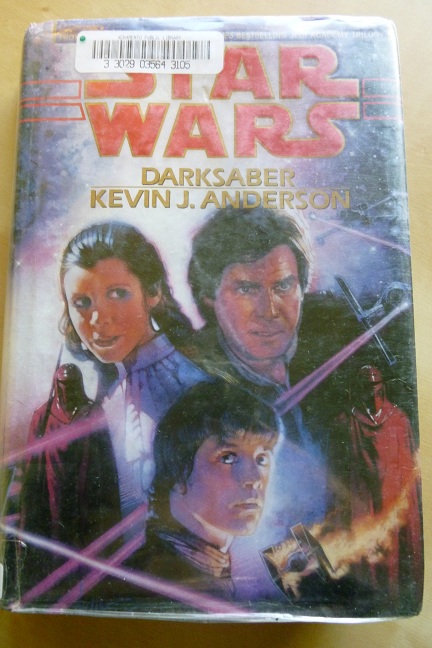
DarksaberAfter a brief break for L. M. Montgomery, I’m back to focusing on the Sci Fi Experience.  I enjoyed the break and was happy to go back to lasers and aliens…but I am sorry to say that I was sadly disappointed by the next installment of the Callista Trilogy, Star Wars: Darksaber by Kevin J. Anderson.  There was an author switch here, and it showed–though I was quite surprised, as I know Anderson is a prominent name in Star Wars novels.

This one picks up shortly after Children of the Jedi (my review here), with continuing character threads but a new plotline.  Callista and Luke are on a search for a way to restore her lost Jedi powers.  Leia is in political negotiations with the Hutts (as in, Jabba the), who are secretly building a super-weapon using the plans of the Deathstar.  Han has pretty much nothing to do but follow along with Leia.  Meanwhile out on the fringes, Admiral Daala and Vice-Admiral Pellaeon are striving to unify the squabbling remnants of the Empire to attack the New Republic, and especially the Jedi Academy.

You might already be able to tell that this plot is rather fractured.  The Hutts and the Empire pose two major threats that, as far as I can tell, have absolutely nothing to do with each other.  I honestly don’t know why they’re both in one book.

I did actually quite like one minor plot thread, involving one of Luke’s Jedi trainees.  Dorsk 81 is from a world of clones; he’s the first one to have Jedi powers and the first one in a very long time to do anything unexpected.  He returns to his home planet hoping to serve with his new abilities, only to find his community expects him to go back to conforming.  This was an intriguing culture that could have been explored more thoroughly, and it’s too bad it was in a book that was already over-stuffed with plot elements.

Possibly more problematic than a fractured plot is the fractured point of view.  Star Wars books typically jump between different characters, and I don’t object on principle.  This one, however, spends so much time in the POV of supporting characters or villains that I feel like I barely saw Han and Leia at all.

We spend far too much time in the POV of Admiral Daala, who is a decent enough villain but not that special for the amount of attention she gets here.  We also spend a lot of time in the POV of Bevel Lemelisk, an engineer behind the Death Star who’s now working for the Hutts.  Despite spending too much time with Lemelisk, I still have no idea why he’s working for the Hutts.  He doesn’t seem to be trapped; he’s not bloodthirsty; he’s plainly not enjoying the experience; he’s not unaware of the destructive power of his creations, and yet he gives the consequences no thought at all.  I’m guessing his motivation is sheer love of his craft, but I haven’t the faintest idea why he’s choosing this way to express it.

That leads into the third problem.  The characters throughout feel…not quite shallow, but something like that.  Perhaps the problem is that the writing is unsubtle.  I don’t know exactly how to explain this, so let me invent an example.  These aren’t actual quotes, but I think they’re representative.  It’s the difference between writing “Leia was sad about Alderaan” and writing “Leia watched the purple sunset and thought wistfully of Alderaan’s blue skies.”  They’re both expressing emotions, but Darksaber‘s only method seemed to be to use the first, and just announce what a character felt.  Characters do feel things, even deep things, but there’s somehow no depth to the writing.

Perhaps I’m most disappointed by the portrayal of Callista.  She felt more alive when she was a Jedi ghost in the first book.  Even worse, I didn’t like how her personal journey was handled.  The facts of the situation are: she’s a Jedi Knight from a previous generation who has been isolated for thirty years, now inhabiting a new body in a galaxy that is very different from her earlier experience, who finds herself unable to touch the Force.

You’d think a character with all that going on could hardly help but be deep and complex.  But none of that is explored in the slightest way, except for her inability to reach the Force.  That’s the primary focus, and even that becomes less about her crisis of self-identity than about her inability to Vulcan mindmeld with Luke (to thoroughly mix my galaxies!)  The story of their relationship is not a bad direction to go and would certainly be a good element to a larger story…but as-is, it feels like so much less than what could have been done.

Now that I’ve completely torn this book apart, I really should say it’s not a terrible book.  It’s not very good, but it’s okay.  Perhaps a hazard of writing in a larger universe like Star Wars is that it’s so easy for the reader to see how much better a novel could have been–because there are better Star Wars books out there.

Children of the Jedi doesn’t seem to get much love from hardly anyone, but I greatly preferred it to its sequel.  So all in all–I’m looking forward to jumping back into Barbara Hambly’s writing for the third book in the trilogy.

Other reviews:
Rancors Love to Read
Meme Read
Star Wars Wikipedia
Anyone else?

Buy it here: Darksaber by Kevin J. Anderson