I accidentally paired two Newberys lately, and found myself reading two books about small medieval villages in a row. Which actually worked out well, as a lot of historical elements paralleled and supported each other.
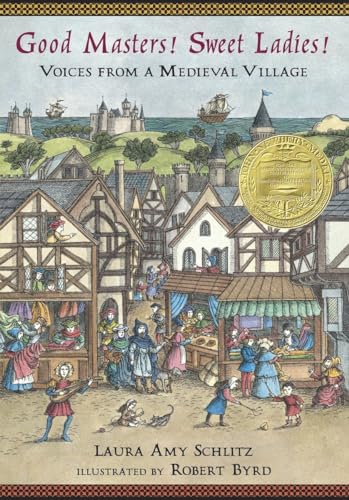 First I read Good Masters, Sweet Ladies: Voices from a Medieval Village by Laura Amy Schlitz. An unusual format, this is a collection of monologues (and two dialogues). Each speaker is a different character from the same village, each speaking about his/her life.
Considering the presentation, I was impressed by how vividly the characters and world came to life. Originally written for a school pageant (giving each child a good part), all the characters are children. They’re a wide range of classes and life situations, from the Lord’s son to the beggar boy. Altogether they depict the society, its rules and hierarchies throughout the village.
I liked best the monologues that built on each other, as when the Lord’s daughter spoke about having a clod of mud thrown at her and her confusion…followed by the monologue of the girl who threw it, and her hard home life, envy of the Lord’s daughter, and ultimate remorse. Continue reading “Book Reviews: Good Masters, Sweet Ladies and Crispin”

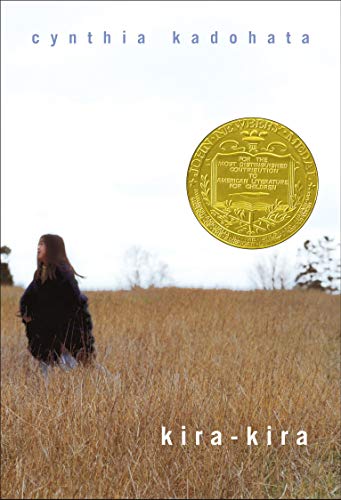 Continuing the pattern of last year, I’m making a good run through the Newbery winners. I picked Kira-Kira by Cynthia Kadohata in part because it also serves my diversity challenge, centering on a Japanese-American family living in Georgia in the 1950s. There was some exploration of that dynamic…but it was also the most unrelentingly depressing Newbery I’ve read yet!
 I love a good premise. I love good characters, but I usually pick up books because something in the premise grabs me—so how could I resist The Girl from Everywhere by Heidi Heilig? It’s a fantasy of traveling to anywhere a map records—in the present or the past, real or imagined.
 Tales of the Marvelous