Reflecting on Writing with Diana Wynne Jones

ReflectionsReflections by Diana Wynne Jones is not quite a book about writing…and not quite an autobiography…but a good bit of both.  Diana Wynne Jones is one of my favorite children’s fantasy authors, so I was eager to read her book of essays “On the Magic of Writing” when it was published this fall.

I feel like this is less about writing than it is about storytelling, which are not quite the same thing.  It’s not much about the craft of writing, and definitely not about publishing.  It’s about something more integral, about the art of crafting a story rather than how that story becomes a novel.  So don’t come here looking for one essay about how to create a character, another about plot arcs, or a third about the advantages of outlining.  Some of those elements may come in, but you’ll only find them as one possible aspect of an essay about, for example, the influence of Anglo-Saxen myths on modern fantasy, or the ultimate responsibility of writing for children.

That second topic may be one of my favorites addressed here, in the essay “Writing for Children: A Matter of Responsibility.”  That sounds rather weighty and apt to be moralizing, but it isn’t at all.  Without being overwhelming about it and certainly without advocating for Victorian stories where bad little children swiftly meet bad ends, Diana Wynne Jones gets at the influence books have on children.  I remember once in college I mentioned in conversation with an acquaintance that I wanted to write young adult novels.  She remarked, “so you can be an influence on twelve-year-olds everywhere.”  She clearly meant it scornfully, but…yes!

I’ve certainly “met” books later in life that have influenced me, but I think stories touch us and shape us in childhood in a way that later books don’t.  Diana Wynne Jones obviously understood that, and obviously believed in the power of books to be a positive influence.  I don’t mean that her books are ever moralizing, but I think they do build strength and courage and belief in oneself and one’s own imagination.  Those, of course, are good lessons for anyone, at any age.

I also particularly enjoyed “A Talk About Rules,” which discusses how seemingly-ironclad rules change.  I think this essay may be the key to why the book isn’t more about rules of writing–because it’s evident she doesn’t much believe in them.  To quote: “What you see should be a magnificent, whirling, imaginative mess of notions, ideas, wild hypotheses, new insights, strange action and bizarre adventures.  And the frame that holds this mess is the story.”

I mentioned autobiography at the beginning, and the book frequently tells stories about Diana Wynne Jones’ own life.  She tells wonderful, improbable stories about growing up in a town where everyone was mad, during World War II when the whole world had run mad.  She talks about her own writing process (something that always fascinates me about authors I love), about the influences on some of her novels, and about her experiences being an author.

If there’s a flaw in the book, it’s that some of the stories become repetitive.  This is a compilation of essays and talks that were originally spread across years, and when they’re all put together, you find that she describes the same details of her childhood three or four times.  Perhaps slightly heavier editing would have resolved some of this.  As it stands, it’s not too big an annoyance, although it may be an argument for reading this a few essays at a time, rather than straight-through.

If you really want a book about writing, I recommend Writing Magic by Gail Carson Levine.  But if you want a book about stories, and about Diana Wynne Jones, this collection is delightful.  And perhaps by focusing more on that deeper core, she’s created a book that would be as interesting to readers as it is to writers.  Really, to anyone who enjoys stories–particularly if you enjoy Diana Wynne Jones’ stories!

Author’s Site: http://www.leemac.freeserve.co.uk/

Other Reviews:
Things Mean a Lot
Awfully Big Reviews
Fall into Fiction
CalmGrove
Anyone else?  Tell me about yours!

Buy it here: Reflections

What Are You Reading: Mostly, Les Mis

itsmondayI think it’s time for another installment of What Are You Reading?  🙂  What I have been reading is lots and lots of science fiction, but I’m getting down to the end of my stack.  I’m midway through Federation, leaving just one Trek book left from my original plans…and quite a few new additions to the To Be Read list after reading everyone else’s reviews for the Sci Fi Experience!

But for the moment I’m stepping away a bit from the sci fi.  In my ongoing quest to finish series, I have the next installment of the Pink Carnation series, The Orchid Affair by Lauren Willig.  It’s a series of historical fiction romances–with spies!–and while some are better than others, they’re always quite a lot of fun.

P1020361After I check that one off, I’m finally diving into Les Miserables by Victor Hugo.  I bought a big, thick, not-too-heavy copy and am ready to go on that one.  I was debating about which translation to get, and then in the end I wound up with a copy that doesn’t list the translation–even though I spent five minutes in the book store peering at the table of contents, the jacket flaps, etc.  I did discover in the (very long) table of contents that the book is divided into five parts, so I might intersperse other reading in between–or not, if I’m being carried along by the story.

If I do intersperse, I have a handful of quick reads that ought to be a nice break from the long and dense classical fiction…Rapunzel’s Revenge by Shannon and Dean Hale, a graphic novel; The Four Seasons of Brambly Hedge by Jill Barklem, which is more or less a picture book collection; and The Illustrated Man by Ray Bradbury, which may not be short in itself, but is a collection of short stories I could dip in and out of.

Hmm…as I consider all this, I kind of feel like Les Mis is the heavy-gravity planet that all my other reads are currently orbiting around (it’s all that sci fi reading…)  I am slightly intimidated, but also excited.  I’ll let you know how it goes!

In the meantime…what are you reading?

And as an addendum note–this is my 500th blog post!  *tosses confetti*

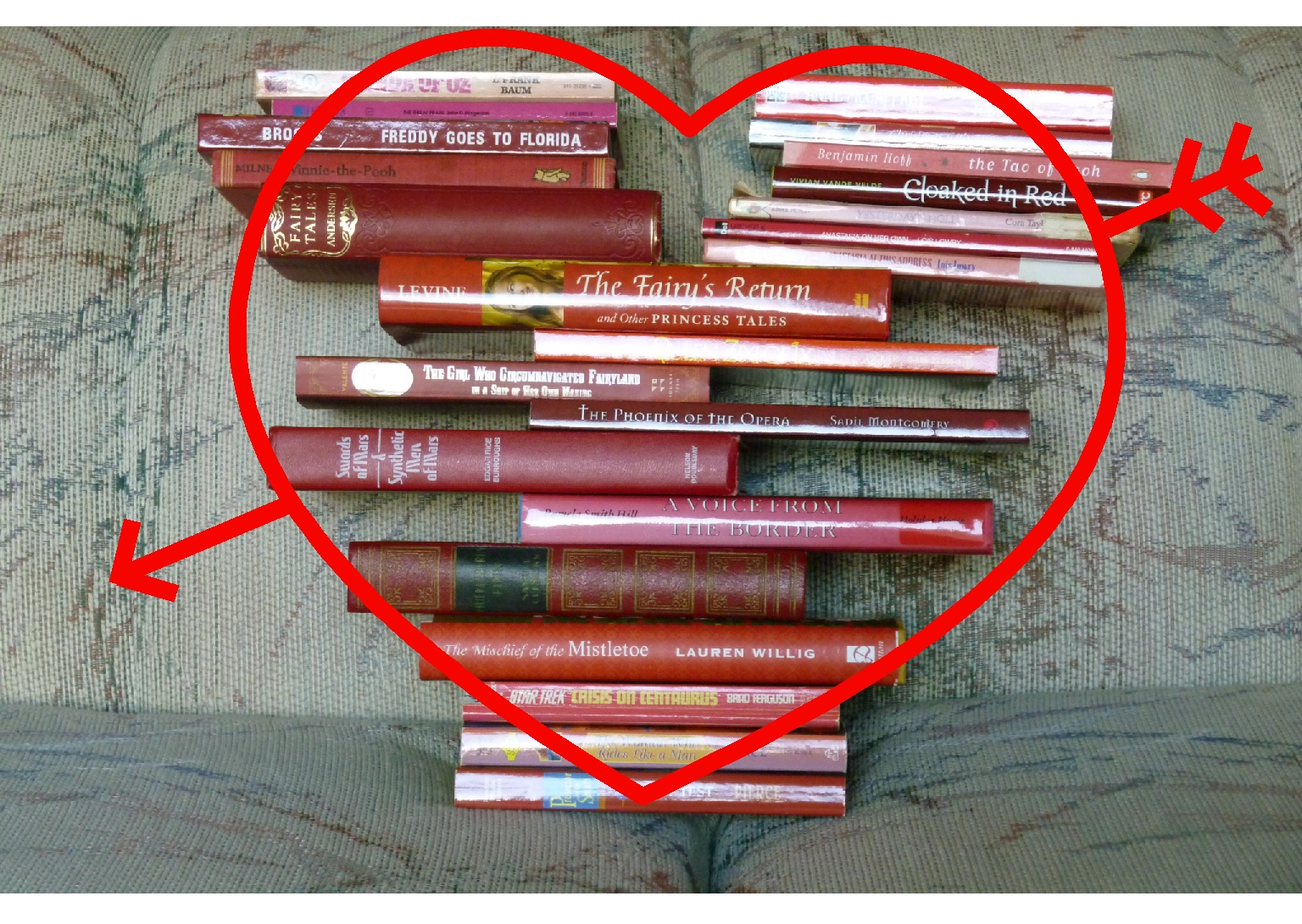
Saturday Snapshot: Bookish Valentines

Last year for St. Patrick’s Day, I came up with Forty Bookish Shades of Green.  So with Valentine’s Day coming up this week, I thought I’d haul my red and pink books off of the shelves and come up with a Bookish Valentine’s Day picture!

Bookish ValentinesHappy Valentine’s Day!

Visit At Home with Books for more Saturday Snapshots.

Favorites Friday: Cary Grant

Most people who know me have probably gathered that I’m just a bit fond of Johnny Depp.  But today I thought I’d do a post on another favorite actor who doesn’t seem to get mentioned as often around here: Cary Grant, the dashing star of old Hollywood.  Unlike Johnny, Cary played the same role in most movies…but he’s always a pleasure to watch!  Here are a few favorites…

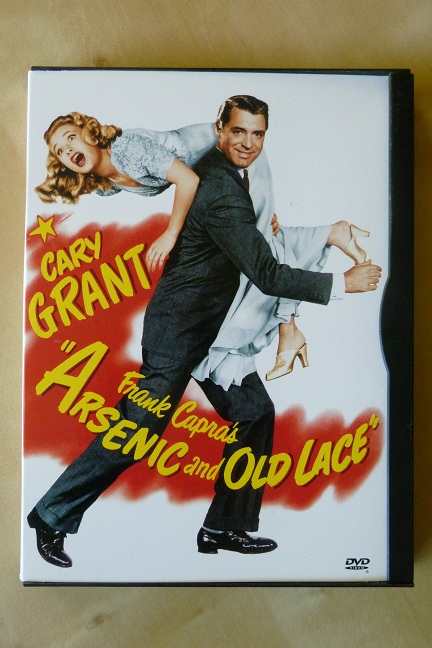
Arsenic and Old LaceArsenic and Old Lace is one of my all-time favorite movies.  Cary plays Mortimer Brewster, who’s just found out that his two beloved aunts–who are the kindest, sweetest women you could ever want to meet–poison lonely old men as a charity.  They bury the bodies in the basement with the help of Mortimer’s brother Teddy, who believes he’s Theodore Roosevelt.  The stairs are always San Juan Hill (so he yells “Charge!” every time he goes up them) and he thinks he’s digging the lock in Panama in the cellar.  Even more chaos ensues in the second half of the movie, when long-lost brother Jonathan shows up with a mad scientist and another body in tow.  This is a wonderful black comedy, full of completely mad characters.  Everyone’s funny, but it’s all worth it for Cary Grant’s double-takes alone.

Bringing Up Baby pairs Cary Grant with Katherine Hepburn.  He’s a book-bound paleontologist and she’s a madcap socialite whose adventurer brother sent her a leopard named Baby.  Cary gets pulled into her whirlwind, the leopard gets loose, and there’s a fantastic scene involving a dinosaur skeleton.  If this suffers from anything, it’s a slightly contrived romance, but…when it’s Cary Grant and Katherine Hepburn, you don’t have to work very hard to contrive something.  This movie gives us the textbook example of one of Cary’s two usual roles–the perpetually baffled man who’s trying keep his head up as life sweeps him to crazy places.

The Philadelphia Story gives us Cary Grant and Katherine Hepburn again, but we get Cary’s other persona–the suave sophisticate who’s always charming and always in control.  This was the person everyone (including Cary Grant) always wanted to be.  In this movie he’s C. K. Dexter Haven, ex-husband to Katherine Hepburn’s Tracy Lord.  Tracy is getting remarried, but of course complications ensue, and when you have Cary Grant and Jimmy Stewart both on screen, the poor fiance becomes a relatively minor point in the story.

Stepping away from the comedies, Suspicion is one of my favorite Hitchcock movies.  Joan Fontaine was so good at playing the wide-eyed ingenue, threatened by sinister forces around her.  In this case, she’s afraid that her husband, played by Cary, is plotting to kill her.  I love the way Hitchcock used Cary Grant’s reputation.  As I said, he only really has two characters, and everyone knew that–so could he really be playing the villain this time?  Hitchcock builds up the tension until you reach the point where a scene of Cary Grant carrying a glass of (maybe poisoned) milk up a flight of stairs becomes terrifying.  Cary Grant!  With milk!  And it’s so sinister.

An Affair to RememberAn Affair to Remember gives us a more dramatic role.  Cary Grant and Deborah Kerr meet on a cruise ship and fall in love, but they’re both engaged to other people.  They vow to disentangle themselves and meet again in six months at the top of the Empire State Building…but tragedy strikes first.  This is a good movie, but I must admit it’s much better if you watch Sleepless in Seattle too!

So I can’t be the only Cary Grant fan in the house…anyone else with a favorite movie?  And do you prefer Suave-Cary or Baffled-Cary? 🙂

The Callista Trilogy: Darksaber

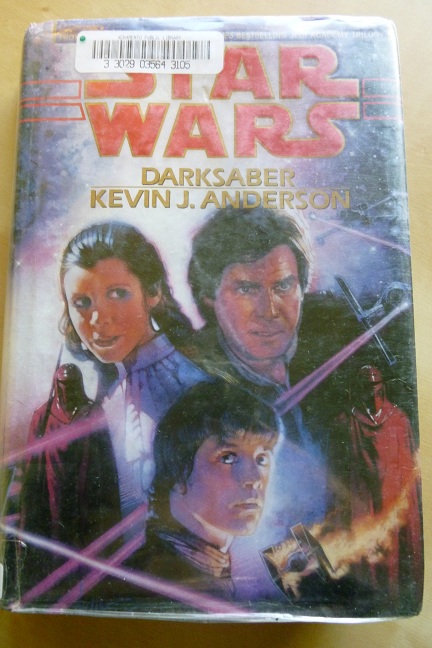
DarksaberAfter a brief break for L. M. Montgomery, I’m back to focusing on the Sci Fi Experience.  I enjoyed the break and was happy to go back to lasers and aliens…but I am sorry to say that I was sadly disappointed by the next installment of the Callista Trilogy, Star Wars: Darksaber by Kevin J. Anderson.  There was an author switch here, and it showed–though I was quite surprised, as I know Anderson is a prominent name in Star Wars novels.

This one picks up shortly after Children of the Jedi (my review here), with continuing character threads but a new plotline.  Callista and Luke are on a search for a way to restore her lost Jedi powers.  Leia is in political negotiations with the Hutts (as in, Jabba the), who are secretly building a super-weapon using the plans of the Deathstar.  Han has pretty much nothing to do but follow along with Leia.  Meanwhile out on the fringes, Admiral Daala and Vice-Admiral Pellaeon are striving to unify the squabbling remnants of the Empire to attack the New Republic, and especially the Jedi Academy.

You might already be able to tell that this plot is rather fractured.  The Hutts and the Empire pose two major threats that, as far as I can tell, have absolutely nothing to do with each other.  I honestly don’t know why they’re both in one book.

I did actually quite like one minor plot thread, involving one of Luke’s Jedi trainees.  Dorsk 81 is from a world of clones; he’s the first one to have Jedi powers and the first one in a very long time to do anything unexpected.  He returns to his home planet hoping to serve with his new abilities, only to find his community expects him to go back to conforming.  This was an intriguing culture that could have been explored more thoroughly, and it’s too bad it was in a book that was already over-stuffed with plot elements.

Possibly more problematic than a fractured plot is the fractured point of view.  Star Wars books typically jump between different characters, and I don’t object on principle.  This one, however, spends so much time in the POV of supporting characters or villains that I feel like I barely saw Han and Leia at all.

We spend far too much time in the POV of Admiral Daala, who is a decent enough villain but not that special for the amount of attention she gets here.  We also spend a lot of time in the POV of Bevel Lemelisk, an engineer behind the Death Star who’s now working for the Hutts.  Despite spending too much time with Lemelisk, I still have no idea why he’s working for the Hutts.  He doesn’t seem to be trapped; he’s not bloodthirsty; he’s plainly not enjoying the experience; he’s not unaware of the destructive power of his creations, and yet he gives the consequences no thought at all.  I’m guessing his motivation is sheer love of his craft, but I haven’t the faintest idea why he’s choosing this way to express it.

That leads into the third problem.  The characters throughout feel…not quite shallow, but something like that.  Perhaps the problem is that the writing is unsubtle.  I don’t know exactly how to explain this, so let me invent an example.  These aren’t actual quotes, but I think they’re representative.  It’s the difference between writing “Leia was sad about Alderaan” and writing “Leia watched the purple sunset and thought wistfully of Alderaan’s blue skies.”  They’re both expressing emotions, but Darksaber‘s only method seemed to be to use the first, and just announce what a character felt.  Characters do feel things, even deep things, but there’s somehow no depth to the writing.

Perhaps I’m most disappointed by the portrayal of Callista.  She felt more alive when she was a Jedi ghost in the first book.  Even worse, I didn’t like how her personal journey was handled.  The facts of the situation are: she’s a Jedi Knight from a previous generation who has been isolated for thirty years, now inhabiting a new body in a galaxy that is very different from her earlier experience, who finds herself unable to touch the Force.

You’d think a character with all that going on could hardly help but be deep and complex.  But none of that is explored in the slightest way, except for her inability to reach the Force.  That’s the primary focus, and even that becomes less about her crisis of self-identity than about her inability to Vulcan mindmeld with Luke (to thoroughly mix my galaxies!)  The story of their relationship is not a bad direction to go and would certainly be a good element to a larger story…but as-is, it feels like so much less than what could have been done.

Now that I’ve completely torn this book apart, I really should say it’s not a terrible book.  It’s not very good, but it’s okay.  Perhaps a hazard of writing in a larger universe like Star Wars is that it’s so easy for the reader to see how much better a novel could have been–because there are better Star Wars books out there.

Children of the Jedi doesn’t seem to get much love from hardly anyone, but I greatly preferred it to its sequel.  So all in all–I’m looking forward to jumping back into Barbara Hambly’s writing for the third book in the trilogy.

Other reviews:
Rancors Love to Read
Meme Read
Star Wars Wikipedia
Anyone else?

Buy it here: Darksaber by Kevin J. Anderson