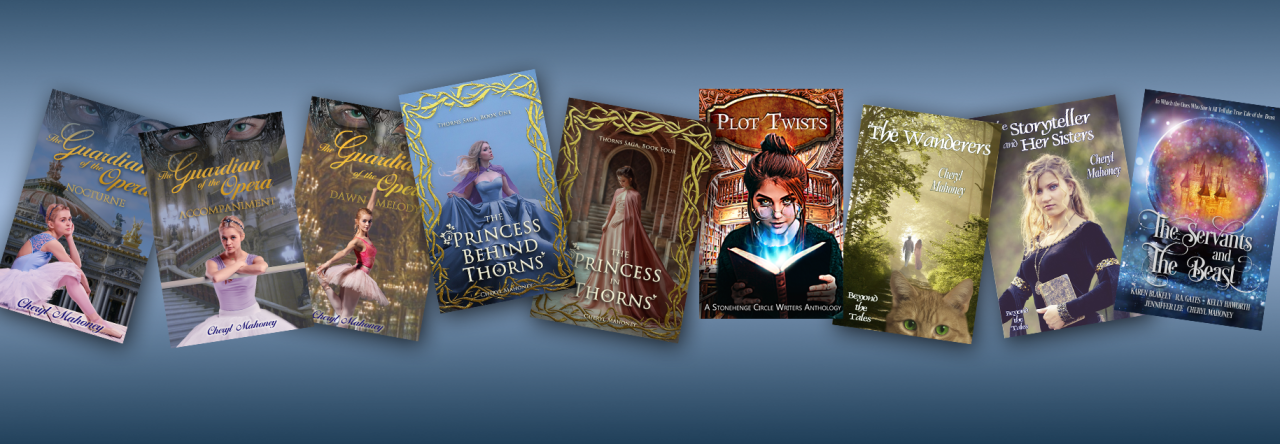
 As you may remember from last month, my writing group, Stonehenge, has started a group blog. I have a new post up there today, about how writing can affect reading, and how reading from the wrong mind can sometimes cause trouble… I hope you drop by to take a look!
Author: cherylmahoney
I'm a book review blogger and writer. I have published four novels, The Wanderers; The Storyteller and Her Sisters; and The People the Fairies Forget; and The Lioness and the Spellspinners. All can be found on Amazon as an ebook and paperback. In my day job, I'm a Marketing Specialist. Find me on Twitter (@MarvelousTales) and GoodReads (MarvelousTales).
Death Comes for an Apprentice
 In my usual way of reading Discworld books, I had read most of the Death subseries without reading the first one. But recently, I finally picked up Mort by Terry Pratchett to get the beginning of the story, confident of finding a book that would be about life and death and eternity–and it was–and be enormously funny–and it was!
Mort has never been much of a success at anything, so his father decides the answer is to apprentice him out to a trade. As it happens, Death is looking for an apprentice. The job is a little daunting but Mort begins to get into the swing of things (pun intended!)…but then matters become complicated when he saves the life of a princess who the universe is now convinced is dead, and when Death begins to explore happiness and contemplate escaping his duties. Also there’s Death’s daughter (adopted) thrown into the mix, and more than one wizard of questionable power. And…well, it’s Discworld. There’s havoc and there’s hilarity.
There’s a whole collection of fun characters here, as I would expect from Terry Pratchett. Mort undergoes an interesting transformation from ordinary screw-up to resembling Death just a little too much–including this problem he keeps having passing through objects. Princess Keli is great fun, especially as she becomes immensely frustrated when the universe thinks she’s dead and everyone keeps forgetting about her. She’s an odd blend of very strong and also quite inept in dealing with the world–as happens when you’ve been a princess all your life, and never needed to deal with the world. Ysabell, Death’s daughter, is an odd blend of crazy and ultimately endearing. And it was fun to learn the backstory on Albert, Death’s servant–he’s in later books, but his background isn’t revisited that I can recall.
My favorite character here was Death himself. I tend to like him best in a supporting role–sometimes when he’s too much the focus it gets old (while often his two-paragraph cameos are the funniest bits of other books). Here, there’s enough focus on Mort and the others that Death gets just the right balance–plenty of him, but not too much. He tries to explore human happiness, which treats us to scenes of Death fly-fishing, line-dancing, and sitting in a bar (at a quarter to three, of course), and never quite understanding any of the things he’s doing. My favorite may be when Death visits an employment agency and puts down “Anthropomorphic Personification” as his previous position.
The setting is also particularly fun here, something I don’t often say about books! But Death created his own world, and though he tried very hard, he has some trouble–everything tends to be black and fake. We also spend time in Keli’s mountain kingdom, and get to visit Ankh-Morpork.
There isn’t a huge lot of satire and depth here, but there are some discussions on justice and eternity and the meaning of life. Death seems to struggle with these questions throughout his books.
The weak point of the book is the ending–only the very, very end. At the risk of a slight spoiler, there’s a sudden switch in the romance, and even though I knew it had to be coming (based on the later books about Mort’s daughter), Pratchett still didn’t sell it to me. It’s like he decided on the last chapter that there was more future potential in ending one way than with the other, and went for it without bothering about whether it made sense. I won’t complain too much…since it did lead to the amazing Susan, heroine of later books.
This is the fourth book in the Discworld series, and it’s one I’d recommend as a place to start. The books still get better, but this is the earliest one that’s already showing just how hilarious Terry Pratchett can be. Highly recommended!
Author’s Site: http://terrypratchettbooks.com/
Other reviews:
Brian Jane’s Blog
Helen Scribbles
The Eagle’s Aerial Perspective
Anyone else?
Saturday Snapshot: Daffodil Season
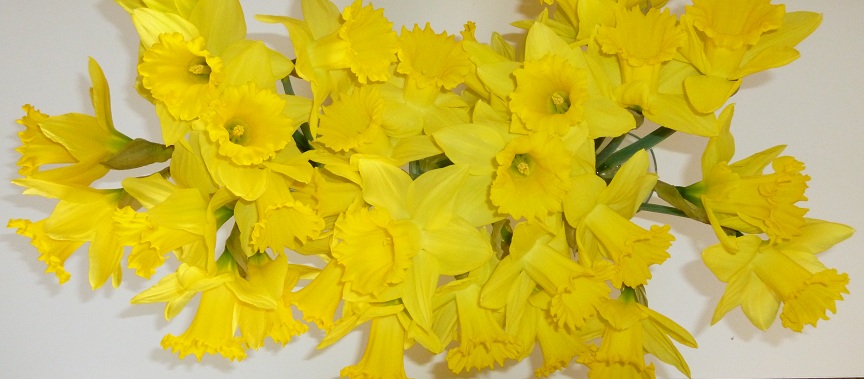
I get ridiculously happy each year when the daffodils are in bloom. They aren’t blooming around my neighborhood yet (though I’ve got my eye on some green spikes) but they are back in Safeway’s floral section. I buy daffodils every week for as long as they’re available, and enjoy them immensely.
Daffodils apparently can symbolize all sorts of different things, but my favorite is as a symbol of renewal and rebirth. And they’re supposed to be good luck! For me, they also remind me of my first, life-changing trip to England. Next time I go back, I plan to go in spring…because it’s off-season for the tourists, and the weather will be decent…and the daffodils will be in bloom!
I don’t have any good pictures of this year’s daffodils yet…but here are a couple riots of daffodils from past years.

Visit At Home with Books for more Saturday Snapshots!
Introducing the Twelve Dancing Princesses
Long-time readers may remember that for NaNo 2011, I wrote the first draft of a novel based around the fairy tale of The Twelve Dancing Princesses (or The Shoes That Were Worn to Pieces). I’ve finally completed a revision of my other major writing project, The Wanderers, and I’m now about a month into revising the princesses’ novel, The Storyteller and Her Sisters.
Since it’s rather occupying my life 🙂 how about an excerpt? You can read this post if you want more context on the fairy tale, but you don’t really need it. This is roughly Page 3 of the novel, and begins to introduce some of the principle characters…
*****************
I think the real beginning of the story, for my sisters and me, was the day the Gate opened.
On that day, Vira, the oldest, was twenty-four. The youngest, Talya, was fifteen. I was seventeen. We are each spaced a neat year apart, except for the two sets of twins.
It was evening when the Gate opened, and though that evening proved momentous, I remember little about the day that preceded it. I assume it was the usual round of embroidery, penmanship and dancing lessons—we are all excellent dancers. Whatever we did, it had to have been inside my father’s castle. We were never allowed to leave. The day no doubt closed with supper in the banquet hall with Father. Such ran every day.
And in the evening, all my sisters were in our bedroom, brushing hair, pursuing hobbies, and chatting about a thousand different topics. Rather like most girls, I think—not that I’d had a great deal of experience with a great many girls. But I had read things.
Twelve of us shared a single bedroom, and there were days when it felt incredibly cramped. In reality it was a large room, long and with a high ceiling. There was a door at one end and a fireplace at the other, beds stretching in two rows down the length of the room. I suppose we didn’t undergo that much hardship in our living conditions—though I defy anyone to share a bedroom with eleven sisters for fourteen years and not come up with a few complaints.
Such as the problem of eternally being interrupted in the good parts of stories. Continue reading “Introducing the Twelve Dancing Princesses”
Back to Pellucidar
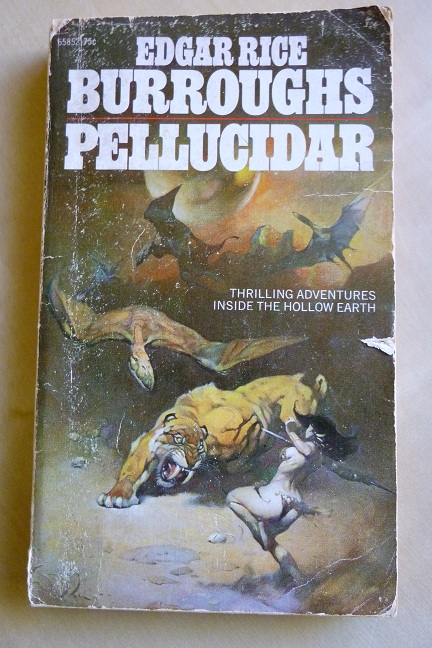 For my second Vintage Sci Fi read, I went back to the world at the Earth’s core, with Pellucidar by Edgar Rice Burroughs. This picks up where the first book left off, following the further adventures of David Innes in the world within the Earth.
There’s not much to be said about the plot–after all, it’s Burroughs, and that tells you most of it. David makes it back to Pellucidar where he sets off through a hostile landscape to search for old friends, encounter new and old enemies, and of course to rescue (repeatedly) his poor beleagured true love, Dian, who is captured on at least three occasions.
It’s all good fun and good adventure, with strange landscapes, a never-ending parade of action, and quite a lot of death but nothing gruesome. Like the first book, Pellucidar is striking me as a kind of Barsoom-lite. The same basic shape, still very entertaining, but somehow not quite as striking as John Carter’s adventures on Mars–and this may have more to do with which order I read the books in than the books themselves.
Rather than dwell on the plot and the characters, I want to talk about some of the themes. Lately it’s been uncanny how books I’ve picked up have unexpectedly fit into the larger discussion going on. First it was Star Trek: The Abode of Life and the examination of transporter technology. Now Pellucidar hits on a number of points that have come up recently.
First, The Abode of Life and Pellucidar both present a man from a more technologically-advanced society choosing what effect he will have on a new world he’s encountering. Kirk went to great lengths to not be a conquistador (his words) for Mercan. David plunges into precisely that role with abandon, becoming David I, Emperor of Pellucidar, and using advanced weaponry to conquer all the natives.
I realized long ago that I can’t look too closely at Burroughs’ philosophy, if I want to continue enjoying his books. Still, I don’t feel like I can just pass right over the last twenty pages of Pellucidar, which are especially, um, troubling. David simply takes it for granted that as the civilized man, he has both the right and the knowledge to assume a leadership role and impose an entirely new form of civilization on the natives. His attempts to eradicate the Mahars, the dominant, lizard-like race, are particularly disturbing. Though the Mahars do treat humans badly, they mostly seem to be condemned for the crime of not being human. The emphasis is much more on their lizardness than on their actions.
It’s also a bit interesting that David doesn’t introduce money (calling it “the root of all evil”), but doesn’t mind introducing guns and cannons. He does insist that his real interest is to spread education and trade and the Industrial Revolution…after obtaining peace by conquering everyone.
While I look askance at all of this, at the same time, I know Burroughs is a product of his time–Pellucidar was written while “the sun never set on the British Empire,” and decades before Kirk got his Prime Directive in the 1960s. For the Dragonflight group-read, we discussed extensively how classic books carry into the modern day, and Burroughs definitely requires acknowledging that this was a different time. In a way, it may help him that he’s so obvious about it–it makes it easier to draw a line around the objectionable bits, and move on.
That’s something I have to do most of the time with Burroughs’ heroines too. The portrayal of the genders was a fascinating discussion with Dragonflight, and it was interesting to still have some of that in mind reading Pellucidar. Burroughs heroes never treat women badly, or with the disdain that the dragonriders show–they generally worship the ground their heroines walk upon. And yet, at the end of the day…the heroine is pretty much a beautiful face who plays the role of a prize to be won.
I noticed here that Dian is more than once referred to as very fierce and brave–but she never actually does anything. She brandishes a javelin now and then, but is completely ineffectual at actually accomplishing anything (including using the javelin to fend off a kidnapper). As comparison, Lessa is frequently marginalized and often treated (and depicted) as childish…but she does things!
To be fair, Dian may be a bit two-dimensional…but so is David, so it’s not entirely a gender thing.
And to be fair on another point, I don’t read Burroughs for his brilliant political insight, or his explorations of the human character. I read him because he tells an exciting adventure story–and he’s never yet failed me at that!
Author’s Site: http://www.edgarriceburroughs.ca/
Other reviews:
SFF Audio
I couldn’t find others! Anyone else?
Buy it here: Pellucidar


