Getting Inside the Outsiders

I first read The Outsiders by S.E. Hinton in 7th grade.  It was one of the major book projects of the year, and I remember the teacher passing out a boxful of battered black paperbacks.  I don’t think my copy is one of those, but it is the same edition—I can’t remember anymore where I got it, and to this day I can’t figure out which character is meant to be which on the cover!

The Outsiders is about Ponyboy Curtis (that’s his real name), and his friends, the Greasers.  Not quite hoods, the Greasers are poor boys from the rough part of town, with a nasty reputation that’s partially deserved.  Their sworn enemies are the Socs (short for Socials), the rich kids in town.

The plot is about Pony, his sad-eyed friend Johnny and tough guy Dally, and what happens to them all when an altercation with the Socs gets horribly out of hand.  The book is really more about Pony’s growth than it is about the plot.  It’s about how he sees the people around him and takes what happens to them to gain new insights on the world.

The voice is so strong in this book.  It’s a shock to know that S. E. Hinton is female, and therefore was never a fourteen-year-old boy.  There’s something wonderfully artless in the writing, the kind of effortless feel that probably requires a lot of work.  There are moments that should be bad writing—when most of the characters are introduced, Pony spends a paragraph or two describing each one.  Usually narration info-dumping to describe characters annoys me and takes me right out of the story.  I quit reading a book once because it spent the first two chapters doing that.  But it works for Pony.  It doesn’t feel like a narrator telling us about characters—it’s Pony telling us about the people he knows.

All the characters are vividly drawn—hard-working Darry; lazy, good-natured Sodapop; hard-edged, angry Dally; and poor Johnny, beat up by life.  I feel like I know all of them, and I care about them—which is actually kind of remarkable.  Most of the people Pony knows, Dally especially, ought to be terrifying.  They shoplift, they carry switchblades, and they have all the external signs of juvenile delinquents.  But we get to see them from the inside, from Pony’s point of view, and it doesn’t really matter if they’re likable, or admirable—they’re Pony’s family.  I hesitate to use the word “gang,” even though it’s the obvious one, because I think it has violent connotations a little beyond what the Greasers deserve.  Let’s say they’re a pack, with all those connotations of loyalty.

The Socs aren’t portrayed as extensively, but we do meet a couple of them, especially dreamy, tough Cherry, who gives us insights into the desperate, bored recklessness of the Socs.

I suppose the ultimate messages of this book are not too radical—it’s tough all over, don’t judge by what a person seems to be, don’t become jaded by the world.  But they’re good messages, and they’re conveyed through some of the most alive fictional characters I’ve ever met.

And this book is responsible for one of the few pieces of poetry I’ve ever memorized: “Nature” by Robert Frost.  It’s a lovely poem, inside an excellent, gritty novel.

Author’s Site: http://www.sehinton.com/

Other reviews:
Misbehavin’ Librarian
The Oubliette
Susan the Librarian
I didn’t find as many as I would have expected…did I miss yours?

Quotable Mark Twain

“A classic is something that everybody wants to have read and nobody wants to read.”

– Mark Twain

I wouldn’t say it’s true of EVERY classic…but definitely some! 😉

Through a Maze, into the Past

Some books seem to make the rounds of all the blogs I follow.  That’s what brought me to The Freedom Maze by Delia Sherman.  So many bloggers loved it, I couldn’t resist giving it a read.  And I did enjoy it, largely for reasons that other people mentioned too…and I had a few reservations.  More on those in a bit!

The book is about Sophie Fairchild Martineau, thirteen years old and living in the American South during the 1950s, just as the Civil Rights movement is starting to take shape.  She’s bookish and awkward and doesn’t know how to be the proper, refined Southern lady her mother wants her to be.  Her mother has never forgotten that their family used to be wealthy plantation owners, before the Civil War.  Sophie is sent to spend the summer with her grandmother and aunt on what’s left of the family land, and wanders into the Maze, a labyrinth of hedges and paths.  She meets a strange Creature, and makes a wish…only to find herself back in 1860, where her Fairchild ancestors assume that this tanned, unkempt child must be a slave.

There’s a lot to love in this book, starting with Sophie.  I already loved her by the bottom of Page One.  She reminds me of Sym from The White Darkness, so obviously a thoughtful, lovely girl who’s being told by the people around her that there’s something wrong with her.  I love that Sophie likes to read–and she and I seem to have read all the same books!  It’s so much fun to have a heroine who has read Edith Nesbit and Edward Eager, and knows how this sort of adventure is supposed to go.  She knows the rules about wishes and magic creatures and native guides…but then nothing goes the way she expects.

I was so interested in Sophie and her family dynamics and life in the 1950s that I was almost disappointed when she went into the past.  But the family dynamics and the life in the 1860s turned out to be very interesting too.  The handling of the master/slave situation was fascinating.  The Fairchilds (with the exception of a very nasty daughter) are not cruel people, but they are slaveowners.  Through a combination of obliviousness, delegation of discipline, and a conviction of how the world is meant to be, they fully believe in their own goodness.  And in a way they are “good masters”–but that doesn’t mean the slaves are happy.  Neither are they desperately miserable in the day-to-day.  Sherman walks a narrow line to avoid falling into stereotypes in either direction, while vividly portraying the culture of the white society, and the community of the slaves.

Sophie is mistaken for the daughter of one of the men in the family, who’s currently living in New Orleans.  She has the Fairchild nose and tan skin from being in the sun, and so must be the offspring of a white master and his African slave–which makes her a slave too.  This was one of the most intriguing and disturbing aspects of the story.  I’ve certainly been familiar with the concept before, but I don’t think I had ever seen it brought to life.  Everyone, white and black alike, believes that Sophie is related by blood to the white family, but she’s still classed and treated as a slave.

Sophie meets many wonderful people, particularly among the other slaves, and somehow those characters are growing on me more as I get farther out from the book.  Strange!  The book takes on the feel of historical fiction the longer Sophie spends in the past, and I liked learning more about life in the time, though to some extent this was a more academic than emotional interest.

As interesting as it all was, it also began to feel somewhat purposeless.  It’s suggested, very clearly, that Sophie has been sent into the past for a reason, to do something.  I had to wait most of the book for any hint of what that might be, and at times I felt as though I was waiting for the main story to get going.  Sophie does ultimately end up helping another character in an important way, but the character wasn’t previously significant, and I didn’t have much reason to care.  If that was the whole point of it all…I could appreciate it from a humanitarian standpoint, but it didn’t have much emotional resonance for me.

The other point, I’m sure, was for Sophie to grow, to find a new view on the world, and to find the strength to seize her own freedom.  And I love that in theory…but in practice that aspect felt a bit rushed.

This book does many wonderful things–the way it does them doesn’t always feel quite as wonderful as they might have been.  But don’t let that dissuade you!  It is an enjoyable, fascinating book.  It takes what feels like a very familiar setting, finds new angles, and is thoroughly thought-provoking!

Author’s Site: http://deliasherman.com

Other Reviews:
Stainless Steel Droppings
Charlotte’s Library
Stella Matutina
Anyone else?

Saturday Snapshot: Visiting Book Characters

I’ve mentioned before that I love visiting places that figure in books, and I’ve been lucky to do that fairly often.  Once in a great while, I get to visit a character from a book–sort of!

These are the original Winnie-the-Pooh characters, the dolls owned by Christopher Robin Milne, A. A. Milne’s son.  Rabbit and Owl were slightly more imaginary, and Roo was lost in an apple orchard around 1925, but you can go visit Kanga, Tigger, Edward Bear, Piglet and Eeyore at the New York Public Library.  There’s a lovely display in the children’s section.  You can’t see it in this picture, but Eeyore’s tail really is held on with a tack!

This is the Peter Pan Statue in Kensington Gardens, which is where Peter ran away to when he left home.  I don’t actually know those two little girls, but they happened to be there when I snapped the picture and I liked how it came out.  And I’m fascinated by the base of the statue–I see something new in it every time I look at it.

There aren’t very many bookish characters available to be visited…but at least there are plenty more bookish places I still want to go…

See more Saturday Snapshots on At Home with Books!

Pathways Through Discworld

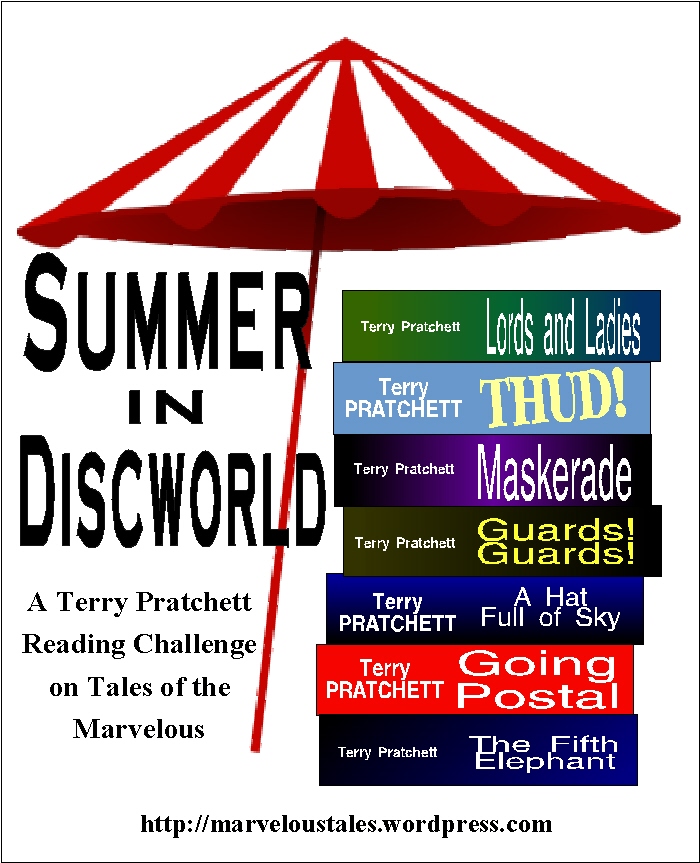
Have you signed up for the Summer in Discworld reading challenge yet?  Still plenty of time to join in!  This week, I thought I’d post some thoughts on navigating Discworld, for people deciding where to start, or which book to pick up next.

The Discworld series has within it several sub-series, with sets of books that focus on the same groups of characters.  It seems to me that the most obvious thing in the world would be to provide a list breaking the books out into these sub-groups.  But…Google hasn’t been able to find me a good list!  There are a few out there, but either they’re hard to read, or they’re not matching my experience reading the books (I’ve seen Maskerade described as a City Guard book–it’s really not, despite some cameos).  So, naturally, I set about to make my own list.

Part of the complexity may be that characters often show up in supporting roles, even when they aren’t a primary focus.  I’ve tried to arrange books based on who the lead protagonists are–for example, Vimes shows up in The Truth, but only in a supporting role so I haven’t put it with the other Vimes/City Guard books.  A few books show up twice, as they cross sub-series.

I’ve starred the books I’ve read, and feel free to ask if you’d like to know more about any of them.   If you notice a book that seems mis-grouped, let me know.  I don’t claim perfect accuracy.  🙂  But, hopefully this will give you some good directions for whichever paths you want to pursue.

Rincewind
The Colour of Magic*
The Light Fantastic*
Sourcery
Eric
Interesting Times
The Lost Continent
The Last Hero

Wizards
Reaper Man*
Interesting Times
The Lost Continent
Unseen Academicals
Lords and Ladies*

Witches
Equal Rites*
Wyrd Sisters
Witches Abroad
Lords and Ladies*
Maskerade*
Carpe Jugulum

Death
Mort
Reaper Man*
Soul Music*
Hogfather*
Thief of Time

City Guard
Guards!  Guards!*
Men at Arms*
Feet of Clay*
Jingo*
The Fifth Elephant*
The Last Hero
Night Watch*
Thud!*
Where’s My Cow? (picture book)*
Snuff*

Wee Free Men/Tiffany Aching
The Wee Free Men*
A Hat Full of Sky
Wintersmith
The Wee Free Men: The Beginning
I Shall Wear Midnight

Independent
Pyramids
Moving Pictures
Small Gods
The Truth*
Monstrous Regiment
Going Postal*
Making Money

Obviously I have not been too systematic in my reading…merely proof that you can attempt Discworld by any route you like!