“For every life situation there is a fitting quote from the hand of Shakespeare.”
– J.V. Hart
A few days late for Shakespeare’s birthday on April 23rd. But really, the Bard is worth celebrating every day…
A few days late for Shakespeare’s birthday on April 23rd. But really, the Bard is worth celebrating every day…

The Fairy Godmother by Mercedes Lackey is a great two-challenges-for-one-book, fitting neatly into the Once Upon a Time challenge, and also my Finishing the Series challenge. It’s actually the first book in Lackey’s 500 Kingdoms series, but somehow I contrived to pick up The Sleeping Beauty first, which is Book 5. They seem to be self-contained, so I don’t think it much matters.
Life in the 500 kingdoms (I think that’s meant literally) is constantly influenced and directed by the Tradition, a nebulous force which wants everything to go as, well, tradition dictates. In practice, this means that certain circumstances result in events being magically nudged (or shoved) along towards some very recognizable paths. If a situation is starting to look like a Brothers Grimm or Charles Perrault story, the Tradition wants to make it go towards its proper conclusion. Not that Grimm or Perrault are referenced, but that’s how it all plays out. Only sometimes, it doesn’t quite work–and the Tradition can drive towards both happy and tragic endings.
The Fairy Godmother is about Elena, who should have been Cinderella–she has the stepfamily and the drudgery. Unfortunately, the prince in her kingdom is only eleven, and Elena is stuck with an unfulfilled story, and a great deal of magical energy hovering around her. Along comes Godmother Bella, who takes Elena under her wing to train her up as a Fairy Godmother. Not necessarily fairies, the Godmothers nudge and influence and shape events, trying to push the Tradition towards the good stories and to mitigate the effects of the bad ones.
This book is really in two parts, first about Elena’s apprenticeship and then about her adventures as a Godmother, particularly in dealing with a difficult prince, Alexander, who she turns into a donkey and takes home to do farmwork in order to teach him a lesson.
I enjoyed the first chapters of the book very much, as Elena struggles with her Cinderella storyline. The book bogged down for me a bit after Elena goes with Bella. Lackey spent a lot of time on world-building, under the guise of telling about Elena’s studies to be a Godmother. The funny thing is, it’s all fascinating ideas…only I don’t actually need to know the distinction between a Godmother, a witch and a sorceress unless it’s relevant to the plot. I think this is a first-in-a-series problem, too much narration trying to establish the world, when many of the details aren’t based in any plot or character development. It may not have helped either that I had read a later book in the series, so some of this I already knew.
The book picked up again in the second half, once Alexander came into it. He brought an interesting dynamic into things; he certainly needed to go through some character growth, but I actually never thought he was as bad as Elena did. Some parts are in his point of view, and I could quite often see where he was very reasonably coming from, while she was convinced he was being stupid or just generally nasty. Also, Elena is supposed to be the heroine, but she fell into the same kind of behavior I always question about the traditional Fairy Godmothers. You turned someone into a donkey to make him be more considerate of others? Really? That makes sense to you as a way to teach a lesson? Of course it works out, because these things do, but I had a lot of sympathy for Alexander when he felt he was being badly treated.
The characters were good on the whole. I liked Elena reasonably well, and Alexander was interesting and likable most of the time. Elena also has a group of brownies working with her and they were rather delightful.
I really don’t think I’m giving anything away by saying that Elena and Alexander end up in a romance (it’s abundantly obvious, if only because there’s no one else she can get involved with). I was a bit dissatisfied by that romance. It turned out all right, but there wasn’t much basis for it. It was mostly a matter of realizing they were physically attracted to each other, and that circumstances made them convenient romantic partners. Sure, physical attraction can be fun, but I prefer a bit more substance when I read a romance. The romance also takes this out of the YA category.
A good book–not a fantastic book–but a brilliant premise. I’ll definitely be continuing with the series, because I do love the premise, and if we’ve got the world-building out of the way now, I hope for better things in later books!
Author’s Site: http://www.mercedeslackey.com/
Other reviews:
Reawrite
Book Buddies Online
Crooked Reviews
Anyone else?
 I’ve been on a Phantom of the Opera kick lately–I mean, more so than the ongoing attachment I’ve had to the story for the last eight years. I wrote a post about different versions, and learned about a new-to-me book, The Canary Trainer by Nicholas Meyer–thank you, Swamp Adder!
Now how I could resist the Phantom of the Opera meets Sherlock Holmes, written by the director of Star Trek: The Wrath of Khan? Especially after rereading the flawed but enjoyable Angel of the Opera by Sam Siciliano, another Holmes-meets-the-Phantom story. It may not be quite fair to compare them (especially since The Canary Trainer was published a year earlier) but it’s also unavoidable. TCT was better than AotO…and worse, contradictory though that might sound.
The big problem with AotO was that it completely maligned Watson. TCT at least did better in that regard, and that does make a big difference. Watson was back in his proper place as Holmes’ closest friend. Holmes regards Watson’s writing about him with outward disdain and secret but obvious pride–as it should be. The book opens very well, with Watson visiting Holmes and discussing past cases, finally teasing a new story out of him. Here we go into a book-length flashback, told from Holmes’ point of view. I think I would have preferred a story that kept Watson’s POV, but this worked well enough–and better than bringing in a superfluous new narrator.
The story is from Holmes’ “lost years,” the time between Moriarty going off a cliff and Holmes’ return from the dead. Apparently Meyer has written other books set in this time period, including one that brings Holmes and Freud together. I haven’t read the others, and though they’re alluded to occasionally, I don’t think it’s necessary in order to read this one. The story, as you’ve probably guessed, has Holmes deciding to go to Paris. He’s incognito, since everyone presumes him dead, and has to find other, non-detective work. He chances to hear that the Paris Opera is hiring a new violinist, and applies for the job. Once at the Opera, he finds mysterious happenings involving the Phantom. He also encounters Irene Adler, who is singing at the Opera. She recognizes Holmes and asks him to help her new friend, Christine Daae–the “canary” who has a mysterious trainer.
And so it goes from there, with a falling chandelier, an inept viscount, a soprano in distress and a crazy man in a mask. Like Siciliano, Meyer doesn’t make major plot changes. Holmes is investigating the story we all know, and if nothing is greatly improved, nothing is done badly either, plot-wise.
You might say the same for Holmes. He was reasonably well-drawn, nothing extraordinary. If there’s anything reading other writers tackle Holmes has done for me, it’s made me appreciate Doyle’s ability to give Holmes clues and let him draw conclusions. No one else seems to be able to do that to any great extent, although in one scene Holmes does figure out Raoul’s entire life circumstances just by looking at him. But it was one moment, instead of a perpetual state. I won’t say that the absence of deductive reasoning was acute enough to have the character actually off-track, but he wasn’t strikingly on-track either. He also seemed to struggle a bit in his investigations. I think he was more accurate to the original and more likable than Siciliano’s Holmes, but also less capable–and not as likable or as capable as Doyle’s Holmes.
We don’t see a whole lot of Christine and Raoul, and they were pretty standard when we did see them. Raoul is immature and incompetent, Christine is hopelessly innocent and naive. They both fulfilled their roles without doing much more than that–although Christine did get to score one point on Holmes. She’s talking about her Angel of Music, and Holmes says he seems very angry for an angel. To which Christine returns, “Haven’t you ever heard of avenging angels?” Touche, Miss Daae. But on the whole, she was pretty much sweet and stupid. Looking at the basic plotline of Phantom, Christine has to be either very stupid or very clever, either a victim or the one who’s manipulating the whole thing. I’d love to see a version where Christine is manipulative (think about it–who comes out ahead quite frequently?), but so far everyone’s been choosing to make her stupid or at least confused (though I think Webber is open for interpretation).
Anyway, now we come to the key question: the portrayal of the Phantom. Usually, he’s a deeply complex character: tragic, sympathetic, terrifying, sometimes romantic, brilliant…certainly the most interesting one in the story. That’s the later versions; in Leroux, he’s much more a monster. Everyone else has been working on reforming him ever since. Except Meyer. The Canary Trainer is the first and only version I’ve found where the Phantom is actually less sympathetic than in Leroux (so…points for originality?) This is the first time he’s gone the opposite direction and felt more like a character from a monster flick, stranger, crazier, and less sympathetic. If you’ve read Leroux, you’ll know that making him crazier is really saying something.
This is the first time the body count has actually gone up. In Leroux, one person is killed by the chandelier; in The Canary Trainer, it’s almost 30. Four men who were drugged in Leroux to get them out of the Phantom’s way end up killed here. You can make the point that the Phantom is a murderer regardless of how many people he kills, but I think there’s still little doubt that Meyer was deliberately creating a more villainous Phantom. I don’t quite know what to make of that. In a way I do applaud his decision to do something different. But…there’s a reason everyone else made the Phantom more sympathetic. He’s more interesting that way.
That may kind of sum up the book. There’s nothing really wrong with it. It’s not flawed in the same ways that Angel of the Opera is flawed, nor is it flawed in other serious ways. But it didn’t do anything all that interesting either. Holmes and the Phantom were both stripped of what makes them fascinating (Holmes’ deductive ability and the Phantom’s complexity), and in the end you get a book that is not bad–better than some versions–but not great either. I don’t hate it, and I don’t love it. I think it comes out about even with Angel of the Opera, but that’s because it’s neither as good in some ways nor as bad in others. I’m glad to have read it; I’m endlessly intrigued by what people make of the Phantom story. But I do think Nicholas Meyer accomplished something much more impressive with The Wrath of Khan.
Author’s Site: http://nmeyer.pxl.net/
Other reviews:
Here, There and Everywhere
A Bluestocking’s Place
Anyone else?
Last weekend I went to my library’s Warehouse Sale, so I thought–why not show off the treasure?
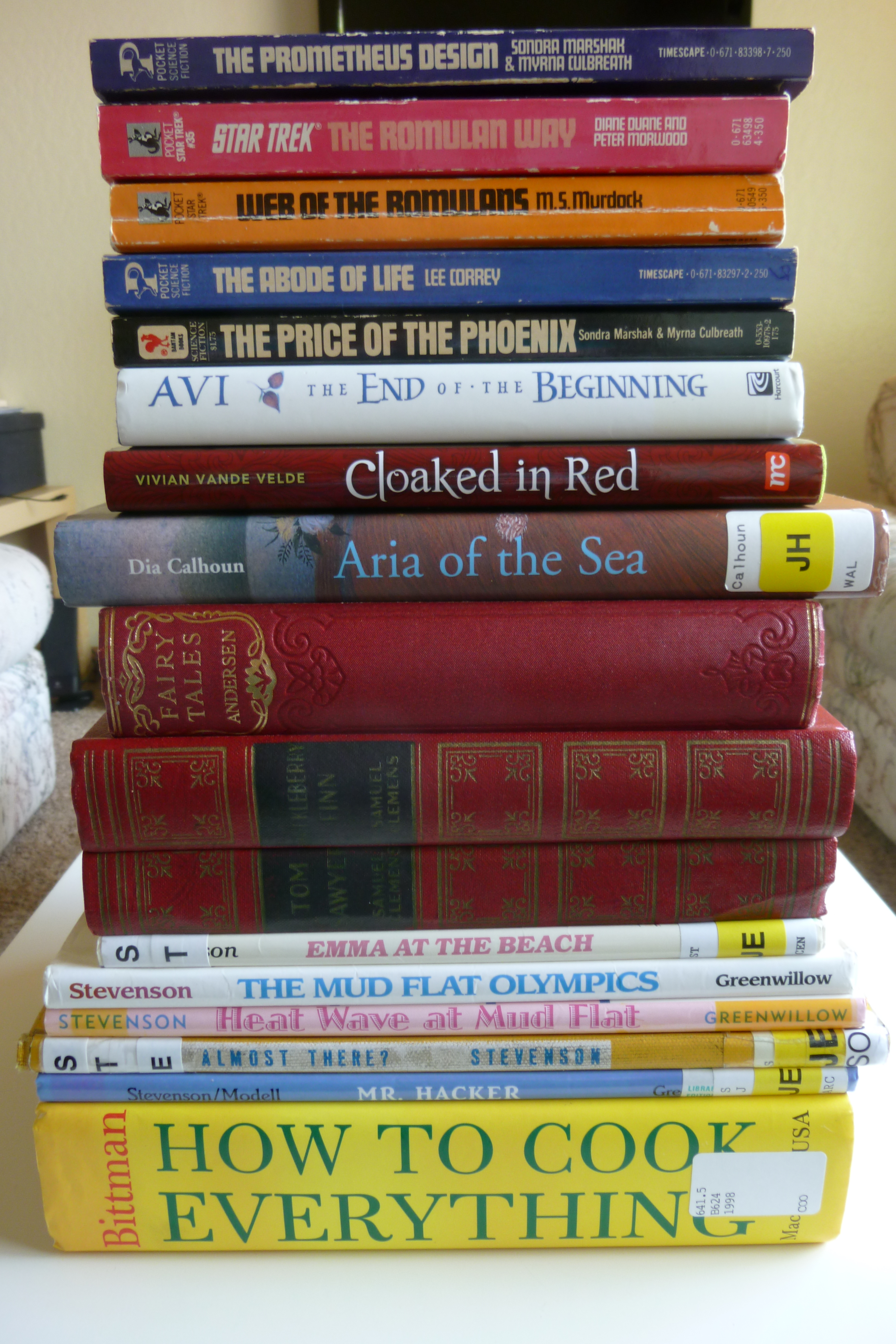
That’s 17 books, for a total price of…$19.50.
I LOVE the Library Warehouse Sale. It’s literally a warehouse full of books. The library opens it up every two months or so, and I usually try to make it over to spend a couple of hours wandering the shelves. The selection is good and the prices are amazing, between 50 cents and two dollars. I shop used book stores a lot, so I have a pretty good idea how much all of this would have cost somewhere else…I’d say a fairly conservative estimate puts the value around a hundred dollars, for the same copies elsewhere.
Definitely a good deal, and plenty of hidden treasure in among all those shelves! At the top I have five new-to-me original Star Trek books; I’ve been hunting, not very successfully, for good ones to try, so these were excellent finds. Under those, AVI and Vivian Vande Velde with two books I know are excellent (and in like-new condition), and Aria of the Sea somehow lured me in even though I almost never buy unread books (barring a series like Star Trek, or a reliable author like Burroughs).
I have the complete Grimms, but no Andersen, so that lovely old copy was a great find. I’ve been hunting (not very successfully!) for a copy of Huckleberry Finn ever since my copy fell apart–I swear I saw them everywhere until I actually needed to buy a copy. This one smells amazing, all old book musty, and when I saw there was a matching copy of Tom Sawyer I couldn’t resist them both.
I poked through the picture books for treasures and decided to expand my James Stevenson collection, resulting in the five you see up there. He wrote and illustrated the Grandpa and Uncle Wainey series, and is wonderfully clever. I appreciate good stories regardless of target age group.
And the behemoth at the bottom, How to Cook Everything by Mark Bittman. I already had the abridged version and know he’s excellent, so I thought I’d just go for the complete one.
So there you have it–book loot! I can always rely on the Library Warehouse Sale to overfill my bookshelves, and let me check off a few more favorite books I’ve been meaning to buy. Anyone else have favorite places they go to look for bookish treasure?
And check out At Home with Books for more Saturday Snapshots!
Because it’s spring and I’m greatly enjoying the Once Upon a Time Challenge, I thought I’d post a fairy tale Fiction Friday this week. This is a short retelling of Cinderella, which I posted about a year ago but thought I’d share again. This started out as a Spanish class assignment, which I rewrote and expanded in English. It has much of the same mentality that eventually led me to write novel-length retellings of fairy tales…
**********************************
Once upon a time in a far off kingdom there lived a maiden who was very beautiful and very kind. Fairy tales always begin the same way, and the maidens are always very beautiful and very kind. Often their name is Ella, as was the case for the maiden we’re talking about. This particular maiden, as do most of them, had long blond hair, very fair skin and eyes of the deepest blue. She didn’t have any initiative, spirit or goals for her life.

