Author: cherylmahoney
I'm a book review blogger and writer. I have published four novels, The Wanderers; The Storyteller and Her Sisters; and The People the Fairies Forget; and The Lioness and the Spellspinners. All can be found on Amazon as an ebook and paperback. In my day job, I'm a Marketing Specialist. Find me on Twitter (@MarvelousTales) and GoodReads (MarvelousTales).
A Maybe-Monster, and a Monster-To-Be
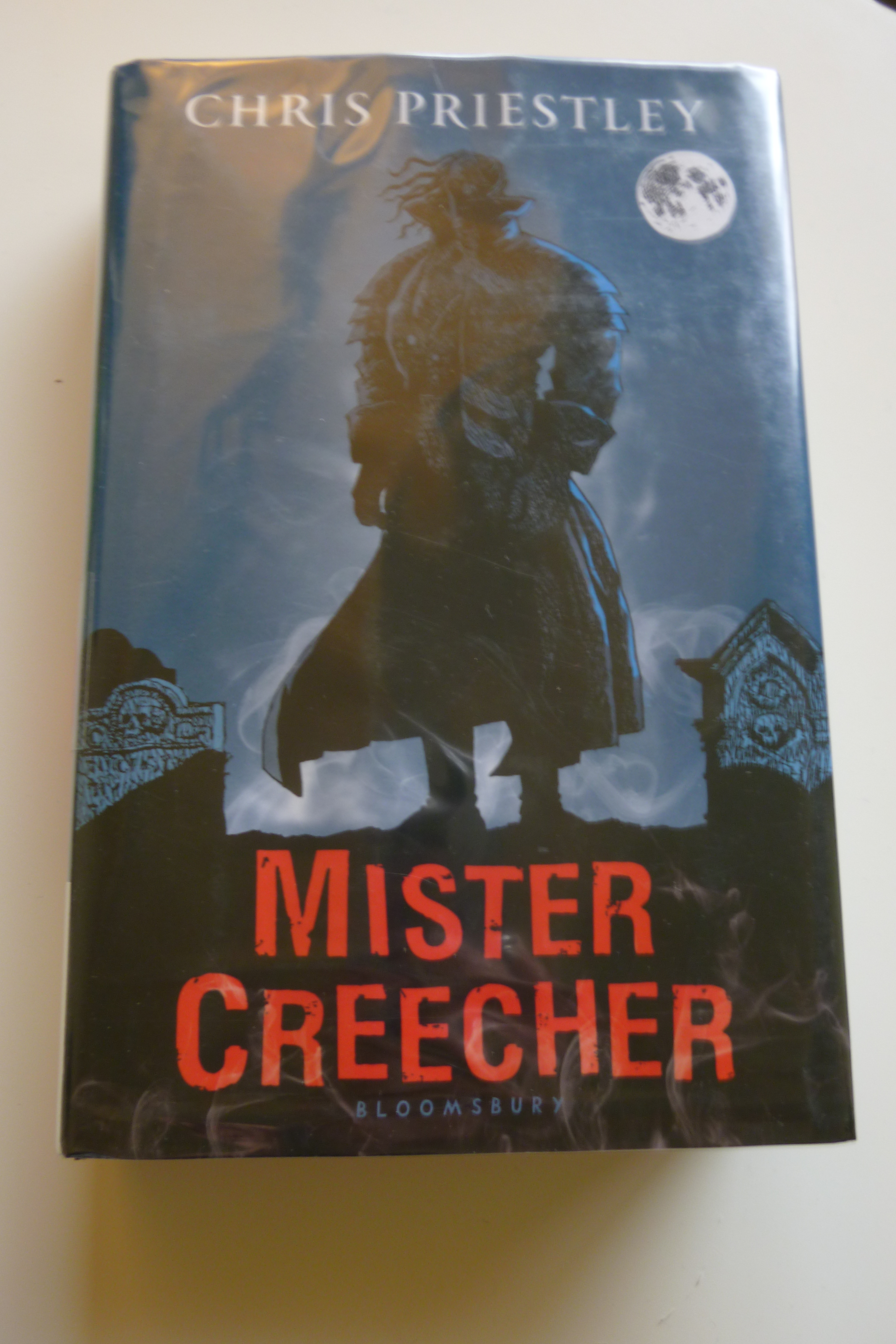 Mister Creecher by Chris Priestley, like Wicked, is another novel that takes characters from a familiar source and reimagines parts of their lives. I read this one with the Sci Fi Experience in mind, although the library stuck a “Horror” sticker on the spine. I guess it’s either–or both.
It’s a story about Frankenstein’s creature (see what Priestley did with the title there? 🙂 ), midway through Mary Shelley’s Frankenstein. The story is from the point of view of Billy, an orphan pickpocket on the streets of London, who one dark night tries to pick the pockets of a dead body–only to have the body get up. Billy and “Mr. Creecher” are thrown together by circumstances briefly, and then because Creecher wants Billy’s help to follow someone–Victor Frankenstein, who has promised to build Creecher a mate. Partially through fear and partially through avarice, Billy finds himself pulled into a situation that is far stranger and darker than he expected.
This was an odd reading experience, because I enjoyed it while I was reading it. And then I thought about it afterwards and decided the whole thing didn’t really work. Most of the book is about the wary friendship that grows between Billy and Creecher. It’s about Billy growing out of the scared pickpocket he was, and, we hope, into a better life. Except…
Slight spoiler here. I won’t tell you details, but I will tell you that both the friendship and Billy’s growth make an abrupt U-turn in the last portion of the book. In a way it’s necessary–the creature’s tragedy is that he’s alone. He has to be alone. Having a genuine friend just won’t work. And Billy turns out to be from another piece of classic literature, which is very clever–except that it means I’ve spent a whole book getting to like someone, who eventually grows up to be a character I’ve always hated (and still do). I just don’t know how to feel about that. Perhaps it was meant to be a new look at two monsters from literature.
Another problem is that this book is only the middle part of Frankenstein. Nothing really happens except for following Victor Frankenstein around England. So if the book isn’t about the creature finding a friend, and if it isn’t about Billy growing into a better person, and if it doesn’t cover any of the major events of Frankenstein…what IS it about? And that, much as I enjoyed reading it while I was reading it, is the question I can’t answer.
It’s too bad, because I loved the premise. I’ve read Frankenstein, and even though I really liked it, Victor is one of the few first-person narrators I’ve ever absolutely hated. Frankenstein from a different point of view, especially one more sympathetic to the creature, sounds great! I’m just not so sure about where the book actually decided to go.
On the positive side, for most of the book Creecher and Billy were both very good characters. I’m impressed by how Priestley handled the creature. I thought it was very true to the original, who was complicated. It would be easy to either make him nice and purely sympathetic, or to make him the shambling, near-brainless mute of the movies. Instead, Priestley kept him complicated. He’s very intelligent, well-spoken, and is even reading Jane Austen at one point. He’s deeply saddened that everyone rejects him, and he longs for companionship. At the same time, he has a serious temper that is easily aroused, and when he’s angry, he thinks very little of killing people. Complicated, and very well-drawn.
Billy is complicated too–he’s had some really, really rotten luck in his life, but he’s also not totally a victim in his circumstances. He was forced into a thief’s life because he had no other options, but he also enjoys robbing people, and he isn’t too scrupulous about it (he’s really not Robin Hood). He’s thrilled that Creecher is the perfect thief’s assistant, and actually pushes Creecher into helping him rob people. One of my favorite moments of the book was when Billy is feeling upset about something, and Creecher asks him if he’d feel better if they robbed someone (answer: yes). Billy has a complicated relationship with Creecher too, as his feelings fluctuate frequently. Billy has some cynicism and some darkness, but mostly he’s sympathetic. I will tell you that the person he turns out to be is NOT.
Maybe this was meant to be a kind of Anakin-Skywalker-to-Darth-Vader story, the birth of a villain instead of the birth of a hero. But most of the book didn’t seem to have Billy on that trajectory, and when he did finally turn to the Dark Side, so to speak, it felt more contrived than not.
One thing that was fun about this book–Mary and Percy Shelley have cameos, and were probably the happiest people in the novel. They were a fun little addition.
But really, the whole book was enjoyable–until I try to make any sense out of the wandering plot and the bizarre character turns. We had a raging debate last month about my issues with Ender’s Game. I have a feeling less people have read Mister Creecher, but if you have, and if you know what it was about, please let me know!
Author’s Site: http://chrispriestley.blogspot.com/
Other reviews (I actually found a LOT):
Bride of the Book God
The Excelsior File (contains spoilers!)
Becky’s Book Reviews
Shelly’s Book Blog
SisterSpooky
And there are others–let me know if one of them is yours and I’ll add it!
Wicked, Sans Singing

In January, my book club read Wicked by Gregory Maguire. Funnily enough, this was my second time reading it for a book club. My high school book club read it too–although I think if the teacher had read it beforehand, we wouldn’t have. To settle one question right away, this is not a young adult book–don’t let the picture of the witch or the Oz connection fool you.
Wicked tells the backstory of Elphaba, the Wicked Witch of the West. If you think you know about the book because you’ve seen the musical, trust me, you don’t. The two are really only similar in very broad strokes. Elphaba is a girl who was born with green skin, to the consternation of her family. In college, she finds herself rooming with Glinda, a bubbly society queen. After initial dislike, the two form an unlikely friendship. Later on as adults, they both end up using magic in positions of power over sectors of Oz…and one day a girl named Dorothy falls out of the sky to impact both their lives.
The musical tells the story above. The book does too…but it takes some 500 pages about it, and crams a whole lot more in. As you may guess already, I had troubles with this book. I feel a little more on uncertain ground when I criticize a book that is clearly very popular, so let me preface it this way–these were my problems with the book. If someone else found it brilliant, insightful and life-changing, I accept your opinion. But this is how it came off to me.
Part of the problem was in the characters, which may come down to point of view. It’s hundreds of pages before we actually get into Elphaba’s point of view. Maguire has a disconcerting habit of spending 90 pages from the POV of a particular character, only to then have them completely or nearly disappear from the story as soon as their section is done. Result: even though this is the backstory of the Wicked Witch, it still felt hard to get any sense of her character, of her motivations, of her hopes, dreams and desires…and so on. For me, the musical does it all in two songs: “The Wizard and I” and “Defying Gravity.” The book is 500 pages and doesn’t do it as well. (And also, I don’t think the book-Elphaba would sing either of those songs.)
Another problem is focus. Part of our book club discussion (in January, not in high school) was about what Maguire’s purpose was in the book. It really seems to not be the characters at all. In many ways he seems far more interested in examining the meaning of good and evil, and the politics of life in Oz–the conflicting religions, the issues of Animal rights (not the same as animal rights), the folklore of history and the questionable rule of the Wizard. All of these are perfectly good elements…but leave something to be desired as the primary focus of a very long book. It ended up feeling scattered to me, with too many plot threads and minor characters, interwoven with politics and philosophy.
Maguire was clever in some of the ways he built off of Oz–the green skin, the aversion to water, the talking animals and the tiktok creatures. Some of it is from the movie, some of it is from the book series, and some of it really is clever. Some of it is also drawn from the real world and brings the book into a position of satire–which is some of that endless politics and philosophy, but some of it is fine.
And then there were parts that just seemed to be shock value, bringing me to another problem. This isn’t young adult partially for the philosophy but mostly because Maguire at times seemed to decide to be vulgar just for the sake of being vulgar. I really think the point was just to say, “this isn’t the Oz you think you know.” An adult Oz is fine–but gratuitous vulgarity is still gratuitous vulgarity, and there have to be better ways to say that this isn’t the land of sweetness and light that L. Frank Baum wrote about. Just like kids books can delve into deep issues, you can tell an adult story without making it inappropriate for kids.
The remaining big issue I have with the book vs. the musical is the relationship between Elphaba and Glinda. In the musical, they clearly are for each other that one best friend who forever changed them, and even if they haven’t seen each other in years they still have a bond. In the book, they’re both part of the same circle of friends, fond of each other but not in a soul-altering way, and years later they’re just a couple of former friends who had lost touch.
The musical narrows the story’s focus, concentrates on just a few characters and deepens their portrayals and their relationships with each other. The book is scattered all over the place, and while it has deep examinations of the meaning of evil and of Ozian politics, it doesn’t get very far with any characters. I still don’t feel like I fully understand the Wicked Witch’s motivations. At the end, Maguire pulls the “and then she goes crazy” card, and her final confrontation with Dorothy is just a confused semi-farce.
It’s too bad, really, because I LOVE the idea of telling the life story of the Wicked Witch of the West. I know the book is wildly popular, but I still feel it falls short of what might have been. I have no idea how anyone ever looked at the novel and thought it could be a musical, but I’m glad they did–because that’s the better place to go if you want the story of what happened before Dorothy got to Oz.
Author’s Site: http://www.gregorymaguire.com/home.html
Musical’s Site: http://www.wickedthemusical.com/page.php
Other reviews:
My Personal Cafe
Ermilia
Nikola’s Book Blog
Zombie Mechanics
Tell me about yours!
Saturday Snapshot: Times Square
I went looking through my photos for Saturday Snapshot this week, and hit on a much busier photo than last week: you don’t see many daffodils in Times Square!
 I love theater. It’s something about the performance happening right there in front of you, once and never precisely the same again, more fleeting than a movie or a TV show that you could keep returning to. I love taking trips to theater towns–that isn’t usually my reason for visiting whatever city it is, but I love when I can go somewhere with good theater.
In this picture, I love all the elements that got into a single shot–true to the busyness of Times Square! Front and center, of course, is the Phantom sign. I’ve seen Webber’s Phantom six times, which is why I feel I can say that every performance of a play, even the same play, really is different. I saw it on Broadway–second best performance.
You can just see a bit of Glinda in the Wicked sign next to the giant mask. I hadn’t seen Wicked yet when I took this picture, or I probably would have angled it differently! I hadn’t fallen for “Defying Gravity” yet (pun intended).
On the other side of the mask is the South Pacific sign. I saw that at Lincoln Center, with a really excellent Emile. I already had the movie soundtrack, but I bought his “This Nearly Was Mine” on iTunes when I got home.
I also got the Palace sign–according to Me and My Gal, the Palace was the promised land of the vaudeville performers. When you played there, you knew you had arrived.
And finally, you can see that in the city that never sleeps, McDonalds is open 24 hours a day!
Favorites Friday: Author Blogs
Somehow it never occurred to me to look for author blogs until I started writing a blog myself. One of the best parts of all this has been reading other people’s blogs, and it’s been so fun to find that several of my favorite authors have blogs. Today, here are some favorite ones from favorite authors, with links if you want to check them out.
 Patricia C. Wrede has a very valuable writing-focused blog. She posts Sundays and Wednesdays, and discusses both the craft of writing and the complexities of publishing. Most often I feel like I see either the art OR the business, so this is a great place to get information on both. She offers solid advice across a range of writing topics, gives funny examples at times, and makes references to her own books, which is always fun too.
 Gail Carson Levine also writes about writing, mostly the craft. I think her target age group is middle school, but her advice is good regardless of your age. The middle school aspect mostly comes out in that her writing prompts revolve around school or parents or topics like that. Levine posts every Wednesday, and while her topic is sometimes more basic than Wrede’s, she still drills into great areas and often gives me a new idea or a new angle on something (say, Point of View) that I felt like I already knew a lot about. She also makes frequent references to her own books and writing process; I’m fascinated by how writers write, so I love knowing that background to her books.
 Robin McKinley posts every day; her blog requires a certain amount of wading. She tends to write stream-of-consciousness about whatever is going on in her life, and some of it seems like it would have, er, niche appeal. I usually read her posts a week at a time, and I skim until I find a section that looks good. On the so-so (for me, at least) days, she talks about her knitting, her singing lessons, and the intricacies of bell-ringing. On better days, she talks about her garden, her hellhounds, and her fights with recalcitrant technology. On the best days, she talks about her writing. And then there was the Great Bat Catastrophe (my name for it) last spring, when she had bats nesting in her attic and finding ways through into her house…terrible for her, I’m sure, but so funny to read about.
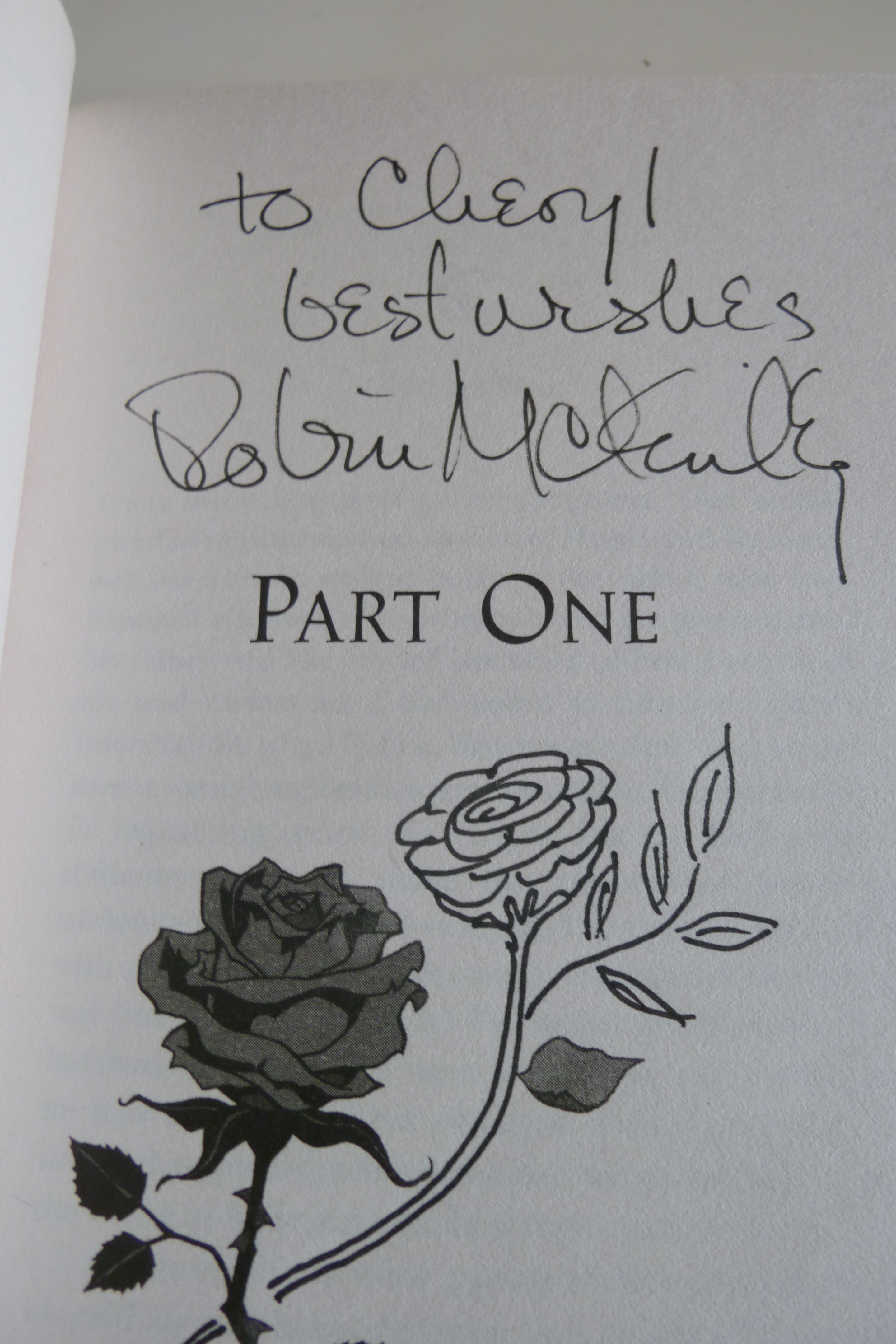 The thing with McKinley’s blog is–when she’s dull, she’s very dull (unless you’re interested in bell-ringing, perhaps). But when she’s good, she’s VERY good. The thing about reading blogs by favorite authors is that they’re good writers. McKinley can be very funny and very engaging, and once you’ve been reading for a while you get used to the groove of her life and it’s fun to stroll through. Then when I read her book Sunshine, I felt like I could see her personality coming through in the book, which added a whole new layer to it. And it’s great to be up on the key events in her writing–I knew about it when she switched the book she was working on, and I got to order a personally signed (and doodled) copy of Beauty when she had an auction!
Other favorite authors with blogs include Gordon Korman and Geraldine McCaughrean, but they post very rarely, and Tamora Pierce, who posts sporadically, usually about news items. I also hear good things about Neil Gaiman’s blog, though I haven’t followed him regularly.
Who are your favorite authors who blog? Or favorite blogs that are by authors? Almost the same thing…but maybe not always.

