A Servant’s Magic

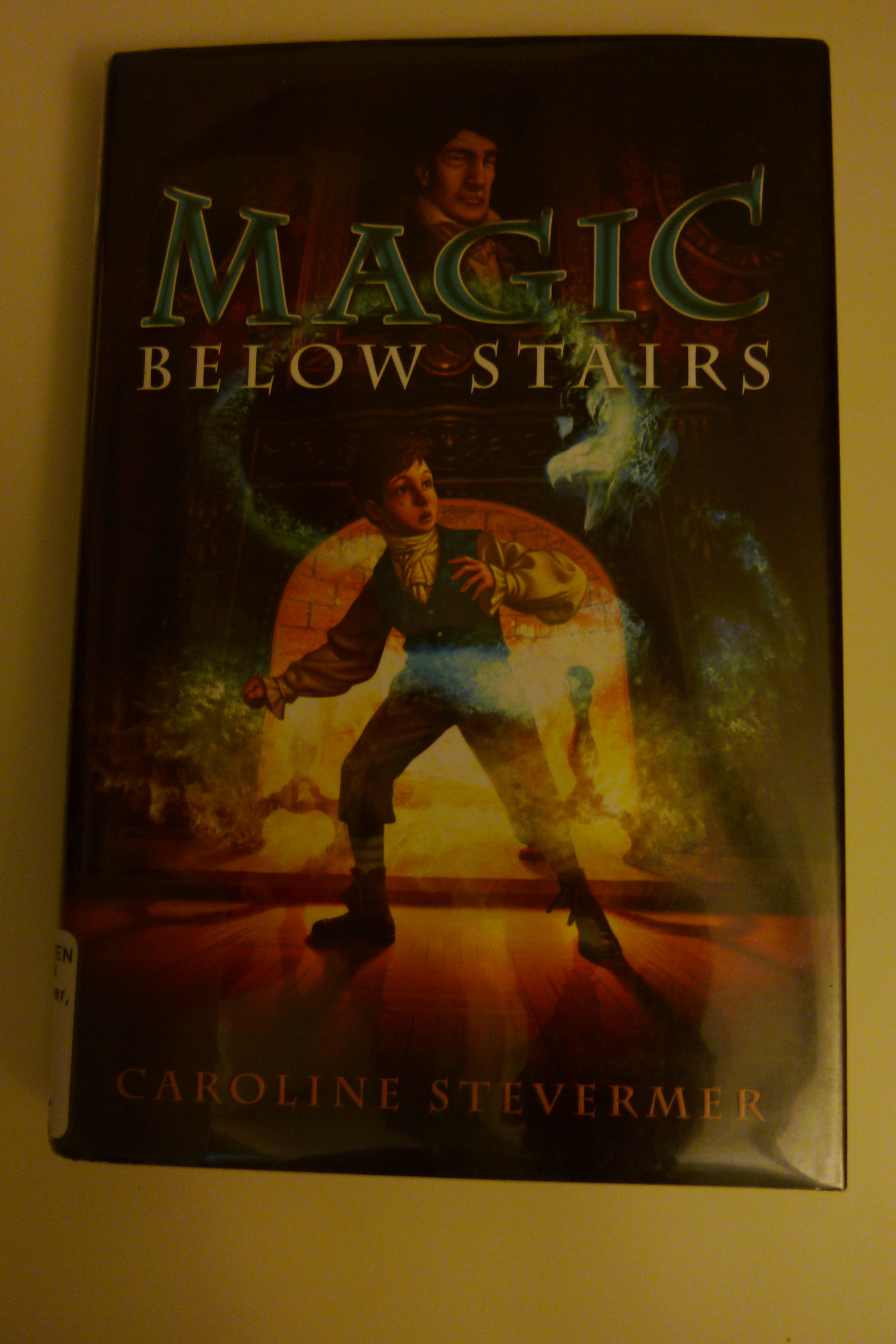
I love the Sorcery and Cecilia series by Patricia C. Wrede and Caroline Stevermer, so I was excited to stumble across a companion book recently.  Magic Below Stairs by Caroline Stevermer revisits the world of the series from a new point of view.  You don’t need to have read the rest of the series to enjoy this one, though I think it would add more meaning to some parts.

The series is about two women, Kate and Cecilia, who marry a couple of magicians, Thomas and James (respectively!)  They’re aristocracy of some sort; Magic Below Stairs comes from the other side of the social strata, and focuses on Frederick.  He notices strange happenings at the orphanage where he lives, and discovers that their cause is Billie Bly, a house brownie.  Billie Bly has attached himself to Frederick, and when Frederick is chosen to join Kate and Thomas’ household as a new servant, Billy Bly comes too–which Thomas does not appreciate at all.  Meanwhile, there’s also a nasty curse lying in wait.

This actually felt oddly like a Diana Wynne Jones book.  You have the earnest young boy, the absent-minded magician, and a looming threat.  And it’s all set in a grand English manor.

Stevermer’s website tells me this is set in Victorian Britain.  I’m not good at all at keeping straight different eras of British history (unless you give me an actual event to measure by–the Battle of Trafalgar, say, or the life of Shakespeare), so I just knew this was set somewhere back in the past when manor houses had entire staffs of servants hard at work below stairs.  Part of the fun of this book is seeing the world from that perspective.  This is especially true because this isn’t a book about the oppressed lower classes, which you do see sometimes.  The servants here actually seem a fairly contented lot who are fond of Thomas and Kate.

Saying that this reminded me of Diana Wynne Jones is a high compliment, of course.  🙂  This is a fairly short book without a huge amount of depth, but it’s a fun read with good characters and some nice humor at times.  And if you try it and enjoy it, you should definitely go on to the longer and more complicated Sorcery and Cecilia books!

Author’s Site: http://members.authorsguild.net/carolinestev/
Short Stories Near the Enchanted Forest

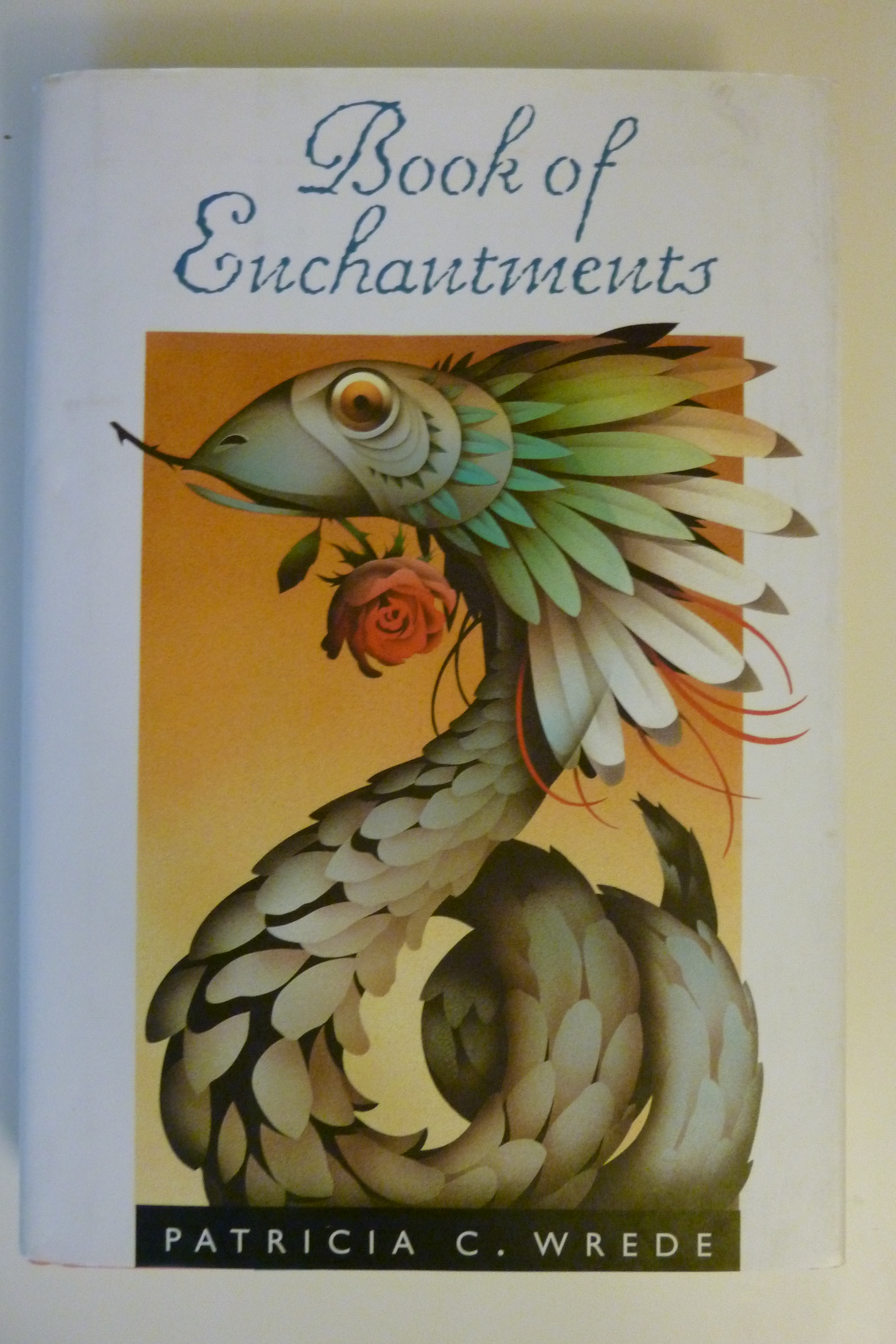
You may know that I’m a big fan of Patricia C. Wrede’s Enchanted Forest Chronicles.  I just recently bought another of her books–Book of Enchantments.  It’s a collection of short stories, and I’ve lost track of how many times I’ve read the library’s copy.

When it arrived in my mailbox, I went down the Table Contents.  I could vividly remember all but two stories, matching my memories to the titles–and I’m usually not good at remembering things like titles, especially when I haven’t read the book in probably a couple of years.

It’s a wonderful collection of stories.  They all deal with magic, but they vary widely in subject, setting and tone.  Some are funny; some are eerie; some are haunting.  And obviously, they’re memorable.

“Rikiki and the Wizard” has a fable-like quality to it, about Rikiki the blue chipmunk god, who’s obsessed with nuts (as a chipmunk naturally would be!)  “The Lorelei” combines a perfectly ordinary, modern student bus trip with the dangerous power of a siren.  “Cruel Sisters” and “Stronger than Time” both reimagine old fairy tales, bringing darkness but also more human characters.

Two of the stories are related to the Enchanted Forest Chronicles.  One, “Utensile Strength,” actually features major characters from the series, which is delightful simply in itself.  Combine familiar characters with a magical weapon called the Frying Pan of Doom, and I really don’t know how you could go wrong.  “The Princess, the Cat and the Unicorn” is less directly tied into the series, but it makes up for it by being amusing and lovely and a bit romantic.  It’s set in a magical kingdom where nothing goes quite right: “The magic carpet had a bad case of moths and the King’s prized seven-league boots only went five-and-a-half leagues at a step (six leagues, with a good tailwind).”  It has all the charm of the Enchanted Forest Chronicles, gently poking fun at how fairy tales are supposed to be.

Two of my favorites (aside from the two above) are very different from each other.  “The Sixty-Two Curses of Caliph Arenschadd” is about a caliph who works his way through a list of curses whenever anyone displeases him.  Most of the curses are funny, like turning people green or giving them monkey paws.  The story centers on the daughter of the Caliph’s grand vizier, who has to figure out a way around the worst curse of all.

“Roses by Moonlight” is set in the present day.  Adrian, a teenager, is unhappy with her life, jealous and resentful of her perfect younger sister Samantha.  One night a mysterious woman invites her for a walk in the garden, and Adrian finds herself in a rose garden she never saw before.  Adrian realizes that each rose she smells gives her a vision of a different future.  The woman tells her that she may pick one rose…  There’s something haunting about the idea of a garden of possibilities, letting you see all that could be, and then giving you the chance to choose your life by reaching out and plucking a flower.

But obviously they’ve all stuck with me to a greater or lesser extent.  Try the book–maybe they’ll stick with you!

Author’s Site: http://pcwrede.com/index.html

Killing Rutland

I have a confession: I love shrieking Shakespeare.  And I think there are not enough opportunities to do this.  I have had some good moments of very loud Shakespeare because I was very lucky in high school to be part of Shakespeare Society.  Many of my best memories in high school involve Mr. Shakespeare in some way.  🙂

I took an Experimental Fiction class in college, and decided to write a rather tongue-in-cheek story about my experiences with Shakespeare Society, and especially one favorite scene I enjoyed performing.  Because it was an experimental class, I wrote it in iambic pentameter–with footnotes!

I’m not sure how easy it’s going to be to handle footnotes on a blog, but…well, if it’s good enough for Robin McKinley, it’s worth a shot, right?  Sorry if you have to scroll up and down a lot!

***************************

Killing Rutland

Have you ever shrieked out “Plantagenet”[1]

To the unhearing skies[2] stretching above?

I have because I am[3] a proud member

In my high school’s Shakespeare Society.[4]

Continue reading “Killing Rutland”

Every Book You Ever Read…

This is something in between a book review and a reflection–a reflection prompted by a specific book.  I read The Night Bookmobile by Audrey Niffenegger, after seeing it reviewed on two different blogs I follow.  It’s a very short graphic novel, almost a picture book for adults–but, despite outer appearance, not appropriate for children, mostly because of the ending.  The story follows Liz, who becomes so obsessed with reading that it takes over her life.  This begins when she encounters the Night Bookmobile, a traveling library that holds every book she has ever read, from childhood to the book she’s reading now.  The Night Bookmobile only appears sporadically, and she’s consumed with the desire to find it again.

A few quick comments on my thoughts on the book: I hated the ending, which I probably should have expected since I hated the ending (really the second half) of Niffenegger’s Time Traveler’s Wife too.  I couldn’t figure out the point–I think this was a warning about letting books consume your life, so I kept waiting for Liz to have a revelation…and instead it kind of worked out for her.  In a twisted way.  And despite her consuming obsession with the Night Bookmobile, I didn’t think she was really utilizing it to its potential; all she does when she finds it is vaguely wander the shelves and think how nice it is to see books she remembers reading.  You can do that at a library or a bookstore; you don’t need a magical bookmobile.

So much for the review part.  As to the reflection–I love the premise.  Not anything about Liz, but the idea of a magical library, mobile or otherwise, that holds everything you ever read…I want one of those!  But I wouldn’t waste time smiling at old editions of L. M. Montgomery books.  I can walk over to my own bookcase right now and do that.  I’d want to find the books I’ve forgotten about.  Or not exactly the ones I’ve forgotten–the ones I just barely remember.  The ones I read when I was six or nine or fourteen, and I remember a character or an incident or a little snatch of the plot, but not the title or the author or a character’s name.  In other words, nothing that will help me find it now.

Once a teacher read us a book aloud–it was about kids who went through a tunnel and ended up in this valley where there were cave people and dinosaurs.  They were hailed as gods and fought a T-Rex.  My family went on vacation (it was a summer program) just as we were getting to the end of the book, and the class finished it while we were gone.  So I never heard the ending, and I haven’t the faintest idea of the title.  I’ve tried a bit of Google searching, but I’ve never been able to find it.  I’d be searching the bookmobile for that one.

And I’d be in there with a pen and paper so I could write titles down.  I started keeping a  book journal my senior year of high school, and I wish I’d started a dozen or so years earlier.  The bookmobile would help me fill in a lot of gaps.

The bookmobile also has a librarian.  I’m not sure how I’d feel about that, about someone metaphorically peering over my shoulder to look at everything I read.  I’m not reading anything particularly embarrassing, but I wonder if it would make me self-conscious?  If I’d feel more of an impetus to read “impressive” things like Hardy and Dickens.  In a way I suppose it’s not unlike a book review blog–but this blog doesn’t record everything I’m reading.  I follow other bloggers who do review everything they read, so perhaps they’d know more what it would be like.

As to the theme of reading taking over your life, I’m sure it can happen, but I think it’s equally possible to be an enthusiastic reader without losing touch with the rest of the world.  I think I resent a bit the implication that reading cuts you off from the world.  I’ve bonded with and even met friends because of shared interest in books.  And reading doesn’t have to stop you from living.

I always think of reading as a way to live a thousand lives instead of just one.  Why stay only in this world when you can go to so many others?  Maybe it’s particularly apt for me because I read so much fiction, and so much of it fantasy, or otherwise very different from the world around me.  But having a rich inner book-life doesn’t mean I’m not living my outer life too.

So I didn’t particularly like The Night Bookmobile.  But it did prompt a lot of thoughts about reading.

The Secret Lives of Rabbits

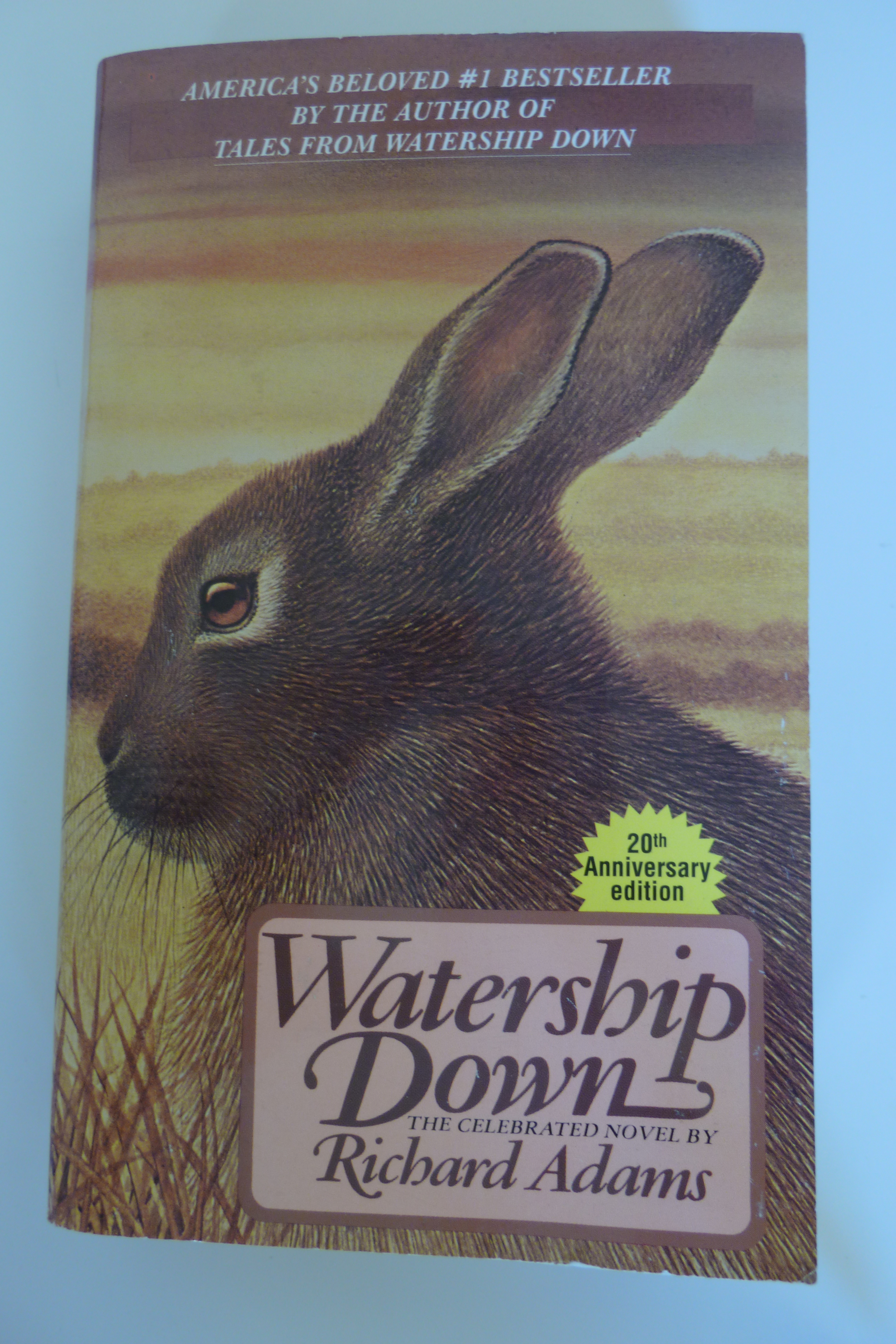
I didn’t mean to do a trend this week, it just happened…and then I couldn’t resist the title.  Actually, it’s not much of a trend, because Watership Down by Richard Adams has nearly nothing in common with The Great Good Thing.  No princesses–rabbits instead.

I have a feeling the story is fairly well-known, but here’s a quick recap anyhow.  Watership Down is the story of a group of rabbits who flee their warren, led by Hazel and guided by Fiver’s premonitions.  Through a series of adventures, they establish a new warren on Watership Down.  Along the way, they tell stories about El-ahrairah, a mythical figure who resembles Brer Rabbit and is the father of all rabbits.

I enjoyed this book on almost every level.  I liked the characters, especially Hazel, Fiver and their friend Bigwig (so named for the shock of fur on his head), although many of the more minor characters were well-developed too.  The adventures, especially in the later parts of the book, were exciting ones.  And I loved reading about how the rabbits lived their lives, a mix of science and anthropomorphising.  I’m fascinated by world building and by survival in foreign circumstances, and there was a bit of both in this.

One part that did bother me (and it turns out to be the same issue as in The Great Good Thing, randomly enough) was a total lack of romance–or of much in the way of female characters, for that matter.  I’ve read few books that were this male-dominated, outside of stories set on a British Navy ship.  I love strong female characters, but I can be okay with a mostly-male world, if it feels natural.  The trouble here is, the entire second half of the book is driven by the male rabbits’ realization that they’ve started a new warren without a single female (doe), and had better do something about that if they want to survive.  It would be so easy to have a romance.  There were even a couple of nice does who had a glimmer of character, and who could have been so much more.

Now, before the objection is raised–I know, I know, they’re rabbits.  So what if they only think about does in the context of breeding?  I know–rabbits.  However, they’ve been anthropomorphised in every other way.  They have an organized society, they tell stories, they play games, they clearly have meaningful relationships between brothers or between friends, and it’s even mentioned that sometimes mating pairs are devoted to each other.  But any romance is left completely undeveloped, and we don’t even know how most of them end up pairing off.  Nor does it help that the bucks have names like Dandelion and Holly, easy to say, while the does are mostly named things like Hyzenthlay and Thethuthinnang.  It’s kind of surprising, when apparently the book started as stories Adams was telling his daughters.

Well, now that I’ve gone on about what bothered me, let me backtrack and repeat that it really is an excellent book.  I feel like it might have been more, where the female characters are concerned, but it’s not really a fatal flaw.  It’s still a good read, and well-worth exploring.