A Writing Lesson from Barry Manilow’s “Mandy”

As you learned from my recent review of 15 Minutes, I’m a Barry Manilow fan.  Much as I love 15 Minutes, one thing I thought it was missing was a really good “loved her and lost her” song at the climax of the story arc–and I commented that it’s not as though Barry doesn’t have plenty of songs like that to choose from.

That got me wondering about just how many he does have.  And in the process, I think I discovered a great example of a good lesson in writing.

I don’t have access to every Barry Manilow song, so I can’t give you a definitive answer, but I can tell you how many I have.  I have about 170 songs sung by Barry Manilow, probably around 140 of them original. I went through my collection to pull out all the “loved and lost” songs, using a fairly strict criteria.  Essentially: the storyline of the song is that two people were at some point happily in love; somehow things went awry, and now the singer is singing from a perspective of still loving a girl he has lost.

And the total count: thirty-eight songs.  That’s about 20% of my total Barry Manilow collection.

Of course there’s an obvious gibe here that Barry only ever sings one kind of song (which isn’t even true–after all, I have over 130 songs with a different storyline) but the point I actually want to make is how impressed I am by this–because that’s thirty-eight very different songs, all playing off of the same essential story.  I don’t know whether to compliment Barry or his lyricist, but either way–I am impressed.

Somewhere I read that there are no new stories.  It’s also been said that there are really only seven stories in the world.  So what’s the lesson for a writer, looking for something original?  It’s all in what you do with the story–how you interpret it–how you can put a different angle on it.

Let’s look at some of those “loved and lost” songs, and all the different angles.  There is, of course, the classic, “Mandy.”  Mandy used to be there for him, he got “caught up in a world of uphill climbing,” sent her away and now he realizes “I need you today, oh Mandy.”  A straight-forward tale of regret, loneliness and lost love.

Sometimes the singer has found someone new, but “Even Now” yearns for the girl he used to have.   Possibly he sought out this second girl in the interest of being “Lonely Together,” but I think she ought to pay some attention to “If I Should Love Again,” with its dreadful lines, “Although I hold her close, and want her now and then, I’ll still be loving you, if I should love again.”

At least one song borders on suicidal, with nothing to do but “Lay Me Down,” while other times there’s confident hope that “Somewhere Down the Road” they’ll be together again.  The romance in “London” apparently ended amicably but still leaves him wistful, while there may be a girl waiting for him “In Some Bar by the Harbor.”

Sometimes we see the romance still falling apart, and might yet be saved.  He feels that “We’re Losing Touch” but suggests, “Let’s Take Some Time to Say Good-bye,” and if she’d just “Talk to Me,” it all might work out.  Especially if he starts playing “The Old Songs.”

You can also find love lost at the holidays.  I have one Barry Manilow Christmas CD, and even there the same theme recurs.  It’s bleak December, but he remembers “When the Meadow Was Blooming” and they were together, and “The Bells of Christmas” are ringing for a past romance.  I also have to make a comment on “I Guess There Ain’t No Santa Claus.”  I don’t technically include this one in my list–the singer is clearly alone and lonely, but I can’t find any indication he was ever in love in the past.  It does, however, contain some real gems of lines, like “Sugar plums in my head, only me in my bed,” and “They sure got it right when they sing ‘Silent Night.'”

Occasionally the focus is on “Where Do I Go From Here?” when “I Don’t Want to Walk Without You,” and in fact, “I Can’t Smile Without You.”  Alas, sometimes, “When Love Is Gone,” all you can do is say, “Good-bye My Love.”

Point made?  🙂 Trust me when I say that this just scratches the surface.  One essential story line.  Thirty-eight songs.  Thirty-eight different angles on one theme.

Some things can get over-done, of course.  I think an awful lot of angles on paranormal teen romance have been explored recently.  But it’s still something to think about.  Writers sometimes beat themselves up looking for a new story–when maybe what they really need is a new angle on an old story.
Stranded with a Talking Mouse

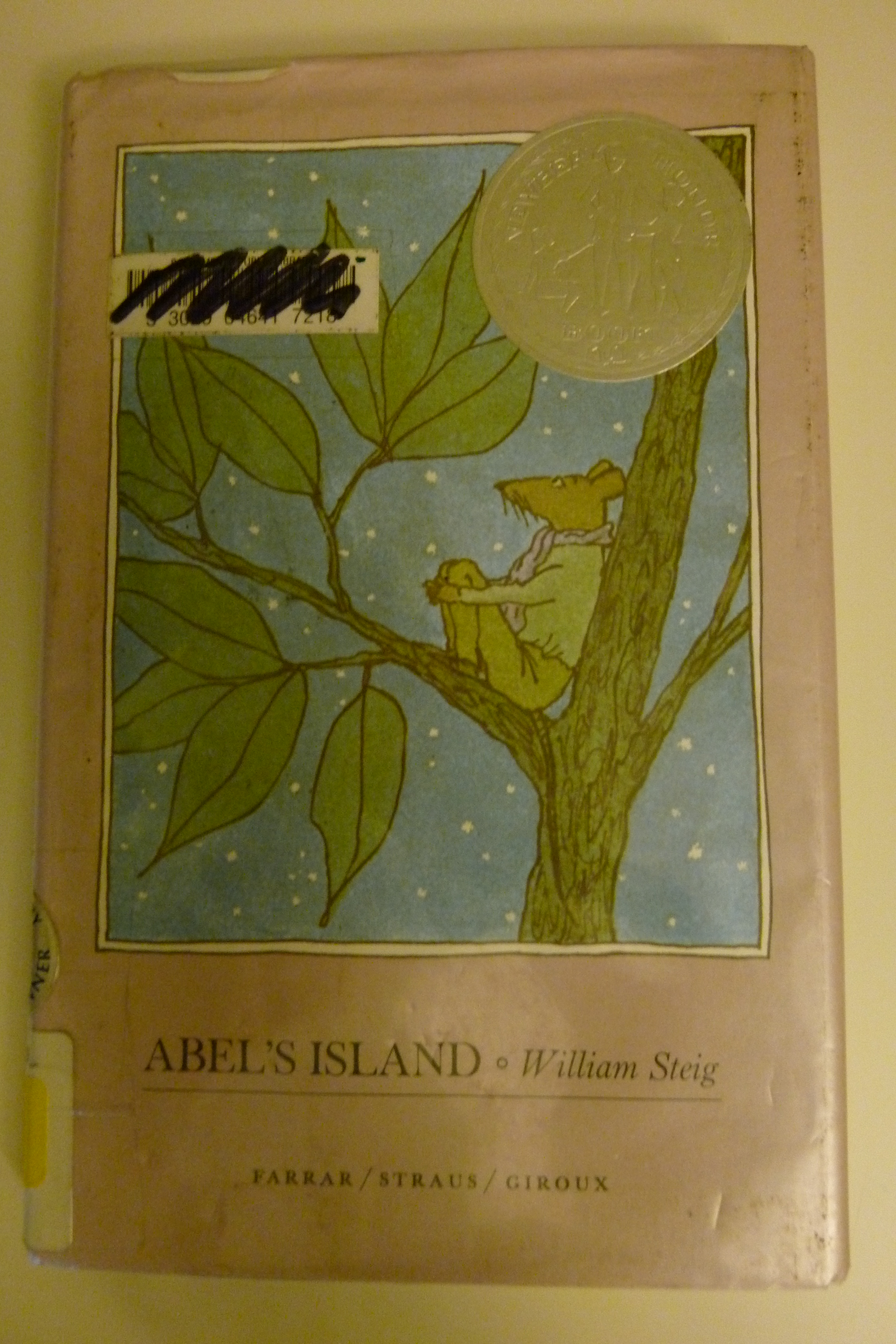
It’s funny the books that stay with you.  I remember around about third grade (maybe, I don’t remember that part for sure) we had to do a certain number of book reports during the school year, maybe per month.  I don’t remember if I found that challenging, but I doubt it.  🙂  I also don’t remember any of the books I did for this, except one: Abel’s Island by William Steig.  For whatever reason, that one stuck.

Although I don’t think it was until I reread it last week that I made the connection–William Steig!  The one who did a bunch of picture books!  You know, Doctor De Soto and Sylvester and the Magic Pebble (and he also has the happy good fortune of being alphabetically near James Stevenson, my favorite picture book author).  Yet another advantage of revisiting childhood favorites.

By all means check out the picture books, but for now, back to Abel’s Island.  Abel is a mouse, who lives in a fairly modern society with other mice.  They have clothes and towns and jobs–although Abel doesn’t have a job himself, because his mother has money.  Abel and his wife Amanda go out for a picnic in the woods one day.  When a storm comes up, Abel is literally blown away.  He’s carried down a stream and ends up on a small island in the middle of the river.  And there he stays, unable to signal help or to build a craft which will survive the river’s current and carry him to the opposite shore.

Abel has to figure out how to survive on the island, taking care of his physical needs and, even more so, struggling to deal with his intellectual and social needs.  I suppose it’s a bit of a Robinson Crusoe story, but a lot shorter and more interesting!

I’m trying to remember what I liked best about the book when I was a kid, and it may have been the survival aspect.  Now, it’s Abel’s internal growth.  His time on the island strips away all the clutter and the defenses that society normally gives us, and forces him to really look at himself in raw honesty.  He realizes how pointless his life has been, struggles with how he’s been living, and ultimately comes to a new realization about his calling.

Pretty deep stuff for a kids book, right?  😉  It’s handled fairly lightly, but the themes really are deep and universal.  Yet another example that makes me want to throw things when people say, “oh well, I didn’t expect much depth from it–it’s a kids book.”  A talking mouse can have an existential crisis too, and do it in a way that will make it a perfectly appropriate book for a third-grader.

I won’t swear that Abel’s Island is really vastly better than all those other books I read that I can’t remember anymore.  But it’s definitely a good one, and one worth remembering.

Oh, THAT’S What the Obelisk Is!

I’ve just finished reading the ABC of classic science fiction writers–Asimov, Bradbury and Clarke.  I’m not sure which is my favorite, although Asimov is the one I’m most likely to read more by.  For all of them, I felt I could really see their place in the science fiction canon.  It’s nice to go back and see the originals that have filtered out into the culture in references and inspirations.  Although I read novels by all three, all of them felt somewhat like short story collections.  Maybe it’s a product of being from a time when science fiction magazines publishing short stories were much more prevalent.  Anyway, I feel I have better geek cred now that I’ve read more of the classics–and also because I recently watched Firefly.

But today I actually wanted to talk about Arthur C. Clarke.  Or his novel, that is–I decided to read 2001: A Space Odyssey, mostly because I wanted to see if it made more sense than the movie.  Amazingly enough, it did!  It’s worth reading the book just for that–it’s like being handed the magic keys to unlock the secrets of this classic and utterly incomprehensible sci fi movie.

The book follows essentially the same path as the movie, beginning with primordial man, who sees a strange black obelisk one day, and then picks up a bone and discovers tool use.  But what the book tells you (and the movie doesn’t) is that the obelisk is an unmanned probe sent by highly advanced aliens who are seeking intelligent life.  They see potential in primordial man, and the obelisk actually helps him to discover tool use.

The book goes on as humanity leaps ahead to (a very advanced) year 2001, and discovers an obelisk on the moon.  The obelisk sends a message to Saturn (Jupiter, in the movie), and astronauts are sent out to see if anything received the message.  This gives us the best part of the story, as astronaut Dave battles with his shipboard computer, HAL, who seems to have gone insane.

That’s by far the most relatable part of the book.  When HAL receives a command at one point, he responds with, “I’m sorry, Dave, I’m afraid I can’t do that.”  I think that’s been the mantra of every computer since.  I can’t do this thing I’ve always done in the past.  No, I can’t explain it.  I just can’t.  I’ve been tempted to name every computer I’ve ever owned HAL, except I feel it would be asking for trouble.

2001 has some good moments, though it certainly isn’t a perfect book.  Even though it’s about the biggest moments in human history–the discovery of tools, the discovery of alien life–there are still long stretches where nothing much happens.  In that regard, the movie is significantly worse, but it’s an issue for the book too.

If the actual events dragged at times, at least the concepts of the book were fascinating.  I don’t know if they were ground-breaking at the time.  Despite what the cover quote says, I didn’t find it all that mind-bending; I’d already encountered a lot of the concepts by way of Star Trek–advanced aliens who have evolved into noncorporal beings, unmanned probes, aliens helping other races along on their evolutionary path, a future where Russians and Americans work together in space, travel by way of wormholes.  I don’t know if either influenced the other, or if they’re just sci fi archetypes, but there were definitely shared concepts.

The book is not big on humor.  The funniest part was in the introduction.  Clarke was writing about how pervasive 2001 has become, and mentioned talking to the astronauts who were the first ones to circle around to the far side of the moon.  They told him they had considered radioing back that they were seeing a giant black obelisk, but thought it would be ill-advised…

2001 is a good book if you want to delve into sci fi’s history, and even more so if you care about finding out WHY there was a baby floating in space at the end of the movie (there really is an explanation).  I enjoyed it for those reasons, but otherwise I’m lukewarm.  Though it does give me a great framework for relating to my computer.

Author’s site: http://www.arthurcclarke.net/

Favorites Friday: Book to Movie Adaptations

The book is always better than the movie.  Except once in a while when it’s not–sometimes they’re equally good, and on very rare occasions, the movie is actually better.  I’ve found that I probably shouldn’t watch movie versions of books I love, and if I want to try something new that’s in both formats, I should watch the movie first.  In many of the cases where I like both, I saw the movie before I ever picked up the book.

That’s my overall philosophy on this subject.  But for today, here are a few where the movie producers really did get it right.

Horatio Hornblower miniseries

This list is in no particular order, except that Horatio Hornblower has to come first.  I watched the miniseries with Ioan Gruffudd, then went on to C. S. Forrester’s books–and found out that all my favorite parts of the miniseries aren’t in the books!  By parts, I mean plot points, characters, and sometimes even themes.  Oddly enough, the creators of the miniseries managed to follow the books fairly closely–they just added in a bit here and a tweak there that made it so much better.  And I find Ioan’s Horatio so much more likable than Forrester’s Hornblower.

Gone with the Wind

In a way, the opposite of what happened with Horatio Hornblower–the movie took out great swathes of the book, but managed to zero in on the most essential parts.  Although I’m probably biased about what’s essential, since I saw the movie first.  In this case, I wound up liking them both.

The Wizard of Oz

I was obsessed with this movie when I was a kid.  I can’t remember when I first read the book, but it’s very different from the movie in a lot of ways, and I found that disappointing.  It could be that the movie spoiled the book for me.  I don’t really like Baum’s Wizard of Oz–but I love his later books in the series.  I can’t explain that, except that the movie probably affected my expectations.

Bridge to Terabithia

A rare case where I read the book first and still loved the movie.  A beautifully-rendered version of the book.  The characters were perfect, the plot was well-captured…well-done.
I ought to get around to buying it so I can give you a picture!

Hmm, short list.  Any good movies I’m missing?

A Human and Hideous Snow White

Reading A Tale of Two Castles put me in a mood to reread a favorite Gail Carson Levine book, Fairest.  Set in the same world as Ella Enchanted (and very loosely connected), this one is a retelling of Snow White.

The main character, Aza, has milky white skin, blood red lips, and coal black hair–the traditional Snow White.  Except that Levine takes this to its literal and logical conclusion.  Pay no attention to the cover–Aza is ugly.  As someone would be who had literally white skin, red lips, and black hair.  In her favor, Aza has a kind disposition, a loving family, and a magnificent singing voice.  She’s not a princess, but she ends up visiting the castle for the King’s wedding to his new bride, and finds herself caught up in intrigue–and intrigued by the handsome prince.

As with Ella Enchanted, Levine has given us a very clever, practical and creative retelling of a familiar fairy tale.  Many of the original elements are there, but reshaped.

Aza is the best part of this.  Besides the part about her appearance, she’s a wonderfully human character.  She’s not perfect, but she’s sympathetic.  She wants to do the right thing, but doesn’t know what to do in some difficult situations.  She has to find her own strength, and her own value.  She struggles a lot with her appearance, and sometimes gives in to temptations.  She’s both likable and realistically flawed.

This is definitely an excellent Snow White retelling–one of the few.  It occurred to me I hadn’t read many, and a recent search didn’t turn up much.  Anyone have a suggestion for another good retelling of Snow White?

Author’s Site: http://gailcarsonlevine.com/