Catching Up with Catching Fire

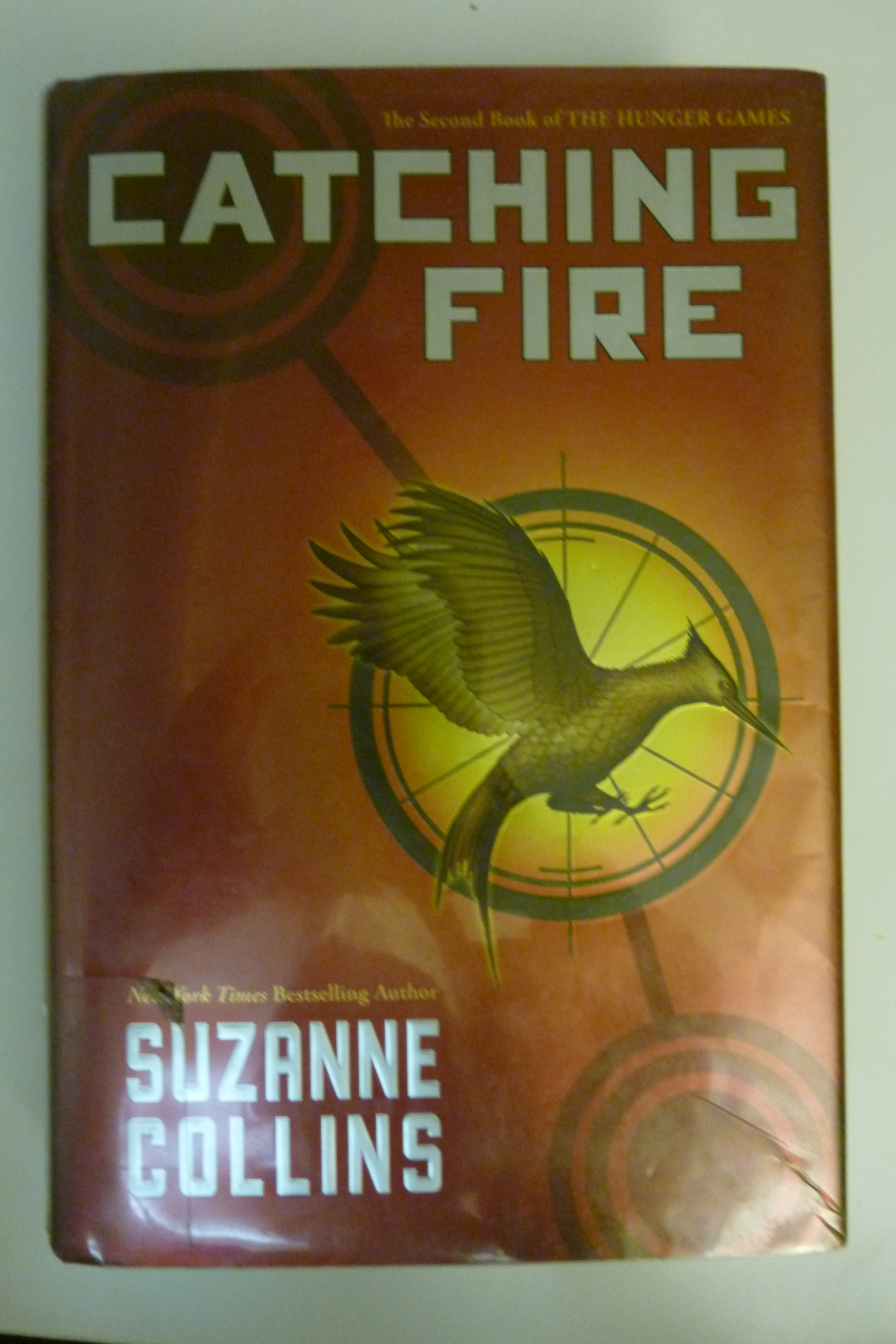
I just finished Book Two of the enormously popular Hunger Games trilogy, Catching Fire by Suzanne Collins.  Read my review of Book One here.  Be warned, there will be spoilers for the first book, going forward!

I enjoyed Catching Fire, and it had much of the same page-turning quality of the first book.  In fact, I was late for something because I wanted to finish reading the last chapter!  However, enjoyable as it was, it didn’t feel as strong as the first book.  My hope is that this is just the common fate of the Part Two’s of many trilogies.  The first one is new and different and introduces you to everything; the third one is the final epic battle.  The second one is doomed to be primarily a bridge between the two.

The book felt somewhat unfocused, and it may be because of everything it was trying to do, as that bridge for the trilogy.  It begins after Katniss and Peeta have returned to District 12 as the two victors of the Hunger Games.  Quite unintentionally on their part, their dual victory has become a symbol of resistance against the Capital.  The Districts are growing increasingly restless, with rumblings in some and actual uprisings in others.  The first part of the book is mostly about Katniss and Peeta’s attempt to carry on their (mostly) fake love affair, in an effort to present themselves as not at all trying to incite rebellion.  The second part of the book takes us through the 75th Hunger Games.  In the midst of it all, Katniss is still trying to choose between Gale and Peeta, and to decide if she even wants a romance with either, and to figure out how to keep the people she loves safe as the world gets even more precarious.

I think this book definitely succeeded in raising the stakes.  Between the beginnings of a revolution and the Capital’s much more targeted enmity towards Katniss, the scope of the conflicts seems larger.  The dangers feel bigger (and considering it was literally life and death before, that’s impressive).  The threats seem more far-reaching.  I never had to worry about Gale in the first book.  In the second book, anyone could be a victim.  In terms of building towards a climax in the third book, I think this book does do really well.

Catching Fire also carries on Collins’ skill at developing characters in pretty much no time at all.  We get to know some characters from the first book better, and get to meet a lot of interesting new characters too.

I was a little disappointed when it became clear we were going back to the arena for another round of the Hunger Games, because it felt too much like it would be a repeat.  In some ways it was, but it was also very different in very interesting ways–although I was hoping for more dramatic twists than actually developed.

As much as I liked a lot of the characters, I somehow liked Katniss less in this book, and I can’t quite put my finger on why.  Maybe it was that some of her reactions didn’t make her quite as sympathetic.  Maybe it was because there’s clearly something really big developing in terms of a revolution, and Katniss can’t quite seem to figure out how to engage with it, or even if she definitely wants to.  Maybe it’s that she still can’t quite commit definitely to Gale or Peeta, even though she has both time and opportunity (unlike in the first book).  Maybe it’s that she completely fails to see a clue to the twist ending that I found almost painfully obvious (though maybe that’s the author’s fault).  I still like Katniss–but something was a little bit off, and I wasn’t staunchly with her in the same way I was in the first book.  On the other hand, I might’ve liked Peeta better–except I can’t quite decide if he’s skirting too close to being too good.

I think it’s the unfocused plot and whatever it is that’s bothering me about Katniss that leads me to rank this one a bit below the first one.  But don’t get me wrong–it’s still better than a lot of other books!  I’m really hopeful for the conclusion to the trilogy.

And I will say this for Catching Fire–there’s a fantastic moment in here that is probably my favorite of the trilogy so far.  I don’t want to give it away for anyone who hasn’t read it, but for those who have–it’s the interviews with Caesar, especially Peeta’s.  Brilliant.

Author’s site: http://www.thehungergames.co.uk/
A Not-So-Charming Prince

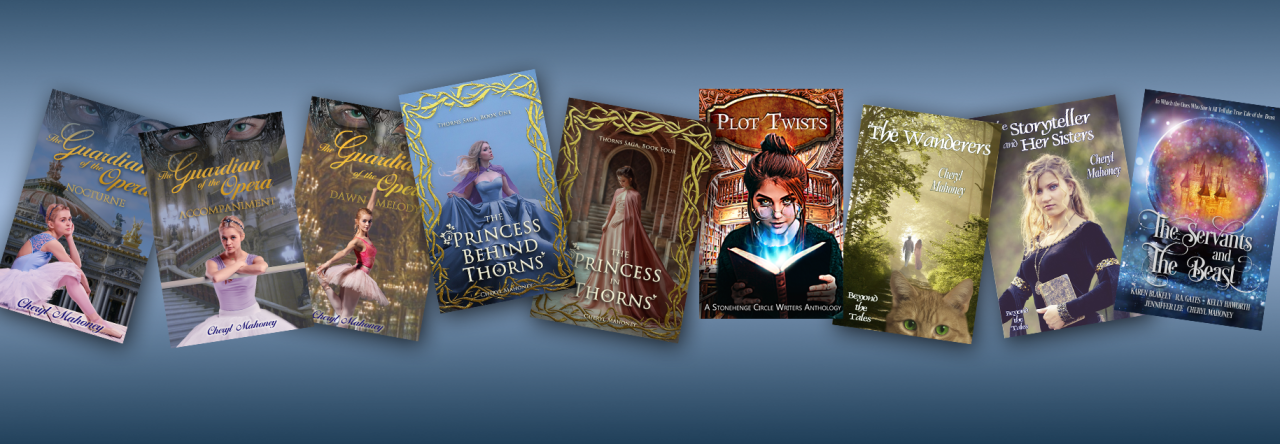
I haven’t shared an excerpt from The People the Fairies Forget recently, have I?  I was thinking it would be fun to introduce…well, he would be Cinderella’s Prince, if he ever manages to get the slipper on the right girl.  Prince Roderick was one of my favorite characters to write, and he seems to get strong reactions from people.  One of my friends is quite adamant that she’d like to hit him with a two-by-four.

Context for the scene below: my heroine, Catherine, was mistakenly carried off to the palace when Cinderella’s slipper fit her.  She’s been waiting around for the prince to come see her; he’s just arrived in this scene.  My fairy narrator, Tarragon, is also present, but invisible.

That should fill you in, but check out the People the Fairies Forget category for more background and other excerpts.

******************************

            Prince Roderick looked like everything a prince was supposed to be.  Tall and handsome and young.  He was wearing a multitude of gold braid and a rapturous expression that looked as carefully designed as the braid.  The expression dissolved away into petulance as soon as he saw Catherine.

“But you’re not the right girl,” he complained before she’d even completed a curtsy.

“That’s what I’ve been telling everyone,” Catherine said, looking vindicated.

Roderick turned to the smaller man with him.  “Leonard, she’s not the right one.”

I’d hardly noticed the smaller man when he had walked in with Roderick.  He was a thin man with long-fingered hands and a wisp of mustache.  His clothes and his hair and his eyes were all shades of vague pale brown, so that he almost blended into the background.  “How unfortunate, Your Highness,” he said smoothly.  “I can’t imagine how such a mistake could have occurred.  Clearly we should not have trusted the herald to handle such a delicate matter.”

The prince sighed deeply.  “Why is everyone always wasting my time like this?” Continue reading “A Not-So-Charming Prince”

A Brilliantly Mad Sherlock

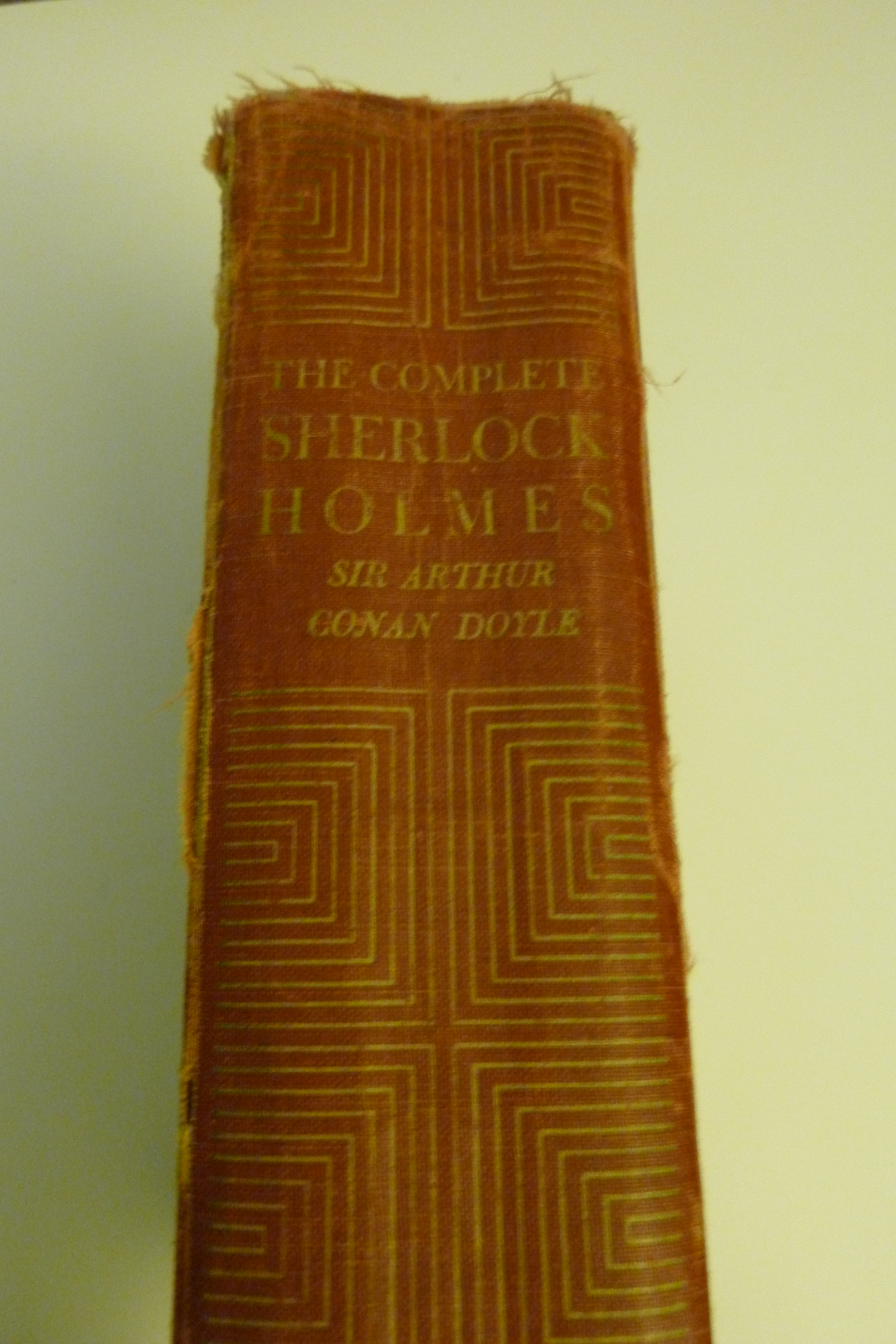
I don't have the TV DVD, so here's my battered original instead.

I may never have mentioned this, but I love Sherlock Holmes.  And I don’t mean any of the various incarnations–I mean the original, Sir Arthur Conan Doyle Holmes.  The Hound of the Baskervilles is on my to-be-reread list, and when I get to it I’ll probably give you a review.

But in the meantime, I wanted to review one of those incarnations.  The BBC is doing a TV version called simply Sherlock.  It’s amazing.  And part of what’s amazing is how well they have balanced changing it completely, while keeping it faithful to the original.

Sherlock translates the original stories into the modern day.  That, of course, changes everything–but within that context, it’s beautifully on track to the original.  Watson is recently-returned from the war in Afghanistan, rather than returning from India.  Holmes deduces clues from cell phones and digital watches.  It’s modernized–but faithful to the original.

The characters are brilliant.  Benedict Cumberbatch’s Sherlock is the most accurate-to-the-book Holmes I’ve seen.  He’s completely insane–but a genius, and totally in control, all the time.  Holmes is a delicate mix–when he’s on an investigation (and sometimes when he isn’t) he runs about doing things that look totally mad, and because he has a distinct arrogant and disdainful streak he probably won’t bother to explain at the time.  When he does finally stop and lay out his thought process, you suddenly realize that it all made sense.  You also realize he was in control of himself and the situation the whole time–and he always looks dignified no matter what he’s doing, probably because he always knows he’s in control.

Sherlock pulls this off.  There’s a scene where Sherlock is investigating a crime scene when suddenly something comes together for him, he rushes off, and the only explanation he yells behind him is “PINK!”  Totally mad.  But it turns out that pink really is the key to the whole mystery.  I couldn’t help comparing this version to the Robert Downey, Jr. Holmes.  That movie, though very entertaining, just makes him look insane and out of control.  Undignified, too.

Also, Benedict Cumberbatch has Sherlock Holmes hands.  And the right nose for the role.

Martin Freeman is great as Dr. John Watson, the often-confused but intrigued sidekick.  I think there’s more complexity added to his role than we sometimes get in the Doyle stories, where to some extent he tries to fade out in his position of narrator.  John is the comparatively normal and rational one compared to Sherlock’s brilliant semi-madness.  He’s also ex-military and realizes that he loves the adrenaline of helping on Sherlock’s cases, even while he’s often frustrated by Sherlock too.  There’s a somewhat delicate balance of a relationship here, with two men who really do care about each other, but will never admit it–except possibly in a “we’re about to die” moment.

The mysteries are loosely based on some of Doyle’s original stories, but more by pulling in elements than by duplicating complete plots.  The mysteries are genuine and suspenseful, somewhat wild but that’s the whole point–they only call Sherlock in for the weird ones.  There are occasional twists, and quite a bit of humor.

If you decide to seek this out, American viewers may be a little baffled by British television schedules.  The first season/series has three, ninety-minute episodes.  The third one ends with a cliffhanger (not literally, although in a Holmes-remake it could be an option!) and they’re currently planning the next season.  Sadly, it won’t be available for a while.  I for one am eagerly awaiting it!

The Quintessential Diana Wynne Jones Book

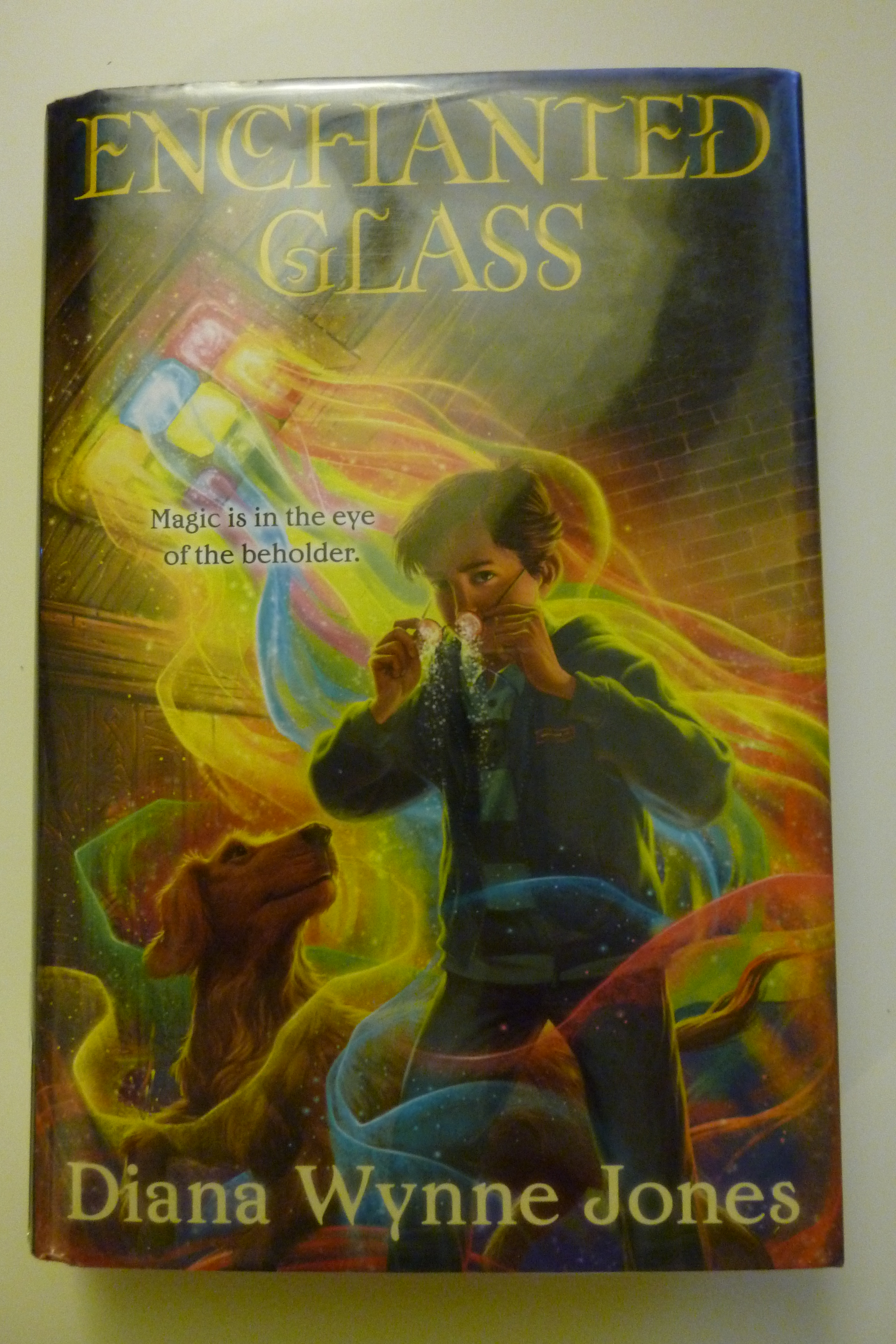
I loved reading Enchanted Glass by Diana Wynne Jones.  It was a delightful book, especially in its Diana Wynne Jones-ness.  I’ve been trying to think how to explain it.  It’s original, and new, and independent of her other books.  But so many elements I expect from her were here.

There was the earnest young boy, presently displaced, possessed of powerful magic.  There was a well-meaning though absent-minded man, also possessed of powerful magic, who holds a position of responsibility in the magical world.  There was a full cast of quirky supporting characters.  Many characters were somehow paired with others (I don’t mean romantically–in a more thematic sense).  There’s a mysterious magical threat, involving another world.  And it’s all set in an English village amidst rolling hills.

It’s like the quintessential Diana Wynne Jones book.  It all comes together to create a charming and, for fans, familiar atmosphere, while being a new book.  It makes it all rather poignant to know it was the last one published during her lifetime.

The story centers around Aidan, the earnest young boy, and Andrew, the well-meaning, absent-minded man.  Aidan is an orphan, fleeing from mysterious, magical Stalkers.  He ends up at Andrew’s big old house in the country, where Andrew is trying to figure out how to take over the magical reins from his recently-deceased grandfather.  They have adventures with magic, the Stalkers, a village fair, and an enemy neighbor with his own magic.  Also, there’s a giant, a werewolf, bizarrely large vegetables, and colored glass windows they’re sure have magic somehow.

The book is lovely–though not totally without flaws.  The point of view jumps haphazardly between Andrew and Aidan, which mixed me up occasionally.  It doesn’t help that their names have similar letters in them, making them run together sometimes so I lost track of who was thinking.

I also had a little trouble with the state of magic in this world.  Most of the characters seem to accept magic as perfectly natural–one character even mentions it when convincing Andrew to hire her as a secretary, and refers to it much the way she might refer to ability with typing.  However, I think most of the characters accept magic because they live in a particular place where magic is strong, as there are some hints that most of the rest of the world doesn’t believe in magic.  The complicated part is that Andrew has managed to forget most of what his grandfather taught him about magic.  When there’s a host of characters who think magic is ordinary, coupled with a main character who accepts magic but can’t remember much about it, I don’t know whether to view magic as ordinary or mysterious.

But both these problems, the magic and the point of view, seem to improve as the book goes on, and neither is serious enough at any point to spoil the book.  Definitely a high recommendation here.

Author’s site: http://www.dianawynnejones.com and http://www.leemac.freeserve.co.uk/

Favorites Friday: British Children’s Fantasy Classics

I think there was something in the water in Great Britain near the beginning of the last century.  Fairy dust, perhaps, because that’s when so many of the great classic children’s fantasy books were written.  There’s something about them, a style, a flavor, a spark, that marks them out as part of that group.

I doubt many titles or authors on this list are new to you–they are, after all, classics–but still, here’s my list of favorite writers of British children’s fantasy classics, noting their most famous books.  Some books are earlier and some are later, but all have that particular flavor.

In no particular order:

  1. P. L. Travers – Mary Poppins series
  2. Edith Nesbit – Five Children and It, among others
  3. J. M. Barrie – Peter Pan
  4. Frances Hodgson Burnett – A Little Princess and The Secret Garden
  5. Lewis Carroll – Alice in Wonderland and Through the Looking Glass
  6. Kenneth Grahame – The Wind in the Willows
  7. Charles Kingsley – The Water Babies
  8. George MacDonald – The Princess and the Goblin and The Light Princess
  9. A. A. Milne – Winnie the Pooh

And #10, Honorary Mention, is L. Frank Baum, who wrote the Oz series (and many others that are just as good).  He was American, not British, but somehow contrived to write books with that same magical flavor.

There must be classics I’m missing–what are some of your favorites?  And are they sprinkled with the same fairy dust?  🙂 I hope so–I’d love to find more!