Classic Review: Much Ado About Nothing

Today happens to be Shakespeare’s birthday (if you’re a Stratfordian, which I am) and so it seems appropriate to bring out this long ago review of my favorite Shakespearean comedy!

My love affair with the Bard goes back to high school, where I was a charter member of my school’s Shakespeare Society.  A lot of my best memories from high school involve Shakespeare (or Johnny Depp, but that’s another story!)  So I was definitely instrumental in my book club selecting a Shakespearean play last month.  Not solely responsible, but I was one of the ones who pushed.

Which is how I ended up rereading Much Ado About Nothing recently, and remembering why this is my favorite Shakespearean comedy.  It’s a great gateway play for people not very familiar with Mr. Shakespeare.

The story follows two romantic couples.  There are Claudio and Hero, whose romance takes a dark turn when Hero is falsely accused of wanton behaviour (and Claudio, the cad, believes it).  And there are Beatrice and Benedick, both known for their wit, who are continually baiting each other.  Their friends decide that they’d be perfect for each other, and set about on a plan to make each believe the other is madly in love with them.

My favorite scenes in the play are the gulling scenes, when each group of friends stages a conversation for the eavesdropping Beatrice or Benedick.  This preference may in part be because I performed in each of those scenes in my high school’s Shakespeare Festival.  But they really are brilliant comedy. Edited to add: Since originally writing this review, I saw David Tennant’s Much Ado.  His gulling scene is by far and away the funniest I’ve ever seen, though I can’t find it on YouTube, alas.  Nor is it on DVD yet, but I live in hope! </edit>

I was particularly noticing on this recent read-through how little Shakespeare gives in stage directions (though there is that one immortal stage direction in A Winter’s Tale: “Exit, pursued by a bear”).  It leaves a lot open to interpretation.  It doesn’t say that Benedick knocks over the potted tree he’s hiding behind at this point–but he can.

More significantly, many lines change completely by whether you believe the speaker is serious.  Was Don Pedro really proposing to Beatrice?  Are Benedick and Claudio really friends at the end?  You can go too far believing characters don’t mean what they’re saying, but there is room for reasonable interpretation–which makes the plays even richer.

If you’re at all interested in Shakespeare, try Much Ado About Nothing.  I recommend the Folger Shakespeare Library edition–good footnotes, and they put them on the facing page, which I find easier to read.  If you don’t feel up to reading Shakespeare, watch the Kenneth Brannagh version.  Excellent, although I can’t remember if he knocks any trees over.  I think I do recall some splashing about in a fountain though…
Blog Hop: Organization

book-blogger-hop-finalToday’s Book Blogger Hop question is: How do you organize your books for review? Does it work for you or have you had to change it?

I used to be very organized about my reviews.  I had a print calendar I used to track all my posts because I liked being able to see it visually.  When I first started, I posted three times a week (at least) and usually wrote posts two weeks ahead, so I always had a buffer of posts already scheduled.  I used the calendar to keep track of posts made and scheduled, which helped me balance the focus of reviews and vary my non-review posts.

And…then life got busy!  At some point I got through that buffer and never caught it up again.  And I dropped down to two posts a week, though I’ve been successful maintaining those.  I don’t use the calendar anymore, I just know I post Monday and Friday.  I still schedule everything–I usually do the Friday post (like this one) during the week some time, and write a review for Monday each weekend.

I never did too much organizing of books in anticipation of reviews.  I do track my books read though, in a print notebook.  If I don’t have a book in mind to review, I’ll page through that to see if I read anything recently that sparks some thoughts.

Fellow bookbloggers, do you have an organizing system for your reviews, or is it more haphazard?  Has it evolved over the life of your blog?

Book and TV Review: Father Brown

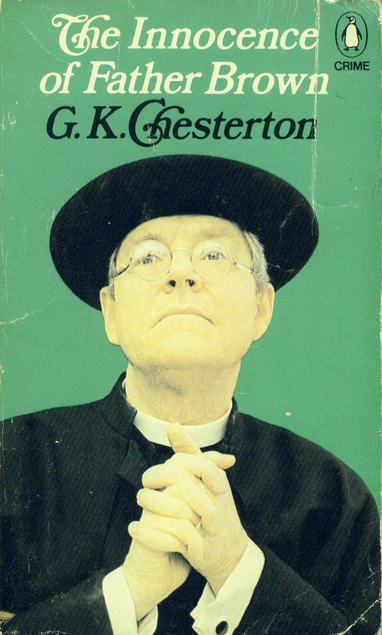
I’ve been watching the TV series Father Brown (a BBC series, available on Netflix) for many months now, and it’s quite delightful.  I thought I’d try the original stories, written by G. K. Chesterton, and got The Innocence of Father Brown. the first collection of short stories, from the library.  It was an engaging book with some clever mysteries–though not quite the Father Brown I was looking for.

Father Brown is a Catholic priest in England, with a knack for solving mysteries.  Many of the short stories in this first book feature Hercule Flambeau, first as a criminal and then reformed into a detective.  The setting is mostly London, I think in the late 1800s.  Some of the stories relate to Father Brown’s activities as a priest, though less than you might expect.  The connection is more through the insights Father Brown has gained as a priest than through plot connections.

The TV show, on the other hand, moves the setting to the Cotswolds in the 1950s, where Father Brown is pastor of St. Mary’s Church.  Here his parish work is much more integral to the stories, as usually some aspect of his priest work brings him into contact with the crime–nearly always murder.  The TV show adds in additional supporting characters: Mrs. McCarthy, parish secretary and quite proper; Lady Felicia, local aristocracy and not so proper; Sid, chauffeur to Lady Felicia; and, in later seasons, Bunty, Lady Felicia’s very modern niece.  There’s also an ongoing parade of local police chiefs, none of whom appreciate this priest interfering in the world of crime.

The short stories were interesting and engaging, but the TV show is charming and delightful–so it probably didn’t set me up that well for the short stories!  The tone just feels very different.  The Cotswold setting is a big part of the charm (though one does have to wonder about the number of murders happening in this idyllic rural village!) Continue reading “Book and TV Review: Father Brown”

Blog Hop: Fictional Home Away From Home

book-blogger-hop-finalToday’s Book Blogger Hop question is: Is there a fictitious town in a book that you would love to live in? What makes it appealing?

The first one to come to mind is…not exactly a town.  I read the Pern books when I was pretty young, and I loved the Harper Hall in Dragonsinger.  I’m not sure anymore why I like it so much, since I’m not even musical (and I’ve realized a few issues with Pernese culture, another story entirely).  But there’s still something that feels very appealing about a craft hall/school where everyone makes music and records history in songs.  And bubbly pies sound delicious and fire lizards delightful.

The probably more significant fictitious town I’d like to live in is Avonlea–or Glen St. Mary–or whatever town Emily of New Moon is living in (I can’t seem to find a name!)  Because really, they’re all fictitious versions of Cavendish, the village L.M. Montgomery grew up in, on Prince Edward Island.  Like the Harper Hall, there are obvious disadvantages (both to the late 1800s and to the rural setting) but she makes it sound so delightful.  Her (word) pictures of nature are breathtaking, and I love the idea of a little village where everyone knows everyone and is interconnected in a complex web of relations and friendships and shared histories.

What fictitious town would you like to live in?  Are you totally sure, or do you see some reservations to your choice too?

2018 Goals – First Quarter Update

I’m a little overdue for an update on 2018 goals…because life is busy!  And it’s because life is big and complex that I’ve widened my focus this year beyond only reading challenges.

My first, biggest, and most consuming goal is to get married!  The wedding is just over a month away, and most of the plans are all in place.  My bridal shower was on Saturday, and all the last pieces are coming together.  I kind of get now why people run away to Vegas (it’s so much less time-consuming!) but I’m still glad we haven’t.

Reading challenges still continue.  I’ve been focusing a lot on Newbery Medal winners, and they’ve actually been a big chunk of what I’ve read so far this year.  I’m up to eleven, putting me about halfway through the year’s goal.  I also got through the juggernaut, first-ever winner, The Story of Mankind, which ought to count for three all by itself.  And happily, it was a better read than I expected.

  1. Onion John by Joseph Krumgold (1960)
  2. Amos Fortune: Free Man by Elizabeth Yates (1951)
  3. The Slave Dancer by Paula Fox (1974)
  4. The Girl Who Drank the Moon by Kelly Barnhill (2017)
  5. Hitty: Her First Hundred Years by Rachel Field (1930)
  6. Gay-Neck: The Story of a Pigeon by Dhan Gopal Mukerji (1928)
  7. The Twenty-One Balloons by William Pene du Bois (1948)
  8. The Story of Mankind by Hendrik Willem van Loon (1922)
  9. Shadow of a Bull by Maia Wojciechowska (1965)
  10. Carry On, Mr. Bowditch by Jean Lee Latham (1956)
  11. Rifles for Watie by Harold Keith (1958)

Continue reading “2018 Goals – First Quarter Update”