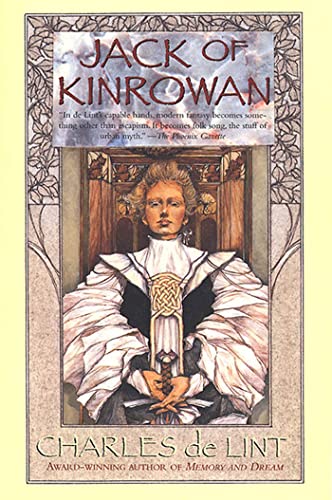
Jack the Giant-Killer, in Urban Fantasy

Katy from A Library Mama recently guest posted about her favorite fairy tale retellings, and I was delighted to hear about a Jack the Giant-Killer retelling from Charles de Lint.  That one went straight on my list!  The only copy the library had was an omnibus, Jack of Kinrowan, which combines Jack the Giant-Killer and its sequel, Drink Down the Moon…so naturally I wound up reading them both!  Perfect for Once Upon a Time.  My favorite de Lint tends to be his urban fantasies, and these were classic examples.

Jacky Rowan, midway through a personal crisis, stumbles on a gang of supernatural bikers, the modern-day Wild Hunt.  Jacky finds herself on the fringes of Faerie, a world of hobs and goblins existing invisibly side-by-side with the mortal world.  There are deep troubles in Faerie, with the Unseelie Court growing in strength, fed by mortal man’s belief in the darker side of stories.  Jacky impetuously volunteers to help…and once you’ve seen Faerie–and Faerie has seen you–there’s no turning back.

I have to start by saying how much I love that Jack the Giant-Killer is a girl!  Jacky is promptly accepted by the denizens of Faerie as a Jack, a wily trickster; the designation is part role, part title and part birthright, but gender doesn’t seem to make a bit of difference.  Jacky is believable as someone who is both out of her depth but trying to rise to the occasion–and generally managing, with a lot of luck to help.  Luck, of course, is a classic feature of any fairy tale Jack.

If there’s anything I found less believable, it was Jacky’s initial plunge into the situation.  There were moments early on when she still could have walked away, and I don’t know that I ever quite understood why she didn’t.  She was having a personal crisis and trying to prove something, but all the same…  Still, that was a bump early in the book, and once I accepted she was in the situation, the rest of the book rolled along just fine.

Jacky is joined in her plunge into Faerie by her best friend, Kate Hazel (or Crackernuts, which also has folklore origins).  We saw in Blue Girl that de Lint has a flair for presenting stories of strong friendships, and this is another good one.  There was a little romance around the edges, but the friendships were the central relationships of the story.

I’ve read a few other de Lint urban fantasies, and this has much the same feel–which I mean as a compliment!  He has a real skill for bringing magical creatures into the modern world, fitting them into the crevices and dark shadows of an urban landscape, and still keeping a fascinating otherness to them.  I’ve never been good at defining the difference between folklore and fairy tale, but de Lint seems to be drawing from the folklore side of things.  His magic is tied to nature and the land, to old traditions and ancestral memory.  No sparkles and little pixies here!

Drink Down the Moon follows closely from Jack the Giant-Killer, bringing back Jacky and Kate and introducing a few new characters too.  The threat-level rises admirably, matching Jacky and Kate’s growing ability–but they’re still new enough to Faerie that a fair bit of scrambling goes on to confront the crisis.  The second book also brings in more musical elements, which seem to be common in de Lint’s magical stories.  If you ever meet a fiddler in a de Lint book, they are probably not what they seem!

I would recommend this as a good book(s) for someone not familiar with de Lint.  Neither book taken alone is very long (about 200 pages in my edition, though it was small print), and they feel like a good introduction to de Lint’s world.  Many of his urban fantasies connect together in a loose web, with characters appearing here and there (a bit like Discworld).  These two are pretty much independent; all I spotted was a couple passing references to musicians or folklore experts whose names I recognized from other books.  If you haven’t read de Lint’s other books, I don’t think you’ll ever feel like you’re missing something!

Author’s Site: http://www.sfsite.com/charlesdelint/

Other reviews:
Black Gate
Keifus Writes
Random Reading
Anyone else?

Buy it here: Jack of Kinrowan: Jack the Giant-Killer and Drink Down the Moon

The Ozma Trilogy

You may remember I was reading my way through L. Frank Baum’s Oz series, reviewing in batches along the way.  You may remember, but I forgot for a few months that I never reviewed the last three!  So today I’m finally returning back to Oz to wrap that up…

I had to think quite a bit to find a common thread between the final three, and finally realized that the connection was Ozma—though not in quite the same way for each. (You would think Ozma of Oz would be part my Ozma Trilogy, but that’s really a Dorothy and the Nome King adventure.)  These three all have Ozma as a driving force of the story, in one way or another…

**************

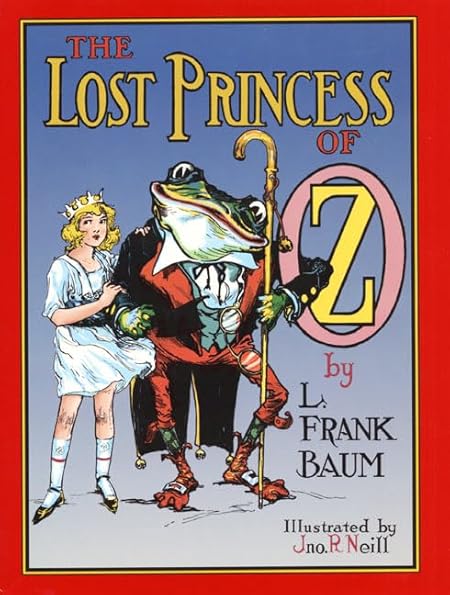
The Lost Princess of Oz has one of the most effective plots for putting something genuine at stake. Ozma has been kidnapped, the same day that many of the most powerful magical objects in Oz have gone missing. Handicapped though they are by their lack of tools, the characters set out in search of their beloved princess. Meanwhile in a far-corner of Oz, Cayke the Cookie Cook has been robbed of her diamond-encrusted dishpan, and sets off with the Frogman in search of it. Naturally all the events eventually tie together…
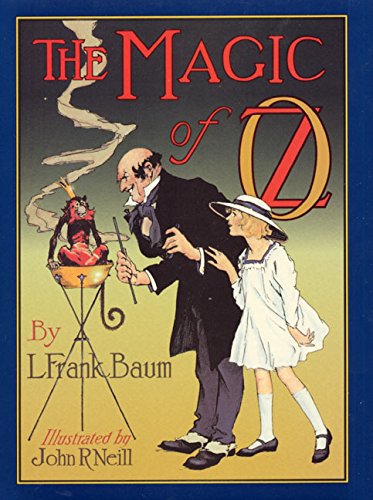
I’m inclined to think that Baum noticed his characters were growing too powerful (see the conclusion of Rinkitink in Oz), and in this book he takes steps to give them genuine obstacles. As a result, we get a true crisis, with real danger and a villain who could inflict actual harm. It never gets very dark—this is Oz after all—but a plot is more exciting when the characters have something to lose.

The Frogman is also a particularly interesting new character. He’s been ruling the Yips, who believe him to be wonderfully wise. He realizes all the time, however, that his wisdom is just an act.  This becomes a problem for him when he accidentally swims in the Truth Pond, forcing him to always tell the truth in the future. Though it’s treated fairly lightly, it creates an unusually complex problem for the world of Oz.

Ozma’s search party encounters some marvelously whimsical cities along the way, and finally encounters a villain with some real menace to him. This book also features one of the largest roles for Toto, who is here worrying about his missing growl, and wondering if it was stolen with everything else.

****************

The Magic of Oz ostensibly centers on a search for birthday gifts for Ozma (earning it its spot in my Ozma Trilogy), but swiftly develops into more dramatic crises. Trot and Cap’n Bill’s search for a gift causes them to be trapped on a magic island, slowly shrinking away to nothing. Meanwhile the deposed Nome King is back to stir up trouble, joining forces with Kiki Aru, a Munchkin boy who stumbled on the ability to transform himself and others into creatures of his choice. They attempt to rally the animals to attack the Emerald City, and inflict transformations on many characters.

I enjoyed the return of an old villain with new power, and the Nome King’s attempt to conquer Oz this time is far more interesting than his previous one (where he pretty much gathered an army and marched). I always enjoy Trot and Cap’n Bill, and I think it may be because they actually worry. Dorothy is downright Pollyanna-like in her good cheer, while Trot gets into real danger at times and knows it, giving the reader a reason to care.

This installment also offers one of my favorite pieces of whimsical Baum magic, in the form of the magic flower, which is constantly in bloom in an ever-varying succession of different kinds of flowers.

************

The final book in the series, Glinda of Oz, finally gives a starring role to a significant character usually on the sidelines. Not, as you might expect, Glinda—but rather, Ozma. She’s played an important role in other books, but this one gets her out of her palace and into the active role of heroine.
Ozma and Dorothy go to visit Glinda, and in her magical record book they read about a war happening in a far-off corner of Oz, between the Flatheads and the Skeezers.  As ruler of Oz, Ozma decides it is her duty to make sure all the people of Oz are happy, and therefore she must set off to stop this war. That’s all well and good, though I’m at a bit of a loss to understand why she has to go alone, with only Dorothy to accompany her! (Plot reasons, no doubt.)  The girls first visit the mountain of the Flatheads (who have flat heads, and carry their brains in jars—really!) and then go on to the island city of the Skeezers. When the city’s ruler submerges the island, Dorothy and Ozma are trapped within, and the rest of their friends, led by Glinda, must come to the rescue.

This book gives us more of Baum’s wild and whimsical cities. I suspect that Oz is sparsely populated in sections solely so that he could keep having the characters run across new, strange communities! Between the weirdness of the Flatheads and the fairy tale-like nature of three enchanted fish in the Skeezers’ lake, we get some of Baum’s magic at its most entertaining.

The book also succeeds where others have faltered (I don’t quite like to say “failed”) by giving the characters real dangers. Ozma and Dorothy aren’t likely to die, but they are very seriously inconvenienced by the submerged city, and there’s at least a hint of real danger from the Flatheads too.

If this book falters anywhere, it’s in Ozma herself. She’s so very well-meaning, but there’s still something problematic about her rulership of Oz. The Flatheads and the Skeezers have never heard of her, yet she insists on her right to rule them—insists it sweetly, of course. Baum has unfortunately set Ozma up as a hereditary dictator, as far as I can tell. Because she’s so kind and sweet and concerned for her people, it all works out…but I can’t help being bothered all the same!

***********

Sometimes when it’s been a very long time since I read something, I reach the point where I feel like I can’t really have an opinion on it anymore.  I don’t remember it well enough, or I don’t know how present-day-me’s opinion would compare with long-ago-me’s opinion. I had reached that point with Oz, so I’m glad to have gone through the entire series, so that I can comment on them again!

The 14 books unquestionably vary in quality, and even the best aren’t without flaws (which my younger self probably didn’t notice). But—with that said—these are still, by and large, delightfully whimsical classic fantasy. Baum’s strength is in weird and wonderful magical creatures, and some of his creations stayed with me through all those years I wasn’t reading the books.

Apart from the later books including characters introduced earlier, these books are largely self-contained. They’re fun to read in order, but once you’ve read the first three (which introduce most of the major characters) you could pretty easily get away with jumping around. Just in case you want my opinion on the matter, here’s my ranking of the books by quality… (with series order after the title)

  1. Ozma of Oz (3)
  2. Scarecrow of Oz (9)
  3. Rinkitink in Oz (10)
  4. The Land of Oz (2)
  5. The Magic of Oz (13)
  6. The Lost Princess of Oz (11)
  7. The Wizard of Oz (1)
  8. Tik-Tok of Oz (8)
  9. Patchwork Girl of Oz (7)
  10. Glinda of Oz (14)
  11. The Tin Woodman of Oz (12)
  12. Dorothy and the Wizard in Oz (4)
  13. The Road to Oz (5)
  14. The Emerald City of Oz (6)

This is, of course, highly subjective…so if you’ve read any of the series, I’d love to hear your favorites too!

Down Time’s Rabbit Hole

I find time travel stories deeply intriguing–and Alice in Time by Penelope Bush promised an especially intriguing trip into the past.  Since the travel is facilitated by a magical merry-go-round, it’s solidly fantasy and suitable for Once Upon a Time.

Fourteen-year-old Alice hates her life–loudly and constantly.  She’s convinced that all her problems started from the birth of her younger brother, her mother’s post natal depression and her parents’ divorce soon after.  A spin on a merry-go-round sends her back seven years to just a few days before her brother was born.  She inhabits her younger body, while keeping her older memories.  Freaked out at first, Alice soon decides that this is her chance to change everything, saving her parents’ marriage and inflicting revenge on the girl who will bully her through middle school.

I was fascinated by the idea of going back into one’s own past, with the opportunity to relive life differently.  Doesn’t it make you think about what you’d do if you could go back into your own past?

Alice has definite plans, and one of the best parts of the book is Alice’s growing understanding of what really happened the first time around when she was seven.  As an older (and not emotionally-involved) reader, I saw very quickly what the real problems were in Alice’s family.  Within the first few chapters (pre-time travel), Alice’s father holds the reception for his second wedding at a pub, next to a bookie’s office, which probably tells you quite a lot too.

Even though I figured things out before Alice did, I believed in her blindness, and didn’t mind waiting for her evolving understanding.  There were also some nuances in her friendships that were, if not surprising exactly, interesting to watch unfold.

One of my favorite parts was watching how teenage Alice dealt with being seven again.  There were good things, like the closeness with her mother, and bad things, like the lack of freedom and control.  One of the sweetest parts of the book is when Alice gets to spend some time with her grandmother, who had died when Alice was eight.

I have to warn you that this book started a little slow for me–it’s a fast read overall, at a little over 200 pages, but it’s about 80 pages before Alice goes back in time, and I was starting to get impatient by that point.  It picked up a lot once the time travel came in, and became a very good read about family, friends and growing up…by being younger!

Author’s Site: http://www.penelopebush.com/

Other reviews:
Charlotte’s Library
Ms. Yingling Reads
Anyone else?

Buy it here: Alice in Time

Whimsy and Wisdom in a Land Without Time

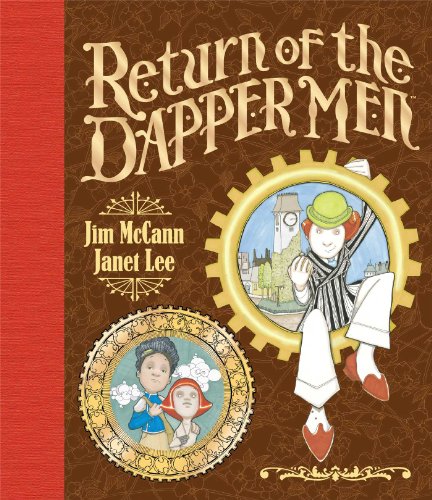
Return of the Dapper Men by Jim Cann and Janet Lee sat on my To Be Read list for three years…and then I read it in forty-five minutes.  Possibly because it’s a graphic novel, which I may or may not have known when I added it to the list.  I can’t remember anymore!  I’m not sure whether it’s sci fi or fantasy, but it has a lovely whimsy that I think makes it altogether suitable for Once Upon a Time.
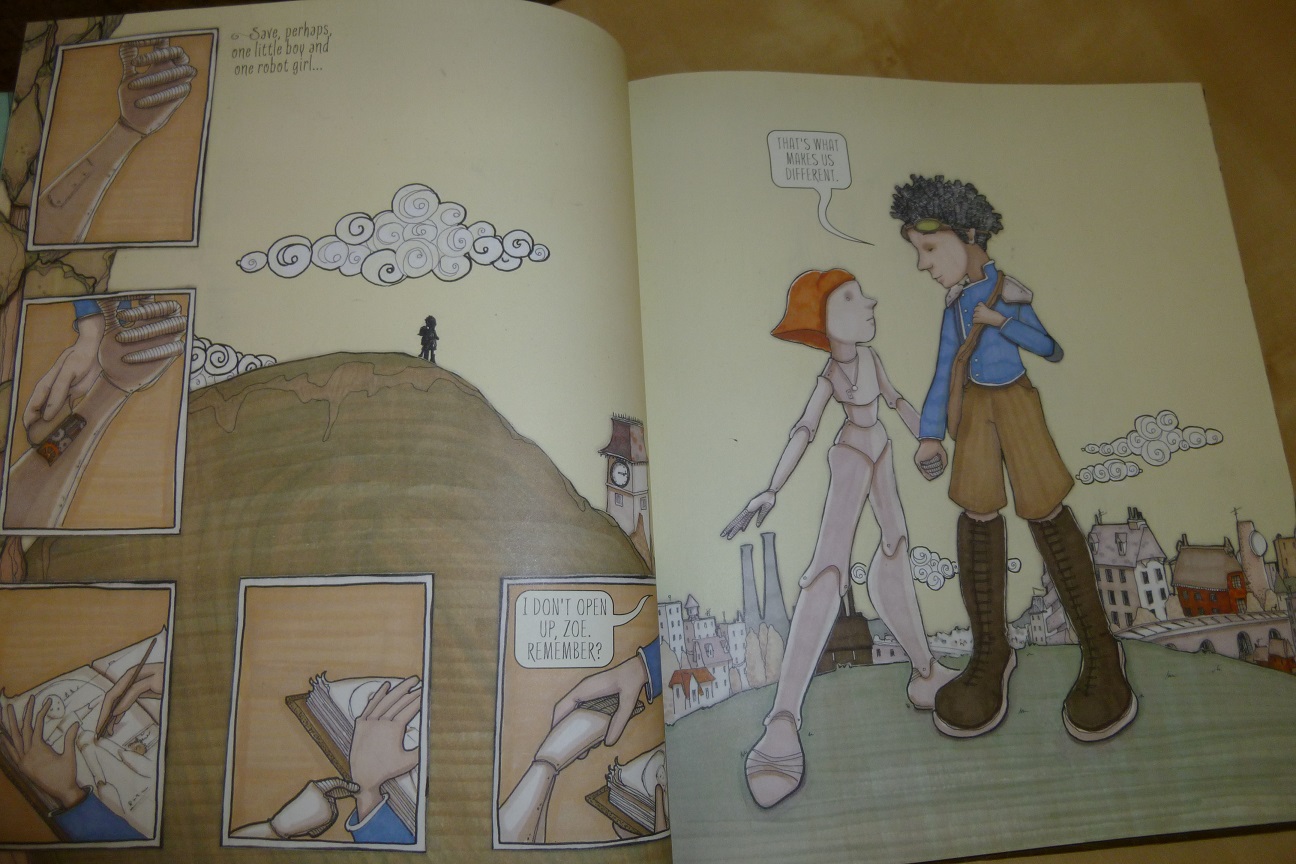
The story is set “long from now, in a land known as Anorev.”  Somehow or someway, time has stopped, creating only an endless Now.  There dwell in Anorev only children under the age of eleven, who live below the ground and endlessly play; and robots, who live aboveground and endlessly work.  Ayden, a human boy, and Zoe, a robot girl, have a unique friendship, and wander and wonder together.  And then one day, 314 Dapper Men, with identical bowler hats and umbrellas, descend from the sky to restart time and change everything.

If you’re thinking this doesn’t make much sense, you would be right!  This is not a book that offers explanations, or gives answers on a plot level.  The only “answers” are on a metaphorical, emotional level.  I tend to be suspicious of obscure books posing as profound, but in this case, I don’t think it’s just a pose!

Even though I read this in less than an hour, that was due to short length, not fast reading.  This is a book that demands slow reading.  It’s rich in details, both in text and pictures, which turn a bizarre story into something beautiful.

The drawings throughout are soft and whimsical with few straight lines and many textures.  And the text is full of lovely lines like this one about tomorrows, “the wonderful thing that follows dreaming.  Where everything is possible as long as you keep one foot in front of the other and make sure a tock follows every tick.  And hopefully, time for tea.”

I could ramble on, but perhaps I’ll give you my favorite page instead, the page that introduces Ayden and Zoe.

Return of the Dapper Men (2)I think it’s the tenderness between the two characters that I love, captured so well with such a deceptively simple drawing of two people looking at each other.

If I didn’t love this book enough already, it also draws from classic fantasy, opening with the lines, “To anyone who ever fell down a rabbit hole, walked to the sidewalk’s end, danced a wild rumpus, or followed the second star to the right, may you find adventure, wonder, and a little something from which dreams are made in these pages.”  And the pages do contain a setting that seems to combine Alice’s rabbit hole and Peter’s Neverland, make allusions to Pinocchio and Shakespeare–and I like to believe that the reference to “the little white bird who had become an angel” was a quiet nod to J. M. Barrie, and one of my very favorite books.

I don’t really understand Return of the Dapper Men, and plenty of things about it didn’t make a bit of sense…but just this once, I don’t mind in the slightest!

Other reviews:
Geeks of Doom
Hopelessly Devoted Bibliophile
Knight Reader
Anyone else?

Buy it here: Return of the Dapper Men

Reaching Into Books

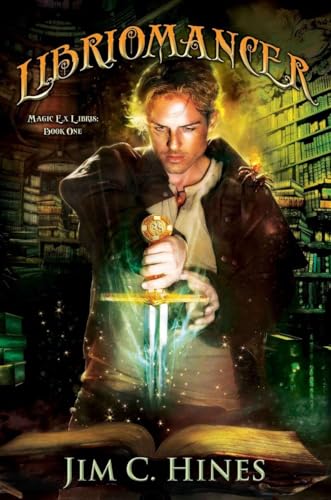
I don’t often finish a book and then start grabbing friends to tell them, “You must read this!”  But I have been having that experience with Libriomancer by Jim C. Hines.  Quick advisory that it’s not my usual YA, but for older readers it’s amazing!

This one has been on my To Be Read list for ages, and I don’t know how it took me so long to get to it.  It has one of the most brilliant premises ever.  The lead, Isaac, is a librarian–but he’s also a libriomancer, part of a secret organization of magicians.  Libriomancers can reach into books and pull out objects–like Excalibur, Lucy’s healing cordial or Tinkerbell’s fairy dust. Libriomancers use their powers to deal with magical threats, from natural magic creatures, or ones created from books (more on that in a bit).

Isaac has been relegated to fieldwork after he lost control on a mission, but when a pack of vampires (the “sparkler” variety) attack him in his library as part of a widespread vampire uprising, Isaac is forced back into the fray.  Isaac, his fire spider pet, and a dryad named Lena soon find themselves at the center of a threat much bigger and more complicated than a simple vampire attack.

So I mentioned the premise is brilliant, right?  The mere concept of pulling objects out of books is amazing, but Hines makes it even better with complex rules around how the magic works.  In some ways I could almost see him deliberately creating limitations, but they’re limitations that make sense. For instance, you can’t grab the One Ring of Power, because certain objects have been deemed too dangerous, and their books were magically locked.  You can’t write your own book with whatever object you need, because it’s the readers’ belief in the story that enables libriomancers to pull objects out–so it only works with widely-read books…and did I mention that Johannes Gutenberg founded the libriomancers’ order?  You can’t do too much magic too quickly, because characters start bleeding into the libriomancer’s mind.  With some of the rules come dangers, giving this rollicking ride some darker undertones and greater depth a well.

So–brilliant premise and plausible, complicated magic, check.  References galore to other books?  Check!  Isaac uses books in his magic, and Hines has mostly drawn from real books–he includes a helpful list at the end.  I recognized most of the books, and I think that will be the case for most readers who enjoy sci fi and fantasy too.  This is a firmly fantasy book, but Isaac deals in sci fi books a lot too, so there are ray guns, and one never-identified-but-unmistakable lightsaber.

References in themselves are great, but Hines manages some hugely entertaining, tongue-in-cheek references.  Remember that mention of “sparklers”?  Many vampires came about because someone accidentally reached into a vampire book at the wrong moment and became infected.  So there are a variety of vampires classed according to what book they spawned from–like Sanguinarius Meyerii vampires, irritatingly superhuman and nicknamed sparkers, or the more traditional Stokerus vampires.  So.  Much.  Fun!

The danger of a really brilliant premise is how disappointing it is when a book falls down some other way.  Fortunately, that’s not the case here.  Isaac is a likable hero, flawed but honorable and well-meaning.  He struggles with some interesting, magical morality questions in a way that made me quite like him.

Lena, as I would expect from the author of The Princess Novels, is tough, take-charge, and very much an equal participant in the adventure.  As a dryad, she has some amazing wooden weapons she can use in very clever ways.  She’s also very much out of the mold of typical characters, considering she’s heavyset and bisexual, two ideas that don’t appear much in fantasy.  Lena has a very complex arc that I won’t try to unpack here, exploring questions of free will, character stereotypes, and power in relationships.  It’s carefully and powerfully handled.

If the book falters at all, it’s that I was just a smidge disappointed by the ultimate reveal on the villain.  Trying not to give spoilers, but essentially I expected the big bad villain to be, well, bigger and badder.  However, this is the first book in a trilogy, so I am optimistic that the threat level will rise with each book, and there were definite hints of something more dangerous lurking.

And the up-side to waiting so long to read this…I can go straight on to Book Two!

Don’t forget you can enter the KidLit Giveaway and win a signed copy of my novel!  Contest ends May 18th so enter now…

Author’s Site: http://www.jimchines.com/

Other reviews:
Making It Up As I Go
The Book Smugglers
Little Red Reviewer
Anyone else?

Buy it here: Libriomancer