Twenty Mysteries with Dame Christie

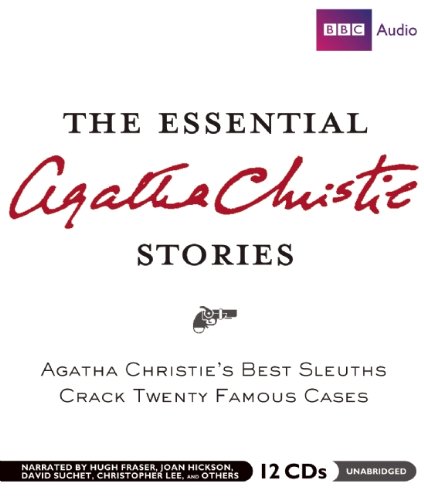
Agatha Christie has been on my “should read” list for a while now, and I did read a couple of her books–but she wrote so many, I didn’t know where to go next.  The Essential Agatha Christie Stories on audio seemed like the perfect solution!

This collection provides 20 stories in 15 hours, with a variety of readers (including Christopher Lee!)  It did exactly what I wanted it to do, giving me a sampling of Christie stories, including three with Miss Marple, quite a few with Hercule Poirot, and a handful of independent ones too.

Overall I enjoyed the stories quite a bit, and I’m impressed that twenty different stories, most of them centering on a murder investigation, held my interest so well.  Christie comes up with clever twists that I usually don’t guess.  Not every story had a satisfying answer to the mystery, but the majority did.

I had been considering picking up a Miss Marple novel next, but now I’m not so sure.  Those three stories were fine, and one, “Murder vs. Opportunity” had a nice twist…but I found I wasn’t that satisfied by how Miss Marple operates.  Poirot claims to base everything on “psychology,” but it seems even more true for Miss Marple…and that doesn’t appeal to me because there’s no answer!  I like mysteries for the sake of the puzzle, and seeing at the end how everything fit together.  Telling me that Miss Marple knew the answer “because she understands human nature” is, for me, dissatisfying.

I think I’m more likely to try a Poirot novel, as I fared much better with him.  My two favorite stories in the collection were both Poirot stories.  The first was “Four and Twenty Blackbirds,” and Poirot combines both an understanding of psychology and physical clues to deduce the answer to a murder, starting from something as simple as a change in the dead man’s habits.

“Murder in the Mews” was my other favorite, one of the longer ones in the collection, focusing on a suspicious suicide.  This one was complex, full of details and a few red herrings, with a satisfying answer in the end.  I listened to this collection on CDs in my car, and this was the only story that got me to take the CD out of the car to listen to the ending after I finished driving for the day.

I also met Captain Hastings in this collection, an apparently regular figure in Poirot stories.  He plays a very Watson-type role, the somewhat blundering friend who narrates the detectives adventures.  He was fun for a few stories, but began to wear on me.  The joke of Hastings thinking he’s being clever when he isn’t only worked a few times, and somehow Poirot seemed to come across as more ridiculous when through Hastings’ eyes.  On the other hand, Hastings did provide the vehicle for a Poirot-narrated mystery, “The Chocolate Box,” told in a nearly story-length flashback.  That was another one with clever details and a good answer to the puzzle.

In the non-Poirot stories, I especially liked “The Girl on the Train.”  It’s full of wild and improbable hijinks, and splendid wit.  Take this paragraph:

“It was true that George embodied a veritable triumph of the tailor’s art.  He was exquisitely and beautifully arrayed.  Solomon and the lilies of the field were simply not in it with George.  But man cannot live by clothes alone–unless he has had some considerable training in the art–and Mr. Rowland was painfully aware of the fact.”

Love it!

On the audio side of things, most of the readers were good, and Christopher Lee was quite good!  The only sour note among the readers was the final story, “Yellow Iris.”  The reader tried a little too hard to do different voices, I think, and it didn’t fly at all…but nineteen out of twenty stories had good reading to back them.

So, Christie fans–have you read any good short stories from her?  And where do I go next with the novels?  Any Poirot ones I should try?  Should I give Miss Marple a chance after all?  Let me know! 🙂

Other reviews:
Bookshelves of Doom
Anyone else?

Buy it here: The Essential Agatha Christie Stories (it’s expensive…try the library, that’s where I found it!)
If History Was Different…

I read The Explosionist by Jenny Davidson so long ago that pretty much all I remembered was that it was set in an alternate history, and there was a sequel I always meant to read.  Clearly a reread was in order before going to that sequel!

The Explosionist is set in Scotland in 1938–but this is an alternate history, where Napoleon won at Waterloo.  The Northern countries of Scotland, Scandinavia and Russia have united in the New Hanseatic League, in uneasy peace with a united but oppressive Europe.  Sophie Hunter is 15, an orphan raised by her Great-Aunt Tabitha after her parents died in an explosion at a dynamite factory.  Her world begins to unravel with terrorist bombs near her school, an unsettling encounter with a ghost through a medium who is later murdered, and hints of something sinister about IRLYNs (pronounced “Irons”), a patriotic training program for young women.

Sophie is a wonderful portrait of a very intelligent, slightly naive girl who is well-meaning yet often conflicted about what’s best.  She felt very fifteen somehow, just old enough to grasp the magnitude of the conspiracy she begins to uncover, but young enough to still think she can somehow handle it herself–with her best friend, Mikael.  There’s an intriguing thread through the book about the benefit or harm of strong emotions.  Sophie herself is a committed rationalist, who believes that doing away with extreme emotions would be all to the best…though she can’t quite manage it!

This book is part boarding school story, part murder mystery, part conspiracy theory, and part ghost story as Sophie discovers an ability to speak with the recently-dead.  All those pieces somehow balance together, creating an intriguing mystery with a series of surprises and turns.

The alternate history of it all creates some fascinating touches.  The overarching changes to history and government are intriguing, though the small details may be even more fun (if a little silly!)  Many people famous in our own history are famous in Sophie’s world–but for very different reasons, like Freud the radio host, or Einstein the poet…

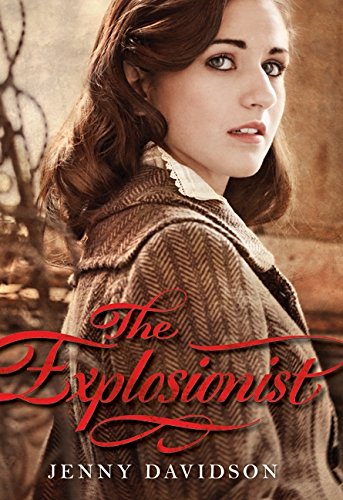
By the way, I hate this cover–it has none of the character of the first one!

The Explosionist ends with a big shift and a lot of questions still wide open, which is how it stuck in my mind that I needed to read the sequel, Invisible Things.  (Some minor spoilers for the first book to follow.)  The sequel sees Sophie in Denmark with her friend Mikael’s family, volunteering at a scientific facility headed by Niels Bohr where nuclear fission is a hot new topic.  Europe and the New Hanseatic League are rushing ever closer towards open war, while Sophie begins to uncover new truths about her family’s past.  Halfway through the book, we see an abrupt shift with a terrorist attack (using a gas that alters Mikael’s personality), a new villain, and a quest for Sophie.

I enjoyed The Explosionist a lot, but I’m not sure how to feel about Invisible Things.  Sophie, Mikael and all the rest are still likable and compelling characters.  The premise and the alternate history are still fascinating.  But while the first book had a busy and carefully balanced plot, this book feels like it lost its balance somehow.

Sophie has a very passive role for the first half of the book; there are revelations a-plenty, but Sophie herself doesn’t actually do much.  The stakes get higher and so does the interest level in the second half of the book…but that part also seems like a big departure from everything that came before, and begins to strain credulity a bit in certain ways.  The last portion of the book is a “Snow Queen” retelling, which is a cool idea–yet feels forced in places.

It’s unfortunate, because there are a lot of great pieces in here…they just fit together a little awkwardly.  Still, it was worth the read to find out the answers to some of the mysteries left by the first book, and to see the continuing development of Sophie’s story.  If you like historical fiction with a little fantasy thrown in, or enjoy slightly spooky conspiracies, these books are a fun read!

Other reviews:
Bib-Laura-graphy
Bookshelves of Doom
Frenetic Reader
Anyone else?

Buy them here: The Explosionist and Invisible Things

Back to Boston with Jacky Faber

I’ve been reading the Jacky Faber series by L. A. Meyer since high school.  I think there were only two or three books when I started.  Last month, I was very excited to read the latest installment–Book Eleven, Boston Jacky.
I’ve previously reviewed the (amazingly brilliant) audiobooks (Book One and Books Two through Five), as well as last year’s Book Ten.  The series follows the adventures of Jacky Mary Faber, a London street orphan who disguised herself as a boy to join a Royal Navy ship (hoping for regular meals).  Her adventures have taken her around the world as a pirate, a spy, a deep-sea diver, an artist’s model, a singer…and sometimes a fine lady.

Book Eleven sees Jacky back in her beloved port of Boston, where she buys a tavern, scraps with the local gangs, has a falling out with beloved friend Amy, and may finally lose her long-time and long-separated love Jaimy Fletcher (but I doubt it).

The last few books have been wild geography tours, taking Jacky to Australia, China and Spain, and fun though that was, I was happy to see that we were heading back to familiar locales.  This let us focus less on the strange landscape and more on the characters–with plenty of familiar ones back, like Amy Trevelyne, Mistress Pimm, Clarissa Worthington Howe (of the Virginia Howes) and the endlessly-supportive Higgins.  The cast makes this a good one for people who have read the series…but not a good one to jump into if you haven’t!

Far less happens in this book than in the previous one, and I think that’s a good thing.  Book Ten felt like a mad whirlwind of too-briefly touched-on incidents with far, FAR too many flirtations.  This book felt like a short but effective chapter in Jacky’s career.  It didn’t move the story forward very far, but it was a better trip for what was covered.  And maybe I wasn’t the only one who felt serious sparking with five men (I counted) in a short book was a bit much in Book Ten–this one toned it down, and while Jacky still has her moments, it was all with old familiar characters instead of an endless parade of new ones.

We also get another installment of miscommunication and missed-opportunities with Jacky’s “own true love” Jaimy.  I have been thoroughly over the Jacky/Jaimy romance since Book Five, and really wish Meyer would give up the ongoing separations and misunderstandings coming between them.  Either have them marry, or break them up permanently–or Jaimy could die, I’d be comfortable with that.  I don’t dislike him, but I really don’t think he’s right for Jacky…so at this point I’m actually rooting for them to not resolve their endless obstacles.

I will say that at least this particular romantic mishap is fairly amusing, and at least doesn’t get in the way of the more interesting plot developments, like the fight with the Ladies Temperance League, or the abduction of two children Jacky has taken under wing.

On the whole, this book was a solid installment in the series, and if not extraordinary, it was an improvement on Book Ten.  It left me deeply curious where Meyer plans to go next–not because of the specific cliffhanger, but just because I’m wondering if this one (or the next book) may signal a change in direction.  I love irrepressible Jacky, but she’s only aged about four years since Book Two, and I’m thinking I’d very much like to see an older, more mature (though still irrepressible!) Jacky.  I feel like settling down in Boston is our best chance at a more stable future in the series…  Or maybe Jacky’ll set sail again in Book Twelve and we’ll see where the wind takes us.  For now at least, I’m still willing to continue the ride.

Author’s Site: http://www.jackyfaber.com

Other reviews:
In Bed with Books
Lori Twitchell
Kid Lit Geek
Anyone else?

Buy it here: Boston Jacky

Esmeralda of Notre Dame

Hunchback of Notre DameI’ve been working on intimidating books this year…and diving into shadowy mysteries and Gothic literature for RIP…so September was clearly the month for The Hunchback of Notre Dame by Victor Hugo.  I enjoyed it quite a lot–I had been thinking I might take a break and read something else in the middle.  Instead, I ended up being so engaged that I didn’t stop after all–even though I had the new Jacky Faber book arrive while I was reading (but that’s a topic for another review).

The copy I read mentions on the jacket flap that Hugo despised the title The Hunchback of Notre Dame, which only arrived for the English translation.  Hugo called it Notre Dame de Paris–1482.  Not so catchy, but more accurate.  The Hunchback is just one member of an ensemble cast, and if I was going to pick one character as the lead, it would have to be the gypsy Esmeralda–hence the title of this post!  Because it really is centered around Esmeralda…and the men around her.

After my experience with Les Mis, I felt comfortable skipping or skimming when Hugo seemed to be off-plot, which happened a lot in the first hundred or so pages.  In fact, the main character of the first section of the book (if there even is one), is Pierre Gringoire, a destitute poet, and the story didn’t really pick up for me until he reached the Court of Miracles, where live the gypsies and vagabonds of Paris.

This is one of those books that’s worth sticking with, though, as it really does improve as it goes (with a few side diversions into history or cultural background…but that’s Hugo).  Gringoire has an interesting adventure or two, then disappears for most of the book as we finally focus on beautiful Esmeralda, terrifyingly sinister Frollo, sad hunchback Quasimodo, and surprisingly awful Phoebus.  For all the cultural weight and the number of pages, it’s essentially a story of unrequited love: Frollo wants Esmeralda who wants Phoebus who doesn’t value her–and no one wants Quasimodo, who was struck to his core by one act of kindness Esmeralda showed him.

Esmeralda is the center of the story, in that all the other characters circle around her and the plot is mostly driven by how they feel about her.  I couldn’t get much sense of Esmeralda herself, though.  She’s something of a will o’ the wisp, always flitting about but we don’t get into her head much.  She almost irritatingly enamored of Phoebus, and it’s a shame that that becomes such a driving part of her character.  She could be fascinating, as an independent woman who makes her own way in the world, on her own terms.  In a sense Fantine of Les Mis is independent, but her life fell apart; Esmeralda is actually getting along fine.  We don’t get much of that, though.

I was also rather disappointed by the lack of relationship between Esmeralda and Quasimodo.  She does show him kindness once in an extreme situation, but later on she’s still deeply uncomfortable around him.  Oh well, I should have known Disney would make it all rosier!

And on that subject–for a man named after the Sungod, Phoebus was horrible!  I deeply missed Disney’s courageous, noble captain, when Hugo gives us instead a philandering cad who can’t actually remember Esmeralda’s name…

This may be weird, but I think I was most fascinated here by Frollo.  Hugo’s heroine may have left a bit to be desired, but you can trust him to provide a complex villain.  It shouldn’t be surprising that we descend into the depths of his sordid obsession and twisted desire for Esmeralda.  I mean, even Disney didn’t manage to clean that up entirely!  I was more surprised by how openly sordid and at times sensual the book was, considering the time of the writing…maybe I’m just used to restrained British Classics, and it’s different when the French were writing them?  🙂

So how about the not-actually-title-character?  Quasimodo reminded me SO much of Leroux’s Phantom.  And I think that was just me and my particular, um, interests.  Hugo’s Quasimodo is dark, at times hostile, but also coming from a place of deep sadness.  His hostility towards the world is founded on the world’s rejection of him and that makes me feel so very bad for him.  I love his love for the cathedral, and I was thrilled to see a line where he’s talking to his favorite gargoyle statue…and it’s heartbreaking that that line is, “Why can’t I too be made of stone?”  Sad sad sad.

And he’s also like Leroux’s Phantom in that I think they both had authors who didn’t realize what they’d created.  Leroux spent far more pages on Raoul than he did on the much more interesting Phantom, and Hugo could have given us more of Quasimodo and less of some others…but what we got was very good.

This is only about half as long as Les Mis (so, 500 pages…) and some parts require a bit of wading, but on the whole I thought it was an excellent, very readable story with extremely engaging characters–even if some were less likable than I had hoped!  Once the book gets into its stride, it’s also hugely exciting.  I read the last hundred pages straight-through.  And, of course, the ending is deeply tragic.

I’ll probably still watch the Disney movie more often than I’ll read Hugo 🙂 …but I did thoroughly enjoy reading the original.

Other reviews:
My Turn to Talk
The Yellow-Haired Reviewer
A Good Stopping Point
Anyone else?

Buy it here: The Hunchback of Notre-Dame

Questing with Emily of New Moon

Emily's QuestFinishing out my reviews of the Emily of New Moon trilogy by L. M. Montgomery, today is Emily’s Quest!

Book Three sees Emily back home at New Moon, continuing to pursue her writing.  Love-interest Teddy becomes a much more driving force in this volume, not so much in his presence as in his absence.  Emily and Teddy are driven apart through a series of circumstances and misunderstandings, and even though it’s sometimes far-fetched or conveniently coincidental, Montgomery grounds everything in such genuine emotion and human nature that I’m willing to go along with her.  Example: Teddy’s mother plays a convenient role in derailing their romance, but it’s so based in who she is as a character that I completely believe it.

Another strand of the plot is Dean Priest, Teddy’s only serious romantic rival.  He’s an odd one, as he’s likable and sympathetic in some ways, but I keep running up against the problem that he’s far too old for Emily.  This might be workable, except that it gets squickier because he harbors romantic feelings for Emily starting when she’s eleven, and is waiting for her to grow up.  On the other hand–Dean seems to realize this is all a little weird, and that he’s too old for her–which possibly should make matters worse but actually seems to help.  The realization comes with a strong overtone that he’s never, ever, ever going to do anything inappropriate, which makes it all a little less uncomfortable.

Although just as the Dean/Emily romance seems like a maybe, then he does some absolutely reprehensible things in the area of her writing, and I know some people have some very strong Dean-hatred as a consequence…  Personally, I think he’s a little like Mad Mr. Morrison from the previous book, in that Montgomery gives us just enough of how Dean sees the situation, and himself, that I end up feeling more sorry for him than angry.  Though it was reprehensible, and directly responsible for a lot of the sadder parts of the book.

Emily’s Quest was written directly after The Blue Castle, and it’s fascinating to look at Valancy’s blossoming from empty stagnation into a vibrant confidence and enthusiasm for life, compared with Emily’s vibrant youth and apparent path towards an emptier adulthood.

Emily is anguished at some points, and there are long stretches where she faces a very bleak future–and somehow that bleakness seemed even more affecting than the sharper pains.  As far as I can remember, the last time I read this I saw it as a pretty standard true-love-never-runs-smooth story where the point was to get through the travails to the happy ending.  This time I was really struck by all that’s being explored by those sections of darkness.  Maybe it’s just the effect of being older–maybe it’s because I read Montgomery’s journals and know exactly what she was drawing from to write these sections.  Either way, I found the book deeply moving on this read.

And for those who are worried…it’s worth noting that Emily believes in always giving her stories happy endings, and she’s a very autobiographical character. 😉

I feel like I’m making something of a litany of dark dark dark in these reviews!  But it’s so different from how Montgomery is usually viewed that I think it’s worth emphasizing.  And there is still soul-stirring beauty and occasional humor too.  If you really just want sunshine, then by all means, read Anne of Green Gables.  But if you want a few shadows to contrast with the light, then I highly recommend the Emily trilogy.

Other reviews:
Becky’s Book Reviews
Bookshelves of Doom
Stewartry
Jade Sanctum
Anyone else?

Buy it here: Emily’s Quest