Investigating the Mystery of the Phantom of the Opera

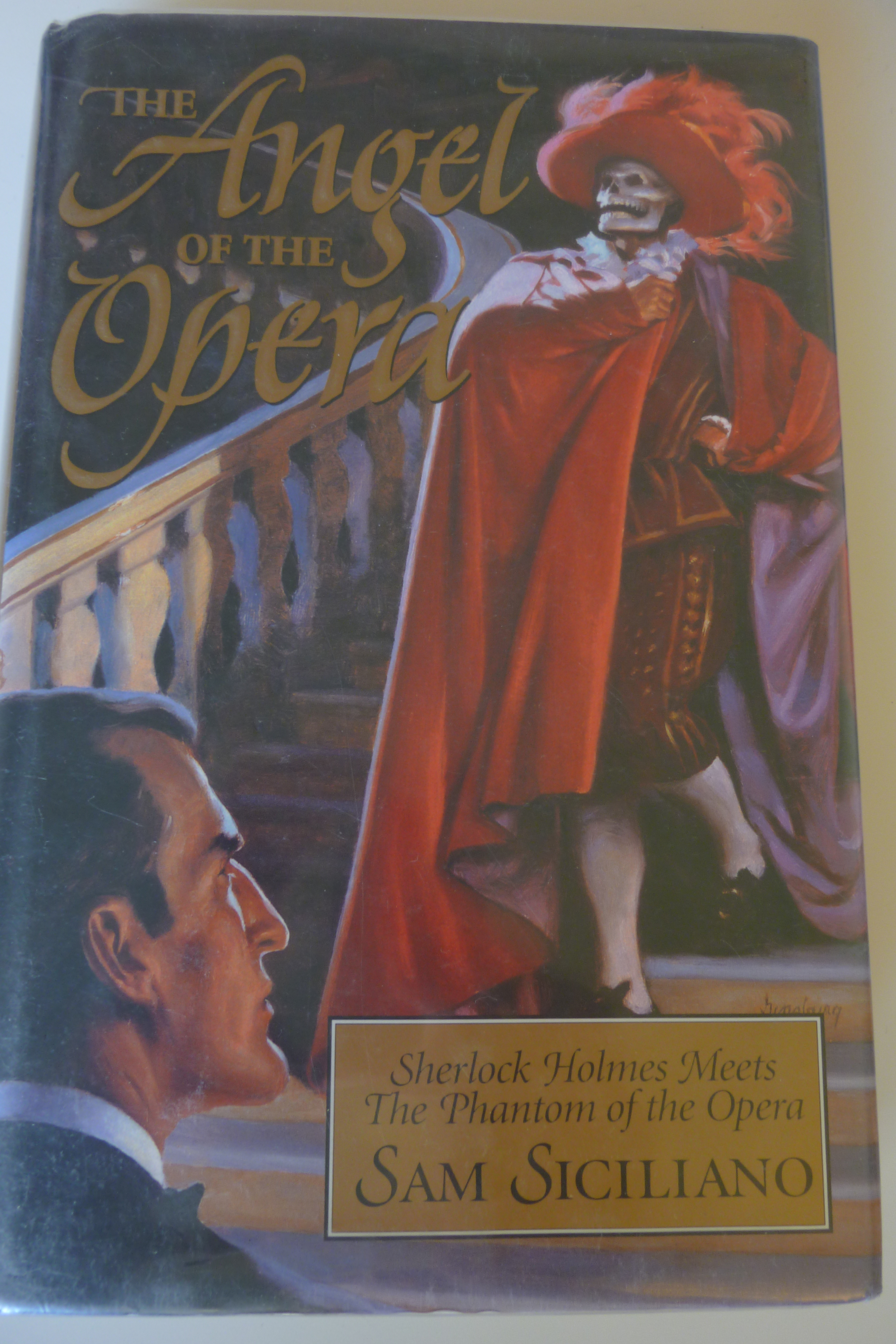
My January post about the Phantom of the Opera inspired me to buy and reread Sam Siciliano’s Angel of the Opera.  I last read it six or seven years ago, but I find my feeling toward it was much the same this time–and it’s an odd, odd feeling.  When I look at the disparate elements of the book, I dislike far too much.  And yet somehow, taken as a whole, I enjoyed the book.  Baffling!

It may be the premise.  Sherlock Holmes meets the Phantom of the Opera; I love both of them in their original forms, so it’s hard to resist a cross-over.  People I tell about this seem to have trouble picturing the two stories coming together, but it actually makes a certain amount of sense.  The premise is that the managers of the Opera are deeply distressed by this Ghost business (as they are in every version), and decide to hire a very famous London detective to come investigate–Mr. Holmes.  Holmes arrives in Paris and goes exploring through the Opera in an effort to work out the mystery of the Phantom.  Siciliano also makes much of Holmes’ love of music (which is an element in Arthur Conan Doyle) and that ties things together in an extra way too.

If only that clever emphasis on Holmes’ love of music had been part of a broader, equally clever portrayal of Holmes.  But there’s where we begin to have problems.  This book begins very, very badly.  Watson has been booted from the scene and we have a new and original narrator, Holmes’ cousin, Henry Vernier.  The second sentence of the book reads, “My purpose at the time was to reveal the real Sherlock Holmes as corrective to the ridiculous fictional creation of John Watson.”

Ouch.  I mean, really, ouch.  Henry goes on in this way for a couple of pages, maligning poor Dr. Watson and discounting Watson and Holmes’ friendship, then peppers the rest of the book with occasional caustic references to Watson and his writing, both from Henry and, even more painfully, from Holmes.  It’s always a chancy business trying to write another author’s characters, and frankly, if you’re going to attempt it, you had better approach the original with a great deal of respect, bordering on reverence.  It’s hard to believe that Siciliano even likes Doyle’s stories.

The particularly stupid part is that I don’t think all this added anything or was at all necessary.  Henry is pointless as an original character.  He fills exactly the same role as Watson, right down to being a doctor, and I nearly forgot at times that he wasn’t Watson.  Other than a fear of heights and occasional musing about whether he ought to marry a girl he’s been courting, he has very little personality to add.  And Holmes is almost Holmes, but not quite.  Siciliano plays around a bit, and not to Holmes’ advantage.  His attitudes towards women and religion are mucked about with, and his deduction skills are not shown to any great advantage.  He doesn’t do much of the “I saw a telltale clue and drew 14 conclusions from it” that Holmes is so well-known for.  He does figure out a lot about the Phantom, but it all seems like fairly obvious details–although I admit, Holmes doesn’t have my advantage of familiarity with some 14 versions of the story to help him along.  Anyway, the whole thing ultimately comes off like Siciliano realized he couldn’t quite write Doyle’s Holmes, or that Doyle’s Holmes didn’t quite fit his novel, and decided he’d better come up with an excuse for the differences.

He does better with the Phantom side of things. This is plainly based on Leroux, not Webber–Raoul’s brother is in the story (delightfully awful), Meg Giry has dark hair, several minor characters from Leroux are at least mentioned, and there’s just an overall atmosphere of Leroux.  That actually may be my favorite part.  Siciliano brings the Opera, with all its confusing passages and dark cellars, to life in a wonderful, fascinating way.  It really may be the atmosphere that carries this book more than anything else.

The Phantom characters were better handled than the Holmes ones too.  Siciliano wrote what is probably the most annoying Raoul I’ve ever seen (which is saying something) and his Christine is a nice mix of well-meaning and flighty childishness.  The managers, Carlotta and Madame Giry are well-portrayed.  And I thought he did well with the Phantom (although we don’t see him as more than a shadow until two-thirds into the book).  He’s dark, complex, a musical genius, and I actually really enjoyed Holmes’ insight into the Phantom.  And points for getting his name right–Erik.  Such a simple thing that is so rarely done correctly.  Siciliano does slip on one character–like Watson, he maligns the poor Persian, who was the most heroic figure in Leroux but here is dark and villianous and (metaphorically) drenched in blood.

The plot is all right.  Holmes and Henry poke around on the edges of the plotline of The Phantom of the Opera, trying to unravel the mystery.  Siciliano doesn’t really add much, but neither does he do any harm to it.

So–decent plot, well-done Phantom characters, excellent atmosphere, poorly-done Holmes, pointless original narrator.  And there is one more original character who absolutely gives me fits.  There’s a mostly-irrelevant prologue, where Holmes and Henry are tying up an unrelated case, and in the midst of it they get a telegram about the Paris Opera situation.  The main point, though, seems to be to introduce Susan Lowell.  She lives in Wales, is half-British and half-Indian, and is despised by society for her mixed-race status.  She’s all alone in the world.  She’s very beautiful, but for a variety of reasons has always thought that she was very ugly.  And she’s completely brilliant musically.  Is this obvious enough yet?  It gets better.  She’s blind.

Well now.  A novel with a musically-brilliant deformed man features a completely superflous musically-brilliant blind girl.  I wonder where that could possibly be going?  Honestly, I am all in favor of the Phantom getting over Christine, and if that means writing a new character to suit, fine, no problem, go to it.  But at least be a bit more subtle about it!  I also think it oversimplifies to assume that falling in love with a blind girl would solve all of the Phantom’s problems.  I’m convinced that Erik’s problem is not really that he’s ugly–it’s that he knows he’s ugly, and is convinced of his own unworthiness as a consequence.

But that is a long and complex discussion.  Suffice to say here, this book would be better off and far less obvious without the prologue or the epilogue–even if that meant leaving off a basically happy ending.

So where do I wind up in the end?  I don’t know.  I like some parts of this book.  I dislike a lot of very key parts.  And I enjoy it overall.  Draw your own conclusions from that.  I hear there’s another Holmes-meets-the-Phantom book out there, and I am definitely going to check that out to see if it does any better!

Author’s Site: http://samsiciliano.net/

Other reviews:
Better Holmes and Gardens (I love that title!)
My Den
Anyone else?
Lost on Mars with John Carter, and Four-Armed Green Martians

Regular readers know that one of my favorite authors is Edgar Rice Burroughs–so I was both eager and wary regarding the new movie inspired by his Mars series, John Carter.  Fortunately, in the end I think it was a well-handled retelling of Burroughs’ A Princess of Mars.  They took a few liberties, as filmmakers will, but the spirit was good.

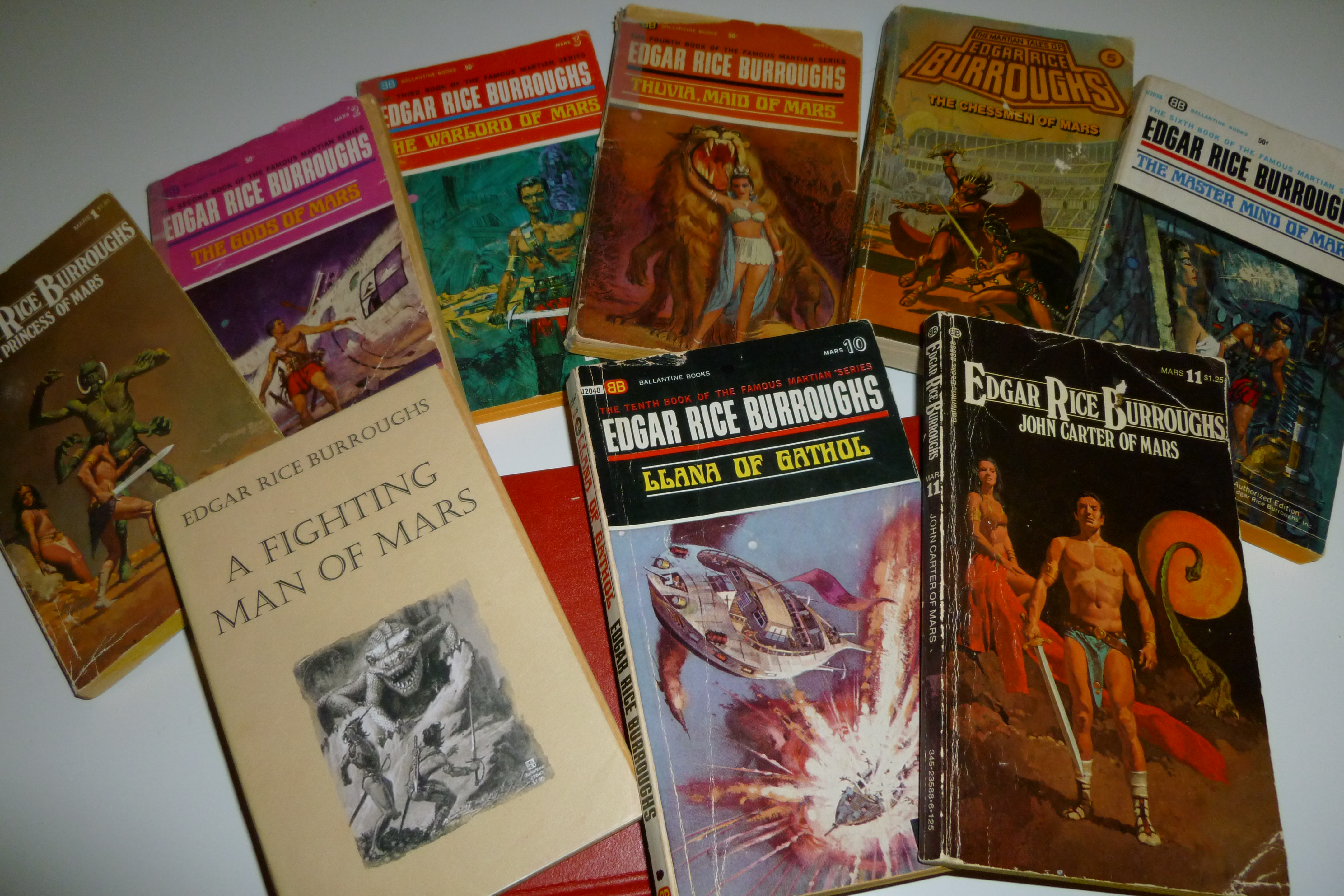
My Burroughs Mars Collection

The plot was essentially accurate to the book.  John Carter of Virginia is a Civil War veteran who goes out west prospecting.  Out in the wilderness, he finds himself mysteriously transported to a new wilderness, with a red tint.  He eventually realizes he’s on Mars (Barsoom), where he meets the Tharks, giant green men with tusks and four arms (Burroughs was the first to have green Martians, incidentally).  It isn’t long before he also encounters the beautiful Dejah Thoris, Princess of Helium.  Not green and without tusks, she’s a member of the red Martians, who look human apart from red skin.  Adventures involving swordfights, epic battles and a villain intent on marrying Dejah Thoris quite naturally ensue.

The movie kept all of that from the book, along with many other details, although they also threw in some extra bits.  I can only conclude that they felt they had to explain John Carter’s transportation, which Burroughs never does.  Part of me loves it that John Carter just looked at Mars and wished and was there, but I can see how the filmmakers felt they needed to give a more complete explanation.  So they introduced the Therns, priests of the Martian goddess Issus, who have medallions which allow them to transport between worlds; one of the medallions takes John Carter on his journey.  The Therns also tie the plot together a bit more, by giving a weapon to Helium’s enemies and presiding over the resulting destruction.  They’re brought up in the first five minutes of the movie and gave me a few bad moments–but I felt better once their mysterious goddess was named as Issus, because then I could place them.  Issus and the Therns show up (albeit in a different capacity) in the second Mars book.

I’m generally much more forgiving of movies making changes if they also demonstrate that they really, really know their source material.  Anybody who can get all the minor characters’ names right and very carefully depicts Martian animals according to Burroughs’ descriptions has earned the right to tweak things a little–and I think it was essentially effective, once I figured out what they were trying to do.

The characterization was well-handled.  They gave John Carter (Taylor Kitsch) a tragic past, to create a character who was lost in more ways than one when he lands on Mars.  He was a bit surly for a Burroughs hero, but they got a little of the Southern gentleman in, and his prowess in battle was perfect.  In a strange way, my favorite moment may have been when he turns to face an oncoming horde of hostile Tharks, buying time for the fleeing Dejah Thoris.  It’s straight out of the book, and only a Burroughs hero could plunge into an oncoming army, alone, armed only with a sword, and come out of it alive.  I’ve heard it commented before that the biggest mystery of the Mars books is how the South ever lost the Civil War when they had John Carter on their side.  The scene was well-shot too, splicing battle shots with flashes of John Carter’s past, and piling up the bodies without being grotesque (more on that in a moment).

I also enjoyed Dejah Thoris (Lynn Collins).  Heroines are not usually Burroughs’ strong point.  She was always beautiful, but she was never much else.  The movie made her both smarter and tougher.  Dejah Thoris the scientist throws me for a loop a little, but Dejah Thoris the swordfighter is pretty much awesome.

The more minor characters were well-done too, particularly among the green Martians.  Tars Tarkas, John Carter’s green Martian friend, was excellent, as was Sola, a more sympathetic green Martian female.  The green Martians were all CGI and there were excellent effects throughout.  I avoided seeing this in 3D so I don’t know how that would change things, but in 2D the effects were convincing, for creatures and landscapes and technology.  I thought the green Martians all looked a bit scrawny for a warrior race, but they did wonderful things with the four arms.  I also absolutely loved Woola, John Carter’s dog-monster.  He was delightful, and added some comedy.  Comedy is not really one of Burroughs’ strong points either, but the movie got some good moments in.

On the whole, I thought the movie picked up as it went.  The opening on Earth was not as interesting (although big points for including John Carter’s nephew, a fictionalized Edgar Rice Burroughs, who’s included in a foreword in the book) but it got better on Mars, and eventually accelerated to some wonderful epic battles and excitement by the end.  That was done perfectly and completely in the spirit of the books.  Burroughs wrote about men who lived by their swords, who would fight their way literally through armies and across planets, have clashes featuring casts of thousands and deaths of hundreds–but he wrote it all with a Victorian sensibility that never dwelled on the blood, and was never gruesome or disturbing.  This movie managed to do the same thing.

This is one of the biggest reasons I’ve always been wary of a movie version–the blood, and also Dejah Thoris’ clothes, or lack thereof to be precise.  Burroughs wrote about plenty of scantily clad women, but again, with a Victorian sensibility that kept it all very clean.  It would be very easy to make a movie with half-naked women and disturbing fight sequences, technically accurate to the book but not at all in the right spirit (and nothing I’d want to see, though I’m sure that would have a market too).  So I was so relieved to know that this was being produced by Disney; it even opens with a red-tinted view of the Disney castle logo.  I figured they’d do it right, and they did.  Dejah Thoris’ costume designer seemed to be looking at the same book covers I have; the princess was scantily clad (and for that matter, John Carter spent plenty of time shirtless) but somehow it didn’t feel exploitative either.

So, to sum: good characters, good effects, good Burroughsian spirit.  A few changes but acceptable ones.  If they do a sequel (and they always do sequels of action features, right?) I’ll be watching it.  I hear it’s not doing well at the box office, but we’ll see!

And in the meantime, there are so many exciting movies coming out this month!  Next up I’m looking forward to The Hunger Games, and after that Mirror, Mirror, a Snow White retelling.  If they live up to their potential as well as John Carter did, it’s going to be a good month at the movies.

Other reviews:
Screen Rant
Angelocracy
Eclipse Magazine
The Oregonian
Stainless Steel Droppings
More?

The Playwright from Stratford

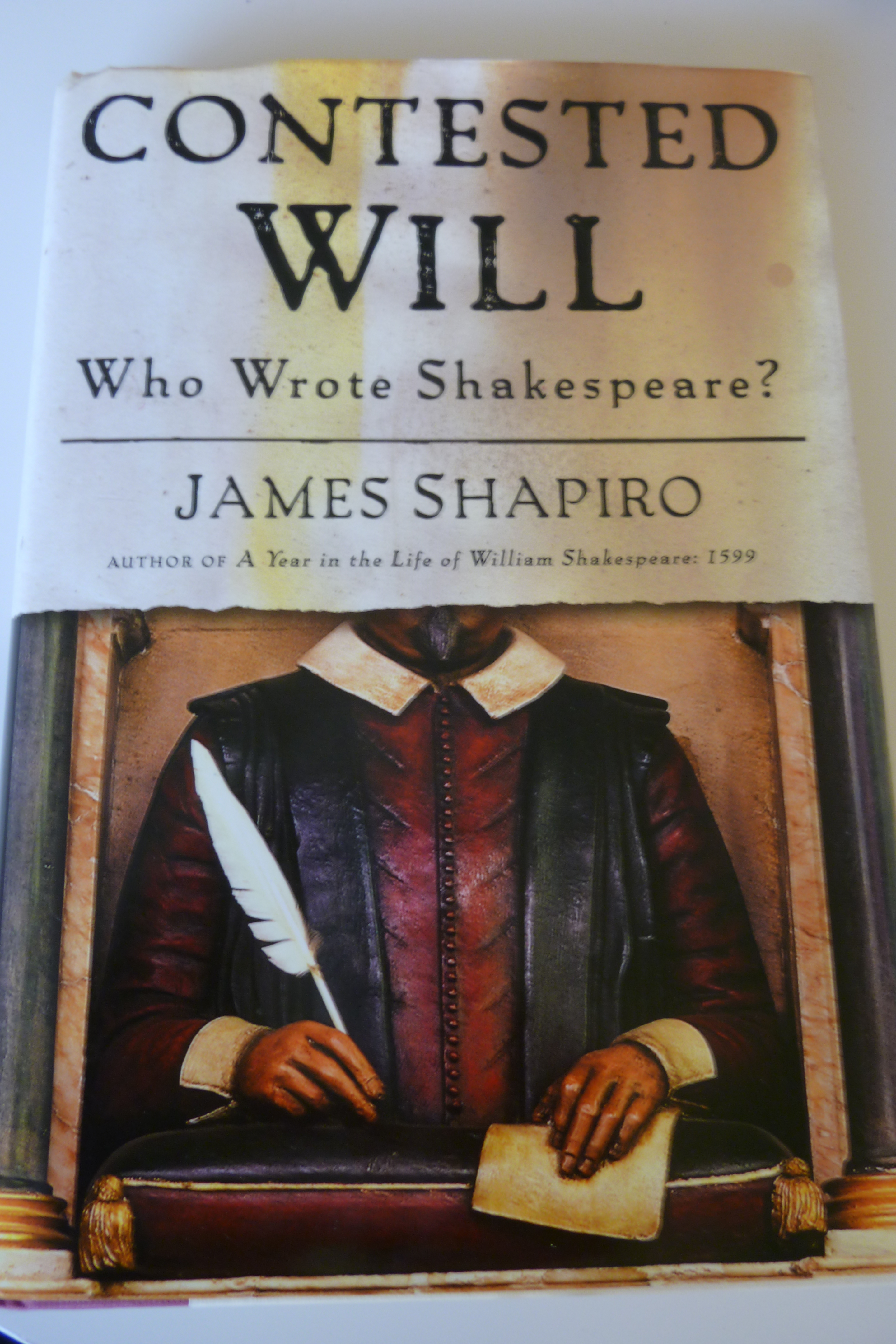
I recently tackled my first Nonfiction book of the year for the Non-fiction Non-memoir Challenge, and it conveniently addressed my Dusty Bookshelf challenge too.  The book: Contested Will by James Shapiro.  Clever little pun there, as it’s a book about the Shakespeare authorship question.

Back-story for the Dusty Bookshelf challenge:

How long has it been on my shelf? Since Christmas, 2010, so a little over a year.  Erm.  I am SLOW about getting to nonfiction.

I almost never buy unread books, so how did I get it? As noted, Christmas.  It was a gift.

Now that I’ve read it, am I keeping it? Probably for the moment, though it could go in some future, panicked, “I have no shelf space” purge.

Considering the subject of the book, I should probably start by discussing biases.  I’m a Stratfordian, meaning I think the man from Stratford wrote the plays–that is, I think Shakespeare really was Shakespeare.  Shapiro is a Stratfordian too, which may be one reason I liked his book; it doesn’t hurt when you agree with a conclusion.  But that wasn’t the only reason.  It was a very engaging, scholarly but entertaining look at the history of the authorship question, and of cultural attitudes towards Shakespeare, his plays, and writing on a broader level.

Shapiro takes us through the history of the authorship controversy, starting with early impressions of Shakespeare and how the authorship question first arose.  He looks in-depth at two chief contenders for the role of secret author, Francis Bacon and the Earl of Oxford.  He then concludes with a section on the evidence for Shakespeare really being Shakespeare.

It’s a scholarly book that isn’t at all dry.  Shapiro examines the people who were involved in pushing opinion one way or another.  Many are recognizable names, like Mark Twain (a Baconite) and Sigmund Freud (an Oxfordian).  Many proposed extraordinarily entertaining theories.  The Baconites wanted to read codes and ciphers hidden in the plays, and came up with things that make The Da Vinci Code look simple and rational by comparison.  The Oxfordians tend to push for vast conspiracies hiding the true identity of the playwright.

For myself, I’ve always been a Stratfordian because the arguments against the man from Stratford seemed so flimsy, and Shapiro has reinforced that feeling.  There seem to be three chief arguments, and they’re all frequently examined throughout Contested Will.

1) Shakespeare didn’t have enough education – This discounts the very solid grammar school in Stratford at the time, which had a curriculum more like a university philosophy degree than the grammar schools we think of.  It also discounts the possibility of self-education, and, most importantly, the capability of genius.  To say that Shakespeare couldn’t write his plays because he didn’t go to university is to say that Abraham Lincoln couldn’t write the Gettysburg Address and Mozart couldn’t have begun composing at four years old.

2) Shakespeare didn’t have the right life experience – Shapiro discusses extensively how people first started viewing Shakespeare’s writing as autobiographical.  This was fascinating, exploring the different cultural expectations over the centuries and the amazing amount of fiction people come up with about what Shakespeare “must” have known/felt/thought/lived.  In Shakespeare’s day, autobiographies were virtually unheard of, and the expectation was not that playwrights were drawing on their own life experiences.  As to the supposed extensive knowledge Shakespeare would have needed, of court life, falconry, geography, foreign languages and so on, I might concede this point if anyone claimed he had lived in Stratford all his life.  But he didn’t–he lived in London, the metropolis of his day.  If he didn’t speak French, he could find a Frenchman to help him out.  He could learn what he needed to, and let’s not forget he wasn’t perfect: he did have sailors land on the shore of Bohemia, a land-locked country.

3) There aren’t records of Shakespeare as a playwright – There are actually frequent contemporary references to Shakespeare as actor and playwright, which Shapiro highlights at length in the last section of the book.  We don’t have Shakespeare’s papers and manuscripts, but apparently no one went looking for them until the 1800s.  Shakespeare died in 1616 – by the time scholars were trying to find his papers, all the witnesses were long since dead, and even his direct family line had died out.

Shapiro paints a fascinating picture of scholarship over the centuries, showing how cultural understandings of different times changed the views on Shakespeare.  A couple of trends emerge.  One is a tendency to deify Shakespeare, to make him and his plays impossibly insightful and profound.  They are insightful and profound.  But 400 years of scholarship and analysis endows them with so much insight that of course people question whether a glover’s son from Stratford could possibly be that brilliant.  No one could be that brilliant, if he had really intended even half of what people have read into the plays.  (And the frequent attack on him as a glover’s son smacks of classism too.)

The second trend that keeps showing up is the desire of scholars to make Shakespeare look like themselves.  I’ve noticed this before.  I had a college professor (female) who was convinced that Shakespeare was a woman.  Not Queen Elizabeth–some unidentified, well-educated, multi-lingual, upper-class woman (because there were a LOT of those in Elizabethan England…)  The tendancy seems to be for scholars to project how they want Shakespeare to be, and then go look for someone who fits the part.

I’m sure this book is much better if you already have a solid knowledge of Shakespeare.  It’s in-depth, and Shapiro goes for the details more than the broad strokes.  But if you like the details, the last section of the book is great fun, when he gets into the evidence for Shakespeare writing Shakespeare.  It’s almost a collection of anecdotes about Shakespeare’s life in London, the players he worked with, the other writers he knew…I really enjoyed the glimpses of Shakespeare’s life.

So in the end, I ended up more firmly convinced in my stance as a Stratfordian.  For one thing, the theories of the other groups seem so poor (and often funny), it bolsters the man from Stratford’s claim.  For a second thing, I like the man from Stratford.  I like the glover’s son who went to the big city, became an actor and a playwright and rose to fame, who wrote great art but also wrote according to the constraints of actually putting the plays on, who responded to the muse but also intended to make some money.  But then, I’m a mix of artist and pragmatist in my writing–so maybe I’m projecting onto Mr. Shakespeare too!

Author’s Site: http://www.jamesshapiro.net/

Other reviews:
Vulpes Libris
Steep Stairs Review
California Literary Review
Any others I should link to?

Talking to Animals, Fighting Monsters

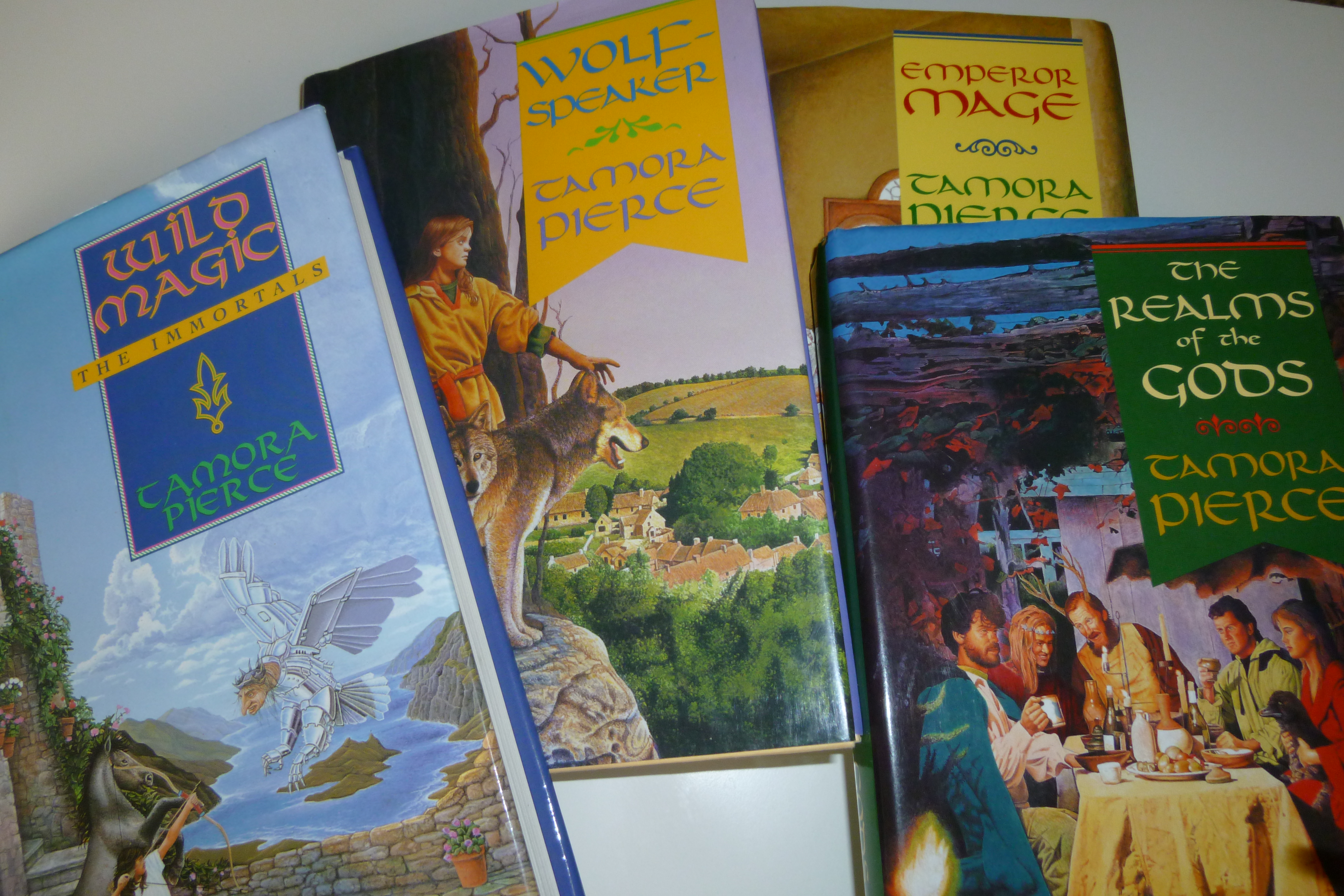
It’s not one of my reading challenges, but I have a personal goal this year to re-read Tamora Pierce’s Tortall books.  I’ve been reading her new books as they come out, but it had been years since I read the older ones.  I re-read the Song of the Lioness quartet in January, and it really is just unutterably wonderful.  In February, I re-read The Immortals quartet–and that’s my subject today.

The Immortals quartet is always referred to in my mind as the Daine books.  The main character is Veralidaine Sarrasri, an orphaned girl who discovers that her “knack with animals” is actually powerful magic.  She comes to Tortall (the setting of Song of the Lioness); she finds a job caring for horses for the Queen’s Riders, and finds a mentor in the magician Numair Salmalin, who helps her learn to use the wild magic that lets her talk to animals.  Meanwhile, the realm is threatened by strange magical creatures, who were locked in the Divine Realm 400 years before and are now escaping.  These are the immortals–they can in fact be killed, but will live forever if they aren’t killed.  Many of the creatures are in league with Emperor Ozorne of Carthak, who seeks war against Tortall.  Daine and her friends, human, animal, and even immortal, have to unite to defend against the threat.

The quartet opens almost ten years after the end of Song of the Lioness.  Many of the major characters from the first quartet come back in supporting roles here, and I LOVE seeing Alanna, George, Jonathan, Thayet and all the rest back again, and finding out what they’ve made of their lives.  The new characters are good too.  Numair is great fun and often quite funny–at one point he’s turned to stone, breaks free of the spell, and asks the spellcaster to do it again so he can try to break out again.

Daine is a lovely heroine as well.  She grows a lot, both as a person and in her magic.  Her magic develops, finding new abilities in every book.  At first she can only talk to animals; then she learns to inhabit their minds, then to change shape herself.  She also starts out very friendless, hesitant to trust anyone, absorbed only in her own life, and grows into relationships and a position of importance in the world.  She also grows in her understanding of the immortals, realizing over time that they’re more than just monsters.  She does find a place among very important people very quickly, which feels a little contrived–but only a little.  It’s mostly justified by circumstance, and also by what I know of the characters.  Queen Thayet’s friendliness to a strange girl from another country has more to do with Thayet than with Daine.

Other than Daine and Numair, the other characters that stand out the most to me are the animals and the immortals.  Daine has at least one animal sidekick in every book.  In the first it’s her horse, Cloud, who feels she has to take care of Daine and keep her from doing anything foolish.  By the second book, Daine has adopted Kitten, a baby dragon.  There’s also a wolf pack in that one, and a squirrel I just love.  In the third book there’s a tiny monkey, and the fourth book introduces the darkings, inkblot-like creatures who are surprisingly adorable.  And there’s Rikash, a Stormwing–half human, half metal bird–who brings Daine to see that even Stormwings, one of the most vile of the immortals, are more than just monsters.

These are in many ways more fantastical books than Song of the Lioness.  There’s certainly magic in the first quartet, but it feels different.  Magic is more like a tool, one Alanna uses or that her enemies use against her, or it comes up as part of rituals.  For Daine, magic is a way of life.  She’s constantly using her magic one way or another, her closest friend is a magician, and she’s always fighting magical creatures.  It creates a different feel; in some ways it may make Daine a little harder to relate to, although it’s certainly a lot of fun to read about.

I love this quartet, although I will acknowledge it’s not quite on a level with Song of the Lioness.  A few times there were point of view switches that bothered me, especially in the beginning of the first book, and sometimes the characterization seemed just a touch off–people weren’t saying things I thought they ought be saying.  Those are relatively minor, though, and I mention them only because I know this was written after Song of the Lioness, and it makes me wonder if that quartet has issues too, only I’m so swept along by the characters and the plot that I don’t notice them!

A bigger issue in The Immortals is the romance.  I don’t like it.  I’m sorry to people who are fans of it, but I just don’t.  I don’t want to give spoilers but…I will say Daine ends up with a character who is in all four books, but their relationship is very different in the first two books.  In the third there are a few hints of something, but everything could very easily and reasonably be interpreted according to the earlier basis of their relationship.  And then in book four there’s suddenly a romance.  And I just don’t like it.  It’s a particular kind of romantic story arc that almost never works for me.

But don’t be put off by that.  Because whatever the minor issues of the books are, they’re still wonderful to read.  I won’t say they changed my life, but they’re certainly another great example of a strong female lead in fantasy, and there’s a good message about everyone having strength and value.

Author’s Site: http://www.tamora-pierce.com/

Other reviews:
My Advice to Avoid Being Laughed Off the Page (includes spoilers)
Kathy Takes on Books
The Sleepless Reader
Tell me about yours!

Another Star Trek Artform

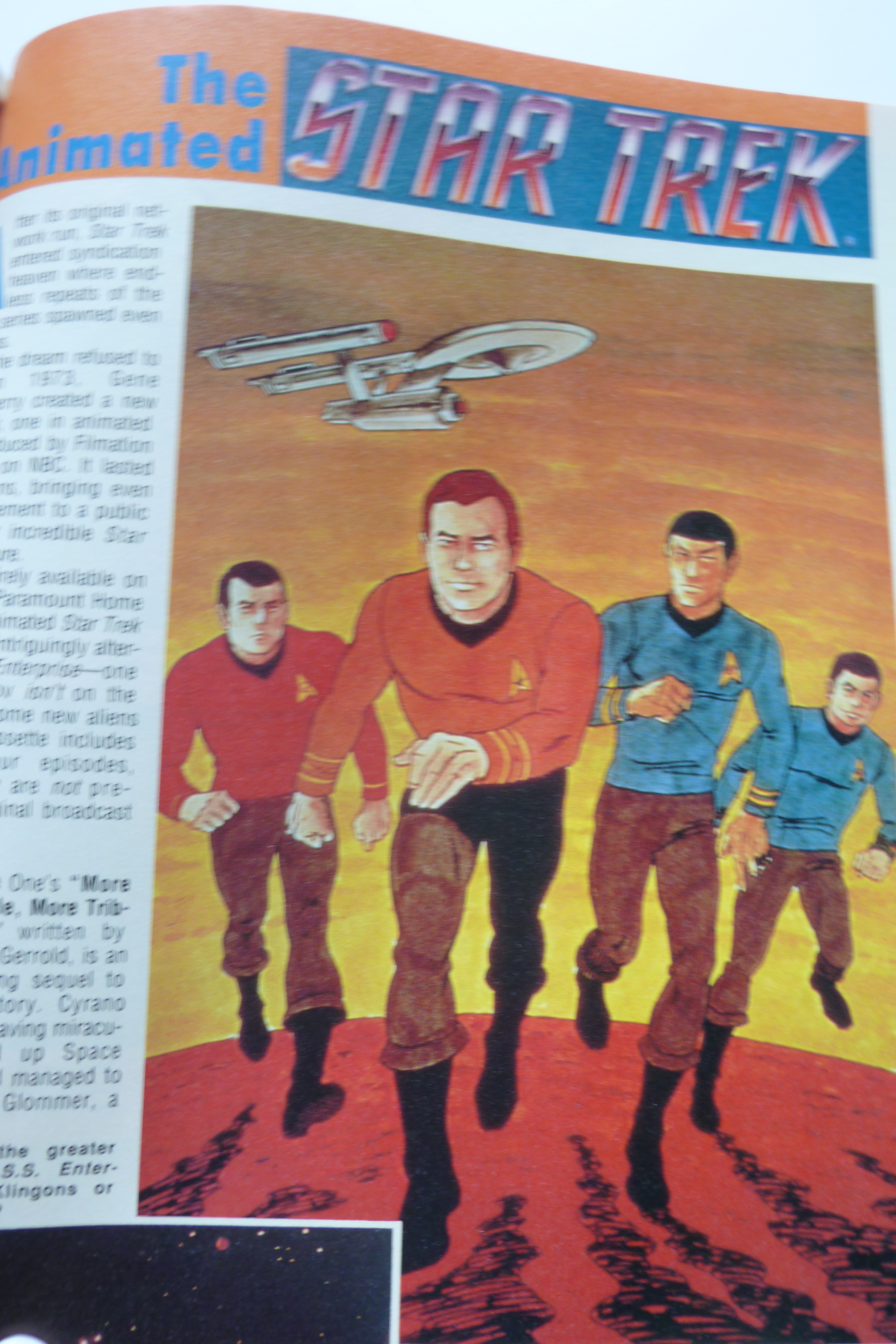
I talked about Star Wars recently, and now I want to jump over to Star Trek–but probably not a series you’re thinking of.  Lately, I’ve been watching The Animated Series.  It seems to be the Forgotten Star Trek Series.  I’ve rarely seen or heard references to it, and one of the few times I did see some discussion, I found out that it’s not considered canon, the way the other filmed material is.

But it was streaming on Netflix, and I was curious, so I watched it.  And honestly, I think it ought to be remembered again.  I mean, more adventures of the original series’ characters, voiced by the original actors, with some of the original writers contributing scripts–what’s not to love?  Well, a few things actually, but I’ll get to that later.

Things I do love include, of course, the cast of characters.  I don’t think they created any particularly memorable new characters (despite the presence of a cat-like alien assistant for Uhura, and a three-armed replacement for Chekov), but it’s fun to see the old familiar characters again.  All of the regulars are back (except Chekov), and we get to see some guest characters back too, including Harry Mudd (with a new scheme) and Cyrano Jones (with more tribbles).

Many of the episodes feel like they could have been Original Series episodes, and some even give us a chance to look deeper at a character.  Spock travels into his own past to meet his younger self in one episode, and another revisits the (hopelessly doomed) Spock/Christine romance.  Some of the plots are a bit silly–in one the Enterprise computer takes on the personality of a practical joker, and in another the crew starts to shrink.  But they’re not really much sillier than I, Mudd or The Trouble with Tribbles, and I’m all in favor of funny Trek, provided you keep the characters in character.

There are frequent strange aliens and wild landscapes.  It reminds me of very early Star Trek novels, where you can just tell the writers are reveling in the opportunity to create something that couldn’t be shown in live-action–at least not at the time, and with Star Trek‘s budget.

That brings me to some of the things not to love.  The Animated Series seems to have had an even worse budget than the original show, and it very much shows in the animation.  The drawing is somewhat simple (though all the characters are clearly recognizable), and people move as little as possible, to reduce the number of frames needed.  They also like to zoom in on shots rather than having actual movement, or to reuse the same drawings again and again.  But honestly, it didn’t bother me that much.  It just feels like a different art form.  It felt more like watching a narrated comic book in some ways.

They also couldn’t afford voice actors.  With only a few exceptions, any non-regular character was voiced by a regular actor.  If you look at Jimmy Doohan’s IMDB page, you’ll see that he sometimes did as many as seven characters in a single episode.  But I have to say I’m very, very impressed by him, because I honestly couldn’t tell most of the time.  Nichelle Nichols and Majel Barret Roddenberry were not as talented at voices, and all the women on the show tended to sound like Nurse Chapel or Lt. Uhura…

I admit that this is a show you probably only want to watch if you’re already a fan of Star Trek.  If you’re looking for really high-quality cinema, that’s not this show, and if animation is really important to you, don’t watch it.  But if it never really bothered you that the Gorn was clearly a man in a lizard suit, or if aliens with orange skin and bad wigs seemed secondary to whether they were in a show with a good plot, then you should check this one out.  Despite being the Forgotten Series, it’s a cute little show.