A Maybe-Monster, and a Monster-To-Be

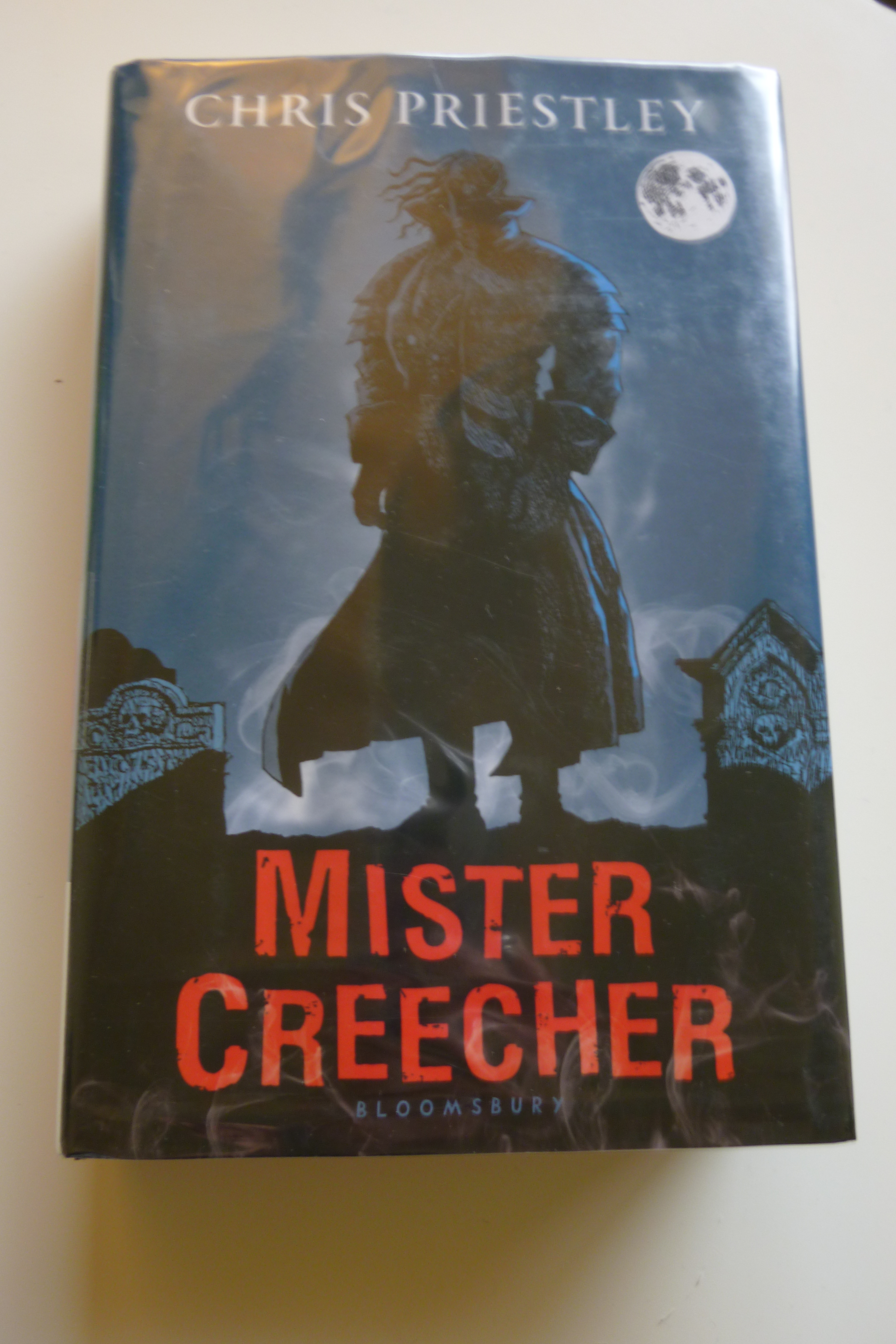
Mister Creecher by Chris Priestley, like Wicked, is another novel that takes characters from a familiar source and reimagines parts of their lives.  I read this one with the Sci Fi Experience in mind, although the library stuck a “Horror” sticker on the spine.  I guess it’s either–or both.

It’s a story about Frankenstein’s creature (see what Priestley did with the title there? 🙂 ), midway through Mary Shelley’s Frankenstein.  The story is from the point of view of Billy, an orphan pickpocket on the streets of London, who one dark night tries to pick the pockets of a dead body–only to have the body get up.  Billy and “Mr. Creecher” are thrown together by circumstances briefly, and then because Creecher wants Billy’s help to follow someone–Victor Frankenstein, who has promised to build Creecher a mate.  Partially through fear and partially through avarice, Billy finds himself pulled into a situation that is far stranger and darker than he expected.

This was an odd reading experience, because I enjoyed it while I was reading it.  And then I thought about it afterwards and decided the whole thing didn’t really work.  Most of the book is about the wary friendship that grows between Billy and Creecher.  It’s about Billy growing out of the scared pickpocket he was, and, we hope, into a better life.  Except…

Slight spoiler here.  I won’t tell you details, but I will tell you that both the friendship and Billy’s growth make an abrupt U-turn in the last portion of the book.  In a way it’s necessary–the creature’s tragedy is that he’s alone.  He has to be alone.  Having a genuine friend just won’t work.  And Billy turns out to be from another piece of classic literature, which is very clever–except that it means I’ve spent a whole book getting to like someone, who eventually grows up to be a character I’ve always hated (and still do).  I just don’t know how to feel about that.  Perhaps it was meant to be a new look at two monsters from literature.

Another problem is that this book is only the middle part of Frankenstein.  Nothing really happens except for following Victor Frankenstein around England.  So if the book isn’t about the creature finding a friend, and if it isn’t about Billy growing into a better person, and if it doesn’t cover any of the major events of Frankenstein…what IS it about?  And that, much as I enjoyed reading it while I was reading it, is the question I can’t answer.

It’s too bad, because I loved the premise.  I’ve read Frankenstein, and even though I really liked it, Victor is one of the few first-person narrators I’ve ever absolutely hated.  Frankenstein from a different point of view, especially one more sympathetic to the creature, sounds great!  I’m just not so sure about where the book actually decided to go.

On the positive side, for most of the book Creecher and Billy were both very good characters.  I’m impressed by how Priestley handled the creature.  I thought it was very true to the original, who was complicated.  It would be easy to either make him nice and purely sympathetic, or to make him the shambling, near-brainless mute of the movies.  Instead, Priestley kept him complicated.  He’s very intelligent, well-spoken, and is even reading Jane Austen at one point.  He’s deeply saddened that everyone rejects him, and he longs for companionship.  At the same time, he has a serious temper that is easily aroused, and when he’s angry, he thinks very little of killing people.  Complicated, and very well-drawn.

Billy is complicated too–he’s had some really, really rotten luck in his life, but he’s also not totally a victim in his circumstances.  He was forced into a thief’s life because he had no other options, but he also enjoys robbing people, and he isn’t too scrupulous about it (he’s really not Robin Hood).  He’s thrilled that Creecher is the perfect thief’s assistant, and actually pushes Creecher into helping him rob people.  One of my favorite moments of the book was when Billy is feeling upset about something, and Creecher asks him if he’d feel better if they robbed someone (answer: yes).  Billy has a complicated relationship with Creecher too, as his feelings fluctuate frequently.  Billy has some cynicism and some darkness, but mostly he’s sympathetic.  I will tell you that the person he turns out to be is NOT.

Maybe this was meant to be a kind of Anakin-Skywalker-to-Darth-Vader story, the birth of a villain instead of the birth of a hero.  But most of the book didn’t seem to have Billy on that trajectory, and when he did finally turn to the Dark Side, so to speak, it felt more contrived than not.

One thing that was fun about this book–Mary and Percy Shelley have cameos, and were probably the happiest people in the novel.  They were a fun little addition.

But really, the whole book was enjoyable–until I try to make any sense out of the wandering plot and the bizarre character turns.  We had a raging debate last month about my issues with Ender’s Game.  I have a feeling less people have read Mister Creecher, but if you have, and if you know what it was about, please let me know!

Author’s Site: http://chrispriestley.blogspot.com/

Other reviews (I actually found a LOT):
Bride of the Book God
The Excelsior File (contains spoilers!)
Becky’s Book Reviews
Shelly’s Book Blog
SisterSpooky
And there are others–let me know if one of them is yours and I’ll add it!

Wicked, Sans Singing

The library's battered copy

In January, my book club read Wicked by Gregory Maguire.  Funnily enough, this was my second time reading it for a book club.  My high school book club read it too–although I think if the teacher had read it beforehand, we wouldn’t have.  To settle one question right away, this is not a young adult book–don’t let the picture of the witch or the Oz connection fool you.

Wicked tells the backstory of Elphaba, the Wicked Witch of the West.  If you think you know about the book because you’ve seen the musical, trust me, you don’t.  The two are really only similar in very broad strokes.  Elphaba is a girl who was born with green skin, to the consternation of her family.  In college, she finds herself rooming with Glinda, a bubbly society queen.  After initial dislike, the two form an unlikely friendship.  Later on as adults, they both end up using magic in positions of power over sectors of Oz…and one day a girl named Dorothy falls out of the sky to impact both their lives.

The musical tells the story above.  The book does too…but it takes some 500 pages about it, and crams a whole lot more in.  As you may guess already, I had troubles with this book.  I feel a little more on uncertain ground when I criticize a book that is clearly very popular, so let me preface it this way–these were my problems with the book.  If someone else found it brilliant, insightful and life-changing, I accept your opinion.  But this is how it came off to me.

Part of the problem was in the characters, which may come down to point of view.  It’s hundreds of pages before we actually get into Elphaba’s point of view.  Maguire has a disconcerting habit of spending 90 pages from the POV of a particular character, only to then have them completely or nearly disappear from the story as soon as their section is done.  Result: even though this is the backstory of the Wicked Witch, it still felt hard to get any sense of her character, of her motivations, of her hopes, dreams and desires…and so on.  For me, the musical does it all in two songs: “The Wizard and I” and “Defying Gravity.”  The book is 500 pages and doesn’t do it as well.  (And also, I don’t think the book-Elphaba would sing either of those songs.)

Another problem is focus.  Part of our book club discussion (in January, not in high school) was about what Maguire’s purpose was in the book.  It really seems to not be the characters at all.  In many ways he seems far more interested in examining the meaning of good and evil, and the politics of life in Oz–the conflicting religions, the issues of Animal rights (not the same as animal rights), the folklore of history and the questionable rule of the Wizard.  All of these are perfectly good elements…but leave something to be desired as the primary focus of a very long book.  It ended up feeling scattered to me, with too many plot threads and minor characters, interwoven with politics and philosophy.

Maguire was clever in some of the ways he built off of Oz–the green skin, the aversion to water, the talking animals and the tiktok creatures.  Some of it is from the movie, some of it is from the book series, and some of it really is clever.  Some of it is also drawn from the real world and brings the book into a position of satire–which is some of that endless politics and philosophy, but some of it is fine.

And then there were parts that just seemed to be shock value, bringing me to another problem.  This isn’t young adult partially for the philosophy but mostly because Maguire at times seemed to decide to be vulgar just for the sake of being vulgar.  I really think the point was just to say, “this isn’t the Oz you think you know.”  An adult Oz is fine–but gratuitous vulgarity is still gratuitous vulgarity, and there have to be better ways to say that this isn’t the land of sweetness and light that L. Frank Baum wrote about.  Just like kids books can delve into deep issues, you can tell an adult story without making it inappropriate for kids.

The remaining big issue I have with the book vs. the musical is the relationship between Elphaba and Glinda.  In the musical, they clearly are for each other that one best friend who forever changed them, and even if they haven’t seen each other in years they still have a bond.  In the book, they’re both part of the same circle of friends, fond of each other but not in a soul-altering way, and years later they’re just a couple of former friends who had lost touch.

The musical narrows the story’s focus, concentrates on just a few characters and deepens their portrayals and their relationships with each other.  The book is scattered all over the place, and while it has deep examinations of the meaning of evil and of Ozian politics, it doesn’t get very far with any characters.  I still don’t feel like I fully understand the Wicked Witch’s motivations.  At the end, Maguire pulls the “and then she goes crazy” card, and her final confrontation with Dorothy is just a confused semi-farce.

It’s too bad, really, because I LOVE the idea of telling the life story of the Wicked Witch of the West.  I know the book is wildly popular, but I still feel it falls short of what might have been.  I have no idea how anyone ever looked at the novel and thought it could be a musical, but I’m glad they did–because that’s the better place to go if you want the story of what happened before Dorothy got to Oz.

Author’s Site: http://www.gregorymaguire.com/home.html
Musical’s Site: http://www.wickedthemusical.com/page.php

Other reviews:
My Personal Cafe
Ermilia
Nikola’s Book Blog
Zombie Mechanics
Tell me about yours!

The Author Who Brought Together So Many Classic Literature Elements in a Book of Her Own Making

I’ve mentioned, haven’t I (I have), that I love classic children’s fantasy.  So to those familiar with the book, it will be no surprise that I found The Girl Who Circumnavigated Fairyland in a Ship of Her Own Making by Catherynne M. Valente to be absolutely delightful.
The Girl Who Circumnavigated Fairyland follows the time-honored traditional fantasy plot of an ordinary child spirited away from the drab world to strange and magical lands, to meet dear friends and fight evil and have adventures.  This book was a bit The Phantom Tollbooth and a touch Alice in Wonderland, with more than a little L. Frank Baum, a dash of C. S. Lewis at the end, had a narrator who could be sitting in a pleasant study somewhere with J. M. Barrie–and there was some that was just pure Valente.

The story centers on September, who lives in Omaha until one day she’s carried away by the Green Wind to go to Fairyland.  In Fairyland she accepts a quest to help a witch named Good-bye, meets A-through-L, a wyverary (a cross between a wyvern, which is rather like a dragon, and a library), and finds herself pitted against Fairyland’s oppressive ruler, the Marquess.

The characters and the places September visits have all the whimsy of L. Frank Baum.  The capital city of Fairyland is Pandemonium, which good Queen Mallow wove out of thread–so all the cities are cloth.  September catches a ride with a herd of bicycles, and goes to Autumn, where it’s perpetually Fall.  She meets a community of Nasnas, where the people are halves (right down the middle vertically), and are only whole when they join up with their twins.  It’s strange and sometimes funny and very whimsical.

The narrator came from the same school of storytelling as J. M. Barrie.  My favorite character in Peter Pan is the narrator, who really seems to be sitting somewhere telling you the story, complete with occasional moments when I-the-narrator directly addresses you-the-reader.  Valente uses the same trick here, comparing one place to your grandmother’s house, and promising that I-the-narrator hasn’t forgotten about a subplot you may be wondering about.  Like Barrie, it’s charming.

This is the first novel I’ve read by Valente, so I’m not much qualified to comment on her overall writing style–but I did read a short story, in Troll’s-Eye View, which was what led me to The Girl Who Circumnavigated Fairyland.  I had heard about the book, but somehow it didn’t quite grab me.  Then I was so blown away by her short story, I decided I had to try the book.  The short story was beautifully written–magical, dark, creepy and wonderful.  Parts of this book were dark, a bit was creepy, and a lot of it was beautiful and magical and wonderful.

The dark bits brought just a little realism into the fairy story.  I love Baum and Barrie and all the rest, but no one ever bleeds, or gets really, really tired, or really, really hungry, or has to deal with deep-down-scary choices.  September gets into some very hard spots.  It was just enough to make me think, yes, this is what a child questing through Fairyland would really go through, without being too much and losing all the magic and whimsy.  The creepy bit was primarily at one point when September starts to turn into a tree–a crumbling, winter tree, with cracking branches and shedding leaves.  Beautifully written.  So scary.

If you’ve read the classics, read this book.  If you haven’t read the classics, read it anyway, then go read the classics.  And then, hopefully, come back to Valente again–I’ve been searching her website and I can’t find a promise of a sequel there, but the book itself promises one.  I think I’ll end with that quote (no spoilers)–and it’s such a beautiful line, it may do more than anything I can say to convince you of the loveliness of this book:

All stories must end so, with the next tale winking out of the corners of the last pages, promising more, promising moonlight and dancing and revels, if only you will come back when spring comes again.

Author’s Site: http://www.catherynnemvalente.com/

Other reviews:
Things Mean a Lot
The Little Red Reviewer
Tethyan Books
Tell me about yours and I’ll add a link!

Battles and Journeys Through the Stars

A double-feature today.  I recently read a Star Wars book and a Star Trek book, and it seemed natural to put them together in a post.  I don’t have a huge lot to say about either, so why not group up?

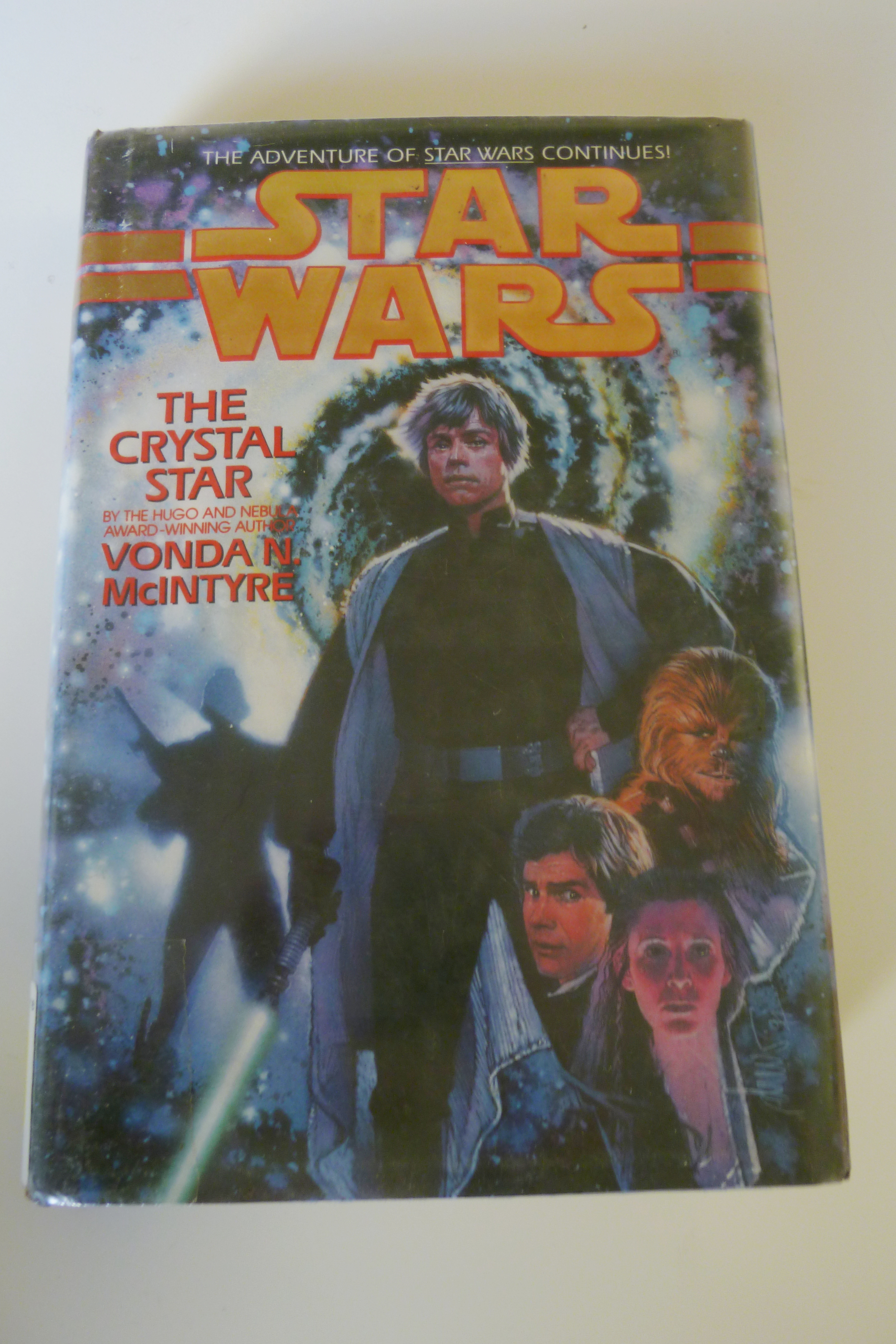
Star Wars: The Crystal Star by Vonda N. McIntyre

This is one of the Star Wars books I read long ago, although stumbling over it at the library was a stroke of blind luck, as I certainly didn’t remember the title or author!  I did recognize the plot, though.

Han and Leia’s children (five-year-old twins, Jaina and Jacen, and three-year-old Anakin) are kidnapped by a cultish group that wants to bring back the Empire.  Leia takes a ship in pursuit, disguised as a bounty hunter.  Meanwhile, unaware of the kidnapping, Han and Luke are off investigating rumors about a lost group of Jedi.  They find an old flame of Han’s, and a bizarre creature (even by Star Wars standards) with healing powers and malevolent intent.

The point of view moves between Leia, Jaina and Han, which I found a little disconcerting at first, but I got used to it.  The different plot threads eventually link up, in a way that’s somewhat far-fetched but does work.

The characterization was good here and, like with Star Trek books, I always enjoy books that let me revisit old friends (so to speak).  It was fun to see Leia go off to be heroic without the guys, and I really enjoyed Jaina’s point of view.  As I discussed in my review of Ender’s Game, Jaina is a very smart, brave little girl–who nevertheless seems like a little girl!  I thought that was very nicely done.

I’ve complained about Star Wars books usually being about mopping up the last traces of the Empire, and to some extent that was what happened here…but the group that kidnaps the kids could just have easily been a weird cult with no Empire connection, so that didn’t bother me too much.  The details of it were very different than just being yet another battle.

All in all, a fun Star Wars adventure–not fantastic or Earth-shattering, but a light, fun read.

Star Trek: How Much for Just the Planet? by John M. Ford

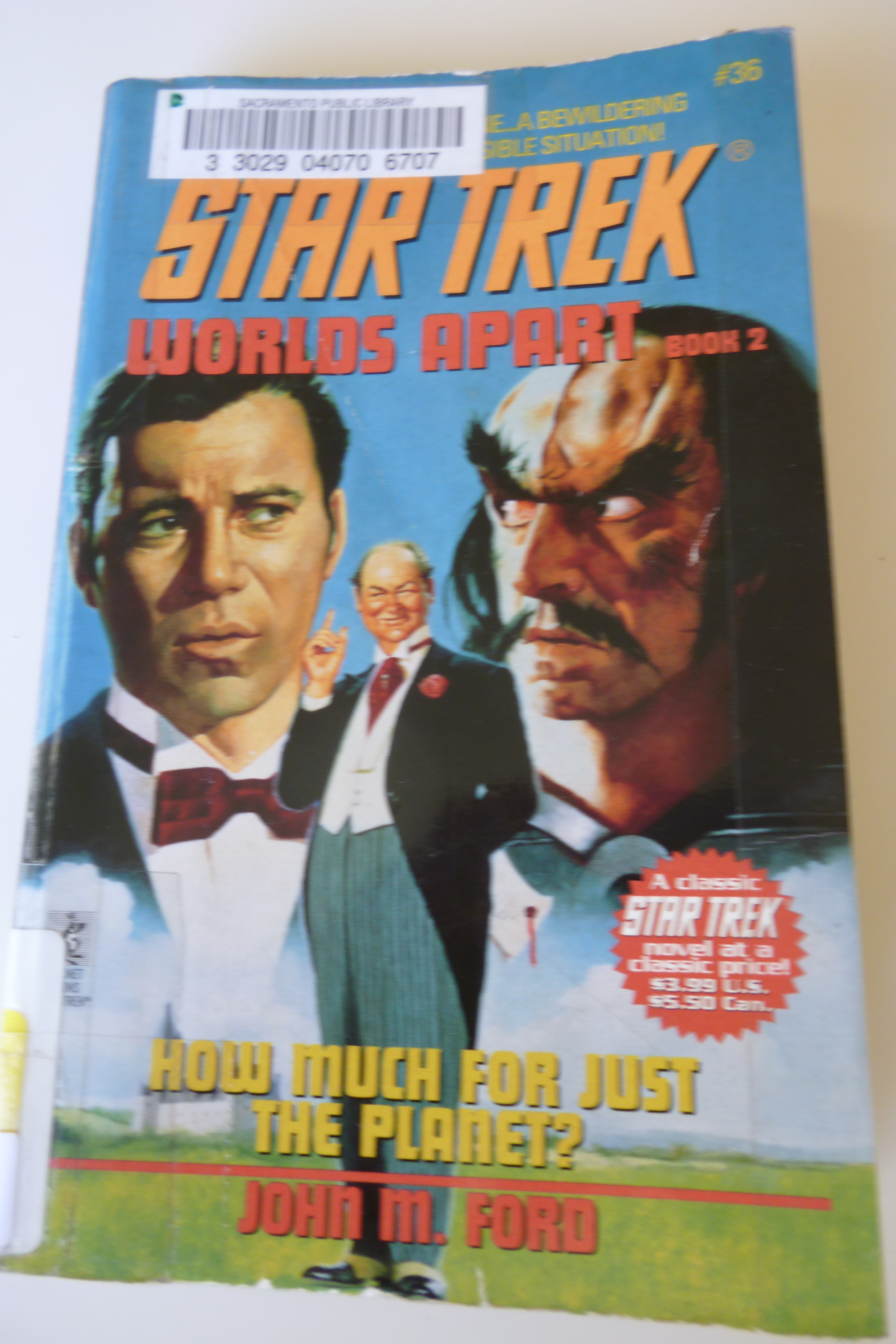
I’ve been wanting to read more Trek books, and I’ve been seeing this one in used bookstores for a while.  Doesn’t the cover look good?  It makes you want to know why Kirk’s wearing a suit–and why he has that expression!  I haven’t read Worlds Apart Book 1, but as far as I can tell from a plot synopsis, they have no significant connection.

So I dived in here based on the cover and a recommendation–and sadly, the book wasn’t quite up to its promise.  It actually read a lot like fanfiction–in good ways and bad.  It started so well, eating breakfast on the Enterprise, where Kirk inexplicably wound up with blue orange juice and McCoy grumbled about early mornings.  Then we jump to a survey ship whose computer seems to be an escapee from a Douglas Adams book, and where a mix-up floods a shuttle with peppermint milkshake.

It’s silly and fun and it’s like fanfiction, where writers are more willing to push the boundaries of what’s reasonable for the sake of a laugh.  Believe me, I was the queen of that when I wrote fanfiction.  I flooded the Enterprise with orange juice–twice.

But then the book went too far.  It’s a very, very thin line between really funny, and dragging your characters out of character and into a universe that is, dare I say it, just too illogical.  (And I won’t swear that I never crossed that line myself!)

The actual plot centers around a human-colonized planet, where massive deposits of very valuable dilithium have been discovered.  Under the terms of the Organian Peace Treaty, the Federation and the Klingon Empire can compete for rights to develop the planet.  The Enterprise and a Klingon ship both arrive on the scene for a diplomatic mission.  They beam down into a small town apparently populated by lunatics who can’t quite decide if they’re in a Hitchcock film, a Laurel and Hardy silent comedy, or a Gilbert and Sullivan musical–complete with characters randomly bursting into song.

What works for Gilbert and Sullivan doesn’t work in a Star Trek novel.  Putting song lyrics into the middle of scenes is just odd.  In fact, the whole book is odd, and made worse by the regular characters not quite acknowledging just how odd it all is.  They do think it’s weird, but not to the extent they should.  It’s too bad because there are some funny parts in here–Scotty challenges a Klingon to an honor match of golf, for one example.  The whole novel finally winds up with a food fight.

Part of me wants to love that–but a bigger part of me says that there’s no way Kirk and a Klingon captain, in their right minds, would actually end up throwing pies at each other.  Ford had a good idea here–and then I feel like he ran too far with it.  I love funny Star Trek stories and I love slapstick humor and I might have accepted much more of this if it really had been fanfiction–but it’s not, and I expect something different from published novels and this one just didn’t quite ring true to me.

But that’s all right.  I’ve been asking everyone I can think of for recommendations on Star Trek books to read, and I have MANY more to explore!

Twelve More Dancing Princesses

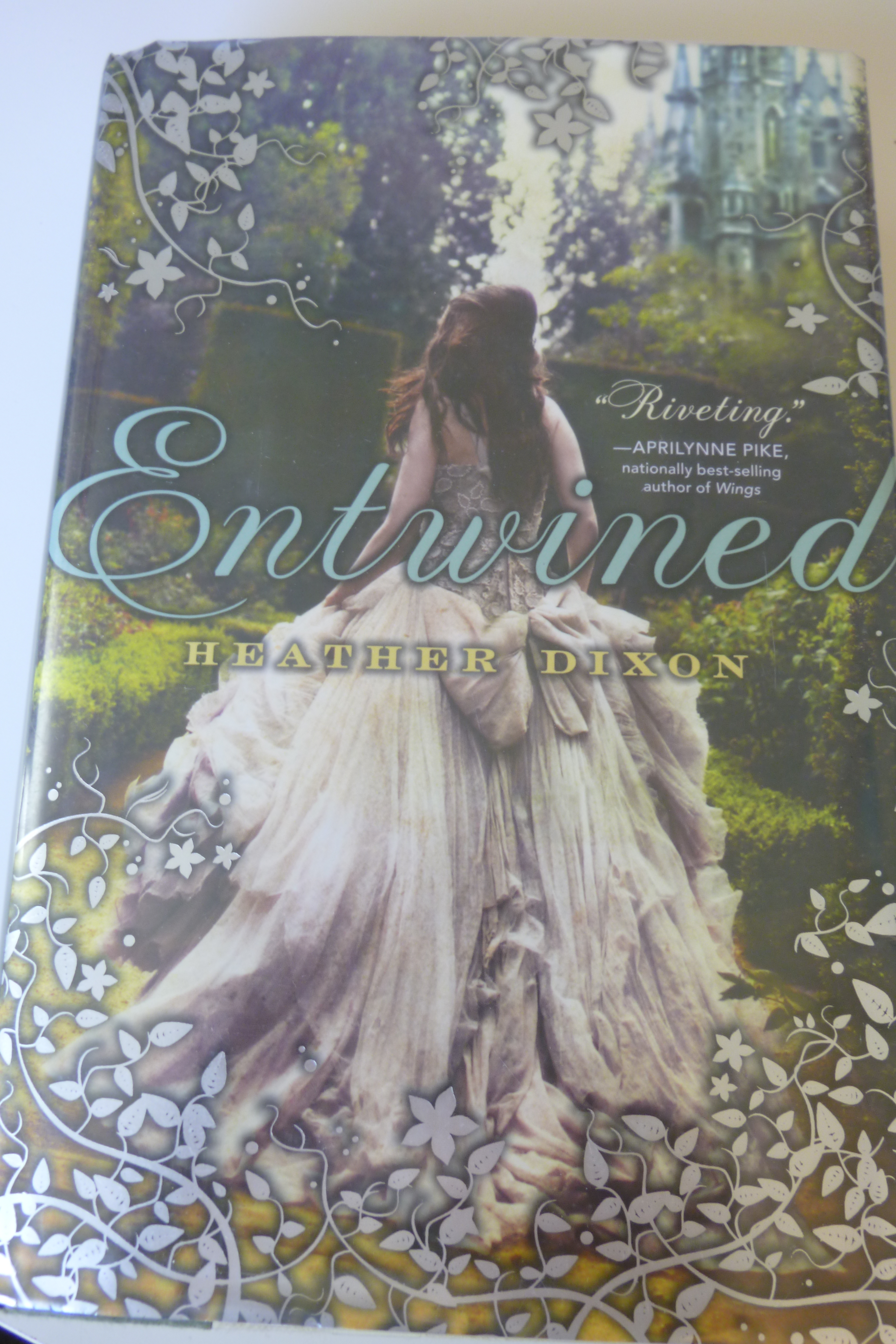
Entwined by Heather Dixon is one of those books I saw make the rounds of several blogs I follow.  And of course I was intrigued–it’s another retelling of “The Twelve Dancing Princesses.”  I reserved this at the library months ago, but the hold list was so long, it finally looked like it was about to come in during November.  Since I was spending November writing my own retelling of the same story, I didn’t want to read this then–I was sure I’d end up subconciously plagiarizing something!  So I put my request on hold, and finally read it in January, after finishing my own novel.

Entwined centers on Azalea and her eleven sisters, all named for flowers or plants and helpfully in alphabetical order: Azalea, Bramble, Clover, Delphinium and so on.  I frequently had to run through the alphabet to figure out the approximate age of, say, Jessamine or Kale.  The princesses’ mother dies early in the book, and the official rules of mourning restrict them from dancing for a year (among other things).  The girls discover a hidden passage leading off their room, relic of a magician-king from two hundred years ago.  They find an enchanted silver forest and a pavilion, whose guardian, the Keeper, tells them they are welcome to come and dance every night.

This book started slow for me.  The first half was only so-so, but it did pick up in the second half.  The turning point for me was when Keeper started threatening the soul of Azalea’s mother, to force Azalea to free him from captivity in the magic pavilion.  It was the first time Azalea seemed to have any significant motivation, and also when she finally figured out how creepy Keeper was–which had been pretty obvious to me from the beginning.  Prior to that, really wanting to dance just didn’t seem like adequate motivation to defy their father and go dancing every night in a pavilion owned by a very sinister stranger.

The romances also pick up in the second half of the book, for Azalea as well as Bramble and Clover.  This actually did a lot for Bramble and Clover as characters.  Prior to that, Clover was very quiet and Bramble was very immature.

That leads me to another point–this book made me think about what is perhaps the first fundamental question of retelling this story.  Namely, which sister to focus on?  The oldest?  The youngest?  Someone in between?  This is a larger question than it might seem, because there seems to be an unwritten rule that the heroine has to be around sixteen or seventeen.  If you give your seventeen-year-old heroine eleven younger sisters, simple math tells you that most have to be children.  Making her one of the younger ones means she can have adult sisters.  In a way, it’s a choice between giving your heroine a circle of peers, or making her a baby-sitter.  The fact that I put it that way probably tells you already that my heroine is at the younger end, #9, with sisters ranging between the ages of 15 and 25 (with a couple sets of twins).

Azalea is the oldest princess, and she spends a lot of time looking after younger siblings.  Most of them completely run together for me.  Even though Bramble should be about 15, she spends the first half of the book seeming very young.  It gets better when she and Clover get a little more screen time, a little more maturity, and can serve more as equals for Azalea.

Another major arc of the book was the relationship between the princesses and their father.  The King starts out as very cold and apparently aloof, but ultimately develops into a caring father (who simply doesn’t always know how to relate to his daughters).  Sometimes that transition is jarring, but it does come together in the end.

There are things I liked about Entwined too.  Some of the description was good, and I liked the treatment of the dancing.  Dixon clearly knows something about dancing, and there’s plenty of discussion about what kind of dance the princesses are dancing, and how they feel.  I do feel convinced about the importance of dancing to Azalea, and there’s good description of what it means to her–for one thing, it’s a connection to her mother, and it also gives her a sense of freedom and of magic.  I believe dancing is important to her–it just doesn’t seem quite important enough for some of the choices she’s making.

This was a good book, with a great climax, and nothing really wrong with it (other than some bland sisters, but with twelve there’s only so much you can do).  It didn’t quite spark for me, though.  Good–but not fantastic, and not particularly distinctive compared to other versions of the story I’ve read.  Aside, that is, from the cover–definitely one of the most beautiful books I’ve read in a while!

Author’s Site: http://www.harperteen.com/authors/37209/Heather_Dixon/index.aspx

Other reviews:
Between the Stacks
Charlotte’s Library
While We’re Paused
Yours?