Revisiting a Galaxy Far, Far Away

This sci fi kick I’ve been on lately has led me back around to Star Wars, which I must admit I haven’t paid much attention to for about ten years–and it had probably been that long since I watched the original trilogy.

First, a little history.  The trilogy was re-released in theaters when I was in elementary school, and me and everyone around me became Star Wars fans.  I read probably 10 or 12 Star Wars books too, but lost interest when it began to feel like every book was basically “let’s mop up the last traces of the Empire…and then the last last traces…and then this last one…”  More significantly, I also found Star Trek.  For me, the fandoms co-existed for a while, but in the end, the traveling turned out to be more interesting than the fighting (I’m convinced the difference really is all in that second word of the names).

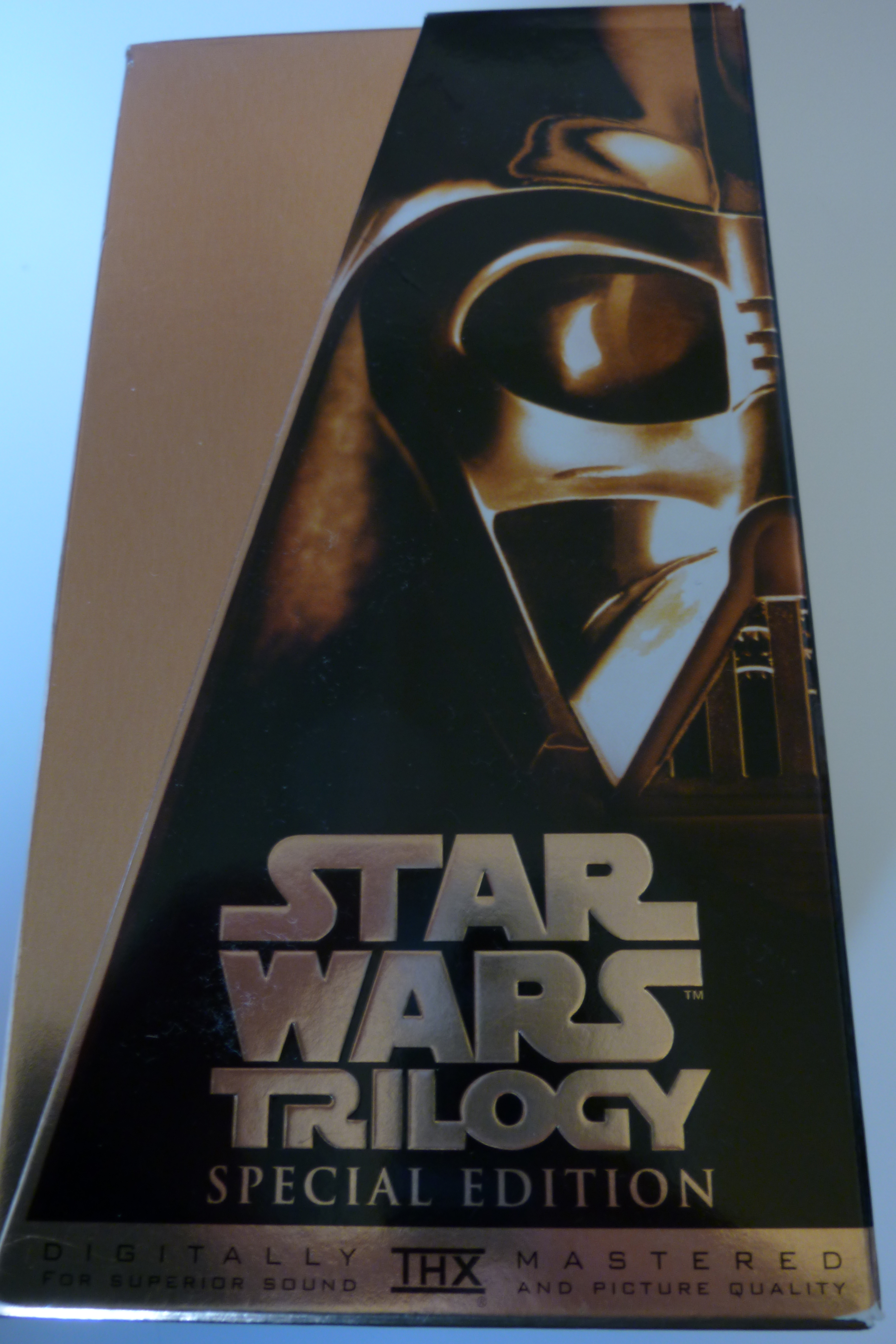
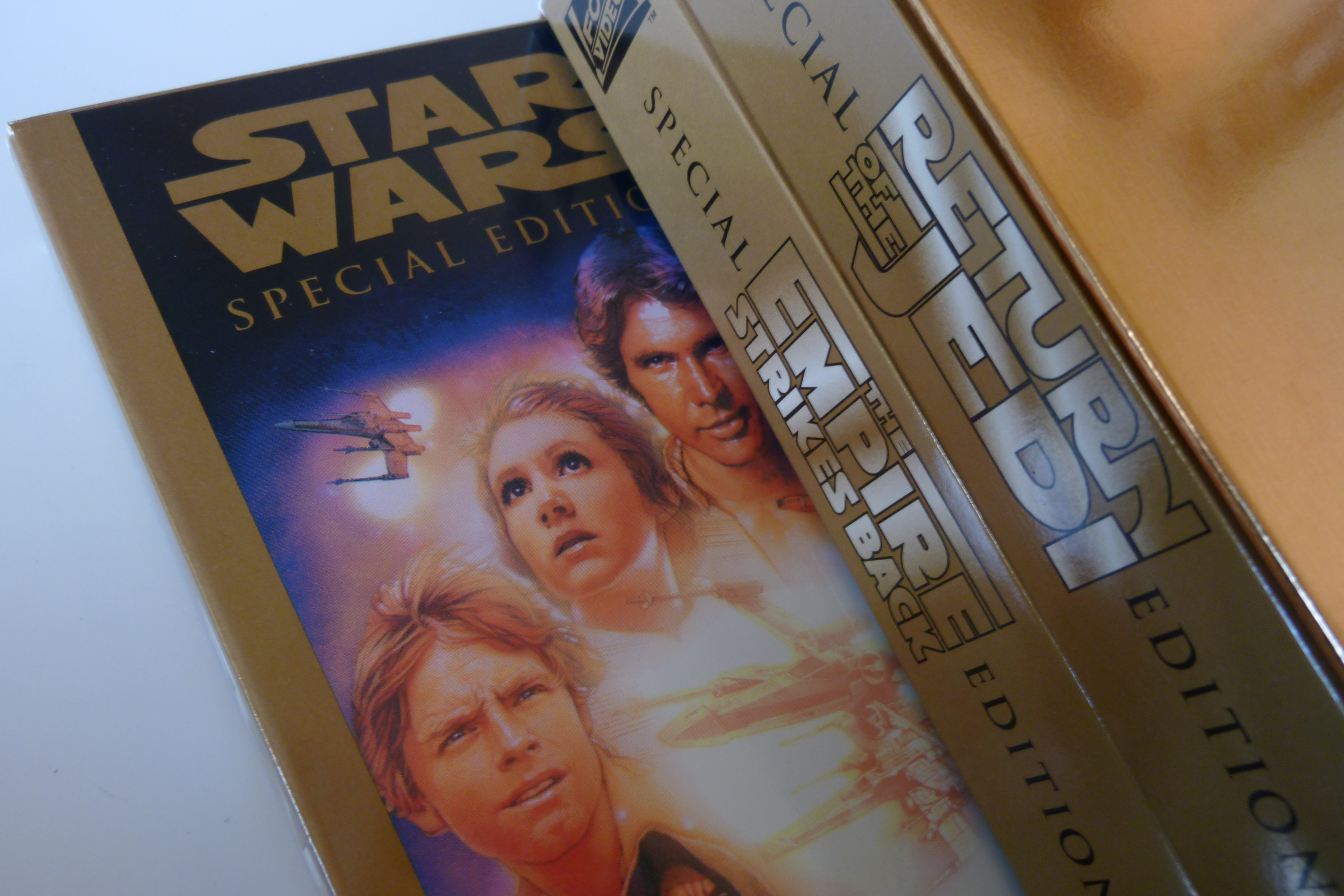
All of this is to say that I identify as a Star Trek fan, but I like Star Wars too, and there was a time when I really liked Star Wars.  And lately I’ve been thinking I’d like to revisit the galaxy far, far away.  So, over a recent weekend, I dug out my very old, shiny gold Special Edition VHS tapes of the original trilogy (a very big deal purchase when I was much younger!) and rewatched all three movies over three days.
And you know, they really are wonderful.  The characters, the strange landscapes, the magic of the Force…even the battles.  It’s often the characters that count most for me, so let’s start there.  Remember it had been ten years (or thereabouts) since I saw these movies.  The biggest “change” was Luke.  Han is right when he’s calling him a kid at the beginning!  You can’t see him the same way when you’re a kid yourself.  I think you have to be older to properly see Luke’s character arc, from a whiny kid on Tatooine (he really is whiny in spots) to the serene and confident Jedi Knight.  It’s the classic growth of a hero story, and it’s very well-done.  I enjoyed Han’s growth too, from refusing to stick his neck out for anybody, to General Solo of the Rebel Alliance–but still with some of that scoundrel edge.  The one who grows less is Leia–she’s awesome from the first moment and stays that way, whether it’s blasting Stormtroopers or making acid comments to Han.  I remembered she was great, but I think I forgot just how much so.

I thought other characters were excellent too–Threepio, with his constant worried commentary, gets some of the funniest lines.  And at the opposite end of the spectrum, you have the looming and menacing Darth Vader.  I don’t think I ever noticed before–his entrance gets more impressive with each successive movie.  I wonder if they didn’t quite know what they had in the first one.

I thought the plot rockets forward at a nice pace, and each time I finished one movie it made me want to watch the next one.  It’s fun to revisit all the iconic lines and moments, and my memory of the later two movies may have been part of why I wanted to go on to watch them.  The trilogy is also a great example of a story which is complete unto itself, despite previous events which influence the present.

Which leads me around to the newer trilogy.  I watched that as it came out, and I don’t think I had seen the original trilogy since watching Episodes 1-3.  Rewatching Episodes 4-6 largely brought home to me how irrelevant the first three episodes really are.  I don’t feel like they added anything to my viewing of the original trilogy.  It was a bit interesting to see the references in the original to the past, and to know how they expanded those references, except that mostly I don’t much like the way they expanded them.

If anything, the new episodes hamper viewing of the original; now when Leia talks about her mother, I’m stuck thinking about Padme’s really stupid death; when anyone talks about Anakin Skywalker, it’s now harder to think of him as a heroic Jedi when I’ve seen him as a sulky teenager who, after the age of nine, was never all that likable.  And even though I like Padme, seeing Leia again makes Padme look like a poor imitation.  It’s sad, really–the original trilogy points up how far the new ones fell short, and how we really already knew anything we needed to know about the backstory.

If I was going to get more backstory, I think I’d rather have it about the galaxy, not the individuals.  Star Wars has good character development, but not so much when it comes to races.  The Wookies, the Ewoks and the Jawas are the only ones I can think of who have their species name even mentioned in the original trilogy (maybe Jabba–is Hutt a species or a title?)  There are endless bizarre-looking creatures, but most of them we know pretty much nothing about.  We don’t need to know about all of them–but it would be nice to know about some of them.  I suppose that’s another reason I ended up as a bigger fan of Star Trek; there’s much more scope in exploring different alien cultures than there is in mopping up the last traces of the Empire.

But there’s plenty that’s good in Star Wars too, and I think I’m going to do a bit more revisiting.  The new trilogy added nothing to the old one for me, but what I remember of the books did.  I remember Wedge got to be a much bigger character, that Leia became a political leader, that Luke continued that character arc to found a new Jedi Academy, that Han kept trying to balance the general and the scoundrel.  I lost interest eventually in reading new Star Wars books, but I remember I liked several of the ones I did read.  So I think I’m going to track some of them down and see if they’re worth revisiting too!
Caught Between a Great Brain and a Money-Loving Heart

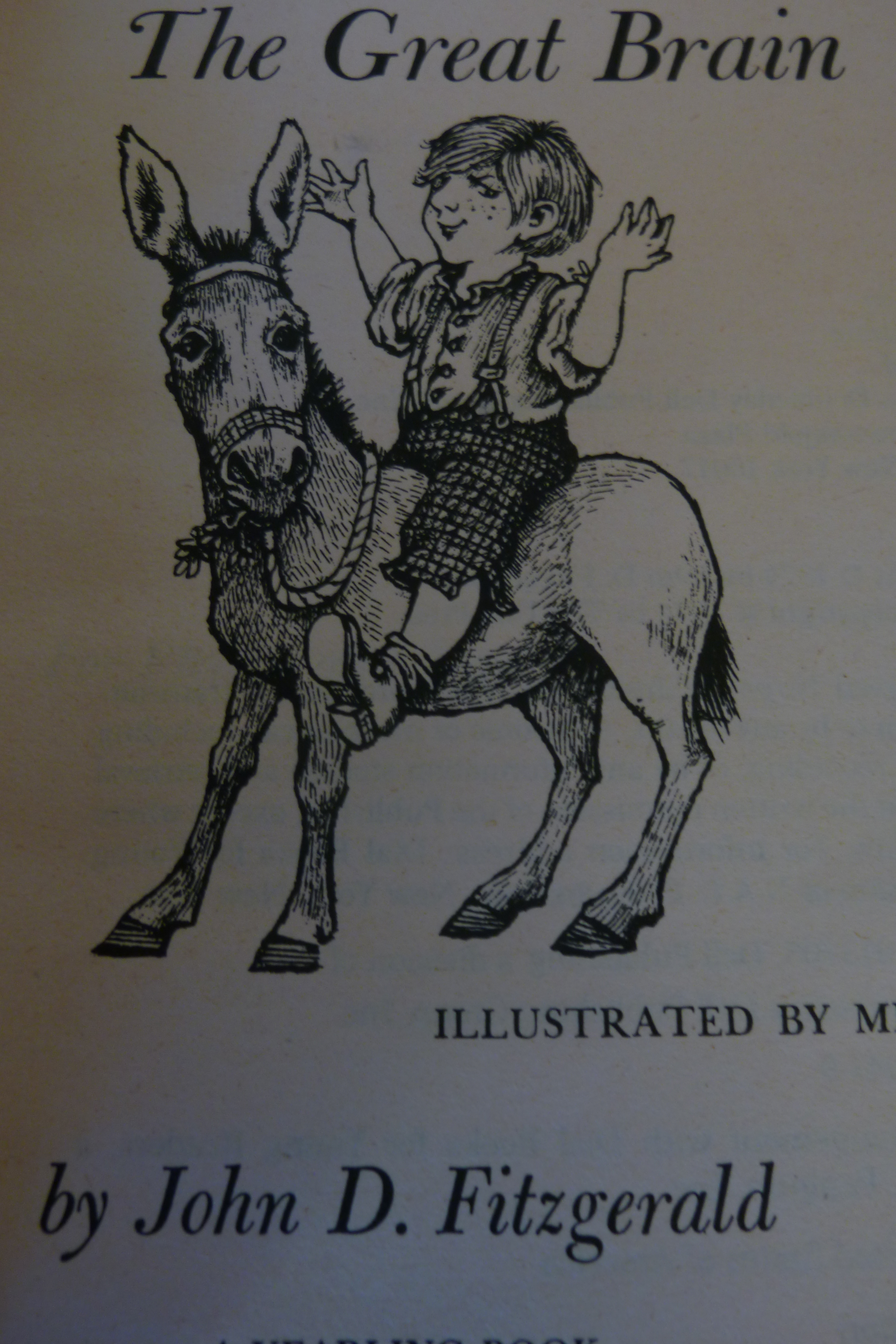
On the subject of funny kids books about boys, another favorite besides Gordon Korman is The Great Brain series by John D. Fitzgerald.  Based loosely on Fitzgerald’s childhood, the books are set in a small town in Utah in the 1890s.  The Great Brain of the title is John’s older brother Tom, who has a brilliant intellect and a “money-loving heart.”

There are seven books in the series, each a string of vignettes.  John narrates in first-person about the adventures of his brother Tom, who always has a scheme going to swindle someone–including John, who never seems to learn that it’s impossible to win a wager against Tom.

Tom is very clever, and it’s always fun to see what scheme he’ll come up with next.  I’ve never been a big reader of mysteries but I like figuring things out, and guessing at what plot Tom is devising, or how he’ll solve some problem, always makes for good puzzles.  Tom is a great character in that he never becomes TOO unlikable.  He’s immensely proud of his Great Brain, and he loves to get money out of people.  He doesn’t cheat, though–he finds ways to trick them, usually exploiting their own gullibility or greed.  He also uses his Great Brain to help people, sometimes saving lives or dramatically changing lives for the better.  He usually gets something for it too…but that’s always the question, of whether he’s acting from compassion or from greed!  Usually I get the sense it’s a little of both.  He’s also not above being humbled at times when greed or pride leads him into a serious mistake.

John is a good character, sweet-natured and modest.  He often refers to his “little brain” in comparison to his brother’s Great Brain.  John is rather eclipsed by Tom, but that aspect of the books seems to work–it’s John’s story about his brother, so it makes sense that he’s giving Tom the center stage.  John’s obvious admiration and love for his brother (no matter how many times Tom swindles him!) also goes a long way to setting Tom up as a likable character.

The stories are mostly light and funny.  They’re not the hilarity of Gordon Korman, but they are very entertaining.  There are some serious ones mixed in too.  Sometimes the situations kids get into have real peril, as when two boys get lost in a network of caves, or when one boy loses his leg to an infection and contemplates killing himself.  The Great Brain series is another example of how deep children’s books can be, addressing very serious issues and subject matter, while being child-appropriate.

And fun, of course.  Even though the stories are sometimes serious and Tom is out to swindle others to satisfy his money-loving heart, these still come across as sweet stories about family, set in a small town in a quieter time.  Well-worth the read.

Other reviews:
The Five Borough Book Review
Books 4 Your Kids
There must be more…tell me about yours?

Chaos and Disorder at Summer Camp

I’m a big believer in re-reading books, and I don’t think there’s any book I’ve read more times than I Want To Go Home by Gordon Korman.  My guess is I’ve read it fifteen times–I lost count at twelve.  Most of those times were also before the age of twelve, but I’ve reread it in recent years too, and even after all those times, it still makes me laugh.

I’ve reviewed some of Korman’s other books, about the deep metaphor of a garbage bag and a hilarious series about a boys school.  This one is another of his best.  This is a story about a summer camp for boys, held on Algonkian Island.  The story centers on Rudy Miller, who hates camp.  He’s a loner, perpetually bored, and has no interest in participating in the many sports played at camp.  His only interest is escaping–which, when you’re on an island, requires considerable planning.  Rudy does become friends with Mike Webster, a comparatively normal boy who doesn’t enjoy camp either.  Rudy has a dry wit, and is creative and intelligent–mostly using those skills to think up wild schemes for escape, dragging Mike along with him.

As per his usual setup, Korman surrounds a relatively normal lead (meaning Mike, not Rudy) with crazy characters.  To name just a few, there’s Mr. Warden, the bow-legged camp director who firmly believes that all boys love camp and never quite registers that Rudy may be a problem.  There’s Chip, the counsellor for Rudy and Mike’s cabin; he’s constantly driven up the wall by Rudy, and has a tendency to fall into the lake.  There’s Harold Greene, Rudy’s nemesis and a twit (Rudy’s dubbing).

Rudy and Mike wind up in a whole series of adventures, involving stolen boats, a pillow fight that destroys a cabin, the startling discovery that Rudy is brilliant at any and all sports, and a good dozen escape attempts.  Before the summer is over, Rudy comes very close to destroying Algonkian Island.

It’s a great book.  Simple, short, and the target age group is probably about ten years old.  But it’s very, very fun even if you’re much older than that.  If you want a quick read that will make you laugh, give it a go.  I have–fifteen times.

Author’s Site: http://gordonkorman.com/

Other reviews:
Lucky Book Deals
Amie Kaufman
SirTheory’s Treatise on Life

Yours?  And by the way–just a brief scan of reviews suggests I’m not the only one who has read this one again and again!

A Child Commander

Another sci fi book I’ve been meaning to read for years is Ender’s Game by Orson Scott Card.  Now that I finally have, I enjoyed it very much–and had some serious issues with it too!

The book is set an indeterminate length of time in the future, when humans have begun to venture into space but have not yet spread as in, say, Star Trek.  They also haven’t met any aliens as nice as the Vulcans–instead, they’ve met the buggers, a race of bug-like aliens who attacked the Earth 80 years before Ender’s Game opens.  The International Fleet has been preparing for a renewed war ever since, sending ships to the buggers’ homeworld that are just now getting close to arriving.  With war expected within the next several years, the IF is looking for a supreme commander to direct their forces.  And they find Ender, a six year old boy with enormous potential.

They ship Ender off to battle school, held in a space station, where Ender and the other children are meant to learn to be soldiers.  Their chief focus is the Game, a sort of combination Capture the Flag/Freeze-tag/Paintball held in zero-gravity.  The book follows Ender’s very, very swift rise, heading towards the new war with the buggers.

First, this was an extremely engaging book.  Between the outside threat to add tension and the exploration of how the school works, and how life in the space station works, it stays interesting throughout.  Even the discussions about movement in zero-gravity were fascinating.  It’s a very grim, even harsh story, but it also has a momentum and an urgency that keeps pushing the book forward.

Ender is an excellent character, very conflicted and complicated.  I think he’s basically a good person, but he’s terrified by the darkness inside of him.  And that darkness does push him to lengths that are sometimes alarming and disturbing.  Ender is a good character in almost every way–except that he doesn’t feel like a child.  And that brings me to my issues with the book.

Let me start with a different though related issue.  The book requires an enormous suspension of disbelief in its primary premise: namely, that the IF is so intent on training up Ender to be their commander.  It reads almost like a story about a prophesized Chosen One, except there’s no prophecy and it’s solely based on their assessment of his abilities.  And fine, perhaps he’s extraordinary–but they need a commander now.  I don’t want to give spoilers, but suffice to say that the ultimate fight with the buggers happens years before Ender reaches adulthood.  The IF has been planning this war for 80 years, and now at the crucial moment they want to make a child their supreme commander?  That seems, um, unlikely.

But maybe they know what they’re doing, because, as I said, Ender does not much resemble a child.  It’s not just him, either, it’s all the children at the battle school.  Officially they’re seven or nine or ten, but they behave as though they’re in their late teens at least.  Which leads me to wonder why Orson Scott Card made them so young to begin with.  It’s not a young adult book, so they didn’t have to be that young.  Perhaps it was for shock value, or a comment on child soldiers, or to emphasize their manipulation by the IF.  Those are perfectly good reasons and the book has some elements of that–but it all has much less resonance when Ender doesn’t feel seven.

I’m reminded of two other books that have parallel elements but actually handled this issue better.  In The Hunger Games, Katniss feels like a teenager.  Rue, another girl in the games, feels twelve.  They’re intelligent, strong, capable, sometimes almost ruthless, thrown into situations no child (or anyone, for that matter) should be in, but they feel like young people dealing with a grown-up situation.  I also just read a Star Wars book (more on that in another post) which had a major focus on Leia and Han’s daughter, Jaina, who’s five and has been kidnapped.  Again–brave, capable, probably genius-level intelligence, but she still seems five.  She gets scared, she wants her mother, and when she is reunited with Leia, Jaina tells her about the kidnappers but also tells her that she lost her loose tooth.  If Ender ever loses a tooth, it’s not mentioned.

I also question the battle school’s methods.  They are harsh, and intended to isolate Ender and keep him from depending on anyone.  I don’t see that as a way to make a good soldier, let alone a commander–or a person.  He’s essentially taught not to trust anyone in authority.  And how can a child who is never shown compassion or kindness, who is actually prevented from forming close ties, be expected to lead people?  They’re trying to create a tool, but they need it to be a tool that is creative, determined, and has a deep understanding for others, and I don’t see where Ender learned any of that.

And now, as tends to happen, I’ve gone on and on about the issues in a book I actually liked!  Perhaps because the ways a book doesn’t work are the most interesting to explore, trying to figure out why and how it didn’t quite fit together.  But don’t get the wrong idea here–despite the various issues I had with the book, it’s very good.  Grim, dark, sometimes bloody (I warned you!) but intense, engaging, and with some very surprising twists at the end.  And after the complete devastation of much of the book, in the end there’s a surprising amount of hope.  If you like science fiction, it’s worth the read.

I know this is a popular sci fi book–who else has read it?  Did you have any of the same issues, or can you explain why they weren’t issues for you?

Author’s site: http://hatrack.com/ (no, really–it’s not orsonscottcard.com, apparently)

Other reviews:
Book Club Babe
End of the Game
Truly Bookish
And no doubt masses more–like yours?

Finding a Book About Finding a Calling

I want to tell you a story about the wonders of the internet when it comes to finding books.  Many years ago I was in a religious book store, and I was passing the time waiting while my parents shopped by reading the picture books.  I found one about an acrobat who wanted to serve God, and somehow it stuck in my mind…but that was almost all that stuck–certainly no title or author name.

I was thinking about that book recently, and went hunting on Amazon for a religious book about an acrobat.  Within a matter of minutes I had found Tumbler by Liz Filleul, which I am 98% sure is the same book I read all those years ago–and as good as I remembered it.

Tumbler is about Tristan, a talented acrobat who travels with a troupe of minstrels in medieval France.  Everyone loves watching him, but Tristan himself admires the monks he sees helping the poor.  He believes that they’re doing work that’s really serving God.  When Tristan injures his leg one day and can’t do his acrobatics, he decides to join a monastery, believing that’s the best way to serve God.  Tristan turns out to be very unsuited to monastic life…and eventually realizes that doing what he does best is the best way to serve God.

I love the message in this book that everyone has a different purpose.  Think of it as a way to serve God or as a life calling or as what we’re each meant to do.  It’s not the same for everyone, and there isn’t any one right way to live, or one right thing to do.  I also love it that Tristan realizes he doesn’t have to force himself down a path–the right path for him is the one he already loves.

I’m reminded of a quote from L. M. Montgomery, in a letter to a friend who must have been questioning his own calling: “I do not think that you need feel worry because the line of work you take up may not be the highest.  It may not be the highest absolutely but–for you–it is the highest relatively.  The work God gives us to do and fits and qualifies us for doing must I think be our highest.”

I always like stories about following dreams and finding a purpose, and Tumbler is a simple, beautifully illustrated, profound story about exactly that.