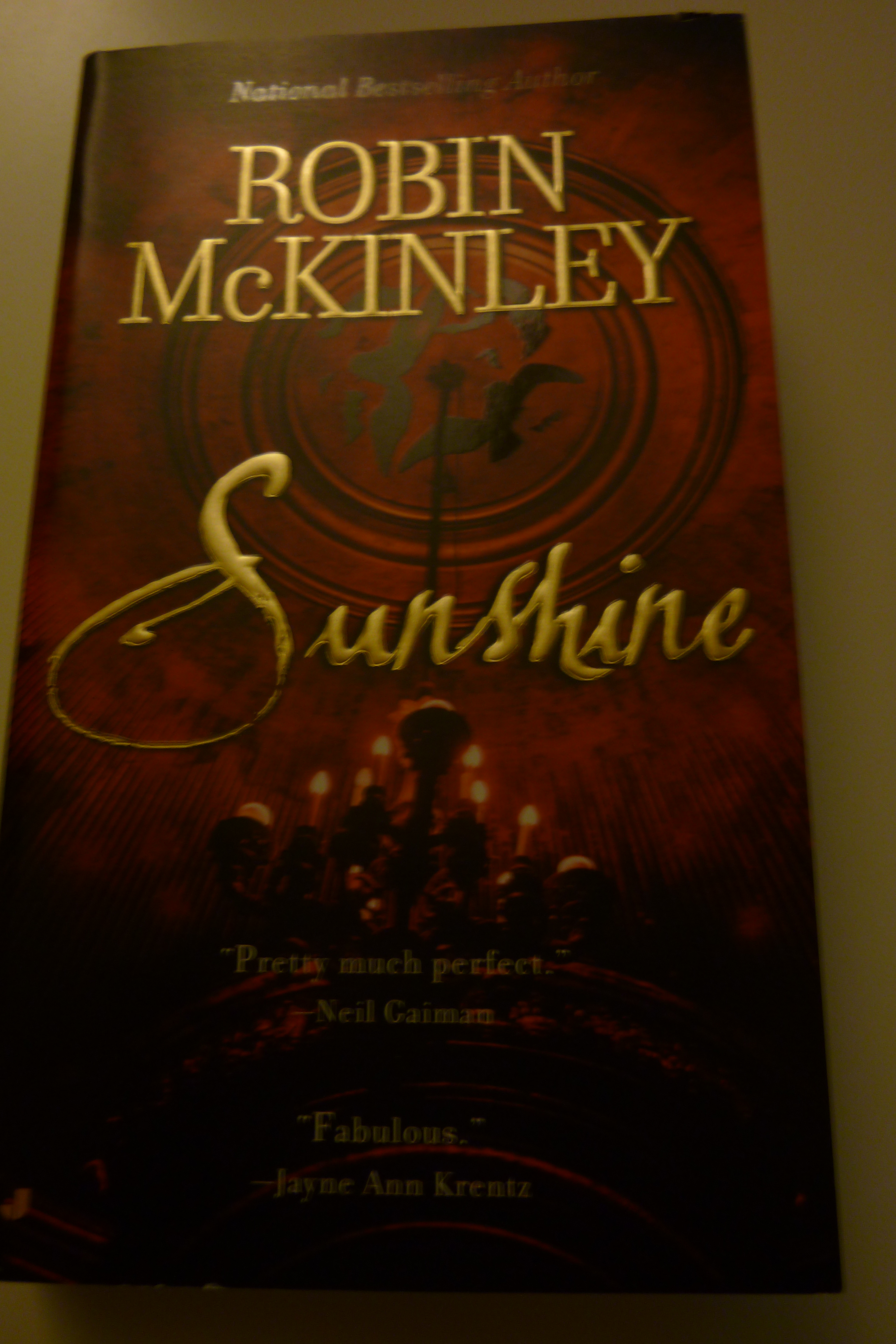
Robin McKinley’s Very Dark “Sunshine”

I think I should begin this post by saying that I love Robin McKinley’s books.  You’ve probably seen her referenced around here as one of my favorite authors.  That said, now I can tell you why I didn’t love Sunshine.

Sunshine was very nearly the last McKinley book I hadn’t read (the only other one is Pegasus, and a friend tells me it has a cliffhanger so I’m waiting for the sequel to come out first).  The funny thing is, I used to know why I hadn’t read Sunshine.  See, it’s her vampire book, and I’ve never been a vampire fan.  It’s also darker, and has a more modern setting.  So I just wasn’t that interested.

But all of my friends had read Sunshine, and they all really loved it (possibly because they are vampire fans), and it was the last one (more or less) that I hadn’t read…so I kind of forgot why I wasn’t reading it.

I finally read Sunshine recently.  It wasn’t a bad book, but I did have problems with it, and it very much was not my kind of book.

Sunshine is set in a world much like ours, but the creatures of gothic novels are real: vampires, werewolves, demons.  Humanity is in an ongoing war, and losing.  The book centers on Rae, nicknamed Sunshine, whose life revolves around her family’s coffee house, where she’s the head baker and cinnamon roll queen.  Life takes an unexpected turn when she drives out to the lake one evening, and ends up captured by vampires.  They chain her up in an abandoned house, an offering for their other prisoner–a vampire named Con.

Con, for reasons more mercenary than merciful, doesn’t drain Sunshine’s blood immediately, and the two of them end up working together to escape.  Sunshine gets back to her normal life, but can’t shake the experience.  She starts discovering that she has strange powers, and that she’s still tied somehow to Con and his enemies.

I liked Sunshine (the character).  The book is in first person and we spend a good chunk of the book reading her thoughts and memories.  She’s pulled in an interesting way between two lives–her ordinary baker life, and this dark world of vampires.  She’s a reluctant hero who just wants to go back to her cinnamon rolls, but finds the other world thrust on her, and with it strange powers and plenty of danger.  She’s a strong character, and I liked following her journey.

I didn’t like Con.  It may not have helped that my friends set me up to expect him to be a great romantic hero, and then…it didn’t come out that way in my reading.  Quite apart from the blood-drinking aspect of things, I didn’t find him likable and I didn’t get any chemistry between Sunshine and him.  She keeps describing him as ugly, for one thing (and yes, sometimes I like the ugly characters because of that–see the Phantom of the Opera–but not in this case).  The larger problem is that he never expresses emotions.  I like Vulcans and I like the occasional mysterious enigma, but I just couldn’t get any sense of Con, or whether he cared at all about Sunshine, because he wouldn’t express anything, ever.

I didn’t much like Mel either.  Notice Mel wasn’t mentioned in that summary up there?  That’s how irrelevant he is, even though he’s Sunshine’s boyfriend and theoretically the other point on the romantic triangle.  Somehow, despite being a tattoed, former biker turned chef, he’s an incredibly bland character.  I think the clincher for me was when Sunshine asked him, sort of rhetorically, who he was, and he answered, “I’m your friend.”  That doesn’t really feel like the right response from a long-time boyfriend and narrative love interest…

I actually liked the more minor characters better.  There’s a whole family of people who work or are regular customers at the coffee house, and some of them are quite interesting and entertaining–like Sunshine’s stepfather Charlie, one of the “big good guys” of her universe, or a customer who turns out to be part demon and can turn himself blue.

My problems with Con and Mel may be me–anecdotally I can tell you that I have three friends who love them, so take from that what you will.  The plot of the story is exciting, and the world is intriguing, although it takes some time to get a proper picture of it.  That’s normal for McKinley, who sometimes makes things mysterious at first, and you gradually start putting pieces together.  This is a dark book, with a lot of blood in it–not too graphic, mostly, but there’s a lot of it.  That’s what makes this not my kind of book, so you’ve been warned…  Also, definitely an adult book, not YA.

It does make me impressed with McKinley in a way, though.  For most of my favorite authors, most of their books are similar (which in a way is nice, because I know what I’m getting).  McKinley has impressive range to write very different books: Dragonhaven, Beauty and Sunshine read like they were written by three different authors.

One more point to address–a sequel.  There isn’t one, but fans have been asking for one for years.  McKinley has said that she’ll write one if she has an idea for one, which says to me that she has, for now at least, no intention of writing one.  (If you ever meet her, don’t ask about a sequel–based on her blog, I guarantee she won’t like it!)

I have to say I agree with McKinley.  I don’t think the book needs a sequel.  I may think that in part because I just don’t care which man Sunshine ends up with…  But the larger point is that I think the book came to an ending.  There’s plenty of plot room for a sequel, and questions left unanswered.  However, I think the book really was about Sunshine’s growth, and her acceptance of herself, both the baker and the monster-fighter.  She comes to a realization at the end, and for me, that is the end.

Final analysis: if you like vampires, read Sunshine.  If you don’t like blood, read Beauty or Spindle’s End instead.

Author’s Site: http://www.robinmckinley.com/

Other reviews (including some who loved the book far more than I did!):
Suite 101
Angieville
Writegray
Bookshelf Bombshells
There are many more–want to tell me about yours, or one you enjoyed?
An Enchantress or an Alien–or Both

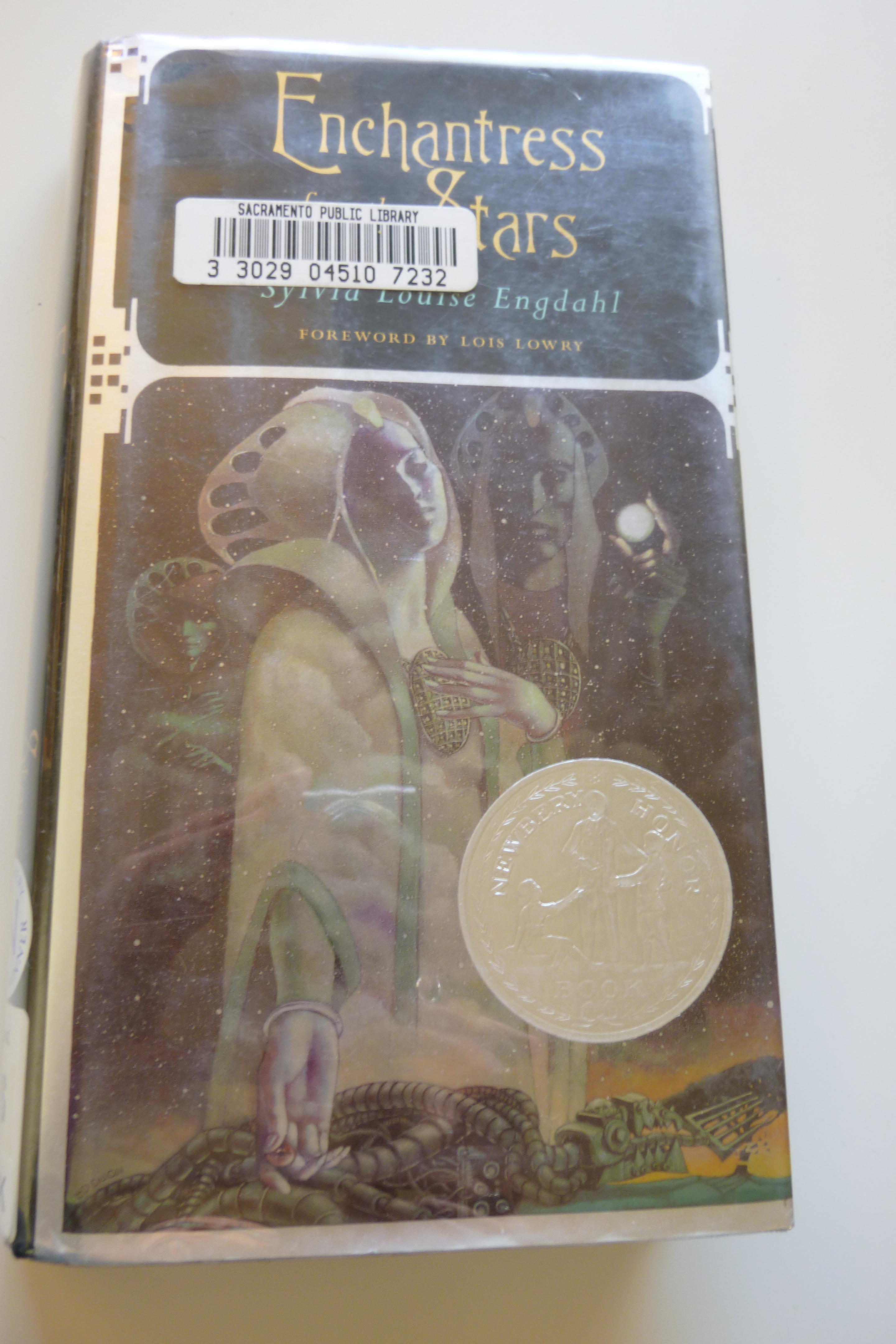
Science Fiction and Fantasy get lumped together all the time, in discussions, in “Best of” lists, in the bookstore.  But you rarely see them together in a single novel.  Enchantress from the Stars by Sylvia Engdahl is a brilliantly-devised story that could be in Earth’s distant past–or even more distant future.

The story is told by Elana, who belongs to a society far advanced beyond present-day Earth.  She is part of a Federation of many planets, joined together in peaceful cooperation.  They study less advanced worlds, but have a strict non-interference policy, believing that it’s best for cultures to develop without knowing about more advanced races.

(For the Star Trek fans–I know, I know.  All I can tell you is that this was written in 1971, but feels less like Star Trek when you’re actually reading it.)

Elana is training to be one of the scientists who studies Youngling worlds, when she stows away on a mission to Andrecia.  Andrecia’s native people are at roughly a Middle Ages level of development.  Their future is threatened by colonists from another world–the Imperials have developed space travel, but have not yet achieved the level of Elana’s people, either technologically or culturally.  The Federation team’s mission is to induce the Imperials to leave, without harming either race’s culture.

Elana ends up taking on the role of Enchantress, to relate to the Andrecians in a way they can comprehend–she especially connects with one, Georyn.  She teaches him magic spells (combinations of technology and telekinesis), so that he can go fight the dragon (the Imperials’ digging machine).  The hope is that if an Andrecian uses powers the Imperials can’t understand, they’ll be convinced to give up their colony.

The brilliance of the story is that it’s told from three very different points of view–Elana, from her advanced, enlightened perspective; Georyn, who tells a Brothers Grimm-style story about a beautiful Enchantress, a dragon served by terrifying demons, and magical spells; and Jarel, an Imperial who questions what his government is doing but doesn’t know how to act–and is probably the closest to all of us who are reading.

The three perspectives are intertwined and so different, yet work so well together.  It’s emphasized, in Elana’s sections, that Georyn’s perspective on events isn’t wrong either–he simply has a different understanding, a different way of viewing what’s happening.  In some ways, he proves to be the most intelligent and the most insightful of any of the characters.

Elana is very interesting too, because we see her as the uncertain, often naive girl she is on the mission; as the strong and wise enchantress Georyn sees her as; and as the more mature voice telling the story after it’s all over.  Her character growth, throughout the story and from the after-perspective, is very excellently done.

This is a good adventure with compelling characters, and it’s ultimately a very hopeful story.  Engdahl is careful to place Andrecia, Elana’s home world, and the Imperials’ home planet all in the position of third from their stars.  It notes in the introduction that any of them could be Earth–this could be a story about our past, or a story about our future.  Ultimately, I don’t think it matters.  We’re all of them.  The hopeful part is that the book makes it clear that Georyn’s people, and Jarel’s, and us, can all learn and grow and eventually reach the wisdom of Elana’s people.

In that way I guess it is like Star Trek, as a vision of a hopeful future.  But if you want to take this as science fiction, as fantasy, as philosophy, or even as something with some of the same elements as Star Trek, it’s worth reading–it’s a wonderful book.

Author’s Site: http://www.sylviaengdahl.com/index.htm

Other reviews:
Book Snatch
Jenna St. Hilaire
Yours?  Let me know!

Capturing Ten Moments in Time

How often do you really think about a photograph?  You’ll look at photos in a whole new way if you read Smile! by Geraldine McCaughrean–or, as I did, listen to the audiobook.

Smile! is about Flash, a photographer whose small plane crashes in a remote area.  He manages to save only one camera–a simple Polaroid, with ten shots.  Flash is taken in by a primitive village, which has rarely had contact with the outside world.  As he speaks to the villagers, he realizes that none of them have ever seen a photograph.  Accepted by the villagers as “the magician who fell from the sky,” Flash must decide what to spend his ten photographs on–what sights will he preserve for the villagers?

Flash comes to love the villagers, and it’s not hard to relate to that feeling.  There are Sutira and her brother Olu, two children who adopt Flash.  And there’s “the old, old man,” the village elder who helps Flash decide what pictures to take–and what shouldn’t be photographed.

Seeing the photographs through the villagers’ eyes is fascinating.  All of us, with our digital cameras and our Google image searches, are so used to the idea of photographs.  But through the eyes of the villagers and through McCaughrean’s gorgeous prose, a photo becomes something magical–a moment in time, frozen and preserved.  Through photos, “the dead can still smile in the land of the living.”  A little boy is ten years old forever.  When the village goes through hungry times, they can look on the feast in their past.  In sad times, the image of their joyful dance.

The book is about photos, and about Flash, as he learns from the villagers–about beauty, about memory, and about what’s really valuable.  It’s a simple, fairly short, and lovely book.

McCaughrean’s writing is beautiful, and I’m sure it was enhanced in the audiobook (available on iTunes) by the reader.  I was thrilled to discover this was read by Richard Morant.  He was the voice of Titus Oates in the audiobook for another of McCaughrean’s novels, The White Darkness.  I won’t wax on again–I’ve done it before–but suffice to say he has a beautiful voice.

This book is listed as a children’s book, and in its simplicity, perhaps it is one.  But it’s another wonderful example of a children’s book with depth, with meaning, and which can be read on so many levels.

Author’s Site: http://www.geraldinemccaughrean.co.uk/index.htm

Other reviews:
Big A little a

I couldn’t find others!  Any you’d like to share?

The Richest Man in Bedford Falls

Continuing the Christmas movie theme this week, today I want to look at another Christmas classic, It’s a Wonderful Life.  I honestly don’t know how many times I’ve watched it–15?  20?  It’s a rare Christmas that I don’t rewatch it, at least since I was maybe eight, so it has to be a high number of times!  It’s one of those wonderful movies that I can keep on watching, and keep seeing new things.

I’d like to just assume everyone’s seen it, but I did that in a class once, when I wanted to quote a line, and was shocked that half the people present had never watched the movie.  So, a plot summary: George Bailey (Jimmy Stewart) lives in the tiny town of Bedford Falls, and has always dreamed of getting out into the world to do great things.  Circumstances, duty and responsibility keep trapping him in town.  He marries Mary (Donna Reed), and runs the Bailey Brothers Building and Loan, his father’s company which makes loans and builds houses for the working class in town.  This job puts him at odds with Mr. Potter (Lionel Barrymore), a “warped, frustrated old man” who cares only for his money and his control; as he puts it himself, “Most people hate me, but I don’t like them either, so it comes out even.”  Mr. Potter can’t stand it that he can’t control George and the Building and Loan; George hates his job but persists so that “people in town will have at least one place they can go to without crawling to Potter.”

One Christmas Eve, George gets into a terrible mess (his uncle and business partner’s fault) involving missing money, and is finally at the end of his rope.  When he contemplates killing himself, God sends Clarence Oddbody, a genial angel trying to earn his wings, who helps George by showing him what the world would be like if he had never been born.

Like Casablanca, I feel like the plot summary barely does it justice.  It’s a wonderful, complex, deftly-handled movie.  Ultimately, it’s about what is probably a nearly-universal problem, the conflicting pulls between our duty and our dreams, between our relationships and our freedom.  I love stories about people who chase their dreams and disregard the consequences.  But I also believe it’s our relationships that bring us the greatest happiness.  Like Mary, I moved back to my hometown after college, mostly because of my family.  Like George, I have big dreams of seeing the world.  Unlike George, I like to think I can combine those goals.

I feel so sad for George, especially in the beginning of the movie, when he keeps getting SO close to going out into the world, and every time something thwarts him–with his own sense of responsibility a major cause.  This would be a terrible movie if I really believed George was miserable his whole life, and then Clarence swooped in at the end to convince him everything was wonderful.  But the movie is handled more carefully than that.

There’s this very nice balance between George’s frustrations and longings, and all the happiness that really is in his life.  We see him dreaming of escaping, but we also see him surrounded by warm friends and loving family.  His frustrations and his happiness tend to be juxtaposed.  (Warning: Spoilers after this point!)  The same day he realizes his brother won’t be taking over the Building and Loan, trapping him in town, he also gets together with Mary.  He turns down a slimy offer from Potter but feels frustrated with his life, and that night Mary announces she’s having a baby.  If George’s friends came to help him only at the end, none of this would work.  Instead, there’s a definite feeling that they’re there all along.

Watching this for the 15th or 20th time, I can pay attention to the background things.  When I watched it this year, I was really drawn by the pictures on the walls.  It’s particularly striking during the bank crisis, when George is on the phone with Potter.  The two men are contrasted through their pictures.  George is in his office, with a picture of his mother on the desk (in other scenes, we also see he has his father’s picture on the wall).  Potter is in his study, with an enormous portrait of himself over the fireplace.  Near the end, when George is frustrated and lashing out, he knocks over a model bridge in his living room, which is sitting on a work table.  Behind the bridge, though, you can see a line of photos: Mary, George’s mother, Uncle Billy…  There’s also a picture of Lincoln.  Contrast that to our view of Potter’s office in the next scene, where he seems to have a bust of Napoleon–and another portrait of himself.  The model bridge also gives me hope that George hasn’t completely given up on his dreams of building great things.

This is ultimately a beautiful movie about what matters most in life, and it delivers the message without being cloying or overly sentimental.  That takes a deft touch too.  One example–George makes several impassioned speeches, about pulling together, or about what really counts, or occasionally fighting with Potter.  His most beautiful speeches are generally disregarded by his audience.  He makes a wonderful, passionate speech during the bank crisis; the crowd stares at him, then says, “Yeah, but we need money!”  This not only demonstrates George’s frustrations, it also saves the scenes from being too over the top.  If everyone applauded at the end, it would turn into sentimentalist nonsense.

Instead, it all builds up to the final message of the movie, a toast from George’s brother: “To my big brother George, the richest man in town.”  The beautiful part is that it’s not a tacked-on message.  It’s there throughout the movie, and I think George really does know all along that, as Clarence says, “No man is a failure who has friends.”  Much earlier in the movie, George is speaking about his father to Potter, and says, “In my book, he died a much richer man than you’ll ever be.”  Because he had character, and he cared about people.

George did have a wonderful life all along, and I think he knew it–he just didn’t know that he knew it.

So how does George wind up, after his experience on Christmas Eve?  We don’t know, but I like to think maybe he ends up a little like, ironically, Lionel Barrymore’s character in another Frank Capra movie, You Can’t Take It With You.  He never gets rich, but he presides over a big happy family, friends with all his neighbors, appreciating the people around him.

Meeting Christmas with Charlie Brown

This week, I’m looking at favorite Christmas movies.  And near the top of the list is A Charlie Brown Christmas, for many, many reasons.

The music is good, of course.  It’s often very funny–one of my favorite moments is when Lucy freaks out because she was kissed by a dog.  Snoopy’s resulting “Bleah” is perfect.  And there’s always something cute and fun about a Peanuts special.

Even more, though, it’s the most insightful twenty-five minute cartoon I have ever seen.   It somehow seems to gain wisdom every year.

It’s insightful right from the beginning.  In the first line of dialogue, Charlie Brown tells Linus something to the effect of, “I know I ought to be happy, but I don’t feel the way I’m supposed to feel.”  Linus tells him that he’s the only person who could take a wonderful season and turn it into a problem.  But the beauty and wisdom of it is–Charlie Brown isn’t the only one.

I mentioned on Friday that I get fed up with the song “It’s the Most Wonderful Time of the Year.”  The truth is, I get fed up with the concept.  Don’t get me wrong, I like Christmas.  I enjoy a lot of things about it.  But it gets overwhelming too.  There’s something in this culture that sends out a pounding message for a month: Be happy!  Be jolly!  Isn’t everything wonderful, wonderful, wonderful?  Isn’t it just the best best best day of the year?

The truth is, unless you’re seven years old, it very probably isn’t that wonderful.  I see that, and I don’t even have a reason to be sad, like people who are alone, or who lost loved ones.   Then of course there are people who don’t celebrate Christmas.  For all of them, it has to be a much more upsetting message than I find it to be.

By all means, be happy on Christmas.  But there’s nothing wrong if we’re not delirious with joy.  My deep thanks to Charles Schultz, for telling us that it’s okay to not be THAT happy.

Part of my problem with that pounding Christmas message is that often, mixed up with it more or less overtly, is the message: BUY!  Buy everything!  Storm the malls!  Spend money!  I like giving gifts, and of course I like getting them too.  But the commercialization of the holiday is downright disturbing at times.  Which gives another reason to love Schultz’s story about a scraggly little Christmas tree and an unhappy boy who stand up against the glitter and glitz of the commercially-driven holiday, taking inspiration from Chapter Two of Luke’s Gospel.

I have to admit, I hear Linus’ voice whenever I hear that passage in Luke, and I’m probably not the only one!  I think this is one of the few Christmas movies that brings the religious side into it, aside from direct Nativity stories.  It’s a beautiful moment; I’ve heard that the networks didn’t want Schultz to include it.

It’s a short film full of beautiful moments.  It’s a cute, sometimes silly movie.  It’s also full of insights, inspirations and good messages about what Christmas is all about.