Classic Review: Writing Magic by Gail Carson Levine

With my new book coming out soon and NaNoWriMo just two weeks after that, it seemed an appropriate time to revisit one of my favorite books about writing.  It isn’t my biggest influence, but it’s one of the best for bringing together a LOT of writing concepts in a fun and accessible way.  Something of a young adult nonfiction book, but recommended for any age too!

************************

If I had read Writing Magic by Gail Carson Levine when I was twelve, I think it would have changed my life.  Unfortunately, it wasn’t published until I was several years past twelve, and I didn’t read it until I was in college.  But it was still an excellent read then.
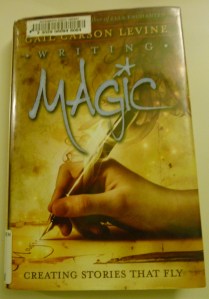
Writing Magic, as you may have guessed, is a book about writing, by one of my favorite authors.  I reviewed her best-known book, Ella Enchanted, early on in this blog.  Writing Magic is a wonderful book for kids who want to write.  It’s filled with good advice of all sorts: save what you write; jot down ideas; pay attention to details; make your characters suffer sometimes.  She covers coming up with ideas, writing the actual story, and working through revisions.  The book discusses practical things like the best way to write dialogue, and discusses why you might feel inspired to write to begin with.  And there are writing prompts at the end of every chapter.

This is a great book on writing, and I think it would also be a lot of fun for anyone who has read Levine’s novels–at least, it was for me!  She illustrates writing lessons with examples from her own books–not only by plucking scenes out of the published books, but also sharing pieces of earlier drafts, or talking about what a story started out looking like, and how her ideas changed along the way.  I love knowing the story behind the story. Continue reading “Classic Review: Writing Magic by Gail Carson Levine”
Book Review(s): Bud, Not Buddy and A Single Shard

I don’t set out to read thematically-similar Newbery winners in a row, but sometimes it happens.  Today, two books about orphan boys looking for a place to belong.  Both good–but I think I’d better read one with a heroine next!

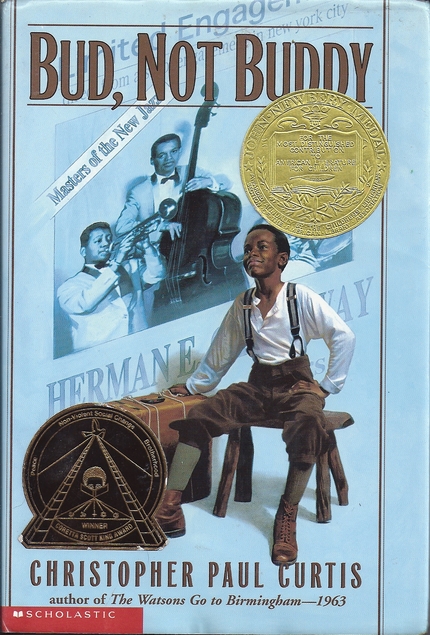
Bud, Not Buddy by Christopher Paul Curtis
Set during the Great Depression, Bud is a ten year old orphan, bouncing from orphanages and foster homes ever since his mother died when he was six.  When things go badly at another foster home, he seizes the opportunity to run away–and to travel in search of his father, based on slim evidence and personal conviction about who his father might be.

This is a book that’s made by its main character.  Bud is a tough kid, but not as tough or grown-up as he thinks he is.  He has a fierce streak of independence, but he also has impeccable manners, a good heart, and a nice sense of humor that lightens what could have been a very grim book.  It also helps that he mostly meets good people.  Not everyone, and rough things happen, but mostly people are at a minimum well-meaning (if not always effective). Continue reading “Book Review(s): Bud, Not Buddy and A Single Shard”

Book Review: A Crack in the Line

I’m carrying on my parallel universe reading with A Crack in the Line by Michael Lawrence, featuring one of the more unusual alternate life scenarios.

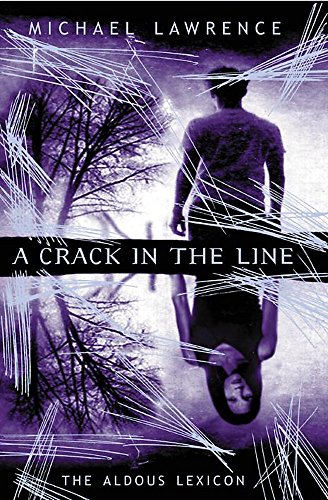
Sixteen-year-old Alaric lost his mother two years earlier in a train accident, following surgery where she had a 50-50 chance of survival.  One day he slips into an alternate version of his house…but in this life his mother survived.  But something else also changed earlier: Alaric meets an alternate version of himself.  Naia is as close to being Alaric as possible–except she’s a girl.  Alaric and Naia begin to explore the differences between their lives, how the parallel worlds work, and mysteries in their family’s past.

This read was a mixed experience.  I liked the concept a lot, and in some places the emotional impact was very well done.  I didn’t mean to read two parallel universe books involving grief in a row; that just kind of happened.  Alaric’s grief over his mother, and the extremely complicated feelings of knowing she’s alive in another universe were well-explored.

I liked the parallel universe mechanics here.  This follows the basic idea of shifts in the key events in the past causing a different present/future.  A lot of versions of that emphasize choice, but this one emphasized even odds.  There’s at least one example where a conscious choice changed things, but the main things (the mother’s survival, Alaric/Naia’s gender) wasn’t really under anyone’s control.  It was just a case of even odds, so universes formed where each option happened.  (It does open the question of whether universes exist for every individual to be gender-swapped…but that’s a bit much to encompass.)  I also liked that it explored multiple changes, instead of just one.  There are at least three key differences between Alaric’s and Naia’s universes, so different results kept happening at different times. Continue reading “Book Review: A Crack in the Line”

Classic Review: Banner in the Sky

Somehow or other, rock-climbing has come up in a few different conversations recently.  I respect people who want to try that, but I’m not one of them.  But when I do find myself with any urge to climb a mountain, I have a favorite go-to book I pick up instead.

*********************

I want to begin this review by saying that I have never been mountain-climbing.  Nor do I ever plan to go.  The truth is, I don’t even like steep hills (which, believe me, can be a problem if you live in San Francisco).  I can walk very happily for miles on flat ground, but give me a hill and it’s all over.  But this is why I love books.  I love that they let me live lives I would never actually live, whether that involves casting magical spells, visiting a distant planet, or climbing a mountain.

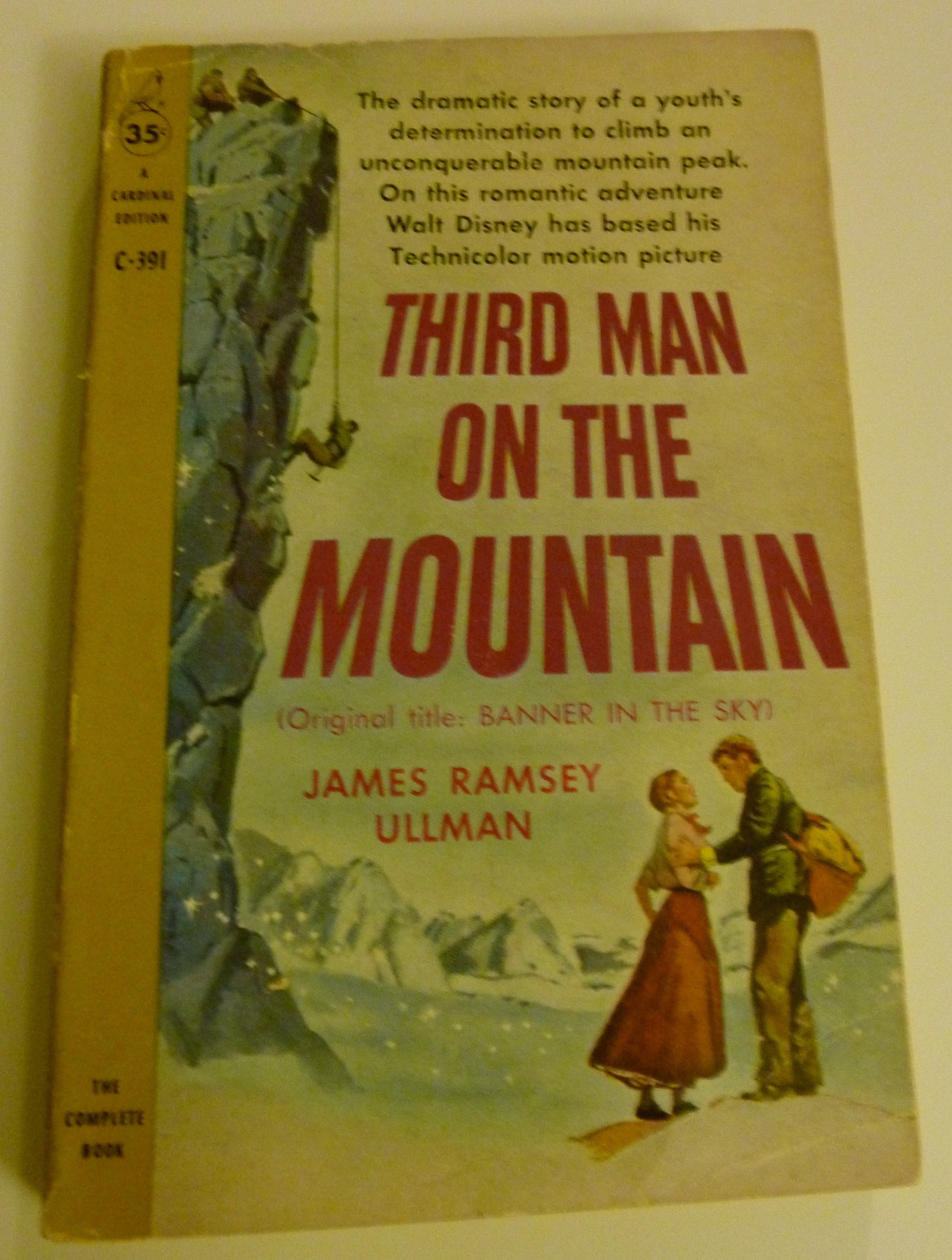
That last brings me to Banner in the Sky by James Ramsey Ullman.  You’ll notice I have a picture of Third Man on the Mountain.  Walt Disney changed the title for his movie version, and then they reprinted the book with the new title.  I like Banner in the Sky better–for one thing, I’m not sure what Disney’s title is even supposed to mean!

With either title, the book is about Rudi Matt, and about the Citadel.  Rudi is a teenager living in a small village in the Alps in the 1800s, and he dreams of climbing the Citadel.  It’s the one unconquered peak, the one no man has ever reached the top of.  No one has tried for years, since the failed expedition that killed Rudi’s father.  Rudi’s mother has forbidden him to become a mountain climber (and I do understand her viewpoint!) but when an Englishman comes determined to lead an expedition up the unclimbable mountain, Rudi is determined to go.

The book is as much about Rudi’s growth as it is about the mountain.  He learns that there’s more to climbing a mountain than just scrambling over rocks, learns about things like trusting others and never leaving a comrade.  He learns to follow his father’s footsteps in more ways than one.  My best guess on Disney’s title is that Rudi becomes a man on the mountain, rather than a boy–but I can’t quite figure out how Disney calculates him as the third one.

This makes it all sound like it’s deep and reflective, and occasionally it is–but there’s also plenty of scrambling over rocks, and getting caught on ledges, and even an avalanche or two.  It’s an exciting story as well as a meaningful one.

It reminds me a little bit of stories about Scott’s expedition to the South Pole.  Not because of the snow similarity, but because they’re both about men trying to achieve a feat that has been considered unachievable.  They’re about pursuing the impossible dream.  And while I personally don’t have any desire to climb a mountain or ski to the South Pole, when the story is told right, I can get very enthused about someone else’s dream.

Why does someone climb a mountain?  “Because it’s there” is always a good answer.  Because it’s there to be conquered.  For Rudi, it’s because he wants to take his climbing staff and his father’s red sweater, and plant them as a flag at the top of the Citadel–a banner in the sky.

Even though I need a good reason to climb a steep hill and can’t imagine climbing a mountain, Banner in the Sky makes me believe in Rudi’s dream, makes me see it as vital and important for him, and makes me want to see him succeed.

Book Review: The Square-Root of Summer

I think I’ve managed a first for me in my challenge reading.  I put The Square-Root of Summer by Harriet Reuter Hapgood on my random To-Read list on my phone (I think I stumbled on a blog post review while at work—more on that later, and why it really was work).  I requested it from the library without remembering it clearly—and found myself stumbling accidentally into a parallel universe novel!

Gottie’s world is coming apart.  Literally.  Seventeen, on the cusp of needing to figure out what to do with her life (or at least whether to go to college), Gottie’s attention is focused on the past.  On her grandfather’s death almost a year previously.  On the return of her childhood friend Thomas, out of touch across an ocean for five years.  On the memories of her secret summer fling last year with her brother’s friend.  And all around her, wormholes are opening up, sending her hurtling back into the past.

First, the mechanics of this.  I never quite got them, even though Gottie is a math genius who spends a lot of time discussing equations and theories.  But in practical and storytelling terms, the point is that she’s periodically encountering wormholes which send her mentally (but not physically) flashing back to earlier points in her life.  As the novel progresses, the effects become more dramatic, until she’s physically moving to parallel lives, not moving through time but moving to a universe where an earlier choice caused a change.  And ultimately cause and effect become confused, and things like writing an email response turns out to be the message that inspired the email that she was responding to.  If you see what I mean. Continue reading “Book Review: The Square-Root of Summer”