TGKA: Star Trek: The Exile of Khan Noonien Singh

To Reign in HellThis year for the Sci Fi Experience, I’m off on The Great Khan Adventure, tracing the story of Khan Noonien Singh through books and movies. So far I’ve watched some of Star Trek: The Original Series, and read the first book  and the second book in Greg Cox’s Khan trilogy.

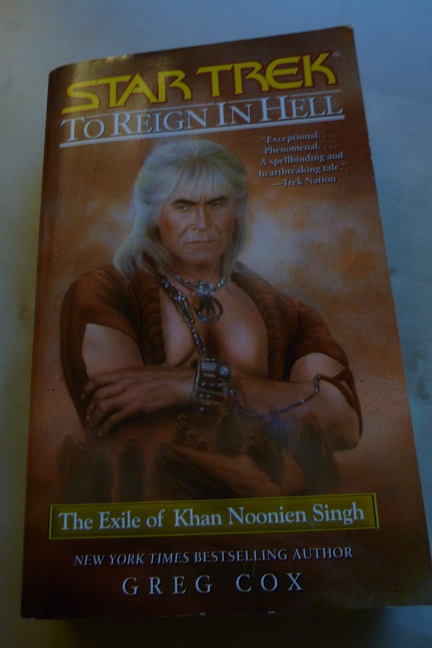
The final book jumps ahead from the 1990s and the Eugenics Wars, past “Space Seed” to Khan’s time on Ceti Alpha V: To Reign in Hell: The Exile of Khan Noonien Singh.  We watch Khan and his crew’s transport down to the planet, the colony’s hopeful beginnings…and then the increasing struggle to survive after Ceti Alpha VI explodes, and the ecosystem on Ceti Alpha V collapses.

The story is told from the alternating points of view of Khan and Marla McGivers, the Starfleet officer who fell in love with Khan and chose exile with him.  As I hoped, we get more depth into Marla and see her emerge as far stronger than she did on the TV episode.  She faces down Khan’s hostile crew, stands up to Khan himself, and perseveres through very trying circumstances.

In part this is possible because Cox also softens Khan, particularly towards Marla.  I think I know now why Khan’s brutality in “Space Seed” surprised me—I had read To Reign in Hell more recently than I’d seen the TV show.  Cox takes Khan on a journey from a well-intentioned, if fierce, leader to a madman obsessed with revenge; it’s a compelling journey, except that I think it downplays how violent and ruthless he was to begin with.

Cox has a nice way of tying things together to explain the little inconsistencies that crop up in Trek.  I was wondering where Marla was, as ship’s historian, when the Enterprise visited the 1960s; the book comments that she was disappointed not to be included on the landing party, and only had the opportunity to assist on the wardrobe.  When Khan and crew first beam down, Chekov is the officer who sees them off, explaining how Khan could recognize Chekov in The Wrath of Khan, when Chekov didn’t join the TV show until the next season (in the real world, Walter Koenig has admitted that he knew that line of the script didn’t add up, but didn’t point it out because he was afraid of having his part cut…)  Cox also explains some details in The Wrath of Khan, like why all of Khan’s crew in the movie is much younger than him, not to mention blond…

This book is effective as a chapter in a larger story, filling in the gap between the TV show and the movie.  Taken in isolation it’s an odd beast, because we spend it exiled with the villain.  I found myself missing Seven and Roberta, mostly for the role they fill as opposing forces to Khan.  Khan and Marla have their virtues and their flaws, but they never really feel like they become heroes of the story—they’re the villain and the woman who fell in love with him.  That complicates the emotional pulls of the story, and isn’t resolved by a very brief frame story with Kirk, Spock and McCoy.

I also think Cox exploded Ceti Alpha VI too soon.  I enjoyed watching the hopeful days of the colony; once disaster strikes, it becomes a hopeless slog for Khan and the reader both, especially when we know how this turns out…and it isn’t good.

The emotional complications are actually increased by the brief frame-story, of Kirk, Spock and McCoy visiting Ceti Alpha V after Khan’s death.  Kirk feels guilty about never checking in on Khan over the years.  Because he’s Kirk, I want a conclusion that says it wasn’t really his fault and of course we all still love him.  Instead, the book makes me feel like he damn well should have checked in…  I’ve had to conclude for myself that it is, in fact, ridiculous to feel that Kirk had personal responsibility for the situation; a colony of genetic supermen clearly falls under the jurisdiction of Starfleet, not one starship captain whose job is not to monitor colonies.  I would have quite liked Cox to make that point for me…

Despite some reservations, the book does fill in a significant chapter in Khan’s story.  It provides a lot of insight into Khan’s character, and expands Marla into a compelling character in her own right.  There’s also quite a bit of action, and of course all those little touches Cox is so good at of tying everything together.

Next up, I’m heading back to the screen for The Wrath of Khan

Author’s Site: http://www.gregcox-author.com/

Other reviews:
The M0vie Blog
And…that’s it.  Anyone else?

Buy it here: Star Trek: To Reign in Hell

TGKA: Star Trek: The Eugenics Wars, Volume Two

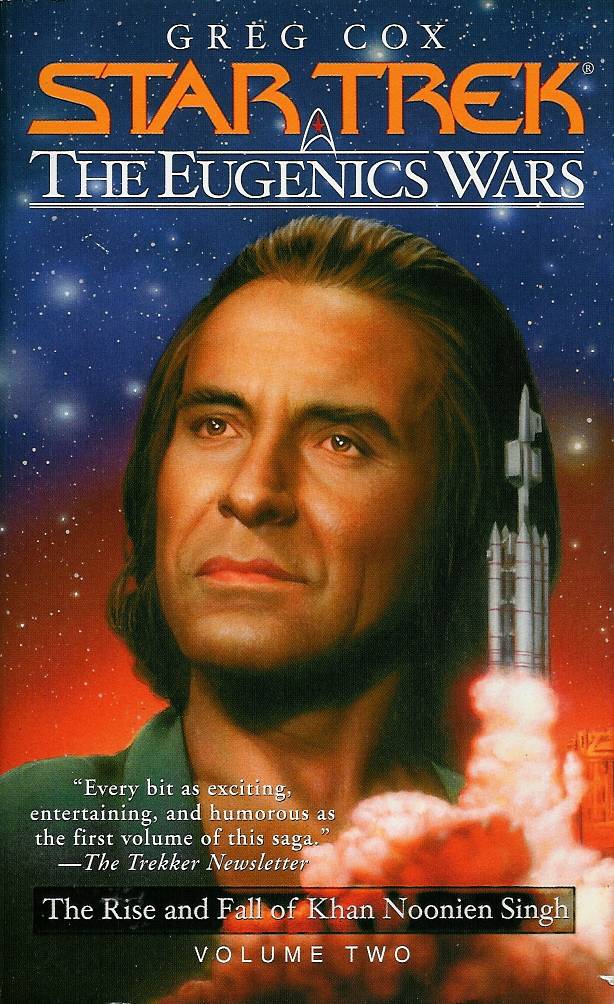
Eugenics Wars, Volume 2This year for the Sci Fi Experience, I’m off on The Great Khan Adventure, tracing the story of Khan Noonien Singh through books and movies. So far I’ve watched some of Star Trek: The Original Series, and read the first book in Greg Cox’s Khan trilogy.  Today I’m looking at the second book, Star Trek: The Eugenics Wars: The Rise and Fall of Khan Noonien Singh, Volume Two.

The first book covered Khan’s childhood and adolescence, focusing mainly on Gary Seven, Roberta Lincoln and mysterious cat Isis, and their work to protect the Earth during the Cold War.  This book brings us into the 1990s, with an adult Khan and his quest to conquer the Earth.  We still have plenty of Seven and Roberta, and their efforts to contain the threat of Khan and the other genetic supermen (and equally powerful superwomen).

I enjoyed this book quite a bit, though I have to note that it may not be what all readers are looking for.  Cox’s goal appears to be to reconcile Star Trek history and real history; I find that hugely interesting, but as a result of that choice (rather than simply presenting altered history–an alternate timeline, perhaps) the Eugenics Wars goes on in the shadows.  Khan “rules” a quarter of the Earth by pulling the strings of officials from behind the scenes.  Presenting a war where most of the population doesn’t know it happened…well, that limits the potential for large-scale conflict.  There’s still plenty of action, but mostly in small, pitched battles between individuals.

Cox also gives ample time to other genetic supermen (and women–there’s no easy way to say that–superpeople?) which I have somewhat mixed feelings about.  Many are extremely interesting, especially Chen Tiejun and her Amazons, but they at times start to feel like a distraction too.  Roberta spends a lot of time infiltrating General Morrison’s Army of Eternal Vigilance in Arizona, and it feels like, well, a lot of time not spent on Khan.

However–we get lots of time on Khan too, and we see him develop as a ruthless but nuanced villain.  He sees the many problems in the world and believes that he is destined to eradicate hunger, war and want–by conquering the planet, and when anyone gets in his way, his retribution is swift.  I like that complexity of benevolent intentions through villainous means–and we also see Khan grow increasingly harsh and merciless as the story goes on.

On the hero side of the story, there’s an older and more confident Roberta, but one who still hasn’t lost her “flower child” origins, and still carries a good bit of snark with her into intense situations.  Seven has some good moments too, increasingly playing the wise mentor type…which is good, except I think Cox overplays Seven’s aging.  I don’t need to be reminded about Seven’s creaking bones every scene (especially when he isn’t really all that old!)

We also see the Enterprise crew in a frame-story.  It continues the story of a colony of genetic super…people, and while there’s some excitement, it’s very much backseat to the Khan and Seven story.

It’s not much of a spoiler to say that the novel ends when Khan and his followers leave Earth.  The next chapter for Khan is waking up from suspended animation in the Enterprise‘s Sickbay (and promptly threatening Dr. McCoy’s life).  I already watched “Space Seed,” so the next step on The Great Khan Adventure is the final book by Greg Cox, To Reign in Hell: The Exile of Khan Noonien Singh.  Stay tuned!

Author’s Site: http://www.gregcox-author.com/

Other reviews:
A Star Trek Literary Adventure
The M0vie Blog
Anyone else?

Buy it here: The Eugenics Wars, Vol. 2

Voyaging Aboard the Dawn Treader

The-Voyage-of-the-Dawn-Treader-943021I made a quick jump from Prince Caspian to The Voyage of the Dawn Treader, Book 3 (or 5) in the Narnia series by C. S. Lewis.  I remembered this one fondly, and happily found my memory correct–this was absolutely excellent, from “There was a boy named Eustace Clarence Scrubb and he almost deserved it” all the way to the end.

This is the third (and last) book focused primarily on the Pevensie children, though in this case it’s only the younger ones, Edmund and Lucy.  They and their cousin Eustace are swept through a picture to find themselves on The Dawn Treader, King Caspian’s ship sailing into the far and mysterious East.  A few years have passed since their last trip to Narnia, and Caspian is ruling over a peaceful country.  He’s set out in search of seven lords who were friends of his father, and disappeared into the East years before.  Their journey takes them through a series of islands and adventures, searching for the lords–and, perhaps, Aslan’s Country.

Journey-focused stories can be engaging or aimless, and this is one of the good ones.  Interesting adventures are frequent, and though each island has little connection to each other, the ongoing quest keeps the story moving forward.  There are wonderful adventures, from Eustace’s transformation into a dragon to the hilarious Dufflepuds to the terrifying, darkness-enshrouded Island Where Dreams (nightmares) Come True.

The adventures are good and the characters are excellent.  Lucy and Edmund uphold the Pevensie banner just fine without Peter and Susan, and Caspian is splendid and noble while still able to be young at times too.  And there’s the boy named Eustace Clarence Scrubb…  For all that I like the plucky, capable Pevensies, I also enjoy a character who does not handle magical adventure well.  S/he among you who would not be upset by a lack of indoor plumbing, throw the first stone at Eustace.  And while too much of Eustace would have been, well, too much, Lewis begins his redemption process early, and so he grows throughout the book.

(A sidenote–you may recall my issues with The Magicians by Lev Grossman, mentioned in an earlier Narnia review.  Try to imagine traveling through Narnia with six Eustaces who never learn anything.  That’s kind of how The Magicians felt to me.)

Perhaps the best character of all, though?  Talking mouse Reepicheep, the bravest and noblest of them all, despite his diminutive size.  We met him in Prince Caspian, but we get much more of him here.  Reepicheep is fearless, unswervingly devoted to honor, and fierce as a lion.  Reepicheep is hugely comical even while being genuinely noble, an impressive blend.

All in all, an excellent installment in the series, and the first rival to The Magician’s Nephew for status as favorite.  Next up, The Silver Chair, which I also remember particularly fondly, so I’m looking forward to it!

Author’s Site: https://www.cslewis.com/

Other reviews:
The Bookworm Chronicles
Bookwraiths
Living on Literary Lane
Anyone else?

Buy it here: The Voyage of the Dawn Treader

TGKA: Star Trek: The Eugenics Wars, Volume One

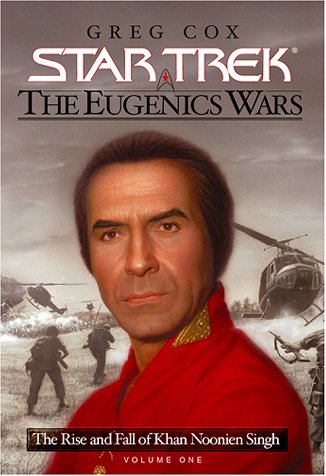
The Eugenics Wars Vol 1This year for the Sci Fi Experience, I’m off on The Great Khan Adventure, tracing the story of Khan Noonien Singh through books and movies.  After setting the stage with some viewing of Star Trek: The Original Series, I’ve moved on to the heart of my plans: the trilogy of books by Greg Cox, beginning with the ridiculously long titled Star Trek: The Eugenics Wars: The Rise and Fall of Khan Noonien Singh, Volume One.

My guess is that the primary impetus for this entire trilogy of books was one line from the episode “Space Seed,” remarking that Khan controlled a quarter of the Earth during the 1990s.  I don’t know about you, but I don’t remember the 90s quite like that!  Cox’s trilogy sets out to tell us what was really going on in the later part of the 20th century, brilliantly melding “official” history with the Star Trek universe.

This first volume covers the rise of Khan, mostly serving as an origin story.  The focal point is really Gary Seven, his assistant Roberta Lincoln, and the mysterious black cat Isis (introduced in “Assignment: Earth”).  With the help of alien technology, they’re at work to keep the Cold War from igniting into World War III.  In 1974, they begin investigating rumors of genetic manipulation, and soon infiltrate the Chrysalis Project, a high-tech compound beneath the desert in India.  There they find hundreds of children with genetically-engineered DNA, including a particularly precocious child nicknamed Noon.  The book goes to 1989 and the fall of the Berlin Wall…when a young Khan is just beginning to make his influence felt on a larger stage–but mostly, that’s Volume Two.

There’s a frame story here too, about Kirk, the Enterprise, and a colony of genetically engineered humans, but that’s a small part of the book and the real focus and draw is the history portion.  Although I will say–despite how briefly Kirk’s crew is present, Cox still manages to have Spock and McCoy sniping at each other (by page 5 of the Prologue), which I consider an absolute win.  No one can claim to be portraying these characters correctly unless Spock and McCoy get to snipe at each other!

After watching “Assignment: Earth” I really wanted to see more of Seven and Roberta’s adventures.  This book gave me that–but dropped so many tantalizing hints that so much more was happening, that I now want an entire book series!  Ah well…  I thoroughly enjoyed enigmatic Seven, always so calm and in control, and of course his mysterious, never-quite-explained cat, Isis.  We got Isis’ point of view briefly, and her disdain of Roberta was particularly amusing (and so cat-like!)  I kind of want to know more about Seven’s background…but mostly I don’t!  I think this is a case where the mystery is better than any answer would be, so Cox is smart to keep Seven’s past, and his alien guardians, pretty much in shadows.

Of the group, Roberta is the comparatively normal (and relatable) one, an ordinary human who stumbled into world-saving by accident.  She doesn’t have any special abilities, but she’s clever, confident and dedicated…with the occasional snarky comment or era-appropriate pop culture reference.  She’s a kind of Girl Friday who increasingly becomes an equal partner as the story goes on.

This is definitely a book intended for fans, as it’s riddled with references to episodes and movies.  Personally, I love that kind of thing!  Cox seems to have found every possible reference in Star Trek to the 20th century, and pulled it in–like a cameo from Gillian Taylor, a reference to Guinan, an appearance by Flint, and discussions of the Ferengi who landed at Roswell in 1947.  “Assignment: Earth” and “Space Seed” are the only really essential episodes to know before reading the book; for the rest, I think it would be clear enough without background–but it’s more fun when you do know the context!

The book is fast-paced and compelling, with engaging characters and a lot of excitement.  Once in a while the writing is a little clunky (Cox is too fond of “stated” as a dialogue tag…which is nitpicking, but it bugged me) but mostly it flows well.  Oddly enough, even with all that’s really good here, I may be most impressed with the Afterword.  Cox goes through chapter by chapter, explaining how the events of the book relate to the “official” history.  Without ever breaking the illusion, it becomes very clear what’s history and what’s Star Trek.  I’m impressed by how much real history he managed to weave his story around, and I’m impressed that he laid it all out in the Afterword.  If Dan Brown had done something similar, I might feel very differently about The Da Vinci Code than I do…but that’s another story.

This story is an excellent ride through Star Trek and real history, and I am looking forward to the next volume, covering the 1990s–and how exactly Khan ruled a quarter of the Earth!

Author’s Site: http://www.gregcox-author.com/

Other reviews:
A Star Trek Literary Adventure
The M0vie Blog
Anyone else?

Buy it here: The Eugenics Wars, Vol. 1

Dancing with the Wintersmith

Terry Pratchett is one of those authors I read on a fairly regular basis, and always have a good time with!  Most recently, I read Wintersmith, the third book in the Tiffany Aching subseries of Discworld.

Tiffany is a 13-year-old apprentice witch of considerable promise (and modesty).  She attends a Dark Morris dance, welcoming winter, and can’t resist jumping in–which brings her to the attention of the Wintersmith, the spirit of winter, who finds himself suddenly enamored of this human girl.  Dealing with the chaos and destruction caused by the Wintersmith’s attempts at wooing requires all of Tiffany’s strength and ability, as well as help from senior witches Granny Weatherwax and Nanny Ogg, from the fighting, drinking and swearing Wee Free Men, and from bookish and good-hearted Roland, who is not Tiffany’s young man.

I think I enjoy the Tiffany subseries so much because, like the City Guard subseries, they give me a sane main character (Tiffany and Vimes), surrounded by wildly eccentric characters.  Tiffany is a wonderful heroine who has been growing into her abilities (and perhaps more importantly, her identity) throughout the series.  I mentioned above she has promise and modesty, but it’s really more complicated than that.  Tiffany always does what’s needed, and doesn’t see anything remarkable in that–even if it’s rescuing her brother from the Queen of the Fairies, or confronting the Spirit of Winter.  I love a character who is flawed enough to not always do the right thing, but to always try to do what’s needed.

The other witches are wonderfully eccentric and unique, from Miss Treason who deliberately made herself a legend, to Annagramma, a somewhat New Age witch who thinks it’s all about rituals and beads.  Then of course there’s Granny Weatherwax–witches don’t have a leader, and Granny is the leader they don’t have–and Nanny Ogg, warm and cheerful and practical about all things, like using a Cornucopia of Plenty to stock the larder.

The Wee Free Men, also called the Feegles, are at their usual wild state of hilarity, endlessly cheerful and enthused, shouting and rushing about and eager to do whatever is needed to help “the big wee hag.” I love it when they attempt to sing “Row Your Boat” while crossing the River Styx, “at every possible speed and tempo and with no regard at all for the tune,” annoying Death not a little.

The funniest feature of this book may be Horace, a very lively Lancre Blue Cheese.  He’s adopted by the Feegles, given his own bit of tartan, and does his best to hum along with the singing.

Roland also gets some nice scenes in this book.  He’s not Tiffany’s young man (in rather the way Granny is not the leader of the witches) and he has to step up to be the Hero in the story, even though he’s only ever used an imaginary sword, and learned swordplay from a book.  He has some truly awful aunts and I am hoping for more of his story in the next book…

If I have one criticism of this book, it’s the first chapter.  Chronologically, it covers events which should slot in between Chapter Twelve (of Thirteen), and I frankly don’t know why Pratchett decided to start there.  It made me thoroughly confused, and wondering if I’d missed a book in the series.  So–if you begin this and don’t know what’s happening, keep reading.

Anything else…have I said much on the plot?  The plot is good, perfectly engaging and exciting in spots–but it’s more important as a vehicle for the wonderful characters and high hilarity Pratchett is so good at!

My recommendation: don’t start the series here…but do start the series. 🙂

Author’s Site: http://terrypratchettbooks.com/

Other reviews:
Tethyan Books
Science Fiction and Fantasy Book Reviews
Feeling Fictional
Anyone else?

Buy it here: Wintersmith