Sherlock: The Empty Hearse

sherlock1I hear that there was something important going on with football this past weekend…  Personally, I found it far more exciting that the BBC’s Sherlock was finally back!  It already aired in England, but it was back at last in America.  Sherlock is on its third series (or season), so there will be spoilers for the previous two.  I’ll try to avoid spoilers for this episode.

The usual method for each 90-minute episode of Sherlock is to solve one major case.  There is a case here, one involving a terrorist attack, but that takes a backseat to Sherlock’s (Benedict Cumberbatch) return from the dead, and his reunion with all the other characters, particularly John Watson (Martin Freeman).  And then, of course, there is THE question–how he managed to fake his death to begin with.

Series Two ended with that absolutely killer cliffhanger, on how Sherlock faked dying by jumping off a building, and we’ve been waiting two years for an answer.  In many ways, I think the show writers set themselves up for an impossible task, to somehow deliver an episode that can live up to that kind of anticipation.  And yet, I feel like they succeeded, mostly by deft uses of humor and occasional sleight of hand.

The answer to THE question?  Well, I’m certainly not going to tell you that!  But I will tell you that the show provides three possible explanations, and winds up by being a bit ambiguous about whether we have the true answer or not (and makes a joke about the listener being disappointed).  I think it would be enormously fun if they keep providing alternate explanations over the rest of the season!  If they don’t, I still feel satisfied.  I have an answer, and if Sherlock wants to be enigmatic about the answer, I can live with that.

Sherlock’s reunion with John is an absolute work of genius.  It’s hilariously funny, while somehow also having some real character depth to it as well.  And there’s a less funny, more sentimental moment later on too.  They could have gone completely towards the dramatic for the reunion, but I think it could so easily have gone cloying or flat.  Comedy was the right choice, and those scenes reminded me just how brilliant this show really is.  I’ve been so focused on THE question of the cliffhanger that I almost forgot to miss the show for itself, rather than for the answer to the mystery.

For Doyle fans, there are some nice moments harkening back to the original stories.  Mrs. Hudson first knows Sherlock is back when she sees his silhouette through a window, which directly reflects how Watson knew Holmes was alive in the short story.  There’s also a minor case Sherlock solves in this episode that reflects the plotline of one of the short stories.  And then the title, of course–“The Empty Hearse” is such a fun play on “The Empty House,” Holmes’ return short story.

This episode is definitely not a starting place for the series on a whole, but if you saw the previous two series, this is a wonderful return.

And I swear, Sherlock really is the good-Khan (or Khan is the evil-Sherlock, however you want to look at that!)

Sherlock Coat 1 Benedict-Cumberbatch-in-Star-Trek-Into-Darkness-2013-Movie-Character-Banner

TGKA: Star Trek Into Darkness

star-trek-into-darkness-benedict-cumberbatch-posterFor the past couple months for the Sci Fi Experience, I’ve been following the story of Khan Noonien Singh through books and television.  My main goal for The Great Khan Adventure was to follow the original arc, but just for fun I decided to wind up with a rewatch of Star Trek Into Darkness.

The story centers around a hunt for a fugitive terrorist.  When the Enterprise successfully captures him (sort of) on the Klingon homeworld of Kronos (which used to be Qo’noS…), they learn that he’s a genetic superman from the 20th century who has been in cryogenic sleep.  Khan is dangerously charismatic, with an alarming story about corruption in Starfleet.

I enjoyed this movie the first time around, with reservations—and I enjoyed it the second time around, with bigger reservations.  On this go-around, I found myself very focused specifically on Kirk (Christopher Pine) and Khan (Benedict Cumberbatch), probably because this viewing followed directly on all that other reading and watching I’ve been doing.

Remember how in Wrath of Khan I had to fight the urge to feel too sympathetic towards Khan?  Well…this Khan was a lot darker and a lot more violent and I was pretty clear that I don’t like him at all—but he was still a MUCH more compelling character than Kirk.

My big issue with the movie, really, was Kirk.  It may in part be because, without question and unequivocally, TOS Kirk (William Shatner) is my favorite Star Trek captain.  He always had a streak of arrogance, but I love him because he really is as good as he thinks he is.  Reboot Kirk, on the other hand, seems to be far more arrogant and far less competent.

I was trying, really, to figure out what exactly Reboot Kirk did that was good in the movie.  (Spoilers ahoy!)  He starts out by breaking the Prime Directive (saving Spock and an intelligent species, true) which bothers me less than that he failed to get away with it, because TOS Kirk always knows exactly how to bend the rules in just the way to pull it off.  Reboot Kirk then sets out to capture Khan, nearly gets his landing party killed by Klingons (I’m pretty sure TOS Kirk would have talked them around, or maybe challenged the Klingon Captain to single combat), and only catches Khan because Khan chose to surrender.  Reboot Kirk goes on to bring Khan over to the Vengeance, and then lets him take control of it.  Khan neutralizes (with questionable means) the threat of Admiral Marcus, is taken out by Spock, and still nearly destroys the Enterprise.  Kirk successfully saves the ship, but meanwhile Khan crash-lands into San Francisco (a major population center!), to then be caught by Spock.

About the only accomplishment from Kirk was rescuing the Enterprise, which happened at the same time that the villain was taking out San Francisco and presumably killing thousands of people.  On the whole…not a very impressive track-record for the hero of the movie.  Especially for a man who runs rough-shod over good advice from virtually every other character, and is quite confident that he knows all, understands all, can achieve all, and is a marvelous gift to Starfleet and the galaxy.  Ahem.

Meanwhile, Reboot Khan is pretty far removed from TOS Khan (Ricardo Montalban), but in a way that worked much better than the changes to Kirk.  Reboot Khan’s history is thoroughly glossed over and he definitely doesn’t resemble the Sikh prince of Cox’s trilogy…  But he does carry the strong sense of superiority, the loyalty to his crew, and the conviction that he’s meant to rule over the lesser beings of the galaxy.  I missed Marla in this incarnation, as well as the sense of the benevolent (yet ruthless) leader he was trying to be in Cox’s trilogy.  What we did get was a sense that Khan really is smarter, faster and stronger than anyone else.  Not necessarily wiser, but in some ways he seems more like a genuine superman than the TOS version.  In fact, he’s arrogant—but he really is as good as he thinks he is.  The problem isn’t the arrogance so much as the contempt he feels for everyone else.

He’s far too violent for me to feel much sympathy for him, but he’s still an extremely fascinating character, with a lot of the charisma that was sadly lacking from Reboot Kirk.  I’d quite like to see more stories with this character, especially if he could be less violent but still just as brilliant, arrogant and eminently capable.

Oh wait, that’s the BBC’s Sherlock

So much for comments on the hero and the villain–and perhaps I’ll just leave it at that.  For a fuller discussion, check my original review.  I still stand by it, although the lack of professionalism bothered me less (that’s not acceptance, just resignation) and I noticed a few more plot holes (exactly how do you blow up a starship in orbit of Earth and expect to get away with it?)  I definitely still feel there wasn’t enough McCoy.

And so ends The Great Khan Adventure.  It was a fun and very geeky ride, and as I believe the Vulcans like to say, I found that the whole was greater than the sum of the parts.  Cox’s books were inspired by the TV show and movie, and the books in turn brought more depth to the shows and the movie.  Now how about the adventure continues in the next movie, with a return of Khan and maybe an introduction of Marla McGivers?  I’d be excited. 🙂

Buy it here: Star Trek Into Darkness

Cursed by Frogginess

FroggedFew things are more disappointing than a premise I love in a book that just didn’t work for me.  It’s very rare that you get a second chance at that original brilliant premise.  I was disappointed by The Frog Princess by E.D. Baker, even though I loved the idea of the princess turning into a frog when she kisses the enchanted prince–so I was thrilled to hear about Frogged by Vivian Vande Velde, a story about a princess turning into a frog, from an author I’ve greatly enjoyed in the past.

Frogged is about Princess Imogene, twelve-almost-thirteen, and worried that she’s not a very good princess.  When she meets a talking frog, she tries to help by kissing him, and ends up trading places–he’s restored to being a boy, and she becomes a frog.  Since he quite rudely refuses to help, Imogene sets off herself in search of the witch who cast the spell.  Along the way, she meets new enemies, secures unexpected allies, becomes a star attraction in a terrible theatre company, and learns something about herself and the people around her.

This is not the same story as The Frog Princess, although the parallels are inescapable.  Happily, I liked this one much better.  It’s a simple story and the target age is young (perhaps 8-10), and there isn’t a huge amount of depth or complexity…but the voice was strong, there was a nice amount of humor, and the story was reliably entertaining.

An ordinary, possibly clumsy, not-stereotypical-beautiful princess has becomes something of a stereotype itself (I can think of five others without even trying), but Imogene has her own unique points.  I like that she very much feels 12-almost-13, and most of her problems are chalked up to being a difficult age more than anything else.  Some “ordinary princesses” are almost overpowering in their identity as “ordinary,” and become unusual by swinging so far that direction.

I also particularly liked an arc of learning Imogene goes through about changing how she sees others.  She’s always good-hearted, but she comes to realize that some people she thinks she understands have unexpected depths (for good and ill), and also that people don’t always perceive her the way she expects.

My favorite character apart from Imogene is the witch, who is gloriously untroubled by anyone else’s problems.  She’s not a wicked witch, exactly, and feels quite comfortable in her own mind that her actions have been reasonable (and she makes a convincing case).  She’s also not a Glinda-type, who wants the heroine to solve her problems herself so that she can learn the true lesson.  She’s simply practical, unsentimental and takes it for granted that everyone should take responsibility for handling their own lives.  She might drive me crazy in real life, but she’s remarkably refreshing in this kind of story.

Actually, a lot of the twists on traditional fairy tales are refreshing in here.  But I do tend to like that kind of thing. 🙂

Author’s Site: http://www.vivianvandevelde.com/

Other reviews:
Charlotte’s Library
Ms. Tami Reads
Kid Lit Geek
Anyone else?

Buy it here: Frogged

TGKA: Star Trek: The Wrath of Khan

khan-posterThis year for the Sci Fi Experience, I’m off on The Great Khan Adventure, tracing the story of Khan Noonien Singh through books and movies. So far I’ve watched a few episodes of Star Trek: The Original Series, and read Greg Cox’s Khan trilogy (Eugenics Wars: Volume One  and Volume Two, and To Reign in Hell).  Getting down to the end of the Adventure, I spent New Year’s Eve watching The Wrath of Khan, The Search for Spock and The Voyage Home.

To Reign in Hell ends almost precisely where The Wrath of Khan begins.  Chekov and his new captain, Terrell, beam down to Ceti Alpha V (thinking it’s Ceti Alpha VI–DON’T ask) looking for a test planet for the Genesis Project.  There they encounter Khan and his followers, who, with the help of mind-twisting eels, take over their starship and set out to pursue Khan’s quest for revenge against Kirk.  Meanwhile, Kirk and friends are aboard the Enterprise with a crew of trainee cadets.  They rush to investigate when an urgent call comes in from Carol Marcus, reporting that someone is trying to steal Genesis, a device to “create life from lifelessness.”

It was fascinating (to coin a phrase) watching this movie directly after reading To Reign in Hell.  There’s so much more room in books than in movies for details and background and character expansion.  Don’t get me wrong, The Wrath of Khan is a great movie, full-stop, period.  However–To Reign in Hell, despite some flaws, provides so much context and insight and character details.

For instance: we get a story on why Khan’s wearing that glove all movie, not to mention why he’s wearing a Starfleet emblem.  Joachim becomes a fully-fleshed character in the book; in the movie, you know him as Khan’s lieutenant, and the only one in Khan’s crew being paid for dialogue.  His name doesn’t come up until the very end of the movie, but I figured all along that he had to be Joachim, based on the book.  In the movie Khan references his wife twice but never actually says her name; presumably he means Marla (and I see no reason to think otherwise) but by comparison, the book makes her a major character and explores their romance.

Of course, the order of creation is a little odd in that Cox watched the movie and then wrote the backstory–but I think that worked, because I felt like I got more from the movie when I was keeping Cox’s backstory in mind.  Strangely enough, I’m not sure it would have worked the other way.  Reading the book, I occasionally thought I might be getting more from it if I had watched the movie recently–but after watching it, I think that might have made the book feel more forced.  Since the movie was fuzzy in my head, I didn’t get every single reference in the book, which, based on how many I noticed when I did watch the movie, might have become a bit much while reading…

Stranger yet, all this backstory and Khan-focus made me feel, well, strangely sympathetic towards him as a character.  Don’t get me wrong, I know he’s a terrible person, and I dearly love Kirk, Spock and McCoy…but Kirk did strand him on Ceti Alpha V and poor Marla got killed and it was all really, really awful and you can see how a person could lose it a bit at that point…even if Khan’s reaction is rather beyond the stretch of justification.

Ah well, a purely reprehensible villain wouldn’t be very interesting.

It also felt rather strange when the events of The Wrath of Khan set up the next two movies–and yet Khan never gets mentioned again.  Granted, Kirk has other things on his mind, but still.  Khan seems to have loomed bigger in the audience’s mind than in the characters’.

Another interesting sidenote: I’ve been complaining ever since Star Trek Into Darkness came out that these people are not qualified to be crewing a starship, and I find Wrath of Khan justifies the complaint.  Imagine if, at the end of the movie, Saavik was made captain and the trainee cadets were handed officer positions and told to go exploring.  That’s basically what happens at the end of the 2009 movie!!  Mumble mumble implausibility grumble…

On that subject, after watching the three classic movies and Khan-a-la-Ricardo-Montalban, I plan to finish up the adventure with a rewatch of Into Darkness and Khan-a-la-Benedict-Cumberbatch…which ought to be interesting directly after Wrath of Khan.  Stay tuned!

Buy it here: Star Trek II: The Wrath of Khan

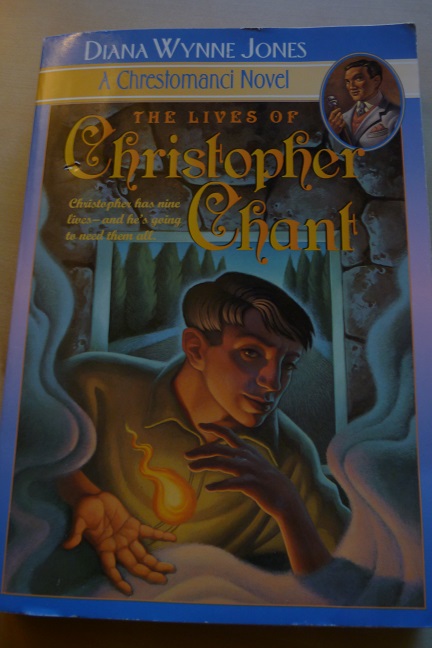
The Lives (and Deaths) of Christopher Chant

Lives of Christopher ChantOne reread project I didn’t get to in 2013 was Diana Wynne Jones’ Chrestomanci series.  I’ve read them all but out of order and at widely-spaced intervals so (not unlike The Great Khan Adventure) I decided I’d like to put them all together in chronological order.  I got started with the earliest, The Lives of Christopher Chant.

Christopher’s life could be rather bleak, with his wealthy, absentee parents and string of unfriendly governesses.  But Christopher has a secret—when he goes to bed, he can step out of his body, go around a corner, and enter The Place Between.  From there he visits the Almost Anywheres, a series of worlds very unlike his own, and each other.  When Christopher’s Uncle Ralph learns about his traveling, and especially his ability to bring solid objects back with him, Uncle Ralph gets Christopher involved in a series of experiments–with, naturally, disastrous consequences.  Eventually we learn that Christopher is a nine-lived enchanter, which proves very fortunate, as his adventures in other worlds keep losing him lives.

I think this book helps satisfy an itch I’ve had ever since reading The Magician’s Nephew, with its wonderful and utterly under-utilized Wood Between the Worlds.  The Place Between is very different in tone but very similar in function, and Christopher (and the reader) gets to visit far more worlds than Diggory and Polly did.  I’d still like more of that, but it was delightful anyway.

Christopher is a compelling boy hero who’s likeable but flawed as well.  He learns and grows as the book goes on, in the best way of complex characters, coming to realizations about how he treats people and where his strengths lie.

Among the supporting characters, the stars are the Goddess and Throgmorten.  The Goddess, otherwise known as the Living Asheth, is a girl Christopher meets in another world.  She and Christopher are on a nice parallel journey of finding out what they want in life, and how to make it happen for themselves, instead of being pushed around by circumstances.  Throgmorten is an Asheth Temple cat, fantastically valuable and fantastically bad-tempered in a highly entertaining way.

The book abounds with other magicians, good and bad and often incredibly strange.  Diana Wynne Jones has a wonderful ability for whimsy and humor in her magical stories, which is on full display here.  All that whimsy and humor is woven around a clever and complex magical system and universe structure.  Much is explored and, equally, it feels clear there’s much more still left…which is nice, when there’s several more books in the series!

This book functions as a kind of prequel, with most of the later books featuring an adult Christopher.  I read the books so spread out before that I’m sure there are lots of connecting lines I haven’t drawn, which I look forward to as I continue through the books…

Author’s Site: http://www.dianawynnejones.com/

Other reviews:
Books and Chocolate
Eyrie.org
Family Reads
Reading the End
Anyone else?

Buy it here: The Lives of Christopher Chant