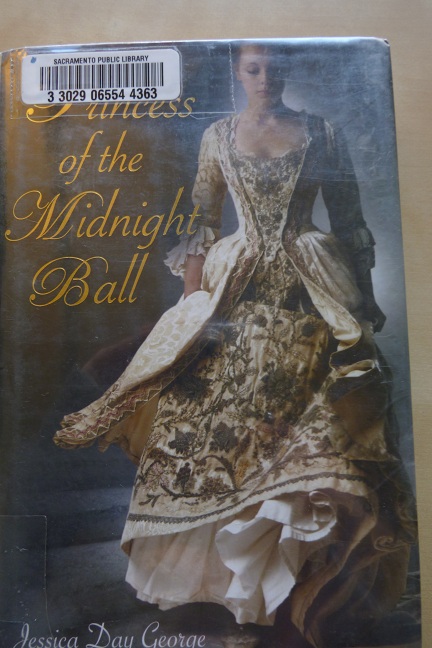
Princess of the Midnight Ball

Princess of the Midnight BallSomewhere in the last couple of years, “The Twelve Dancing Princesses” (or, “The Shoes That Were Danced to Pieces”) became one of my favorite fairy tales.  I’ve read many retellings, and even wrote one for NaNoWriMo 2011.  For the Once Upon a Time reading experience this year, I decided to go back and re-read one of the first retellings I encountered, Princess of the Midnight Ball by Jessica Day George.

This is a lovely, magical retelling that evades the typical pitfalls of the story, while shining mostly for its two lead characters.  The point of view is split between Galen, a young soldier just returning from a long war and taking up a job as under-gardener at the palace; and Rose, the oldest princess, trying to hold her sisters together as they suffer through a curse, evading questions about their mysteriously worn-out slippers.

Rose and Galen both have a way of looking harmless, with unexpected depth and strength beneath.  Rose is a pale, beautiful princess–but that doesn’t mean she doesn’t have intelligence and strength of will.  Galen is a gardener who spends his spare time knitting–which proves to be a surprisingly valuable skill.  When I think about it, the two of them don’t spend much time together.  But I don’t really think about it when I’m reading the book, and this is a rare occasion when I find myself completely buying into a very cute romance, even when the characters don’t really have much opportunity to get to know each other.

The other eleven princesses largely run together, which tends to happen quite a bit in these retellings.  It actually worked rather well in this one, though, I think because George hit a very nice balance of giving me just enough information, while not making me feel like I should be knowing/remembering more.  I’m not sure that makes sense…but for example, on the princesses’ ages: Rose and Lily are the two oldest, at eighteen and seventeen.  Petunia and Pansy are the youngest, seven and six.  The other eight exist in some vague space in between, and while I don’t know precisely how old they are, I also never felt like I needed to know.

Similarly, I had a slight sense of the personalities of roughly half the princesses, and that seemed to be enough.  George has a nice way of never asking the reader to remember the princesses’ personalities, because it’s self-evident whenever that particular princess is referenced.  Poppy is the boisterous one, and it was no effort to remember that because she’s always being boisterous whenever we see her.

For the most part this is a very light retelling, though there are a few moments of genuine creepiness.  It follows pretty close to the original fairy tale, and comes up with some very nice explanations and backstories, filling in the empty spaces in the Brothers Grimm’s much shorter tale.  Some retellings move farther away from the original and it works…but others have completely floundered in the process.  This one didn’t try to go too far, and succeeded very well within its own scope.

I remembered this as one of the best of the retellings I’ve read, though it was hard to judge since I read it before most of the others.  Happily, I was right!

Author’s Site: http://jessicadaygeorge.com/

Other reviews:
Lili’s Reflections
The Dead Authors’ Club and More
Bird on a Pencil
Anyone else?

Buy it here: Princess of the Midnight Ball

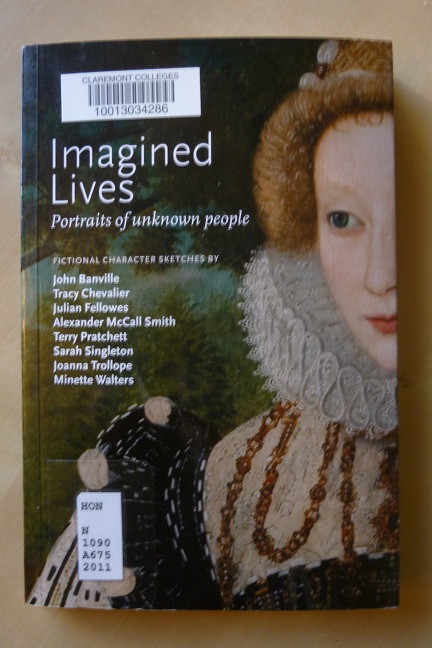
Imagined Lives: Portraits of Unknown People

Imagined LivesI’ve been deeply intrigued by the concept of Imagined Lives: Portraits of Unknown People ever since I first heard about it.  Eight authors wrote fictional character sketches, based off portraits whose original identities have been lost.  Many were at some point thought to be someone famous from history, which is how the portraits ended up at the National Portrait Gallery in London.  Later scholarship has overturned their supposed identities, and now the Portrait Gallery (which, by the way, is my favorite museum, ever) has put together a collection of stories around these anonymous portraits.

I almost bought a copy in the gift shop when I was at the museum…but I have trouble buying books I haven’t read, so I resisted.  I hit the library instead, and I think that was the right decision.  I enjoyed the book, but I’m glad I didn’t spend however many pounds they would have charged me.

There are eight authors and fourteen character sketches, and while I liked the book overall, the quality does vary.  The style also varies, which contributes to the changing quality.  I liked best the ones that were more like stories.  There’s a mix of letters, personal reflections, and fictional encyclopedia entries, all of them only two to three pages long.

The encyclopedia entries read like, well, encyclopedia entries.  Some of the more elaborate ones have some intriguing elements to them, but ultimately…well, how fascinating is an encyclopedia entry, really?  Especially a very brief, overview biography of someone.  Some of these would be wonderful as novels, but in such a compressed format, they fall a little flat.  Not all–but some.

For the letters and the reflections, I liked the shortness.  Because of their style, they’re much more intimate, much more detailed, and give us this tiny, very personal glimpse into the individual’s life.  I especially liked it when the glimpse is very closely tied into the portrait–as in a woman writing to her sister about her husband’s rash investment in commissioning a portrait they can’t afford, or a young noblewoman whose painting has been done with the interest of attracting a suitor, and she fears a husband who would choose his wife in such a way.  That was one of my favorites.  We also get the other side of a similar story, a woman writing to her mother about her indecision on whether she should accept a suitor who has sent her his portrait.

My favorite, though, is actually one of the encyclopedia entries, which will make more sense when I tell you that it was written by the delightful Terry Pratchett.  It tells the tale of the very unfortunate Joshua Easement, who dreamed of being a great explorer but whose “navigational method mainly consisted of variations on the theme of bumping into things.”

The portraits all seem to be from loosely around the time of Queen Elizabeth I, and many are tied very closely into history.  As is frequently true with much longer works of historical fiction, some of the fun of the stories is weaving the fictional characters into the lives of real people.

The book concludes with an essay on how scholars identify portraits, and how portraits like the ones in the book can lose their original identities.  It’s a very accessible essay, and an interesting look at the stories behind the portraits in museums.

If you have an interest in portraits or British history, I recommend this intriguing (and very quick) read.  I didn’t enjoy all the character sketches, but in the midst are several gems.

Museum Site: http://www.npg.org.uk/

Other reviews:
Vulpes Libris
Patrick T. Reardon
Anyone else?

Buy it here: Imagined Lives: Portraits of Unknown People

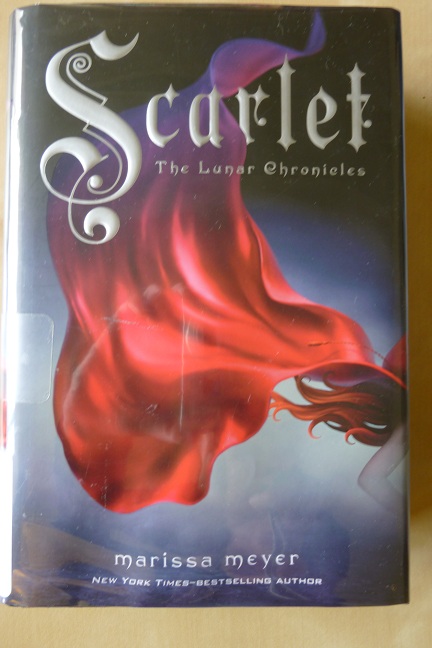
Scarlet: Book Two of the Lunar Chronicles

ScarletI came late to the game last year with Cinder by Marissa Meyer, so I was determined to jump in sooner with this year’s sequel, Scarlet.  It was a great read, and now I’m eagerly waiting to see where she’ll take the adventure in the next book!  Read my review of Cinder here, and be warned, there will be spoilers for that book in this review for Scarlet.

Cinder is a sci fi fairy tale retelling, featuring a cyborg Cinderella (who leaves her foot on the palace steps!)  The last book ended with Cinder under arrest, soon to be handed over to the vicious, mind-controlling Lunar Queen.  Scarlet brings in several new characters, starting us off with title character Scarlet, whose beloved grandmother recently disappeared.  She’s soon pulled into a much larger and more dangerous game than she realized, and reluctantly accepts the help of a mysterious street fighter she knows only as Wolf.

Meanwhile, Cinder swiftly breaks out of jail and goes on the run, by accident and necessity working together with Carswell Thorne, conman, smuggler and thief.  The stories converge when Cinder and Carswell also end up on the trail of Scarlet’s grandmother, everyone intent on what secrets the woman could be hiding.

As you’re probably already guessing, this volume brings in “Little Red Riding Hood,” though only in the loosest sense.  I do love it that Scarlet wears a red hoodie, though!

The split plotlines gave me some trouble at first–I kept wanting to be in the other one, whichever one I was currently in–but once I got adjusted to that, I very much enjoyed the book.  Meyer ratchets up the stakes and the conflict, and introduces us to some excellent new characters.

I have a soft spot for charming rogues, so Carswell was a great addition.  He’s a very arrogant criminal who expects everyone else to be as impressed by his exploits as he is.  He brings some humor into a frequently dark book.  Scarlet is a good character as well, a fierce young woman who is determined to forge ahead and deal with things.  I hate passive heroines, and Scarlet is anything but.  Wolf is fascinatingly complex.  I have kind of a thing for dark, brooding heroes too, and he’s a wonderful blend of strength and wariness.  He’s immensely capable about some things (see: street fighter) but so nervous about others (like romance).  I love that blend.

My favorite character from the first book was also back, though I would have liked more of her…Iko, Cinder’s android friend.  She was dismantled in the last book but Cinder saved her personality chip, and in this book installs it into their spaceship.  Iko’s freaking out about whether she’s still attractive as a spaceship (“But I’m so huge!”) is absolutely wonderful.

Scarlet is living in France, and her search for her grandmother eventually takes her to Paris.  Being me, my first thought was, hey, maybe there’ll be an Opera House reference!  So imagine my delight when it turns out the kidnappers have actually made the Opera House their base. 🙂  This is set a long stretch into the future, so we get to go wandering through the crumbling but still recognizable remains of the Opera House, including the grand foyer, the marble stairs, and the auditorium.  Loved it.

The book takes a turn near the end, and I’m not sure how I feel about it.  For one thing, it suddenly gets a good deal more violent, and I could have lived without some of the blood.  For the other, possibly larger thing, some details are revealed on the Lunar Queen’s army, and I’m not sure if I like where this may be going.  But I can’t really tell, until the next book comes out!

I enjoyed Cinder and I think I may have actually liked Scarlet a bit better.  Or maybe it’s just fresher in my mind.  Either way, it didn’t disappoint, and I’m looking forward to #3!  The title is Cress, so I’m thinking…Rapunzel, maybe? 😉

Author’s Site: http://www.marissameyer.com/

Other reviews:
Dreaming of Books
Sophistikatied Reviews
Dark Faerie Tales
Others?

Buy it here: Scarlet

Victor Hugo’s Les Miserables – Parts IV and V

Les Mis (2)We’re coming down to the final stretch in Les Mis.  If you missed them, you can go back and read the first and second reviews.  Today, I’ll be looking at the last two volumes, when the barricade arises.

This section begins with romance and then moves to revolution.  Marius and Cosette’s relationship takes leaps forward compared to the previous section–by which I mean they actually start talking to each other!  After a blissful interlude, however, circumstances separate them, seemingly forever, and Marius decides that he has nothing to live for.  Conveniently for him, a very good opportunity to get himself killed comes swiftly along.

The revolutionaries finally come into their own in this part of the book.  Paris rises in rebellion and the book focuses in on Enjolras and his band, building and holding the barricade at the Rue Saint-Denis.  They rally around to fight the good fight, while Marius turns up mostly by accident and plunges in.  Inspector Javert is in the midst, revealed as a police spy, and before too long Jean Valjean joins in too…for reasons I felt were never adequately explained.

This is certainly the bloodiest part of the book, and probably the most exciting (although it gets stiff competition from an earlier sequence when Javert was stalking Valjean).  Hugo demonstrates his ability to make even inaction interesting, as they wait on the barricade for each next engagement–and the engagements come with all their drama too.

A few spoilers here, although nothing that the musical won’t tell you…  Gavroche’s death is almost identical in the book as in the musical, and is heartrending in both.  Eponine’s death in the book was more of a disappointment to me.  It’s quick, and it’s largely ignored by everyone, including Hugo.  At pretty much every point of Eponine’s arc, I prefer what the musical did.

But the rest of the barricade sequence is excellent, and I didn’t even mind that they retreated eventually into the cafe.  The movie made it look like a pell-mell retreat, but in the book they fight every inch.

After the barricade falls and a few more trials are gone through, there’s a brief interlude where we actually seem to be heading for a happy ending.  But I didn’t trust Hugo to take us there…and he didn’t.  I won’t get into the particulars but the last section is heartbreaking, and I think the blame falls largely on the heads of Valjean and Cosette.

I love Valjean–he’s a wonderful man–at least until the last hundred pages or so, and then I just don’t know whether I want to cry over him or shake him.  He has a very strong streak of self-sacrifice throughout the entire book, and most of the time it’s immensely admirable.  At the end, though, it begins to approach the point of masochism, self-denial for very little purpose.  There’s an argument for what he does, but it’s flimsy.

Valjean clearly grasped two thirds of the “greatest commandments.”  He has “Love thy God” and he constantly demonstrates “love thy neighbor,” but he never got the idea of that last phrase, “love thy neighbor as thyself.”  The concept of self-forgiveness seems to have escaped him.  I still love him–but Hugo maybe takes it all just a little too far by the end.

As for Cosette–I don’t love Cosette.  She’s such a flighty, childish little nothing.  She has nothing to do in the musical, and scarcely anything more to do in the book, long as it is.  She’s sweet and she’s pretty and Hugo (and Marius) keeps referring to her as an angel, but she never does anything demonstrably angelic.  Cosette has all the refinement to present herself well, and appears perfectly demure and modest and all that, but that’s the extent of her talents.  I suppose if the ability to modestly lower one’s eyes makes one an angel, then by all means, call her that.  But by criteria of actively doing good for others…I find Gavroche far more angelic.

Heartbreaking (and somewhat frustrating!) as the end of the book is, this is still a wonderful read.  I spent longer on this book than I’ve spent on any one book in years, but it was absolutely worth it.  The characters and the world they inhabit are vivid and alive and drew me in completely.  Highly recommended–if you have some time! 🙂

Victor Hugo’s Les Miserables – Volume III

Les Mis (2)This week I’m doing a multipart review of the excellent but very long Les Miserables by Victor Hugo.  Read about Volumes I and II here.  Volume III focuses (though not immediately) on Marius, leaving Jean Valjean and Cosette out of the story for quite a while.  This is where I think it helped the most that I knew the musical, or I would have been feeling very adrift!

Marius was raised in wealth, but fell out with his grandfather over his estranged father’s politics.  Turning his back on his grandfather and his money, Marius lives in Paris in relative poverty, scraping along on some minimal scholarly work–but contented with that.  And then one day at the Luxembourg Gardens he sees a beautiful young woman out with her father and is hopelessly smitten.  They carry on a lengthy courtship of glances, until one day she ceases to come and Marius is plunged into the depths of despair.

I’m not entirely sure how I feel about Marius.  He’s such a nice young man.  I can’t dislike him–he’s so nice–but there’s not a whole lot I like about him either.  I both accept and respect his dedication to his principles (a dedication I don’t quite believe in the musical), but at the same time, he follows that dedication with such utter lack of common sense that I shake my head a bit too.  His most praiseworthy attribute in the musical is his revolutionary fervor, which just doesn’t exist in the book.  On the other hand, his most blameworthy attribute, his blindness regarding Eponine, doesn’t really exist in the book either.  But that brings me to two other plot threads…

Marius’ crowd of revolutionary friends do turn up in this book and I enjoyed getting more depth on them.  At the same time, I was surprised by how shallow Marius’ connection to them was.  He knows them, but he’s really not one of them.  It gets more complicated with the barricade, but that’s Part IV.  I was happy to see Enjolras, though, the leader of the group and one of my favorites from the musical.

Marius’ path also intersects with the Thenardiers, who have come to Paris and fallen on even worse times.  Take away the humor from the Thenardiers, and you have instead examples of just how low people can sink, both in poverty and in moral character.

Two members of the Thenardier family particularly fascinate me.  First, Eponine, the older daughter.  I actually found her a more interesting character in the musical.  There’s a spark of something in her, this sense that she could be so much more than her life has so far let her be.  Oddly enough, I get less of that feeling from the book.  I think it’s there, but she’s far more disreputable too.  There also seems to be less of a relationship between her and Marius than the musical suggested, to the point that I can’t blame him for not returning her unrequited crush.  It redeems him a bit, though I felt less for her.

I was just a little disappointed regarding Eponine, but I was thrilled with Gavroche.  I can see why the musical never got into the fact that he’s the Thenardiers’ son–he has only the most tenuous of relationships.  He emerges in the book just as I had hoped, a plucky, cheeky street urchin, keeping his head up and his confidence intact no matter what life hands him.  I love Gavroche’s spirit, and I also love that even in his own poverty, he’s still generous.  He gives to others even if it means he won’t eat that night himself, and he seems to do it instinctively.  Love, love Gavroche!

You may be wondering at this point what ever became of Valjean, and you’d be justified in that wondering!  I don’t think he’s mentioned by name in this entire Volume…although it doesn’t take much insight to match up Valjean and Cosette with another set of characters who do appear here…

I’m definitely not invested in Marius the way I was in Valjean, but that didn’t really interfere with my enjoyment of this section.  The story was engaging even if I had mixed feelings about the main character.

Come back tomorrow for a review of the last section…one day more ’til the barricades arise. 🙂