Victor Hugo’s Les Miserables – Volumes I and II

Compare the thickness here...
Compare the thickness here…

I have a fear of long books, a fear I have been attempting to confront this year by reading some of the big thick books I’ve put off (usually because there are so many other books to read!)  I’m trying to get in one a month, and in February I tackled what’s probably the thickest of them all, Les Miserables by Victor Hugo.  My copy had 920 pages of very small font, and with that much text to get through, it’s a good thing I enjoyed the story so much!

I’ve seen the musical, both as a play and the recent movie, and I think that was beneficial reading the original.  The musical felt (to me) like it was predominantly accurate to the book–not in every particular, but in most ways.  Knowing the soundtrack so well, I frequently had relevant lines running about in my mind as I read the corresponding scene.  That was fun, but more importantly, knowing the musical meant I had a pretty good idea where Hugo was going–which is not always obvious!

Before I go further, I should confess something.  I didn’t actually read all of the book.  I’m guesstimating I read a solid 750 pages.  You see, Hugo has this habit of going off into history or social commentary for twenty pages at a stretch.  And…I started skipping those chapters.  In a way, it’s actually a compliment to the rest of the book–I was far too eager to get back to Jean Valjean and the rest, and couldn’t stomach the amount of reading time it would take to wade through the other bits.  I never found that I was having any trouble following subsequent chapters after skipping sections, so it seemed to work out.

The book is subdivided into five volumes, but I think really reads like three clear sections.  Volume I and II focus on Jean Valjean and, more briefly, Fantine.  Volume III is Marius’ story.  Volume IV and V are about the revolution, in the middle of which all the earlier plot threads intersect.  I could give you a very, very long review…but as you likely surmised from the title, I’m going to break this into three parts instead.  So today, we’ll start with the first two volumes.

Set in France in the early 1800s, Volume I begins the story of Jean Valjean, an ex-convict on parole who finds himself at a crossroads when he meets a particularly sainted bishop (Hugo drives the point home rather).  Valjean struggles with whether or not to steal from the bishop…and I won’t give the details away, but he ends up resolving to shed his former identity and go forward to lead an honest life.

Jump ahead several years and we meet Fantine, a woman left alone with a child born out of wedlock.  She falls on worse and worse times, eventually turning to prostitution to provide for her daughter, Cosette, who has been left in the care of two innkeepers, the Thenardiers.

The first observation I have to make is that Hugo likes backstory.  The first 35 pages are the backstory for the sainted bishop; I was still feeling dedicated at that point and read them.  They’re not bad, but the story picked up a lot for me at the beginning of Book Second, when Valjean arrives in the story.  I loved learning more about Valjean’s backstory, and about Fantine’s as well, when we come to her.  I loved getting the details that the musical only hints at, and I loved the depth of the character exploration.

Valjean is a wonderful character.  It was fascinating to find out his history, and also how he developed (or perhaps I should say, regressed) during his time as a convict.  We then watch his struggle at the turning point to reclaim his humanity and his faith…and then his struggle for the rest of the book to keep them.  More on that later, though.  These first two volumes demonstrate Hugo’s ability to make mental struggle fascinating.  I think I recall that “man vs. himself” is one of the standard conflicts of literature, but I’ve rarely seen it explored to such an extent.

We meet several other principle characters in the first two volumes, particularly the Thenardiers and Inspector Javert.  I was actually a bit disappointed that we didn’t meet Javert sooner.  He turns up fairly far along, and there’s just a few references to establish that Javert knew Valjean while he was a convict.  So many other things are so much more elaborated upon, I hoped for more here.  What was here was good, though, and we delve into Javert’s mind some too.  I know people who just love Javert; I can’t say I’m one of them, but I do find him an intriguing character.

The Thenardiers probably diverged farthest from the musical version of the characters.  In the musical, they are nasty individuals, but they’re played for humor.  In the book, they’re not even remotely funny.  They’re just nasty, horrible, awful people.  Cosette’s situation living with them is incredibly heartrending.  Imagine whatever other “poor orphan waif” story you’ve read, multiply it a few times, and you’ll probably have it.  I think that was one of the most gripping sections of the book.

Volume II ends on what’s essentially a happy note, and we’ll leave it there for today.  Come back tomorrow to meet Monsieur Marius in Volume III!

Other reviews:
Compulsive Overreader
Teacups in the Garden
One More Page
Anyone else…?  I know I have readers who are Les Mis fans–send me links to your reviews and I’ll add them!

Buy it here: Les Miserables

Welcome to the Land of Oz

Welcome to OzI’ve lately been slowly rereading the Oz series by L. Frank Baum.  This is at least my third or fourth time through, over the span of…maybe 18 years.  Everyone knows the first one: The Wonderful Wizard of Oz.  It’s less well-known that there are another thirteen books in the series–and even more if you count the non-Baum ones, which I don’t.

Fourteen would be a bit many to tackle in one review 🙂 but I’ve been discovering that it’s surprisingly easy to divide the series into sections, mostly trilogies.  So today let’s look at the first three–I’d like to call them the “Welcome to Oz” Trilogy.  Though new characters are introduced throughout, these first few introduce the principle players, not to mention the setting, which is frequently a character in itself.

***********

The Wonderful Wizard of Oz bears some resemblance to the movie…and some differences.  Kansas farmgirl Dorothy is picked up by a tornado and carried away to the magical land of Oz with her little dog Toto.  There, her house lands on a wicked witch, she acquires a pair of magic slippers (silver, not ruby), and sets off through Oz with a Scarecrow, a Tin Woodman, and a Cowardly Lion.  Eventually she meets the Wonderful Wizard, kills the Wicked Witch of the West, and goes home by slipper power.

That all sounds like the same plot as the movie…but the difference is focus.  While the movie ties neatly together with both Glinda and the Wicked Witch appearing early on, and the Witch providing an ongoing threat, they come in later on in the book.  Dorothy spends more time simply wandering about on adventures, without the drive and the urgency of the movie.  Growing up, I actually never liked this book–and I think the problem was that I was comparing it to the movie.  This most recent read-through, I was finally able to look at it more separately, and it is a rather charming (if unfocused) fairy story.

We’re introduced to a lot that’s fun here, and the characters are delightful.  At the same time, there were some things that Baum hadn’t quite figured out yet.  For instance, he all but directly says that the emeralds in the Emerald City are illusion, and that the Wizard didn’t really give Dorothy’s companions their various rewards, but just humbugged it.  This takes a turn in later books–in the later volumes, the Emerald City really is covered by gem stones, and the brain, heart and courage bestowed by the Wizard really are magical.  While I like the message that Dorothy’s friends had all they needed all along…I do also like the more magical version of events.  Though at least Baum maintained the magic in this book to the extent that the story didn’t all become a dream sequence at the end!

The ramblingness of the book is the most serious problem, and while this is good, I don’t actually think it’s one of the strongest volumes–strangely, when it’s the best-known!

***********

In the second book, The Marvelous Land of Oz introduces new characters.  Dorothy isn’t in the story at all, and the hero instead is Tip, a boy being raised by Mombi, an evil witch.  Tip runs away with Jack Pumpkinhead, a stick-man with a Jack O’Lantern head, which Tip made and Mombi brought to life.  Their adventures eventually lead them to an alliance with the Scarecrow and the Tin Woodman against an army of girls who have conquered the Emerald City.

Between the threat of Mombi and the possibility of war, this is one of the more exciting installments.  The characters are also particularly entertaining, the ones mentioned above as well as a giant, highly-educationed Woggle-Bug, a strange flying contraption called the Gump, and a return appearance by Glinda the Good Witch.  The army of beautiful girls armed with knitting needles (really) sets off my feminist instincts a bit, but they’re counterbalanced by Glinda’s far more capable female army.  The ending of the book is bizarre to say the least–I won’t give it away, but I’ll say that sometimes you have to just go along with Baum and not ask too many questions…

***********

Ozma of Oz is Book Three, and one of my favorites of the series.  Despite the title, which refers to the new Queen of Oz, this is largely a Dorothy book.  She gets lost at sea and washes ashore in a magical country near Oz, swiftly reuniting with old Oz friends who are on a journey to the Nome King to rescue the Royal Family of Ev.

This one is full of images and moments that have stuck with me all out of proportion to their importance–though maybe I should just say it has memorable moments.  There’s a wonderful bit early on when Dorothy finds trees laden with lunch boxes and dinner pails.  She picks ripe ones, opens them up and finds entire meals growing inside.  It’s not an important scene, and yet it’s so delightful and whimsical.  It encapsulates the magical things that can happen in Baum’s world.

Later on, Dorothy encounters Princess Langwidere, who has a collection of different heads and interchanges them at whim, the way people normally change hats or jewelry.  It’s weird and wonderful and just a bit creepy!

When the party from Oz reaches the Nome King’s cavern, he explains that he’s turned the Royal Family of Ev into knick-knacks, and invites each rescuer to search among his collection and try to choose the correct ones–at the peril of being turned into knick-knacks themselves.  That story element of having to choose the right enchanted object from a collection has definitely threaded itself into my mind, and is directly responsible for a chapter in my novel–though my heroine had to select the right enchanted fish.

***********

Baum’s books are whimsical and magical and full of funny, fascinating characters.  There are very few rules and anything is possible.  The first one has some flaws, but on the whole these first three in the series are excellent.  They’re rarely highly dramatic or very deep, but they’re entertaining and bright.  These are wonderful pieces of classic fantasy I highly recommend.

Other reviews:
Story Carnivores
Sarah Reads Too Much
Booksessed
Dark Chest of Wonders
Anyone else?

Buy it here:
The Wonderful Wizard of Oz
The Marvelous Land of Oz
Ozma Of Oz

…or the movie version 🙂

Rapunzel’s Revenge

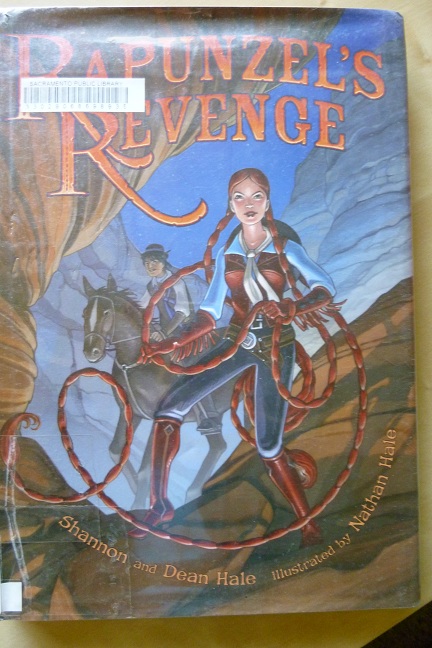
Rapunzel's RevengeIn between sections of Les Mis last week, I picked up the far lighter Rapunzel’s Revenge by Shannon and Dean Hale.  I’ve loved Shannon Hale’s novels, and naturally I was intrigued by a graphic novel retelling of “Rapunzel”–and apparently one with a very awesome heroine.

Happily, I was not disappointed.  This takes “Rapunzel” as its jumping-off point, but mostly tells an original story.  Mother Gothel did steal Rapunzel as a small child, but in this version she’s using her magic to rule over the surrounding country, and keeping Rapunzel’s real mother as a slave in her mines.  When Rapunzel discovers the truth and reacts defiantly, Mother Gothel locks her up in a tower…where an effect of Mother Gothel’s growth magic causes Rapunzel’s hair to get longer and longer.  This Rapunzel rescues herself, and sets off to fight Mother Gothel and free her mother, joining forces with a good-hearted if slightly inept young man named Jack for a series of adventures.

There’s a bit of an Old West flair to this magical world, not the least in Rapunzel’s outfit.  She puts her hair into two braids and uses them as ropes or as whips, as the situation calls for it.  The idea of Rapunzel using her hair as a weapon is pretty awesome.  It’s a little similar to Tangled, but this Rapunzel has a lot more control of her hair than Disney’s Rapunzel.

I rather enjoy the gender role reversal too.  Jack has his talents, but he’s not as good a fighter as Rapunzel–and seems to be remarkably well-adjusted about that fact.  They’re clearly partners and mutually respect each other…and it’s fun to see the girl be the more aggressive half of the partnership.

This is an excellent, light retelling of a fairy tale–with an awesome, braid-toting heroine!  I’ve already got the sequel on request from the library.

Author’s Site: www.shannonhale.com

Other Reviews:
Fyrefly’s Book Blog
EA Younker
Tales Old as Time
Anyone else?

Buy it here: Rapunzel’s Revenge

Federation: Star Trek Across Eras

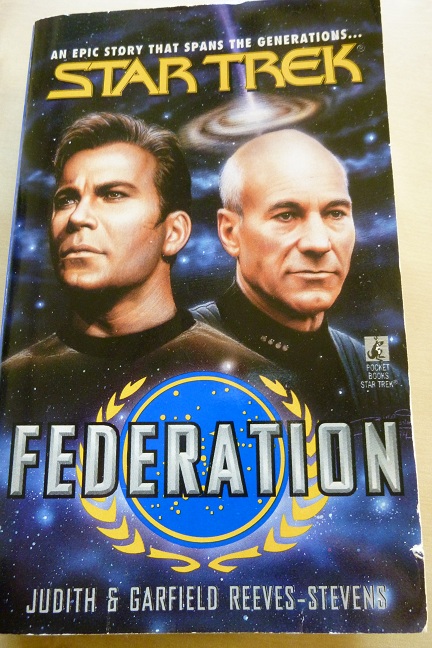
FederationOne of the nearly-last books on my Sci Fi Experience reading stack was Federation by Judith & Garfield Reeves-Stevens.  This was a re-read, but it had been years and I’d forgotten most of the details…but I did remember it was a good one.  The Reeves-Stevens also wrote one of my favorite Trek books, Prime Directive, and are absolutely brilliant at capturing characters.

Federation takes a broad scope, with three storylines across times, which ultimately intertwine.  We follow Zefram Cochrane, inventor of warp drive, through the early days of warp technology and into World War Three.  In the 23rd century, Kirk is facing fire from Starfleet over a recent mission–the one in which they met a much older Cochrane (“Metamorphosis”), who asked to be kept secret.  In the 24th century, Picard is hoping to obtain a piece of Borg technology that could be vital to the defense of the Federation.

There’s a lot to juggle here, and this is a case where, as a writer, I can very much appreciate how well the Reeves-Stevens handled it.  The divergent plots feel like they should be confusing, but aren’t; they ground us very well in each storyline, and a tight point of view helps a great deal too.  We’re only ever in the points of view of Cochrane, Kirk or Picard, and move in regular sequence between the three.

The Cochrane plotline provides a very interesting window into an earlier era of Trek history–even if it turns out not to be canon.  This was written before First Contact, and there’s a very prescient author’s note remarking that later films might invalidate the ideas set out in the book.

With all due appreciation for First Contact, I like the Reeves-Stevens’ version better.  It feels more like possible history and less like an action film.  Cochrane develops warp flight with financial backing from an idealistic billionaire (who I’m pretty sure is the long-lived Flint from “Requiem for Methuselah”), and is instrumental in founding early colonies.  He gets tangled up with World War Three because one military leader believes that Cochrane holds the secret to the ultimate weapon, a so-called “warp bomb.”  It’s exciting, while blending in philosophy, economics and galactic politics in a way that’s remarkably believable.

Kirk’s plotline draws very closely from original series episodes.  The plot points are mostly from “Metamorphosis,” but the timing is directly after “Journey to Babel,” with Ambassador Sarek still aboard at the beginning of the book.  There’s a wonderful scene with Kirk, Spock and Sarek playing poker in Sickbay.  I really enjoyed how much this was grounded in particular episodes.  Most Trek books seem to take place vaguely “on the five-year mission” (maybe in the last year after the final episode).  That’s fine as a rule, but tying it in so closely made me feel oddly nostalgic.

The best thing about Trek are the characters, and I think I love the Reeves-Stevens so much because they know how to tell Kirk, Spock and McCoy.  Trek books live and die for me based on whether Spock and McCoy snipe at each other–and they do here!  It’s understated, but perfect.  They go back and forth a few times, with Spock giving very precise estimates, McCoy rolling his eyes, and at least once Spock is deliberately vague, just to bait him.  It’s excellent.

The Picard plotline had its own mysteries and tensions, which is good since for most of the book it felt completely unrelated to the other two plots.  It comes together in the end, and the authors try to tie it closer together with an Ambassador Sarek connection…but mostly I think the reader has to just take it on faith that the plotline is relevant and enjoy it for itself in the meantime.  The way it ties together is ultimately a bit far-fetched…but personally I’m willing to just go with it.

If I have any major criticism, it’s that the frame-story felt unnecessary.  I see what they’re doing–it’s a thematic thing–but it didn’t work for me.  The book starts with a prologue about a very depressed Kirk coming to the Guardian of Forever.  The timing is right before Generations (which I’d prefer to IGNORE, if you don’t mind) and Kirk is having a premonition that his life is over and there’s no purpose anymore and etc. etc.  The Reeves-Stevens are so good at portraying the characters, but this was odd…and just depressing.  There’s a thematic point about the purpose of it all, and humanity’s journey and the exploration of that idea within the book is inspiring–but it doesn’t need the prologue to draw that out.  So if you pick this up and the first few pages aren’t working for you…skip ’em.

And after the first few pages, this is absolutely worth picking up.  Watch “Journey to Babel” and “Metamorphosis” in preparation, and then I think you’ll thoroughly enjoy Federation!

Authors’ Site: http://www.reeves-stevens.com

Other reviews:
Pareidolia Book Blog
That’s all I found!  Anyone else?  Tell me about yours!

Buy it here: Federation by Judith & Garfield Reeves-Stevens

Pucker Up…and Wake a Dead Guy?

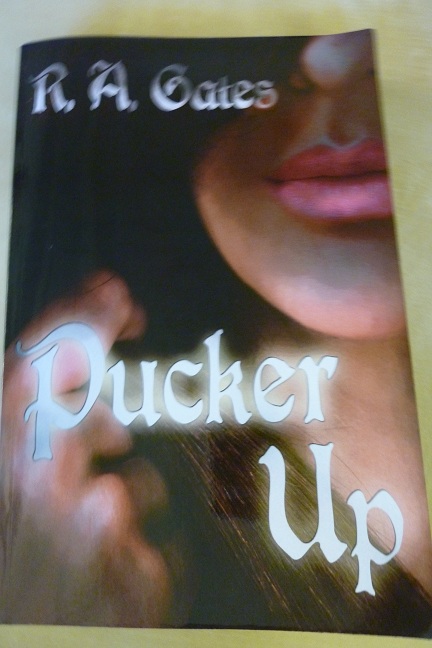
Pucker UpI think anyone who’s around this blog even occasionally knows that I love retold fairy tales.  There are so many fascinating and strange elements to fairy tales that modern authors can play around with.  So what’s not to love in an urban fantasy about a girl who needs to wake a sleeping prince with a kiss?  Pucker Up by R. A. Gates is a YA Fantasy that takes a fun spin on some old fairy tale tropes.  Disclosure–the author is a friend and member of my writing group, but I promise an honest review anyway!

Pucker Up centers on Ivy, a reluctant witch who finds herself on a quest to wake up sleeping Prince Sebastian.  Ivy lives in Salmagundi, the place of refuge for anyone with magic, hiding from the witch-hunting Eradicators.  Unfortunately, the spells hiding the town are breaking down.  Ivy’s cousin Thane believes the answer is to wake up Prince Sebastian, who created the spells to begin with.  Ivy needs the reward money to pay a debt to a very angry werewolf.  As a descendant of Sebastian’s true love, she should be able to wake him up with True Love’s kiss…except that she really doesn’t want to kiss a dead guy!

I always approve of heroines who set off to do things rather than waiting for a man to save the day, and I love the twist of a girl needing to wake up a prince instead of the other way around. Ivy is a fun, somewhat-reluctant heroine, with good mysteries in her past that kept me curious as I read.  The book also keeps moving with a series of adventures on the journey to find the prince.  We get a whole host of magical creatures, including vampires and werewolves and even dragons–like a cute baby dragon nicknamed Sparky.

There are serious moments, but overall there’s a light tone to the book.  It’s frequently funny in a tongue-in-cheek way…as with the ongoing series of necrophilia jokes.  I love retellings that are aware of the absurdities in their inspiration material.

When Ivy and Thane set off on their quest, they’re accompanied by Thane’s friend Garren, who Ivy finds immensely irritating.  Don’t expect too many surprises in the romance department…but even if it’s a bit predictable, it’s fun to read.  And there are more surprises in the plot.

This is the first book in a series, and with some twists in the ending, I’m excited to see where it goes in the next book!  Alas, not published yet…

I think I’ll finish up by borrowing a line from Ivy’s dialogue on the last page–it’s not a spoiler, and I think it sums up the book nicely.

“Don’t even think you’re rescuing me.  I’m no damsel in distress.”

Author’s Site: http://ragates.com/

Buy it here: Pucker Up in paperback or ebook