Sci Fi Experience on Screen: Superheroes and Extra-Terrestrials

The Sci Fi Experience seemed like the perfect time to watch a few sci fi movies I’ve been meaning to get to…old and new.  This Friday, here’s a survey on the sci fi movies I’ve watched in the last couple of months.

The Amazing Spider-Man (2012): I have to admit, I didn’t quite see why we needed another origin story movie for Spiderman (Toby Maguire just wasn’t that long ago…) and while I still kind of feel that way, this was a fun movie.  I’ve been a fan of Andrew Garfield ever since he was the adorable Antoine in The Imaginarium of Doctor Parnassus, and he’s the main reason I saw this.  He plays a wonderfully awkward Peter Parker, who also manages to have a lot of fun with his new powers.  My favorite thing about the movie, though, may be Gwen Stacy (Emma Stone).  I mostly remember Kirsten Dunst’s Mary Jane screaming a lot when things got tense.  Gwen is far tougher, keeping her head and actually being useful in a crisis.  That’s an awesome quality in a superhero’s girlfriend.

E. T. the Extra-Terrestrial (1982): I haven’t seen this one in years, so I was curious to rewatch some classic sci fi.  All the iconic moments are great, and it was so much fun seeing an incredibly young Drew Barrymore (talented even then).  One thing that struck me was how little explanation this movie has.  It’s not incomprehensible like 2001, but we never find out who E.T.’s people are, why they were on Earth, how the government knew to look for them, whether there was any communication after E. T. is picked up…  I was also struck by the moment when E. T. asks Elliot to go with him.  Yes, 10-year-old boys probably shouldn’t go off with aliens–but what a missed opportunity!

The Dark Knight Rises (2012): I kept having near-misses with this movie.  It never quite worked out to see it in local theaters…then I almost saw it while I was in Paris, at a theater a few blocks from the Paris Opera House.  But I couldn’t tell from the posters whether it was subtitled or dubbed, so I gave it up and went back to my hotel room to spend the evening writing fragments of stories involving the Phantom of the Opera, which was probably just as well.

So I finally saw this in January from Netflix.  While quite grim in spots, overall I enjoyed it–especially Catwoman.  Anne Hathaway impressed me this year as both Catwoman and Fantine…and impresses me all over again when I compare those characters side-by-side.  The villain here wasn’t nearly as much fun as the Joker in The Dark Knight, but this was still an exciting ride, and I enjoyed Joseph Gordon-Levitt (who’s been adorable ever since 10 Things I Hate About You) as the new cop trying to make good.

Batman Begins (2005): I knew I’d seen The Dark Knight, but I couldn’t remember if I’d seen this one.  After watching the final installment, I was pretty sure I hadn’t seen the first one, and felt like I ought to do something about that.  The origin story was interesting, some parts of the later movies make a good deal more sense now, and…mostly, I really liked Alfred.  And I have a nice completed feeling now.

I think that covers Sci Fi On Screen…although I may re-watch The Dark Knight soon!  Which will thoroughly complete the out-of-order-ness of it all.

The Callista Trilogy: Planet of Twilight

File:Planet of twilight.jpgIn my continuing exploration of the Star Wars universe, I wound up the Callistra Trilogy with Planet of Twilight by Barbara Hambly.  I thoroughly enjoyed Hambly’s first book, Children of the Jedi, and was disappointed by the second in the trilogy, Darksaber, authored by Kevin J. Anderson.  Book three brought us back to Hambly, and it showed–and I was quite pleased by that fact.
The book opens eight months after the previous one, as Luke searches for his lost love, Callista, who has gone off on her own quest in search of her lost Jedi powers.  Luke’s search and Leia’s political responsibilities bring both of them to Nam Chorios, a former prison planet where the religious-cult majority insists on isolationism, over the objections of the minority of more recent colonists.  The minority political leader captures Leia, while Luke explores very strange operations of the Force on the planet, and hunts for clues to Callista’s trail.

It was such a relief after Darksaber to come back to Hambly’s characterization.  The characters had depth again.  You can feel Luke’s pain at losing Callista, and it feels both real and appropriate–not vaguely self-indulgent, the way the focus on their relationship felt in the last book.  I have a feeling there are those who would object to his focus on Callista when he has larger responsibilities (like an Academy to run), but really, I think it’s just human to balance something personally important against something that’s logically important.  And at the risk of a slight spoiler, ultimately the novel is about how Luke accepts his path going forward.

There’s also some good delving into Leia’s character.  Children of the Jedi had a lot about her past on Alderaan.  This one has more about some of her plans and her fears, and delves into the rarely-addressed fact that she’s the child of Darth Vader as much as Luke is.

Most of the book is in either Leia’s or Luke’s point of view, and between their differing experiences we get to explore some very strange mysteries and very strange characters–including a Hutt with Force-ability, and some truly creepy bug creatures.  It gets pretty gross in spots, and I likely would have been ill with a movie, but it wasn’t too bad in text.  I enjoyed the reveal of the mystery and weird aliens are among the hallmarks of Star Wars.

Han, Lando and Chewie all have small roles here, trying to figure out what happened to Leia, and though they don’t have a big part, it’s enough that they don’t become conspicious by their absence, if that makes sense.  Threepio and Artoo, meanwhile, manage to get lost and provide some excellent comic relief as they try to sort themselves out.  Artoo, of course, is calm throughout; Threepio, not so much!

I got a little muddled in here with politics on various planets, and some arching plotlines involving plague and multiple revolutions.  But the main focus was on the primary characters, so I didn’t worry too much about the larger politics, and that seemed to go all right.

I found this a satisfying end to the trilogy.  I won’t claim it was brilliant, but it was put together well, has good portrayals of the characters, some clever twists, and all in all, an enjoyable read.  And somehow it’s making me want to rewatch Return of the Jedi

Author’s Site: http://www.barbarahambly.com/

Buy it here: Planet of Twilight

Hunting for Secrets in the Dark

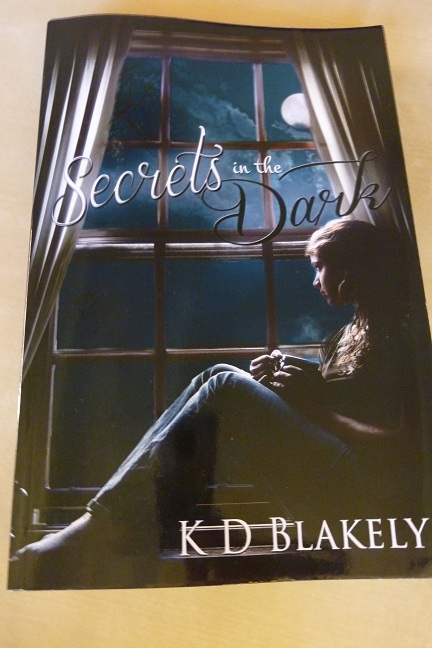
Secrets in the DarkI’m particularly excited to share today’s review, because I know the author, a member of my writing group, Stonehenge.  This may make me a little biased…but I promise you an honest review anyway! 🙂

Secrets in the Dark by K. D. Blakely follows the adventures of Kat and her two best friends–who definitely didn’t expect to fall into a magic world, when they were just trying to hide from a group of bullies.  They discover that an old tree in the town cemetary is a portal to another realm.  Every full moon, they and their friends can pass through to the magical world of Chimera.  It would be great…if the bullies didn’t keep following them, and if something hadn’t gone horribly wrong in Chimera, causing everyone living there to disappear.

This story is a lot of fun, and very engaging throughout.  The characters are my favorite part.  There’s a big cast of kids, but I never had trouble keeping people straight or telling them apart–and I’m not very good at that!  Kat is part of a group of five and there are four people in the group of bullies, so that’s quite a few people…but they all come to life as clear and distinct.  Kat and her friends all have their quirks, as well as their strengths and their flaws, and I particularly enjoy how they all have to work together with their different skills to deal with the challenges of Chimera.

Kat is a very likable narrator.  She’s not perfect but she is appealing, making for the best kind of heroine.  She’s twelve-going-on-thirteen, and is struggling to accept how much her world is changing.  It’s a very believable and sympathetic part of her character, and so appropriate for her age.

My favorite character may be one of Kat’s friends, Brady.  He’s super-intelligent, and talks that way.  His dialogue and the way he sees the world is so entertaining.  There’s also one major older character, Kat’s sister-in law, Ronny.  She has a special connection to Chimera, and does not always fit comfortably in the normal world.  In particular, she constantly gets sayings wrong–like “slow and steady wins with grace,” or “the grass is always cleaner on the other side of the fence.”  So much fun–and sometimes her sayings make a strange amount of sense!

I’ll end with one of my favorite aspects of the story: thanks to a wish that came true in an unexpected way, all the kids have familiars when they’re in Chimera.  The story is just asking for promotional-tie-in stuffed animals.  🙂  Kat and her friends have fun and adorable animals like a tiny owl, a cat and a fox.  They don’t talk, but they’re intelligent and often help as the kids explore the world.  The bullies, on the other hand, get rather nasty animals like a rat and a pig, which they keep trying to chase away.  The whole situation really makes me want a familiar…and who wouldn’t want a chance to explore a magical world?

If you find a tree (or a wardrobe) that lets you into a magical world, then by all means, have fun…but in the meantime, I highly recommend reading your way into the adventure!

Author’s Site: http://Kat-Tales.net

Buy it here: Paperback or ebook

3,000 Years with the Speaker for the Dead

Speaker for the DeadLast year for the Sci Fi Experience, I read Ender’s Game by Orson Scott Card (review here).  It’s been a year now, and I finally got back to the series to read Speaker for the Dead.  Hopefully it won’t take me as long to get to the third book–because I really enjoyed this one!

I can see why Card felt he needed to write Ender’s Game to establish the backstory for Speaker for the Dead, because it’s remarkably complicated.  I’ll try to avoid spoilers as much as I can, though…

The second book is set 3,000 years after the first one.  Ender and his sister Valentine have spent much of that time traveling at almost-lightspeed, changing how time passes for them, so that they’ve only aged into their mid-thirties.  Humans have colonized the Hundred Worlds in a society connected by instant communication but very lengthy spaceflight trips.  For the first time, they’ve encountered another intelligent alien species, the piggies, on the planet Lusitania.  After the disaster with the Buggers, they’ve put an extreme Prime Directive into place, limiting contact between the piggies and the human colony to almost nothing, and striving to let nothing at all about humans be revealed, lest the piggy society be contaminated.  When the researcher studying the piggies is killed, Ender sets out for Lusitania in his role as Speaker for the Dead, to Speak the man’s death and discern the truth.

I feel like I’ve barely touched the surface of the plot here.  It’s a plot that deals with large-scale events, yet is really more about individuals, about one person’s pain and how he or she copes with it, and the results–and how that affects others, and how they respond, and so on.

I think I liked Ender better in this book than the first one.  He’s gained a great deal of wisdom, while still keeping enough human flaws to be sympathetic.  There’s a cast of strong characters, but my other favorite is probably Jane, a self-aware computer program (to vastly simplify), with a deep attachment to Ender and a considerable sense of humor.

This book is full of mysteries, and I read it quickly because I wanted so much to know what would be revealed next.  I think I had all my questions answered by the end–sometimes I had to stop and think a little to work out how it all fit together and explained earlier parts, but that’s all right.  I don’t often think about whether or not books make me think (if that makes any sense), but this one did, in a good way.

Most intriguing are some of the concepts here.  I think the piggies are the most alien aliens I’ve ever encountered in books or movies.  Star Trek usually uses aliens to extrapolate on some aspect of humanity, Star Wars gives us visually-strange creatures but little depth about them, and most aliens in other sources are either humans with strange faces, or mindless monsters.  The piggies are deeply complex biologically and culturally, and they are deeply alien.  But Card takes it seriously, so they aren’t alien as a farce or for the sake of being bizarre–they’re alien in a way that makes us think about our own understanding of the universe, and our own deepest-held assumptions.

Most stories about aliens either show them as immediate allies or immediate enemies.  The interaction with the piggies feels like what maybe really could happen, as two well-meaning species struggle to understand each other because of their inherent differences.  This isn’t a story where we all find out we’re really the same under the skin, but it does suggest we can still meet in some way.

The space travel was also fascinating, though I almost want to call it time-travel.  Most sci fi invents faster-than-light travel and links up the galaxy, or else has very separate and disconnected colonies on different worlds.  Card gives us a society that is deeply interconnected, even though it can take twenty years to get from planet to planet.  The sheer practicalities of it are fascinating, especially the way travelers don’t age appreciably–so for them, two weeks passed, while everyone they left at home has lived through years.

I was especially intrigued by the way Ender and Valentine used space-travel to move through the years, ultimately becoming historical figures in their own lifetimes.  Masterful though most of this book is, I don’t think Card really got into how hard that would be.  He gets into the personal level, but not on the level of dealing with a changing society.  It would be like someone from the Trojan War trying to function today, after only checking in for a few months here and there in the intervening centuries.  Language, customs, technology–everything would change so much.  And if everything doesn’t change during Ender’s 3,000 year span, well, that’s kind of a sad commentary on the future of humanity…

But that’s a small criticism, and probably it’s just necessary to make the novel work.  And it does work, and it’s fascinating.  I preferred this one to Ender’s Game, though I think the first book is necessary for understanding the second.

Speaker for the Dead was full of mysteries that kept me turning pages looking for the reveal, and full of thought-provoking ideas that I expect to linger.  Highly recommended.

Author’s Site: http://hatrack.com/

Other reviews:
Realizing Grace
Ada’s Technical Books
Been’s Blog
John Walters
Anyone else?

Buy it here: Ender’s Game or Speaker for the Dead

Reflecting on Writing with Diana Wynne Jones

ReflectionsReflections by Diana Wynne Jones is not quite a book about writing…and not quite an autobiography…but a good bit of both.  Diana Wynne Jones is one of my favorite children’s fantasy authors, so I was eager to read her book of essays “On the Magic of Writing” when it was published this fall.

I feel like this is less about writing than it is about storytelling, which are not quite the same thing.  It’s not much about the craft of writing, and definitely not about publishing.  It’s about something more integral, about the art of crafting a story rather than how that story becomes a novel.  So don’t come here looking for one essay about how to create a character, another about plot arcs, or a third about the advantages of outlining.  Some of those elements may come in, but you’ll only find them as one possible aspect of an essay about, for example, the influence of Anglo-Saxen myths on modern fantasy, or the ultimate responsibility of writing for children.

That second topic may be one of my favorites addressed here, in the essay “Writing for Children: A Matter of Responsibility.”  That sounds rather weighty and apt to be moralizing, but it isn’t at all.  Without being overwhelming about it and certainly without advocating for Victorian stories where bad little children swiftly meet bad ends, Diana Wynne Jones gets at the influence books have on children.  I remember once in college I mentioned in conversation with an acquaintance that I wanted to write young adult novels.  She remarked, “so you can be an influence on twelve-year-olds everywhere.”  She clearly meant it scornfully, but…yes!

I’ve certainly “met” books later in life that have influenced me, but I think stories touch us and shape us in childhood in a way that later books don’t.  Diana Wynne Jones obviously understood that, and obviously believed in the power of books to be a positive influence.  I don’t mean that her books are ever moralizing, but I think they do build strength and courage and belief in oneself and one’s own imagination.  Those, of course, are good lessons for anyone, at any age.

I also particularly enjoyed “A Talk About Rules,” which discusses how seemingly-ironclad rules change.  I think this essay may be the key to why the book isn’t more about rules of writing–because it’s evident she doesn’t much believe in them.  To quote: “What you see should be a magnificent, whirling, imaginative mess of notions, ideas, wild hypotheses, new insights, strange action and bizarre adventures.  And the frame that holds this mess is the story.”

I mentioned autobiography at the beginning, and the book frequently tells stories about Diana Wynne Jones’ own life.  She tells wonderful, improbable stories about growing up in a town where everyone was mad, during World War II when the whole world had run mad.  She talks about her own writing process (something that always fascinates me about authors I love), about the influences on some of her novels, and about her experiences being an author.

If there’s a flaw in the book, it’s that some of the stories become repetitive.  This is a compilation of essays and talks that were originally spread across years, and when they’re all put together, you find that she describes the same details of her childhood three or four times.  Perhaps slightly heavier editing would have resolved some of this.  As it stands, it’s not too big an annoyance, although it may be an argument for reading this a few essays at a time, rather than straight-through.

If you really want a book about writing, I recommend Writing Magic by Gail Carson Levine.  But if you want a book about stories, and about Diana Wynne Jones, this collection is delightful.  And perhaps by focusing more on that deeper core, she’s created a book that would be as interesting to readers as it is to writers.  Really, to anyone who enjoys stories–particularly if you enjoy Diana Wynne Jones’ stories!

Author’s Site: http://www.leemac.freeserve.co.uk/

Other Reviews:
Things Mean a Lot
Awfully Big Reviews
Fall into Fiction
CalmGrove
Anyone else?  Tell me about yours!

Buy it here: Reflections