The Callista Trilogy: Darksaber

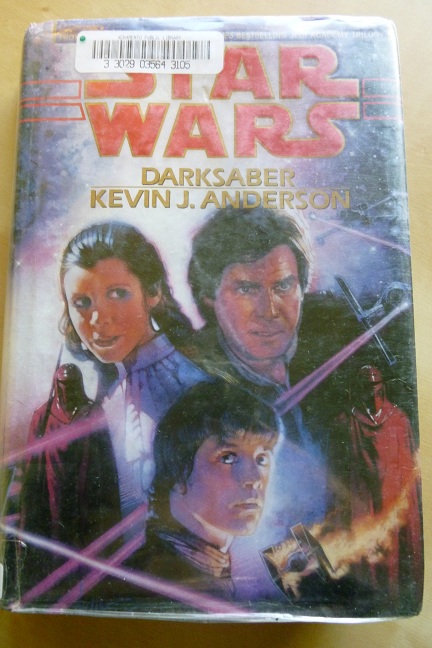
DarksaberAfter a brief break for L. M. Montgomery, I’m back to focusing on the Sci Fi Experience.  I enjoyed the break and was happy to go back to lasers and aliens…but I am sorry to say that I was sadly disappointed by the next installment of the Callista Trilogy, Star Wars: Darksaber by Kevin J. Anderson.  There was an author switch here, and it showed–though I was quite surprised, as I know Anderson is a prominent name in Star Wars novels.

This one picks up shortly after Children of the Jedi (my review here), with continuing character threads but a new plotline.  Callista and Luke are on a search for a way to restore her lost Jedi powers.  Leia is in political negotiations with the Hutts (as in, Jabba the), who are secretly building a super-weapon using the plans of the Deathstar.  Han has pretty much nothing to do but follow along with Leia.  Meanwhile out on the fringes, Admiral Daala and Vice-Admiral Pellaeon are striving to unify the squabbling remnants of the Empire to attack the New Republic, and especially the Jedi Academy.

You might already be able to tell that this plot is rather fractured.  The Hutts and the Empire pose two major threats that, as far as I can tell, have absolutely nothing to do with each other.  I honestly don’t know why they’re both in one book.

I did actually quite like one minor plot thread, involving one of Luke’s Jedi trainees.  Dorsk 81 is from a world of clones; he’s the first one to have Jedi powers and the first one in a very long time to do anything unexpected.  He returns to his home planet hoping to serve with his new abilities, only to find his community expects him to go back to conforming.  This was an intriguing culture that could have been explored more thoroughly, and it’s too bad it was in a book that was already over-stuffed with plot elements.

Possibly more problematic than a fractured plot is the fractured point of view.  Star Wars books typically jump between different characters, and I don’t object on principle.  This one, however, spends so much time in the POV of supporting characters or villains that I feel like I barely saw Han and Leia at all.

We spend far too much time in the POV of Admiral Daala, who is a decent enough villain but not that special for the amount of attention she gets here.  We also spend a lot of time in the POV of Bevel Lemelisk, an engineer behind the Death Star who’s now working for the Hutts.  Despite spending too much time with Lemelisk, I still have no idea why he’s working for the Hutts.  He doesn’t seem to be trapped; he’s not bloodthirsty; he’s plainly not enjoying the experience; he’s not unaware of the destructive power of his creations, and yet he gives the consequences no thought at all.  I’m guessing his motivation is sheer love of his craft, but I haven’t the faintest idea why he’s choosing this way to express it.

That leads into the third problem.  The characters throughout feel…not quite shallow, but something like that.  Perhaps the problem is that the writing is unsubtle.  I don’t know exactly how to explain this, so let me invent an example.  These aren’t actual quotes, but I think they’re representative.  It’s the difference between writing “Leia was sad about Alderaan” and writing “Leia watched the purple sunset and thought wistfully of Alderaan’s blue skies.”  They’re both expressing emotions, but Darksaber‘s only method seemed to be to use the first, and just announce what a character felt.  Characters do feel things, even deep things, but there’s somehow no depth to the writing.

Perhaps I’m most disappointed by the portrayal of Callista.  She felt more alive when she was a Jedi ghost in the first book.  Even worse, I didn’t like how her personal journey was handled.  The facts of the situation are: she’s a Jedi Knight from a previous generation who has been isolated for thirty years, now inhabiting a new body in a galaxy that is very different from her earlier experience, who finds herself unable to touch the Force.

You’d think a character with all that going on could hardly help but be deep and complex.  But none of that is explored in the slightest way, except for her inability to reach the Force.  That’s the primary focus, and even that becomes less about her crisis of self-identity than about her inability to Vulcan mindmeld with Luke (to thoroughly mix my galaxies!)  The story of their relationship is not a bad direction to go and would certainly be a good element to a larger story…but as-is, it feels like so much less than what could have been done.

Now that I’ve completely torn this book apart, I really should say it’s not a terrible book.  It’s not very good, but it’s okay.  Perhaps a hazard of writing in a larger universe like Star Wars is that it’s so easy for the reader to see how much better a novel could have been–because there are better Star Wars books out there.

Children of the Jedi doesn’t seem to get much love from hardly anyone, but I greatly preferred it to its sequel.  So all in all–I’m looking forward to jumping back into Barbara Hambly’s writing for the third book in the trilogy.

Other reviews:
Rancors Love to Read
Meme Read
Star Wars Wikipedia
Anyone else?

Buy it here: Darksaber by Kevin J. Anderson

Death Comes for an Apprentice

MortIn my usual way of reading Discworld books, I had read most of the Death subseries without reading the first one.  But recently, I finally picked up Mort by Terry Pratchett to get the beginning of the story, confident of finding a book that would be about life and death and eternity–and it was–and be enormously funny–and it was!

Mort has never been much of a success at anything, so his father decides the answer is to apprentice him out to a trade.  As it happens, Death is looking for an apprentice.  The job is a little daunting but Mort begins to get into the swing of things (pun intended!)…but then matters become complicated when he saves the life of a princess who the universe is now convinced is dead, and when Death begins to explore happiness and contemplate escaping his duties.  Also there’s Death’s daughter (adopted) thrown into the mix, and more than one wizard of questionable power.  And…well, it’s Discworld.  There’s havoc and there’s hilarity.

There’s a whole collection of fun characters here, as I would expect from Terry Pratchett.  Mort undergoes an interesting transformation from ordinary screw-up to resembling Death just a little too much–including this problem he keeps having passing through objects.  Princess Keli is great fun, especially as she becomes immensely frustrated when the universe thinks she’s dead and everyone keeps forgetting about her.  She’s an odd blend of very strong and also quite inept in dealing with the world–as happens when you’ve been a princess all your life, and never needed to deal with the world.  Ysabell, Death’s daughter, is an odd blend of crazy and ultimately endearing.  And it was fun to learn the backstory on Albert, Death’s servant–he’s in later books, but his background isn’t revisited that I can recall.

My favorite character here was Death himself.  I tend to like him best in a supporting role–sometimes when he’s too much the focus it gets old (while often his two-paragraph cameos are the funniest bits of other books).  Here, there’s enough focus on Mort and the others that Death gets just the right balance–plenty of him, but not too much.  He tries to explore human happiness, which treats us to scenes of Death fly-fishing, line-dancing, and sitting in a bar (at a quarter to three, of course), and never quite understanding any of the things he’s doing.  My favorite may be when Death visits an employment agency and puts down “Anthropomorphic Personification” as his previous position.

The setting is also particularly fun here, something I don’t often say about books!  But Death created his own world, and though he tried very hard, he has some trouble–everything tends to be black and fake.  We also spend time in Keli’s mountain kingdom, and get to visit Ankh-Morpork.

There isn’t a huge lot of satire and depth here, but there are some discussions on justice and eternity and the meaning of life.  Death seems to struggle with these questions throughout his books.

The weak point of the book is the ending–only the very, very end.  At the risk of a slight spoiler, there’s a sudden switch in the romance, and even though I knew it had to be coming (based on the later books about Mort’s daughter), Pratchett still didn’t sell it to me.  It’s like he decided on the last chapter that there was more future potential in ending one way than with the other, and went for it without bothering about whether it made sense.  I won’t complain too much…since it did lead to the amazing Susan, heroine of later books.

This is the fourth book in the Discworld series, and it’s one I’d recommend as a place to start.  The books still get better, but this is the earliest one that’s already showing just how hilarious Terry Pratchett can be.  Highly recommended!

Author’s Site: http://terrypratchettbooks.com/

Other reviews:
Brian Jane’s Blog
Helen Scribbles
The Eagle’s Aerial Perspective
Anyone else?

Back to Pellucidar

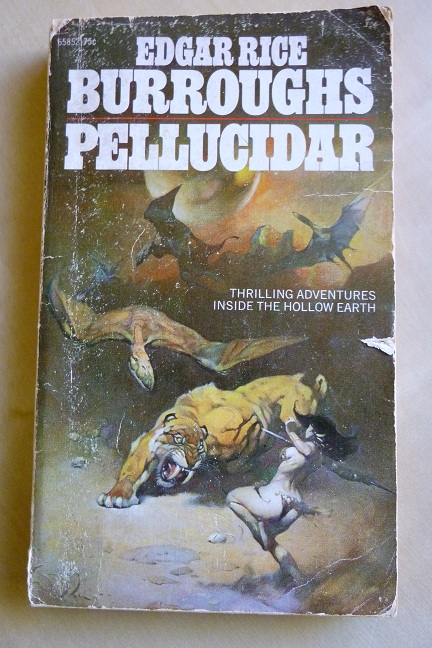
PellucidarFor my second Vintage Sci Fi read, I went back to the world at the Earth’s core, with Pellucidar by Edgar Rice Burroughs.  This picks up where the first book left off, following the further adventures of David Innes in the world within the Earth.

There’s not much to be said about the plot–after all, it’s Burroughs, and that tells you most of it.  David makes it back to Pellucidar where he sets off through a hostile landscape to search for old friends, encounter new and old enemies, and of course to rescue (repeatedly) his poor beleagured true love, Dian, who is captured on at least three occasions.

It’s all good fun and good adventure, with strange landscapes, a never-ending parade of action, and quite a lot of death but nothing gruesome.  Like the first book, Pellucidar is striking me as a kind of Barsoom-lite.  The same basic shape, still very entertaining, but somehow not quite as striking as John Carter’s adventures on Mars–and this may have more to do with which order I read the books in than the books themselves.

Rather than dwell on the plot and the characters, I want to talk about some of the themes.  Lately it’s been uncanny how books I’ve picked up have unexpectedly fit into the larger discussion going on.  First it was Star Trek: The Abode of Life and the examination of transporter technology.  Now Pellucidar hits on a number of points that have come up recently.

First, The Abode of Life and Pellucidar both present a man from a more technologically-advanced society choosing what effect he will have on a new world he’s encountering.  Kirk went to great lengths to not be a conquistador (his words) for Mercan.  David plunges into precisely that role with abandon, becoming David I, Emperor of Pellucidar, and using advanced weaponry to conquer all the natives.

I realized long ago that I can’t look too closely at Burroughs’ philosophy, if I want to continue enjoying his books.  Still, I don’t feel like I can just pass right over the last twenty pages of Pellucidar, which are especially, um, troubling.  David simply takes it for granted that as the civilized man, he has both the right and the knowledge to assume a leadership role and impose an entirely new form of civilization on the natives.  His attempts to eradicate the Mahars, the dominant, lizard-like race, are particularly disturbing.  Though the Mahars do treat humans badly, they mostly seem to be condemned for the crime of not being human.  The emphasis is much more on their lizardness than on their actions.

It’s also a bit interesting that David doesn’t introduce money (calling it “the root of all evil”), but doesn’t mind introducing guns and cannons.  He does insist that his real interest is to spread education and trade and the Industrial Revolution…after obtaining peace by conquering everyone.

While I look askance at all of this, at the same time, I know Burroughs is a product of his time–Pellucidar was written while “the sun never set on the British Empire,” and decades before Kirk got his Prime Directive in the 1960s.  For the Dragonflight group-read, we discussed extensively how classic books carry into the modern day, and Burroughs definitely requires acknowledging that this was a different time.  In a way, it may help him that he’s so obvious about it–it makes it easier to draw a line around the objectionable bits, and move on.

That’s something I have to do most of the time with Burroughs’ heroines too.  The portrayal of the genders was a fascinating discussion with Dragonflight, and it was interesting to still have some of that in mind reading Pellucidar.  Burroughs heroes never treat women badly, or with the disdain that the dragonriders show–they generally worship the ground their heroines walk upon.  And yet, at the end of the day…the heroine is pretty much a beautiful face who plays the role of a prize to be won.

I noticed here that Dian is more than once referred to as very fierce and brave–but she never actually does anything.  She brandishes a javelin now and then, but is completely ineffectual at actually accomplishing anything (including using the javelin to fend off a kidnapper).  As comparison, Lessa is frequently marginalized and often treated (and depicted) as childish…but she does things!

To be fair, Dian may be a bit two-dimensional…but so is David, so it’s not entirely a gender thing.

And to be fair on another point, I don’t read Burroughs for his brilliant political insight, or his explorations of the human character.  I read him because he tells an exciting adventure story–and he’s never yet failed me at that!

Author’s Site: http://www.edgarriceburroughs.ca/

Other reviews:
SFF Audio
I couldn’t find others!  Anyone else?

Buy it here: Pellucidar

Spend Some Time with Pat of Silver Bush

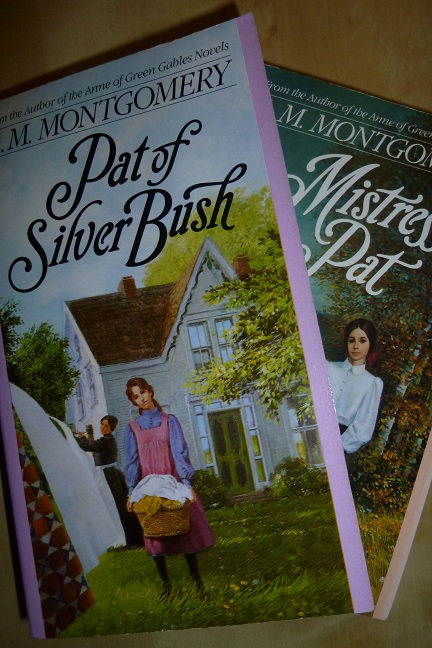
Pat BooksWith the L. M. Montgomery Reading Experience this month, I decided it was the perfect time to revisit the Pat books.  Pat is not as well-known as her literary sisters, Emily and Anne, but she has two charming books, and I was intrigued because Montgomery considered her one of her more autobiographical heroines.

Pat of Silver Bush follows Pat through childhood, from age seven to eighteen, touching on Pat’s small adventures along the way.  I don’t mean “small” as a criticism–part of the charm of Montgomery’s books is that she takes the day-to-day concerns of a girl (and a family) living on a farm on Prince Edward Island, and spins out a beautiful story.

I like Pat, but I think I can see why she hasn’t captured the imagination the way fun-loving Anne or ambitious Emily have.  All Montgomery heroines deeply love nature and a good story, and have at least a glancing appreciation for poetry.  Pat’s interest is more glancing, and though she’s clever, she doesn’t have Emily’s brilliance.  Pat’s chief quality is to love things intensely–often too intensely–and nothing more so than her home of Silver Bush.  Pat worships Silver Bush, and can’t bear the thought of any changes.

It took me a bit to get into the book, and while that may have been a matter of transitioning out of sci fi, I think it also has to do with the particular incidents of Pat’s very early childhood.  Pat can’t bear change–and so she has agonies of emotion over apparently minor things, to the point that it’s hard to sympathize.  This problem is smoothed out as Pat gets older and begins to move in a larger sphere, with larger (and more genuine) concerns.

Pat is one of the few Montgomery heroines to have a large immediate family.  Anne and Emily are both orphans.  Pat has two parents and four siblings.  The funny thing is, I don’t feel properly acquainted with most of Pat’s family.  Her nearest brother, Sid, comes into it a bit, and her younger sister Rae has a significant role in the second book.  The rest, though Pat loves them fiercely, seem to have very little actual presence in the book.

I was particularly struck by the portrayal of Pat’s mother.  She’s lovely and loving and “the heart and soul of Silver Bush”…but she always seems to be off in the other room.  Montgomery’s own mother died when she was a toddler, and she idealized the memory of her mother.  Pat’s mother feels like a living version of this–beautiful, idealized, but not really there.

The one who’s there is Judy, the family cook and house mistress, who understands Pat better than anyone.  Born in Ireland, Judy is an endless source of wonderful, improbable stories, either spooky tales of ghosts and fairies, or funny stories of family history–and of family history for everyone else in town.

The other two characters that shine are Pat’s two best friends: dreamy, ethereal Bets, and practical yet poetic Jingle.  Despite his unfortunate name (and eventually switching to Hilary doesn’t help), Jingle is a delightful childhood sweetheart for Pat–because every Montgomery heroine seems to have one.  Jingle is the mistreated near-orphan of the story, who sees the world clearly and dreams of making a mark in it–but can also join Pat in going in raptures over a bit of woodland.  He has ambitions of becoming an architect, and is forever planning the house he’ll some day build for Pat.

One of my favorite chapters is when Jingle’s long-absent mother comes to visit, and it goes very badly.  It’s a dark crisis for a Montgomery book, not a straight-forward tragedy but a crisis of disillusionment, and very moving.

Mistress Pat follows Pat through eleven years, from twenty to thirty-one, through a series of beaux, new friends and many new changes.  Hired man Tillytuck is a wonderful addition, very colorful and frequently sparring with Judy.  Rae comes into her own as Pat’s dearest friend, and Pat makes new friends out of Suzanne and David Kirk.  They don’t have quite the charm of Bets and Jingle, but they have their moments.

This is a particularly interesting read after reading Montgomery’s journals, because I’m convinced she put so much of her own life into Pat’s.  I’m sure Pat’s brother makes an unwise marriage because Montgomery’s son married a woman she didn’t approve of a year before the book was written.  Pat’s feelings towards David Kirk remind me very much of Montgomery’s feelings towards her husband–though things turn out differently.

I think this is the most heartbreaking Montgomery book (unless you count her journals).  The last third is all but devastating…so at the risk of a slight spoiler, I am glad Montgomery rescued Pat with a happy ending in the last three pages.  I wish there had been a third book–I want to feel Pat’s happy ending, but even though she’s going on to a better life, we don’t get to see it.  Oh well.  It could have been much worse.  It could have ended like Montgomery’s journals!

All in all, Pat doesn’t hold my heart like Anne or Emily, but I still love any Montgomery novel.  Some parts are an absolute delight, especially Judy’s stories, and Montgomery never fails to paint the beauties of Prince Edward Island.  These wouldn’t be the first Montgomery books I’d recommend picking up, but if you’re already acquainted with her other heroines, it’s nice getting to know Pat too.

Other reviews:
This Simple Home
Reading to Know
The Black Sheep
Pages Unbound
And, I am pleased to see, many more–tell me about yours and I’ll link to it!

Buy it here: Pat of Silver Bush and Mistress Pat (It’s weirdly expensive new, but I found some cheap used options!)

A Concert from the Harper Hall

https://i0.wp.com/opland-freeman.com/pernmusic/images/B000CAFWKQ.MH.jpgIt’s funny the things you can find once it occurs to you to look for them.  I’ve loved Anne McCaffrey’s Pern poetry for years and years, the snatches of verses that, in context, are the songs of the Harper Hall.  In the course of the January Dragonflight group-read, it occurred to me to do a search on Amazon to see if Masterharper Robinton’s harpers have put out any CDs–and they have!

Well, not exactly.  🙂  But Tania Opland and Mike Freeman worked directly with Anne McCaffrey to put together two CDs of music inspired by Pern, much of it using the lyrics described in the book.

Can I just pause for a moment here to say how completely amazing that is?  I mean, Harper Hall songs!  Really!

I admit I was a little nervous on purchasing…this could, after all, go very badly if I didn’t like how the songs were done.  Fortunately, I like the music quite a bit overall.  It has a very acoustic, folk-song style that feels eminently appropriate to the context.  You couldn’t possibly play Menolly’s or Robinton’s songs on an electric guitar.  They need pipes and strings and though I have no musical expertise to recognize exactly what instruments are being used, this feels right.  Amazon tells me it draws from a variety of musical traditions, and I can most clearly hear the Celtic.

Most exciting, unquestionably, is that we get to hear songs I recognize from within the novels. I had to buy both albums because favorite poems/songs were split between them.  The Masterharper of Pern has more of the traditional ballads and, obviously, Robinton-related songs.  Sunset’s Gold has songs from Menolly, heroine and songster of the Harper Hall Trilogy.

Some of the tracks are instrumental, and I must admit those were not as interesting to me, though some do relate to book events.  But that’s me–I almost always prefer words in my music.

The Masterharper of Pern has a number of the songs that figure in Dragonflight.  I particularly love “The Duty Song,” which runs through all the key roles within Pernese society, and how all must come together to serve their unique purpose.  “Fighting Thread” is also excellent, about the dragonmen rising to fight their ancient enemy.  That one sticks in my head somehow.  Most exciting here is “The Question Song” which is suitably spooky, if maybe not quite the soul-capturing mystery described in the book (but what could be?)  I have mixed feelings about “Lessa’s Ride.”  Parts of it are lovely, but I would have liked a melody that was more epic and heroic, considering the subject.  On the other hand, “March of the Wings” gives me that more stirring melody I was looking for.  You can just feel the dragons soaring up in formation.

https://i0.wp.com/opland-freeman.com/pernmusic/images/B001QVJC6A.SG.jpgSunset’s Gold has many of my favorites from the Harper Hall Trilogy, brought to life very satisfactorily.  Menolly’s “Run!” song is suitably toe-tapping, and “Brekke’s Cry” is eerie.  I would have liked “The Little Queen” to be catchier somehow, but it’s been growing on me.  I really enjoy “Gather Day,” which very much captures the festive atmosphere (and the lyrics refer to bubbly pies!)  “Sunset’s Gold” and “Sweet Sea” aren’t ones I particularly remember from the books, but they’re beautiful songs in their own right, and would be even if they weren’t part of the larger context.

So, all my friends who read Dragonflight and especially those who liked the poetry…you really, really have to explore these CDs! 🙂

Musician’s Site: http://opland-freeman.com/pernmusic/index.htm

Buy it here: The Masterharper of Pern and Sunset’s Gold