Fascinating Political Intrigue, Just Outside Tortall

Regular readers know that I’ve been re-reading my way through Tamora Pierce’s Tortall series for the last several months.  I’m finally down to the last two–the Tricksters series, a set of two books about political intrigue, revolution and of course some romance.

These books focus on Aly, the sixteen-year-old daughter of Alanna, heroine of Song of the Lioness.  Aly takes after her father more, George Cooper, former King of Thieves and current Assistant Spymaster to Tortall’s king.  Aly knows all about picking locks and picking apart codes, about hiding her thoughts and manipulating a situation.  She needs those skills when she’s captured by pirates and sold into slavery in a neighboring kingdom.  The stakes get higher when Kyprioth, the Trickster god, arrives to offer her a wager.

This series, unlike any of the others, is set almost entirely outside of Tortall, in the neighboring Copper Isles.  The isles’ natives, the raka, were conquered some three hundred years earlier, and have been living as slaves and second-class citizens ever since.  But there’s a prophecy that their royal line will one day be restored, and Aly finds herself in the midst of a brewing revolution.

This is maybe the most fascinating Tortall sub-series.  The intrigue and the plot twists and the thousand and one pieces Aly has to keep track of, especially in the second book, are all, well, fascinating.  It’s probably the most plot-driven series, and in some ways the most focused.

All that fascinating intrigue, however, also comes with some costs.  With a few exceptions, the characters aren’t as good.  The members of the Balitang family, which Aly is striving to protect, are all good, especially Dove, who’s wonderful.  And there’s Nawat, my favorite favorite favorite part of the book.  He’s a crow who turns into a man, and is just adorable and delightful and my favorite Pierce love interest (except George, because I also love George).  But there are also a lot of secondary characters who feel under-developed.  They’re fine for what they are, but when I compare them to secondary characters in other Pierce series, I feel like they could have been better.

As to Aly, similar to Keladry, I like her but don’t love her.  I also find her a bit less believable than the other heroines.  That’s two issues, so let me start with the first one.  Not loving her–I think she gets a poor introduction, and that first impression may be the biggest issue.  When the book opens she’s sixteen and frivolous and doesn’t get along with her mother.  That ought to be fine; plenty of sixteen-year-olds don’t get on with their mothers.  But her mother is Alanna the Lioness who I love and admire and spent years of my childhood wanting to be.  I admit, Alanna may be a very difficult mother, but if it comes to taking sides, I’m still never going to be on Aly’s side.  She is a really good, strong character and I enjoyed reading about her…but I don’t love her nearly as much as her mother.

As to believability, we meet Aly older than most of Pierce’s other heroines, and more established in her skills than any of them.  Usually, heroines go through a book or two (or three) of learning their abilities, of direct or indirect training, and only really come into their power by the end of the series.  Aly already knew everything she was going to know about spying and intrigue when we met her–and there we have a believability problem.  First, she is incredibly skillful for someone who has no actual experience.  It might be easier to believe if we had watched her learn all the theory, but we didn’t.  Second, George doesn’t want her to be in the field, and Alanna doesn’t want her to be a spy at all.  And yet…apparently George and Numair and Myles and all sorts of other intelligent characters we know from other books have been teaching her how to be a spy her whole life.  Some of it I’ll believe was meant to be games or more general skills…but George taught her how to overcome fear spells and Numair taught her how to create elaborate lies that no one could see through.  They taught her that level of skill, and didn’t expect her to use those skills?  Not quite consistent, that.

Still, despite a few issues, it’s a fascinating, intriguing, exciting, suspenseful book.  There are some wonderful twists, occasional humor, and a handful of excellent characters.  And there’s Nawat.  It’s all worth it just for Nawat, and fortunately he’s not the only bright spot of the book anyway!  I’ve also been re-reading Tortall and Other Lands, Pierce’s collection of short stories, reading the stories relevant to each series as I come to it.  One of the best is a story from Nawat’s point of view, about a year after the Tricksters series closes.  Definitely worth reading as well!

And that brings me to the end of my Pierce reading–it was a wonderful adventure, and I have corrected a great wrong in my world, that it had been ten years since I read some of these much beloved books.  If you’d like to read my other reviews, here are the links:

Song of the Lioness
The Immortals
Protector of the Small
Beka Cooper: Terrier, Bloodhound, Mastiff
Tortall and Other Lands

Author’s Site: http://tamorapierce.com/

Other reviews:
Reviews from the Hammock: Trickster’s Choice and Trickster’s Queen
Ems Reviews
Emma Michaels
Yours?

Another Day, Another Monster

I felt terribly clever putting Rick Riordan’s newest book, The Serpent’s Shadow, on reserve at the library a month before it was coming out.  That meant I was only #23 in line! 🙂 They bought enough copies that I actually got mine quickly–and I already returned it for the 150 people now waiting.

If you don’t recognize the name, Rick Riordan is the author of the very popular Percy Jackson series.  The Serpent’s Shadow is the final book in The Kane Chronicles, his Egyptian mythology trilogy.  (Read my review of the first one.)  The trilogy follows Carter and Sadie Kane, a brother and sister who are learning their powers as Egyptian magicians, and practicing forbidden magic by engaging with the Egyptian gods (who are far more metaphysical than their Greek counterparts).  In the third book, Sadie and Carter have to face Apophis, a monster serpent determined to destroy the world and return it to pre-creation-type chaos.

As is typical for Riordan, the book is set in a compressed time period (I think only two or three days), there’s a clear deadline for the end of the world, and the characters have to pursue quests to get the pieces they need to fight the monster.  It’s a structure that I think works well–sometimes he can be a little episodic, but mostly I thought this was tied together well, had a good drive and focus, and both the looming deadline and the present crises kept the tension level high.

The story is told through alternating first-person narration.  The frame story is that an audio recording was mysteriously sent to Mr. Riordan, and throughout the recording Sadie and Carter have been passing the microphone back and forth.  I really enjoyed Carter in this book.  Throughout the trilogy, circumstances have been forcing him to take on more and more responsibility, and by the third book he’s coming into his role as a leader.  He’s still unsure of himself though, and that made him very human and relatable.

If Carter had been the only narrator, I would have loved this book.  I still liked it…but Sadie just irritated me completely.  She’s conceited, obnoxious, and has this incredibly aggravating tendency to view her personal life as of equal importance to the end of the world.  There are two guys she has crushes on, I have no idea what either sees in her, and I can’t help feeling that deciding between them is just not as important as the imminent destruction of the universe.  Especially when I wasn’t that drawn into her relationship with either guy.  (To give Riordan credit, I liked the romance in Percy Jackson better, and Carter also has romantic troubles that are better balanced with the larger looming threat.)  Some of Sadie’s most conceited, most relationship-drama lines are perhaps meant sarcastically or tongue-in-cheek, but it doesn’t come across that way enough for me.  I remember Sadie bugging me a bit in the previous books, but it was much more so this time.

However–it’s a problem but not an insurmountable one.  I did enjoy the book.  I sighed a little whenever I turned a chapter to see Sadie was narrating the next one, but even her sections had good aspects to them.  And it’s a good book, lots of excitement and lots of irreverent mythology humor, which Riordan is so good at.

This winds up the Kane Chronicles trilogy, but there were some very blatant hints at the end about new problems with “other gods.”  I’m seeing a Greek/Egyptian crossover coming, which seems like it would be enormous fun!  I’d definitely read that…even if Sadie is one of the narrators.

Author’s Site: http://www.rickriordan.com/

Other reviews:
Lost in a Book
21st Century Once Upon a Time
Knight Reader
Anyone else?

Another Lady Knight-to-be

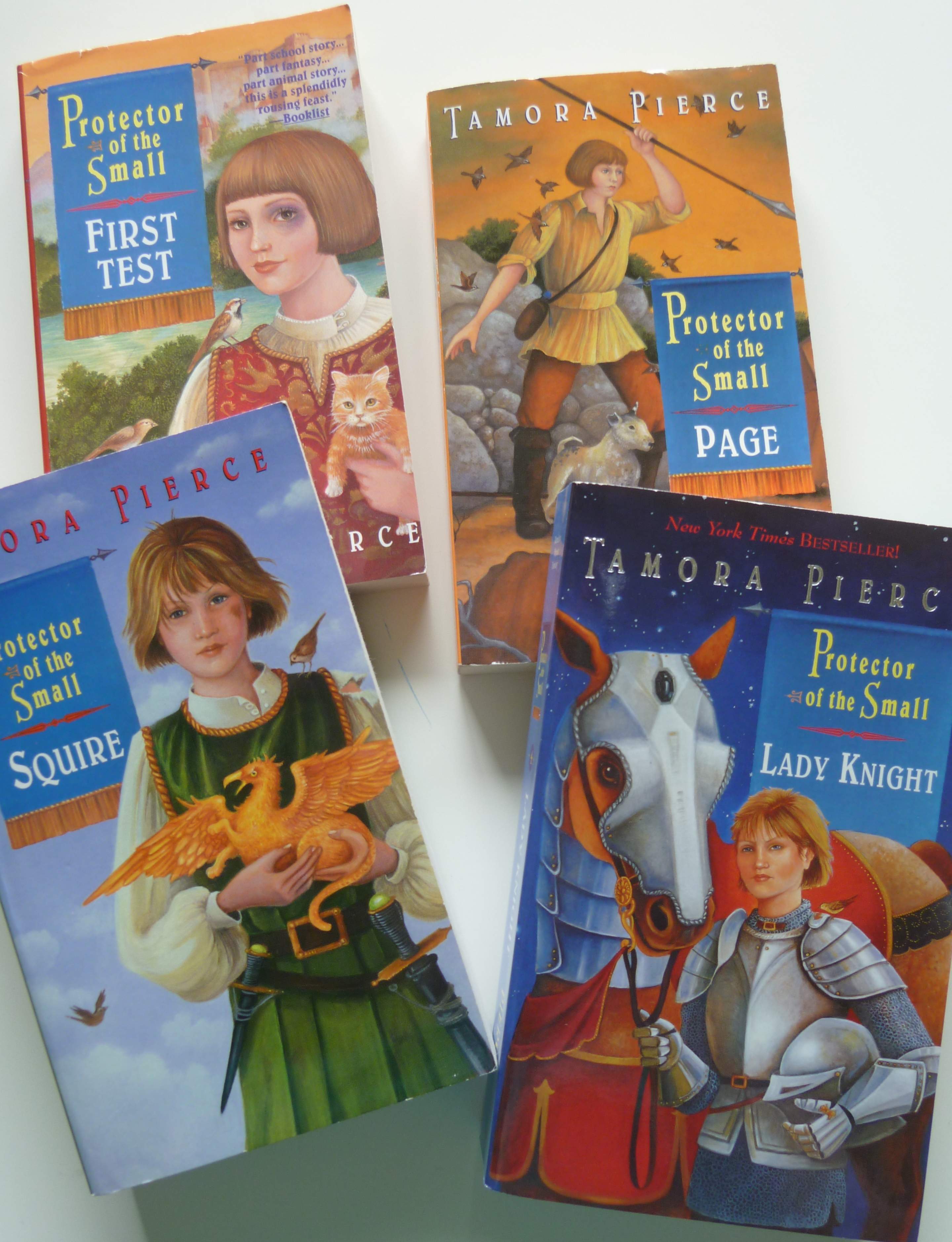
As part of my personal quest to re-read all of Tamora Pierce’s Tortall series (18 books!), I re-read her Protector of the Small quartet during March…then took forever to get to this review!

The heroine of Pierce’s third Tortall quartet is Keladry of Mindelan.  The first time I heard about this series, she was described as a girl with a knack for animals who wants to become a knight.  And I thought…well, isn’t that just a combination of The Song of the Lioness, about Alanna who wants to be a knight, and The Immortals, about Daine with her magical knack for animals?  It kind of is–but in most ways it’s not.

Alanna had to disguise herself as a boy to get her shield, but after her friend Jonathan becomes king, he decrees that girls can become knights.  Then for ten years, no girl ventures to try it.  Finally Keladry comes along, the daughter of a diplomat’s family who has lived most of her life in the Yamani Islands (a very obvious take-off on Japan).  Alanna is her hero (should I say heroine?) and she dreams of becoming a knight so she can protect the defenseless.  She becomes a page, but faces fierce challenges from boys and even instructors who don’t think a girl can be a knight.

The first three books (First Test, Page and Squire) follow Kel through her training, and the fourth book, Lady Knight, is about her first adventure as a knight, mostly commanding a refugee camp during a war.  (Sorry if that was a spoiler to tell you she does eventually get her shield…) In the first book Kel is only ten, but like Alanna, she’s a very OLD ten-year-old.  To diverge slightly, I actually have a theory about this.  Pierce originally envisioned Song of the Lioness as an adult book.  I’m guessing when she decided to make it YA, some editor told her the characters had to be younger, so she dropped five years off their stated ages; all of Alanna’s peers act pretty consistently five years older than they’re supposed to be.  Once Pierce had established that pages start training at ten, she was stuck with that in this quartet too.  I think my actual point here is, don’t be off-put by a quartet that starts out about a ten-year-old.  Kel never feels that young, and she gets older quickly.

The animals turned out to be a relatively minor point; Kel has a bad-tempered horse, a disreputable dog and a flock of very clever sparrows, but the intelligence of the animals is largely chalked up to Daine’s presence at court.  She has powerful magic that sort of seeps into the animals around her.  Kel doesn’t have any magic of her own, the only Pierce heroine not to have some kind of magical ability.

Protector of the Small is in many ways a transition series, both for Pierce’s writing and my personal engagement with the books.  These were written when I was in high school, so I read them later and less frequently than the first two quartets.  I’m not sure, but this may be only my second time through the series.  I like them, but I don’t madly love them the way I do the first two quartets–but I don’t know how much of that is simply my personal history and familiarity with them.  I do know two people who say these are their favorites.

I like Kel, but I don’t love her.  I admire her very much–more than Daine, if I really stop to compare admirability.  Kel is tough and brave and, as the quartet title suggests, constantly trying to protect those around her.  She wages a campaign against bullying among the pages in the first book, and gets into the defense of battered women in the second.  In the fourth, she’s fiercely protective of her refugees.  She’s a great character and a wonderful role model for girls.  And I do like her–but somehow I don’t quite love her.  Maybe she’s a little too serious, or a little too righteous, or maybe I just met her later than I met Alanna and Daine.  She’s inevitably the other lady knight.

Alanna is back in a small supporting role, and I’m always thrilled to see her.  Jonathan, Daine, Numair and a handful of other major characters from earlier books also have roles again, most notably Alanna’s friend Raoul, who if anything has a bigger part here.  As ever, it’s fun to see how characters’ lives are going along.  There are many good new characters here too.  My favorite is Neal, Kel’s very funny best friend (him I love), probably followed by Tobe, an orphan Kel takes under her wing in the fourth book.  There’s also a perfectly dreadful villain, Joren, who matches Duke Roger for charming viciousness.

I mentioned transitions in Pierce’s writing–Protector of the Small is definitely a changing point from the simpler earlier books to the more complex ones she’s writing now.  It’s a little hard for me to explain how they change, because Song of the Lioness has complex characters and complicated plots and good writing…but somehow the more recent books feel denser and grittier and more mature.  They do get darker, especially the fourth book, and the third and fourth are both much longer than earlier ones.  They were written right about when Harry Potter was getting popular, and Pierce directly thanks Rowling for opening the door to longer YA books.

There’s something more realistic about this series, although I’m struggling to put my finger on it.  Tortall has felt like a real, complex world from the beginning, but there is a certain amount of sorcery and legend feel to Song of the LionessProtector of the Small has less magic, and it gets into practical things like politics, diplomacy, the complications of supplying a band of knights, the difficulties of the legal system…  Alanna went through tough training, but Kel seems to keep count of the specific training and the bruises involved much more.  It’s just a bit of a different feeling.

In a way this quartet occupies an unfortunate space–I think I’d be more enthused about Protector of the Small if I didn’t love Song of the Lioness so much.  It really only falls short by comparison–and to be not as good as one of my most favorite quartets ever…well, that’s barely a criticism, really.  So, if it isn’t already clear, let me just say that this really is an excellent set of books, a fantasy series that is nevertheless gritty, with characters that are engaging and very human.  Well-worth reading.

And now I’m down to just two more Tortall books to re-read!  Stay tuned for a review of the Trickster books soon.  🙂

Author’s Site: http://tamorapierce.com/

Other reviews:
Respectable Collection
Young Adult Fiction & Whiskey Sours
The Literary Tally
I found a strange lack of reviews…I know other people are reading Pierce!  Point me to your reviews!  🙂

An Experiment in Understanding

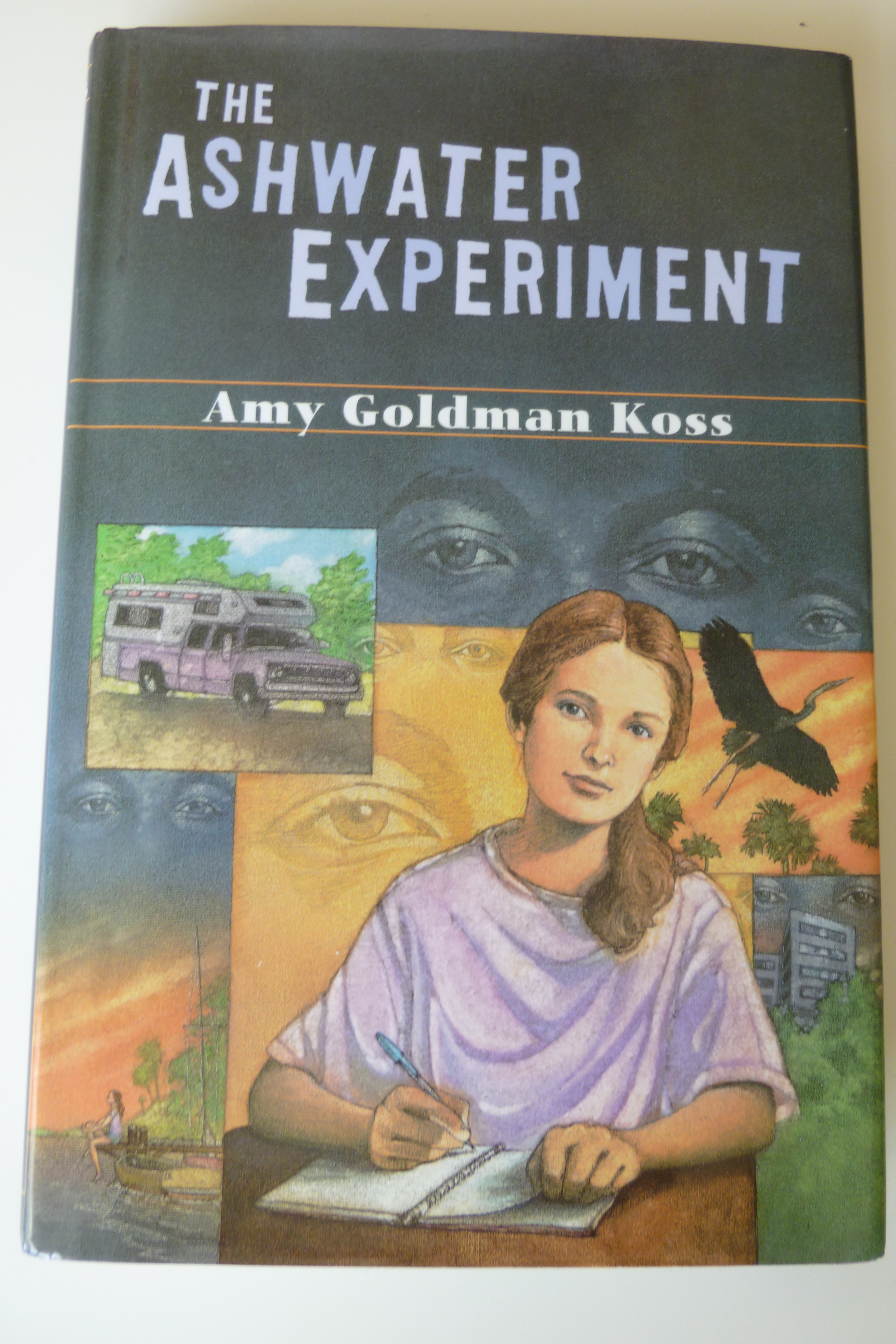
Have you ever felt that you’re not quite like anyone else around you?  I’m guessing most people have felt that way at some time or another–and that feeling is at the center of The Ashwater Experiment by Amy Goldman Koss.

Hillary wonders if she’s the only person who’s real.  You can hardly blame her for feeling disconnected from the people around her.  She and her parents wander the country in their RV, selling trinkets at craft fairs and never staying anywhere long.  By seventh grade, Hillary has been to seventeen different schools and is firmly settled in her pattern of never making ties to anyone.  So when she finds out her parents plan to stay in Ashwater for nine months–longer than they’ve ever stayed anywhere–Hillary feels trapped.  That’s when she comes up with the Watchers.

What if she’s really the center of an experiment?  Part holodeck and part Truman Show, she imagines that the world she experiences is really created just for her, with nothing existing outside of what she can see in that moment.  At first it’s easy to imagine–everywhere she goes has always seemed to have a pattern, with the same kind of people at every school.  As she stays longer in Ashwater, though, people start to seem more real than ever.

I’ve read this book before, and in the past I think it was Hillary’s imaginary (but sometimes so real-feeling) game about the Watchers that struck me.  This time, that seemed more like a sidenote.  It’s a very interesting sidenote–but the heart of the story for me on this read was Hillary’s feeling of being different, and of her gradually increasing understanding for the people around her.

When she first meets the kids at her school, she easily classifies them and easily sees them as stock characters.  As she gets to know them, she finds unexpected depth to Cassie the bookworm, Serena the society queen, and Brian the class clown.  Even the more minor characters, like Serena’s mother or Cassie’s grandmother, the nasty girl who resents Hillary and even Hillary’s own parents and grandparents, are eventually revealed to have their own problems and motives and complexities.  No one is simple.  And we all feel different sometimes–paradoxically, it’s a feeling we often have in common.

This is another one of those books that reminds me just how good and how deep a YA book can be.  It definitely is YA (or even Juvenile), appropriate for young readers and focused on young adults.  Hillary is in seventh grade, and she has seventh grader concerns: whether the girls at school like her, how well she’ll do on the math competition, whether her parents are weird.  But the larger feelings Hillary struggles with are really universal, and there’s a depth that makes this appealing–even though seventh grade was a long time ago for me.

Author’s Site: http://www.amygoldmankoss.net/

Other reviews: I couldn’t find any!  Why has the world not taken note of this book?  If you know of a review, tell me!

A Maybe-Monster, and a Monster-To-Be

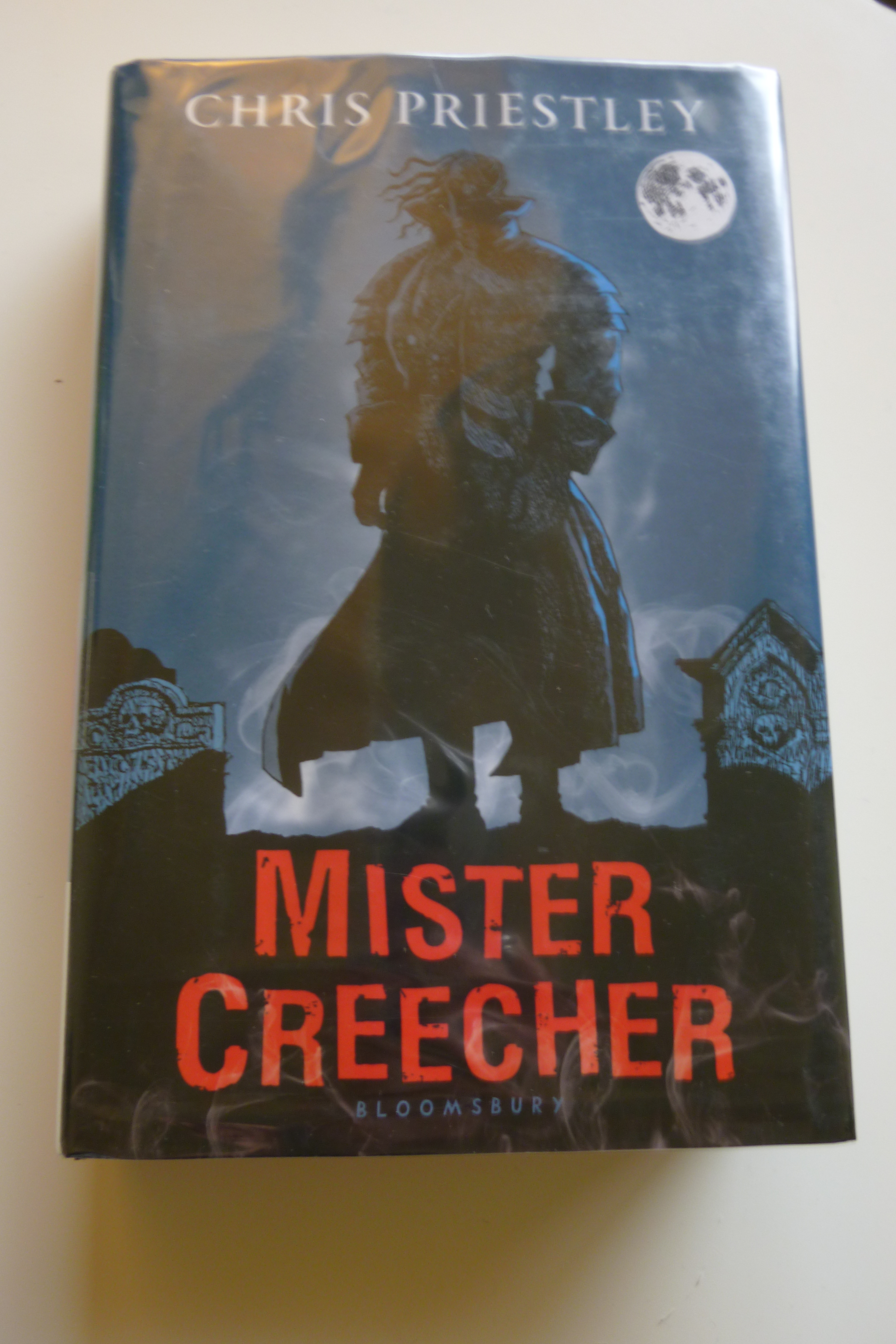
Mister Creecher by Chris Priestley, like Wicked, is another novel that takes characters from a familiar source and reimagines parts of their lives.  I read this one with the Sci Fi Experience in mind, although the library stuck a “Horror” sticker on the spine.  I guess it’s either–or both.

It’s a story about Frankenstein’s creature (see what Priestley did with the title there? 🙂 ), midway through Mary Shelley’s Frankenstein.  The story is from the point of view of Billy, an orphan pickpocket on the streets of London, who one dark night tries to pick the pockets of a dead body–only to have the body get up.  Billy and “Mr. Creecher” are thrown together by circumstances briefly, and then because Creecher wants Billy’s help to follow someone–Victor Frankenstein, who has promised to build Creecher a mate.  Partially through fear and partially through avarice, Billy finds himself pulled into a situation that is far stranger and darker than he expected.

This was an odd reading experience, because I enjoyed it while I was reading it.  And then I thought about it afterwards and decided the whole thing didn’t really work.  Most of the book is about the wary friendship that grows between Billy and Creecher.  It’s about Billy growing out of the scared pickpocket he was, and, we hope, into a better life.  Except…

Slight spoiler here.  I won’t tell you details, but I will tell you that both the friendship and Billy’s growth make an abrupt U-turn in the last portion of the book.  In a way it’s necessary–the creature’s tragedy is that he’s alone.  He has to be alone.  Having a genuine friend just won’t work.  And Billy turns out to be from another piece of classic literature, which is very clever–except that it means I’ve spent a whole book getting to like someone, who eventually grows up to be a character I’ve always hated (and still do).  I just don’t know how to feel about that.  Perhaps it was meant to be a new look at two monsters from literature.

Another problem is that this book is only the middle part of Frankenstein.  Nothing really happens except for following Victor Frankenstein around England.  So if the book isn’t about the creature finding a friend, and if it isn’t about Billy growing into a better person, and if it doesn’t cover any of the major events of Frankenstein…what IS it about?  And that, much as I enjoyed reading it while I was reading it, is the question I can’t answer.

It’s too bad, because I loved the premise.  I’ve read Frankenstein, and even though I really liked it, Victor is one of the few first-person narrators I’ve ever absolutely hated.  Frankenstein from a different point of view, especially one more sympathetic to the creature, sounds great!  I’m just not so sure about where the book actually decided to go.

On the positive side, for most of the book Creecher and Billy were both very good characters.  I’m impressed by how Priestley handled the creature.  I thought it was very true to the original, who was complicated.  It would be easy to either make him nice and purely sympathetic, or to make him the shambling, near-brainless mute of the movies.  Instead, Priestley kept him complicated.  He’s very intelligent, well-spoken, and is even reading Jane Austen at one point.  He’s deeply saddened that everyone rejects him, and he longs for companionship.  At the same time, he has a serious temper that is easily aroused, and when he’s angry, he thinks very little of killing people.  Complicated, and very well-drawn.

Billy is complicated too–he’s had some really, really rotten luck in his life, but he’s also not totally a victim in his circumstances.  He was forced into a thief’s life because he had no other options, but he also enjoys robbing people, and he isn’t too scrupulous about it (he’s really not Robin Hood).  He’s thrilled that Creecher is the perfect thief’s assistant, and actually pushes Creecher into helping him rob people.  One of my favorite moments of the book was when Billy is feeling upset about something, and Creecher asks him if he’d feel better if they robbed someone (answer: yes).  Billy has a complicated relationship with Creecher too, as his feelings fluctuate frequently.  Billy has some cynicism and some darkness, but mostly he’s sympathetic.  I will tell you that the person he turns out to be is NOT.

Maybe this was meant to be a kind of Anakin-Skywalker-to-Darth-Vader story, the birth of a villain instead of the birth of a hero.  But most of the book didn’t seem to have Billy on that trajectory, and when he did finally turn to the Dark Side, so to speak, it felt more contrived than not.

One thing that was fun about this book–Mary and Percy Shelley have cameos, and were probably the happiest people in the novel.  They were a fun little addition.

But really, the whole book was enjoyable–until I try to make any sense out of the wandering plot and the bizarre character turns.  We had a raging debate last month about my issues with Ender’s Game.  I have a feeling less people have read Mister Creecher, but if you have, and if you know what it was about, please let me know!

Author’s Site: http://chrispriestley.blogspot.com/

Other reviews (I actually found a LOT):
Bride of the Book God
The Excelsior File (contains spoilers!)
Becky’s Book Reviews
Shelly’s Book Blog
SisterSpooky
And there are others–let me know if one of them is yours and I’ll add it!