The Last Battle for Narnia

Last BattleI recently finished my voyage through Narnia on audiobook by listening to The Last Battle.  I began with an exciting narrator, Kenneth Branagh reading The Magician’s Nephew, and finished with another exciting one–Patrick Stewart!  And he was excellent, especially in some of the more exciting moments.

The Last Battle is a decidedly odd installment in the series.  It opens many generations after Caspian and Rillian of the previous book, with King Tirian, “the last king of Narnia.”  In the North, a crafty ape and misguided donkey set up a false Aslan to control the Narnians.  They form an alliance with the foreign Calormens, fell the trees and make plans to enslave Narnia’s people and talking animals.  Tirian tries to stand against them, and is soon joined by Eustace and Jill, sent from our world to help.

The book is much grimmer than the previous ones.  That’s not immediately apparent, but as the book goes on it becomes an increasingly desperate struggle against lengthening odds.  There is ultimately a victory, of a sort, but only on a cosmic level.

And that’s why I’m not sure how to feel about this one.  The end ultimately has a very positive feel to it…but it also renders the struggles of the first half of the book somewhat pointless.  The whole world of Narnia is highly symbolic, of course; I think this may be the one installment where Lewis’ symbolism overwhelmed the adventure aspect of the book.  I didn’t dislike the symbolic, cosmic-level side of the book, and Lewis actually did quite nicely with making eternity seem rather homey–and grand and immense at the same time.  All the same, it sits a little awkwardly next to the adventure side.

I am not entirely sure I’m making sense here, so on to other aspects!

The portrayal of the Calormen is a bit complicated here.  They weren’t exactly nice in The Horse and His Boy, but they somehow become worse here, maybe because there’s a new sense that they’re inherently villainous in some way.  Which is all well and good if Lewis wants inherently villainous Calormen; it becomes more troubling when you figure that, symbolically, Calormen are not really Calormen.  However–Lewis does something to redeem that aspect by giving us one Calormen soldier, who is a devoted servant of wicked Tash but still a good person and still comes into Aslan’s Country.  Aslan ends up telling him, essentially, that good is still good and evil is still evil, no matter whose name you’re doing it in.  It’s a simple message on a complex subject, but as a simple message it’s a nice, open-minded touch.

The question of Susan is another troubling one.  Even if she is a bit of a wet blanket, I’ve always felt bad for her in this book!  Here’s a case where Lewis’ symbolism is probably too vague; I find it hard to know exactly what barred Susan in the end (is it really a love of make-up, or is that symbolic?) so I don’t know quite how bothered to be.  I like to think, though, that the tragedy she experiences (rather off-stage) inspires some new depths of character, and that she eventually comes to Aslan’s Country too.

Enough deep and grim discussion, so I’ll wind up with three more amusing notes.

All the discussion of places within places in this book, many of them bigger on the inside, led me to wonder if Lewis’ wardrobe (a wooden box, you know) with an entire world inside of it might have been an inspiration for a police box that is also bigger on the inside.

I recently rewatched the Lord of the Rings trilogy, and that juxtaposition has made me want to mix things together a bit…and after all, who’s to say that the Undying Lands aren’t an offshoot of Aslan’s Country?  (Well, Tolkien and Lewis could say they aren’t, but I rather like the idea!)

And finally, my favorite moment from the very end of The Last Battle (a bit of a spoiler), is when all the long-dead characters of the series reunite (including my favorite, Mr. Tumnus!) and laugh over old jokes together.  Because really–what good is a heaven if you can’t enjoy old jokes there?

Having now finished the entire Narnia series, I can definitely say that The Magician’s Nephew and The Voyage of the Dawn Treader are my particular favorites, probably because they have the most appealing characters and visit the most interesting places.  All the books are good and the entire series is well-worth exploring.  Even if The Last Battle is more grim, it does serve to put a nice punctuation on the series.

Author’s Site: https://www.cslewis.com

Other reviews:
The Bookworm Chronicles
Life with Books & Movies
Stray Thoughts
My Head Is Full of Books
Anyone else?

Buy it here: The Last Battle

Laughing Over Book Titles

This week’s Top Ten Tuesday topic was an invitation to choose from any of their previous weeks’ topics.  Well, it’s not Tuesday…but I thought that was such a fun idea to come up with a bookish topic for a post anyway!  So today I thought I’d write about a few of my favorite “Hilarious Book Titles,” with a thank-you to Top Ten Tuesday for the idea.

1) How I Stole Johnny Depp’s Alien Girlfriend by Gary Ghislain – This is a surprisingly accurate title, as the book is about an alien who comes to Earth looking for her perfect match; she has a picture, and it looks a lot like Johnny Depp.  Unfortunately, the title was the best part of the book, as the “I” of the title keeps romantically pursuing the alien girl even though she’s horrible to him–but beautiful.

2) Beatnik Rutabagas from Beyond the Stars by Quentin Dodd – Titles don’t get much better than that.  The book was actually a little too random for my taste–though I guess I should have expected it!

3, 4 & 5) The Girl Who Circumnavigated Fairyland in a Ship of Her Own Making and The Girl Who Fell Beneath Fairyland and Led the Revels There and The Girl Who Soared Over Fairyland and Cut the Moon in Two by Catherynne M. Valente – There’s nothing all that funny about any one of these titles, but when you put them all together it takes on a tinge of absurdity.  Or when you try to say them all on one breath.

6) The Celery Stalks at Midnight by James Howe – Part of the Bunnicula series, this book is about a possible attack by evil vegetables.  So…the celery stalk is stalking.  !!!

7, 8 & 9) Harpy Thyme, Roc and a Hard Place and Swell Foop by Piers Anthony – These are funnier if I explain that they’re about magical thyme that slows time, a giant bird, and a really terrific foop.  I perhaps should also mention that the Xanth series, of which these are a part, is powered mostly by puns…

10) A Semester in the Life of a Garbage Bag by Gordon Korman – This is both funny and deeply philosophical.  Really.  It’s a metaphor, based on a commercial showing the strength of a garbage bag, valiantly trying to hold together while more and more pressure is pumped in.  Anyone who’s felt stressed and can’t take one more thing can relate.

I find #1 and #2 to be the funniest titles–but #10 is the funniest book!

Can you think of any particularly funny titles?  Share a title (and a laugh) in a comment!

Calling on Chrestomanci

I recently reread The Lives of Christopher Chant, and have continued my chronological rereading of Diana Wynne Jones’ Chrestomanci series with Conrad’s Fate and Charmed Life.  Double review today!

Conrad’s Fate mostly focuses on 12-year-old Conrad of the title, whose magician uncle has told him he is cursed with a terrible Fate, and must go up to Stallery Castle and kill somewhere there to free himself of it.  Uncle magicians seem to never be a good thing, and all the sugar-coating in the world can’t put a very good face on a mission like that.  Conrad successfully obtains a servant job at the castle, but of course nothing goes smoothly after that.  He does make a friend of fellow-servant Christopher “Smith,” who is at Stallery Castle looking for his missing friend Millie.
This is a fun book to read chronologically after The Lives of Christopher Chant, because it fills in (some of) the missing link between the boy Christopher and the adult Chrestomanci of the other books.  Here Christopher is 15, and recognizably somewhere in transition between the two.  I would have quite liked to meet Christopher at around 20, to fill in a little more, but alas, we never got that book.

SPOILER WARNING: I think this book suffered in just one small way from being written after many of the others in the series.  At the end, Christopher and Millie’s wedding is tossed off as a by-the-way, which makes perfect sense if read after all the other books, where their marriage is a foregone conclusion.  Read in chronological order, it feels like there should be more to that story! SPOILERS DONE

Christopher and Millie aside, most of the book focuses on Conrad, who is remarkably likable for having come to the castle with murderous intent.  He’s so unhappy about the idea of killing someone, you see, and he’s so terribly earnest in all other ways.  He’s not a stock character by any means, but he is another of a collection of well-meaning, slightly inept boy heroes who populate Jones’ books.  They’re always such fun to read about, though!

I happened to be reading this at the same time that Downton Abbey was airing, which made for some interesting thought-connections.  Stallery Castle in many ways feels very like Downton Abbey…except with magic!  Magic starts running amok and disrupting the neat order of the servants hall, with disastrous results–of course!

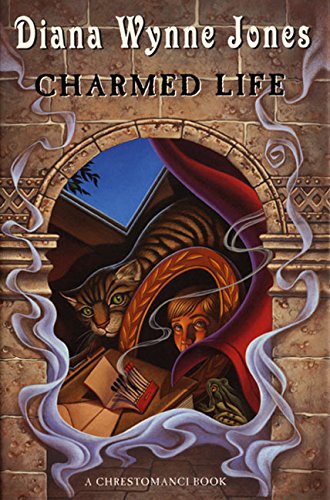
Charmed Life has its own boy hero, Eric “Cat” Chant, who is very thoroughly under the thumb of his erratic, witch-in-training sister, Gwendolen.  Cat and Gwendolen’s parents died in a boating accident, and they’re taken in first by a local witch and then by the mysterious Chrestomanci.  Gwendolen does not like life at Chrestomanci Castle in the slightest, and kicks up a series of magical pranks, culminating in changing places (sort of) with Janet, her double from another world.

Somewhere deep in my subconscious I tagged “Gwendolen” as an unpleasant name, and it may be because of this book.  She’s a nasty piece of work–but she also provides much of the excitement and entertainment of the story.  Cat is perfectly sweet and likable, but he’s also extremely reactionary for most of the book.  Chrestomanci punishes him at one point because he didn’t try to stop Gwendolen from causing trouble, and there’s some valid justification in that.

We’re mostly in Cat’s point of view so I understand how he feels about Gwendolen and why he doesn’t take a more active role…but I still kind of want to shake him.  Although, to be fair, I mostly feel that way when I think back on the book.  When I was actually reading it, I didn’t give that much thought, because the crises and the humor come fast and furious and I didn’t do much analysis of Cat’s actions.

This was the first book  of the series written, and there are some mysteries lost by reading it later.  When you know who and what Chrestomanci is, it clears up a lot of questions Cat has (and probably the reader is supposed to have).  Christopher of the previous two books is Chrestomanci here, and on the opposite side of the order-to-read question, I did have fun spotting little hints and clues that were expanded so much more in The Lives of Christopher Chant.

And Chrestomanci is, of course, an absolute delight as a character, so suave and sophisticated and vague in a terribly incisive way.  Not to mention his fantastical dressing gowns!  Just one representative quote on the character: “Chrestomanci smiled and swept out of the room like a very long procession of one person.”

Chronologically-read or publishing-order-read, these are delightful books in a delightful series.  With three down and several to go, I’m not sure I have a favorite yet, and none have been disappointing.  I look forward to the rest!

Author’s Site: http://www.dianawynnejones.com/

Other reviews:

Conrad’s Fate
Chris White Writes
A Journey Through Pages
Jean Little Library

Charmed Life
The Rhubosphere
The Book Smugglers
Readers By Night

Anyone else?

Buy them here: Conrad’s Fate and Charmed Life

Stranded with the Romulans

Romulan WayA couple years ago I bought five unread Star Trek novels at my library’s sale.  I finally finished reading the last of them!  The Romulan Way by Diane Duane and Peter Morwood was probably the most unusual of the bunch…though not, unfortunately, the best.

This is really two books in one, with alternating chapters.  The main plot focuses on Arrhae, housekeeper in a Romulan noble house…and secretly a Federation spy.  Her cover and her loyalties are thrown into question by the arrival of a captured Starfleet officer, a certain Leonard McCoy.  Interspersed with Arrhae and McCoy’s story are chapters detailing the history of the Romulans–or the Rihannsu, in their own language.

I think this book is the Romulan answer to Spock’s World, also by Diane Duane.  That book alternates an Enterprise story with stories from Vulcan’s history.  However, while that history is (mostly) told as short stories with a mythical tone, the history here reads like something from a history text–and sometimes a rather dry one.  It’s unfortunate, because there are clearly fantastic adventures of death and betrayal and the conquering of worlds…but it’s all told with a decidedly scholarly remove.  I wound up skimming a lot of these sections.

Arrhae’s story was better, as I found her situation decidedly fascinating, and she was a very different character than we usually see in Starfleet.  The political maneuverings of the Romulans, and the various plots underway by Starfleet, were confusing at times (Romulan names are hard to remember…) but I followed the gist of it and there were some exciting moments.  This was originally published as an independent novel, then later rebranded as a sequel to Duane’s earlier novel, My Enemy, My Ally, with characters from that book showing up here–not having read it, that may have added some confusion.

McCoy, of course, I love, and he was in fine form here (writers have been known to stumble on him more than the others, I don’t know why).  However–Kirk and Spock (and everyone else) never even put in a cameo, and McCoy all by himself is, well, only a third as much fun!

Star Trek books are in a way of niche appeal, though it’s a pretty big niche.  I think this particular book is really for a niche within the niche.  For a fan who loves the world of Star Trek, who loves knowing about the alien cultures, this is an amazing book.  If you’re more about the characters (me), well, it wasn’t a bad book by any means–but I don’t think it’s staying on my bookshelf all the same.  I’m much, much fonder of Duane’s other Dr. McCoy-focused book, Doctor’s Orders.

Authors’ sites: http://www.dianeduane.com/ and http://www.petermorwood.com/

Other reviews:
Trek Lit Reviews
The m0vie Blog
Anyone else?

Buy it here: The Romulan Way

Questing Books from Oz

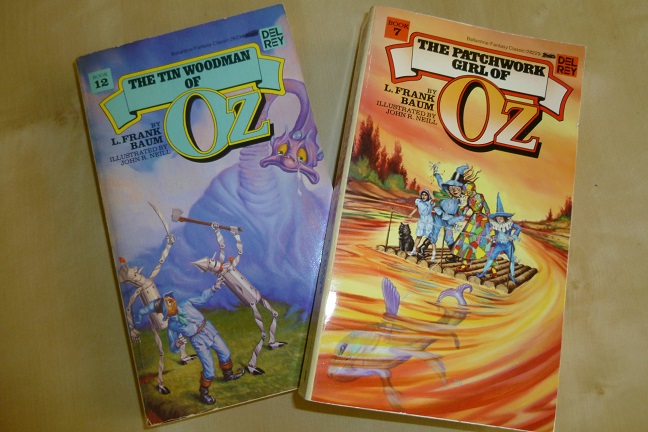
I’ve been slowly rereading the Oz books by L. Frank Baum, reviewing a few at a time as I go.  Most of the books have fallen neatly into sets in numerical order, but the two I want to look at today are more random in series placement, but paired in focus: The Patchwork Girl of Oz (#7) and The Tin Woodman of Oz (#12), The Quest Duet.

Oz 7 and 12**********

The Patchwork Girl of Oz, despite its title (Oz titles rarely signify much), focuses on Ojo the Unlucky, who has grown up in the Blue Forest with Unc Nunkie.  Unluckiness strikes in force when Unc Nunkie is accidentally turned to stone.  Ojo sets out on a quest for the ingredients needed to create a cure, which are scattered all over Oz.  He’s accompanied by the Patchwork Girl, a woman made from a quilt, and the Glass Cat.  They’re soon joined by the Shaggy Man, and make their way to the Emerald City and meet numerous other familiar characters there.

Baum’s favorite device is to send his characters on a journey, and I like the focus Ojo’s quest gives to this journey.  The aimlessness of some of the other Oz books has bothered me; this one has clear stakes and a goal.  Ojo is a fairly typical young-boy-hero, though his determination to rescue his uncle at any cost lends him more depth.  The Patchwork Girl is delightfully zany (even for an Oz character), and becomes part of one of the very few romances in the series; the Patchwork Girl and the Scarecrow manage to flirt a bit, which does make a certain amount of sense.  Cotton and straw could be compatible…

I enjoy the Glass Cat especially, one of the few not-perfectly-nice characters in Oz.  She’s not a villain but she is terribly conceited, frequently inviting people to admire her pink brains, visible through her glass head (“you can see ‘em work”).

As is not unusual, there’s something of a deus ex machina ending, and the ruling party of Oz is a little heavy-handed…but on the whole this is an engaging journey with enough focus to make it a proper quest.

**********

The Tin Woodman of Oz has a surprisingly relevant title, and explores the backstory of the title character.  Woot the Wanderer, a Munchkin boy in the same mold as Ojo, comes to call on the Tin Woodman, finding him visiting with his old friend the Scarecrow.  The Tin Woodman tells the story of how he became tin, cursed by the Wicked Witch of the East who disapproved of his romance with her servant, Nimee Amee.  Although his heart, designed for kindness, doesn’t allow him to love, he decides it would be an act of kindness and honor to go in search of Nimee Amee and marry her now.  All three set off, encountering obstacles including Mrs. Yookoohoo and her transforming magic along the way.

I have the strange feeling that this should be one of my favorite books in the series, and yet it isn’t.  I don’t know that there’s any especial reason for that.  On the positive side, we get history filled in for one of the major characters, the book has a clear focus to its quest, and there are genuine obstacles to get in the way.  I think perhaps if the book falters anywhere it’s that there isn’t quite enough whimsy.  Often it’s isolated moments and bits of magic that appeal to me most in the Oz books, and somehow nothing much stands out (and this may be completely just me) in this installment.

The best part of the book is the ending, which utterly up-ends the expectations of the characters, and gives the Tin Woodman a thoroughly deserved comeuppance.

**********

Neither of these books fall into my particular favorites, but they’re both solid installments in the series.  On a purely plot-level, they’re among the best, and the characters are engaging.  There may be some indefinable spark of greatness missing here, but they do achieve the status of good!

Stay tuned for a review of the remaining three Oz books soon. 🙂

Other reviews:
Kara Kreative
Story Carnivores (Patchwork Girl and Tin Woodman)
Cavalcade of Awesome
Anyone else?

Buy them here: The Patchwork Girl of Oz and The Tin Woodman of Oz