The Lives (and Deaths) of Christopher Chant

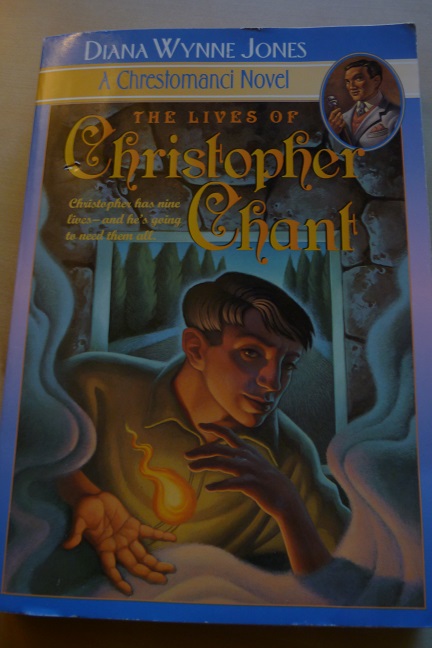
Lives of Christopher ChantOne reread project I didn’t get to in 2013 was Diana Wynne Jones’ Chrestomanci series.  I’ve read them all but out of order and at widely-spaced intervals so (not unlike The Great Khan Adventure) I decided I’d like to put them all together in chronological order.  I got started with the earliest, The Lives of Christopher Chant.

Christopher’s life could be rather bleak, with his wealthy, absentee parents and string of unfriendly governesses.  But Christopher has a secret—when he goes to bed, he can step out of his body, go around a corner, and enter The Place Between.  From there he visits the Almost Anywheres, a series of worlds very unlike his own, and each other.  When Christopher’s Uncle Ralph learns about his traveling, and especially his ability to bring solid objects back with him, Uncle Ralph gets Christopher involved in a series of experiments–with, naturally, disastrous consequences.  Eventually we learn that Christopher is a nine-lived enchanter, which proves very fortunate, as his adventures in other worlds keep losing him lives.

I think this book helps satisfy an itch I’ve had ever since reading The Magician’s Nephew, with its wonderful and utterly under-utilized Wood Between the Worlds.  The Place Between is very different in tone but very similar in function, and Christopher (and the reader) gets to visit far more worlds than Diggory and Polly did.  I’d still like more of that, but it was delightful anyway.

Christopher is a compelling boy hero who’s likeable but flawed as well.  He learns and grows as the book goes on, in the best way of complex characters, coming to realizations about how he treats people and where his strengths lie.

Among the supporting characters, the stars are the Goddess and Throgmorten.  The Goddess, otherwise known as the Living Asheth, is a girl Christopher meets in another world.  She and Christopher are on a nice parallel journey of finding out what they want in life, and how to make it happen for themselves, instead of being pushed around by circumstances.  Throgmorten is an Asheth Temple cat, fantastically valuable and fantastically bad-tempered in a highly entertaining way.

The book abounds with other magicians, good and bad and often incredibly strange.  Diana Wynne Jones has a wonderful ability for whimsy and humor in her magical stories, which is on full display here.  All that whimsy and humor is woven around a clever and complex magical system and universe structure.  Much is explored and, equally, it feels clear there’s much more still left…which is nice, when there’s several more books in the series!

This book functions as a kind of prequel, with most of the later books featuring an adult Christopher.  I read the books so spread out before that I’m sure there are lots of connecting lines I haven’t drawn, which I look forward to as I continue through the books…

Author’s Site: http://www.dianawynnejones.com/

Other reviews:
Books and Chocolate
Eyrie.org
Family Reads
Reading the End
Anyone else?

Buy it here: The Lives of Christopher Chant

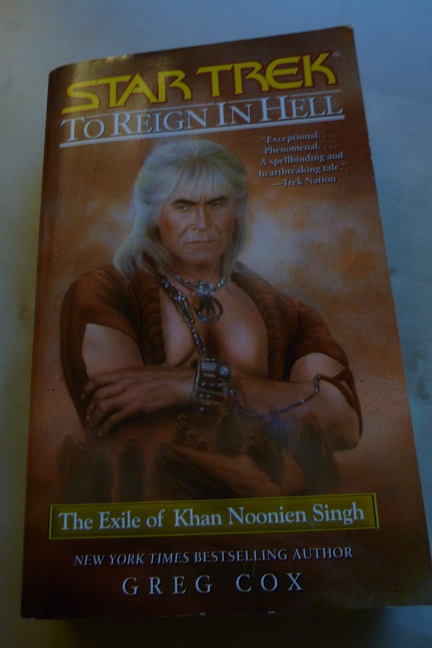
TGKA: Star Trek: The Exile of Khan Noonien Singh

To Reign in HellThis year for the Sci Fi Experience, I’m off on The Great Khan Adventure, tracing the story of Khan Noonien Singh through books and movies. So far I’ve watched some of Star Trek: The Original Series, and read the first book  and the second book in Greg Cox’s Khan trilogy.

The final book jumps ahead from the 1990s and the Eugenics Wars, past “Space Seed” to Khan’s time on Ceti Alpha V: To Reign in Hell: The Exile of Khan Noonien Singh.  We watch Khan and his crew’s transport down to the planet, the colony’s hopeful beginnings…and then the increasing struggle to survive after Ceti Alpha VI explodes, and the ecosystem on Ceti Alpha V collapses.

The story is told from the alternating points of view of Khan and Marla McGivers, the Starfleet officer who fell in love with Khan and chose exile with him.  As I hoped, we get more depth into Marla and see her emerge as far stronger than she did on the TV episode.  She faces down Khan’s hostile crew, stands up to Khan himself, and perseveres through very trying circumstances.

In part this is possible because Cox also softens Khan, particularly towards Marla.  I think I know now why Khan’s brutality in “Space Seed” surprised me—I had read To Reign in Hell more recently than I’d seen the TV show.  Cox takes Khan on a journey from a well-intentioned, if fierce, leader to a madman obsessed with revenge; it’s a compelling journey, except that I think it downplays how violent and ruthless he was to begin with.

Cox has a nice way of tying things together to explain the little inconsistencies that crop up in Trek.  I was wondering where Marla was, as ship’s historian, when the Enterprise visited the 1960s; the book comments that she was disappointed not to be included on the landing party, and only had the opportunity to assist on the wardrobe.  When Khan and crew first beam down, Chekov is the officer who sees them off, explaining how Khan could recognize Chekov in The Wrath of Khan, when Chekov didn’t join the TV show until the next season (in the real world, Walter Koenig has admitted that he knew that line of the script didn’t add up, but didn’t point it out because he was afraid of having his part cut…)  Cox also explains some details in The Wrath of Khan, like why all of Khan’s crew in the movie is much younger than him, not to mention blond…

This book is effective as a chapter in a larger story, filling in the gap between the TV show and the movie.  Taken in isolation it’s an odd beast, because we spend it exiled with the villain.  I found myself missing Seven and Roberta, mostly for the role they fill as opposing forces to Khan.  Khan and Marla have their virtues and their flaws, but they never really feel like they become heroes of the story—they’re the villain and the woman who fell in love with him.  That complicates the emotional pulls of the story, and isn’t resolved by a very brief frame story with Kirk, Spock and McCoy.

I also think Cox exploded Ceti Alpha VI too soon.  I enjoyed watching the hopeful days of the colony; once disaster strikes, it becomes a hopeless slog for Khan and the reader both, especially when we know how this turns out…and it isn’t good.

The emotional complications are actually increased by the brief frame-story, of Kirk, Spock and McCoy visiting Ceti Alpha V after Khan’s death.  Kirk feels guilty about never checking in on Khan over the years.  Because he’s Kirk, I want a conclusion that says it wasn’t really his fault and of course we all still love him.  Instead, the book makes me feel like he damn well should have checked in…  I’ve had to conclude for myself that it is, in fact, ridiculous to feel that Kirk had personal responsibility for the situation; a colony of genetic supermen clearly falls under the jurisdiction of Starfleet, not one starship captain whose job is not to monitor colonies.  I would have quite liked Cox to make that point for me…

Despite some reservations, the book does fill in a significant chapter in Khan’s story.  It provides a lot of insight into Khan’s character, and expands Marla into a compelling character in her own right.  There’s also quite a bit of action, and of course all those little touches Cox is so good at of tying everything together.

Next up, I’m heading back to the screen for The Wrath of Khan

Author’s Site: http://www.gregcox-author.com/

Other reviews:
The M0vie Blog
And…that’s it.  Anyone else?

Buy it here: Star Trek: To Reign in Hell

2013 End of the Year Round-up

A new year means it’s time to look back at how the reading has gone for the past year!  Challenge results were posted yesterday, but today let’s look at the best and the worst, and a few more random categories besides.  As usual, links go to my reviews.

1) Best Book  –  It’s a good year when I have a hard time choosing a Best Book!  I read a lot of books by favorite authors and finished a lot of wonderful series, giving me a LOT of choices here.  I’ve had to separate this out into several sub-listings…

1a) Favorite Character  –  This one goes to Samwise Gamgee of The Lord of the Rings, most particularly in The Two Towers.  He’s not exactly a new character, since I’d seen the movies years ago, but the books were new reads.  And as wonderful as Sam is in the movies (and I do think Peter Jackson and Sean Astin have as much to do with my love for this character as J. R. R. Tolkien does) my very favorite Sam moment isn’t in the movies.  It’s right near the end of The Two Towers, when he thinks Frodo is dead and even though he desperately doesn’t want to do it, he decides to take the Ring to Mordor himself.  It’s beautiful.

1b) Best Romance/Romantic Couple – Easily taken by Heir to Sevenwaters by Juliet Marillier.  There’s a dark hero with a good heart and a heroine who has to find her hidden strength.  Two of my favorite archetypes, and their romance is just lovely.

1c) Most Anticipated Reread – My most anticipated read of 2013 was The Girl Who Soared Over Fairyland and Cut the Moon in Two by Catherynne M. Valente.  I liked it a lot, but I felt that I couldn’t take it in fully on one read–so now I’m very much looking forward to reading it again.

1d) Hardest to Put Down – Marillier makes the list twice by also bringing in this one with Well of Shades.  She has a tendency towards un-put-down-able final hundred pages, but this one outdid any of the others.  The heroine gets into dire straits and meanwhile characters are futzing about and doing other things and I was desperate for a rescue scene and…well.  It was one of the more intense reading experiences of the year.

1e) Most IntriguingSpeaker for the Dead by Orson Scott Card was hard to put down in a different way, not so much the frantic emotional page-turner but rather a book that made me deeply curious, and also offered perhaps the most interestingly alien aliens I’ve encountered.

1f) Loveliest Writing Style – This is kind of an odd category, but it really is what I loved about these particular books: The House on Durrow Street and The Master of Heathcrest Hall by Galen Beckett.  It’s like the best of Austen and Bronte (Charlotte), plus fascinating magic!

1g) Best Nonfiction – I don’t usually read much nonfiction, but I did read The Gift of Wings by Mary Rubio, a biography of L. M. Montgomery.  It was my third attempt to find a good LMM biography, and was all that I might have hoped for.  Truly wonderful and fascinating.

2) Worst Book  –  I am happily drawing a blank here.  I read some books that were only so-so and plenty that were good-but-not-great, but nothing really dreadful enough to qualify for Worst…a happy situation!

3) Most Disappointing Book  –  This one pains me because I so (SO) love Catherynne M. Valente’s Fairyland series…but I think that may be exactly why I was disappointed by Six-Gun Snow White.  It’s a great title, right?  And it is what it sounds like, a Western version of “Snow White.”  Only it was far darker and a far more experimental writing style than I was expecting.  Someone else with different preferences would probably like it just fine, and even I didn’t dislike it exactly…but it wasn’t what I hoped for.

4) Most Unlikely Read – None of my books this year really seem all that unlikely to me, because I know the story behind them…but you might find it more surprising that I read Walden by Henry David Thoreau, as well as Elizabeth and Her German Garden by Elizabeth von Armin.  That second one is an autobiographical and mostly plot-less account of a woman’s planning and enjoyment of her garden, originally published in 1880 or thereabouts.  This might be less surprising if I mention that it comes up frequently in L. M. Montgomery’s journals as a favorite book…

5) Most Satisfying Read -There’s an easy and probably obvious tie for this one, as it is highly satisfying to have finally read The Lord of the Rings by J. R. R. Tolkien, as well as Les Miserables by Victor Hugo.  Collectively, they were the four most-intimidating-but-still-want-to-read books on my mental list of someday-reads for many years!

6) Can’t Believe I Waited Until 2013 to Read It  Lord of the Rings would be a possibility here, except that I don’t actually find it all that strange that I waited a long time to tackle those!  So instead I’m putting Good Omens by Terry Pratchett and Neil Gaiman, because I really DON’T know why I waited so long to read something by Pratchett and Gaiman together, especially when I’d heard it recommended many times (and it was brilliant!)

7) Most Hilarious Read  –  I’ve accepted that this category is simply owned by Terry Pratchett, who has been my most hilarious read for the past three years.  So this one could go to Good Omens, only that was already #6, or it could go to The Last Hero…but I think even funnier was Wintersmith, mostly because of Horace the Cheese!

8) Most Looking Forward To in 2014  –  There are four series I’m caught up on and waiting for new books in, plus I expect Tamora Pierce to put out a new Tortall book next year…but it’s not really that hard to choose.  I’m most looking forward to Valente’s Fairyland 4, especially after the cliffhanger at the end of the third one!

What were your best or worst of 2013?  Or feel free to answer any of the other questions!

2013 Reading Challenges – End of the Year Wrap-Up

It’s the last day of the year, and even though there may be a few hours of final reading left, I think it’s a good time to wrap-up how my reading challenges went.  This was a very satisfying year in challenges, as I knocked out a lot of big, scary intimidating books, and finished some really wonderful series!

All links go to reviews, faded text indicates it was read a previous quarter (except for series–too complicated to separate) and if you’re curious about any unreviewed books, just ask! Continue reading “2013 Reading Challenges – End of the Year Wrap-Up”

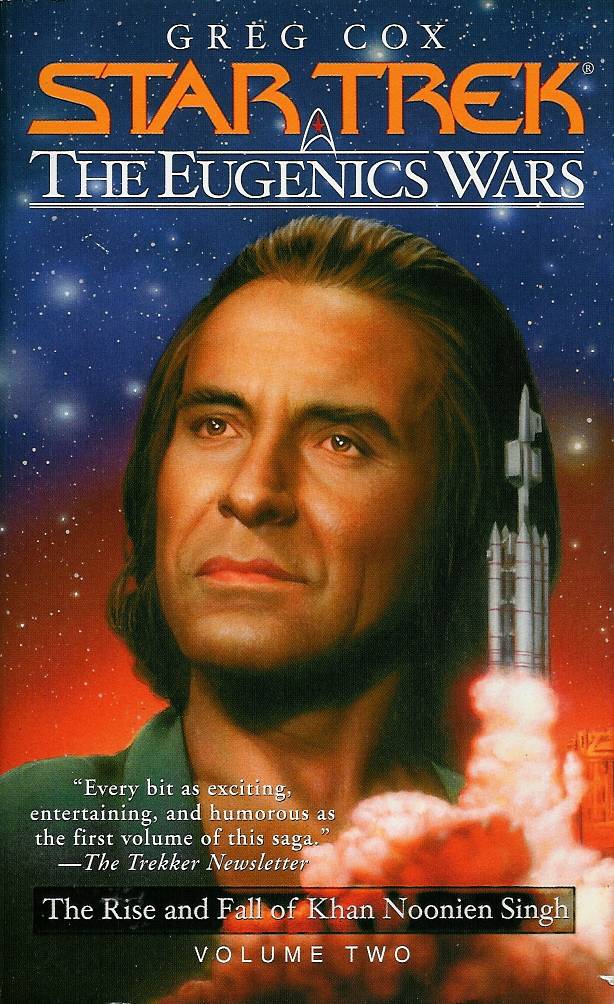
TGKA: Star Trek: The Eugenics Wars, Volume Two

Eugenics Wars, Volume 2This year for the Sci Fi Experience, I’m off on The Great Khan Adventure, tracing the story of Khan Noonien Singh through books and movies. So far I’ve watched some of Star Trek: The Original Series, and read the first book in Greg Cox’s Khan trilogy.  Today I’m looking at the second book, Star Trek: The Eugenics Wars: The Rise and Fall of Khan Noonien Singh, Volume Two.

The first book covered Khan’s childhood and adolescence, focusing mainly on Gary Seven, Roberta Lincoln and mysterious cat Isis, and their work to protect the Earth during the Cold War.  This book brings us into the 1990s, with an adult Khan and his quest to conquer the Earth.  We still have plenty of Seven and Roberta, and their efforts to contain the threat of Khan and the other genetic supermen (and equally powerful superwomen).

I enjoyed this book quite a bit, though I have to note that it may not be what all readers are looking for.  Cox’s goal appears to be to reconcile Star Trek history and real history; I find that hugely interesting, but as a result of that choice (rather than simply presenting altered history–an alternate timeline, perhaps) the Eugenics Wars goes on in the shadows.  Khan “rules” a quarter of the Earth by pulling the strings of officials from behind the scenes.  Presenting a war where most of the population doesn’t know it happened…well, that limits the potential for large-scale conflict.  There’s still plenty of action, but mostly in small, pitched battles between individuals.

Cox also gives ample time to other genetic supermen (and women–there’s no easy way to say that–superpeople?) which I have somewhat mixed feelings about.  Many are extremely interesting, especially Chen Tiejun and her Amazons, but they at times start to feel like a distraction too.  Roberta spends a lot of time infiltrating General Morrison’s Army of Eternal Vigilance in Arizona, and it feels like, well, a lot of time not spent on Khan.

However–we get lots of time on Khan too, and we see him develop as a ruthless but nuanced villain.  He sees the many problems in the world and believes that he is destined to eradicate hunger, war and want–by conquering the planet, and when anyone gets in his way, his retribution is swift.  I like that complexity of benevolent intentions through villainous means–and we also see Khan grow increasingly harsh and merciless as the story goes on.

On the hero side of the story, there’s an older and more confident Roberta, but one who still hasn’t lost her “flower child” origins, and still carries a good bit of snark with her into intense situations.  Seven has some good moments too, increasingly playing the wise mentor type…which is good, except I think Cox overplays Seven’s aging.  I don’t need to be reminded about Seven’s creaking bones every scene (especially when he isn’t really all that old!)

We also see the Enterprise crew in a frame-story.  It continues the story of a colony of genetic super…people, and while there’s some excitement, it’s very much backseat to the Khan and Seven story.

It’s not much of a spoiler to say that the novel ends when Khan and his followers leave Earth.  The next chapter for Khan is waking up from suspended animation in the Enterprise‘s Sickbay (and promptly threatening Dr. McCoy’s life).  I already watched “Space Seed,” so the next step on The Great Khan Adventure is the final book by Greg Cox, To Reign in Hell: The Exile of Khan Noonien Singh.  Stay tuned!

Author’s Site: http://www.gregcox-author.com/

Other reviews:
A Star Trek Literary Adventure
The M0vie Blog
Anyone else?

Buy it here: The Eugenics Wars, Vol. 2