A Girl, an Alien and a Cat

True Meaning of SmekdayI don’t remember anymore where I originally heard about The True Meaning of Smekday by Adam Rex, but I know I read it because I couldn’t resist that title–or the premise that came with it.

Sometime in the future, aliens called Boovs land on Earth on Christmas Day (in true Doctor Who tradition) and proceed to take over the planet.  Resistance is, shall we say, futile.  The Boovs rename Christmas as Smekday, in honor of their General Smek who conquered Earth (Smekland).  Our heroine is Gratuity Tucci–her friends call her Tip.  Tip’s mother was abducted by the Boov on Smekday, a story she begins to relate for a school writing assignment on “The True Meaning of Smekday.”

When all humans are ordered to relocate to Florida, Tip sets out alone in her car (she’s eleven, but she taught herself to drive after her mother disappeared), accompanied only by her cat, Pig.  Along the way, she meets a Boov named J.Lo (his Smekland-name).  He has his own troubles, and they form an uncertain alliance.  They realize that the troubles for Smekland have just begun, when another race of aliens comes to invade: the Gorg, known throughout the civilized galaxy as the Takers.

I am always impressed by books which can manage satire-level humor, balanced with genuine tragedy and heartache.  Telling an absurd abduction story is one thing.  Telling a tragic abduction story is another.  Doing both at once–now that’s really something.  There’s a lot of humor throughout the book, but there are also serious dangers and serious tragedies.  Neither detracts from the other.

Tip is a spitfire narrator, brash and brave while also possessing real fears and pain, particularly around the loss of her mother.  She has an incredibly strong narrative voice that’s a lot of fun to read.  J.Lo is wonderfully funny in his not-quite-grasping human culture, his endless munching on truly awful things and his nutty technology.  Balanced with the humor is the growing friendship between J.Lo and Tip.  And it becomes clear that, regardless of how many legs he has, J.Lo possesses so many of the qualities that make us all human.

I mentioned satire above, and there are definitely strong strands of commentary here on the real world.  The most obvious (sometimes pointed) one is the comparison between the Boovs sending of humans to a reservation, and the Europeans doing the same thing to the Native Americans in history.  There’s a Native American character who is great in many ways, but almost makes the satire a little too hit-you-over-the-head-with-it.

On a less serious parallel to the real world, parts of the book take place in Happy Mouse Kingdom in Orlando, Florida.  Need I say more?  And despite the humor, the book gets into surprising depth about what makes “Happy Mouse Kingdom” so appealing.

There are some interesting experiments in the actual telling of the story.  Besides Tip telling the story, the words are illustrated by Tip’s Polaroid photographs (drawings), and supplemented in places by J.Lo’s comics.  It’s cleverly done, and adds some depth, especially to the portrayal of the Boov.  The comic section detailing their history as a culture was one of my favorite parts (and there was some pretty heavy satire there too).

I read the print edition, but there’s also an audiobook that won an Odyssey.  And Dreamworks is planning a movie for 2014, which I am now looking forward to!

Tip is eleven, and that’s probably a good target age for the reader too, though obviously it’s a lot of fun even if you’re older!  It’s a funny story about aliens, a heartwarming story about friendship and family, and an effective satire about culture, environmental issues and politics.  All that, in a Middle Grade book.  Never tell me books for kids can’t have depth. 😉

Author’s Site: http://www.adamrex.com/

Other reviews:
There Be Words
The Bookshelf Gargoyle
The Cazzy Files
Anyone else?

Buy it here: The True Meaning of Smekday

The Ogre Downstairs by Diana Wynne Jones

Ogre DownstairsI’ve checked another one off my list of Diana Wynne Jones “to be read” – The Ogre Downstairs.  It’s a romp of a fantasy in the old style, about kids trying to cope with magical adventures gone awry.

Caspar, Johnny and Gwinny are not at all happy with their two new stepbrothers, Douglas and Malcolm, and even less happy with their new stepfather, invariably referred to as the Ogre.  The two sets of kids are forced to band together when two chemistry sets arrive, with rows of mysterious chemicals that cause unexpected results–from enabling flight to causing people to switch bodies to bringing inanimate objects (like toffee bars!) to life.

I feel like I’ve read many books (from Edward Eager to Edith Nesbit) about kids dealing with magical chaos, but it’s one of those tropes that doesn’t get old.  These kids felt like archetypal fantasy children, good kids with some flaws.  None emerged really strongly for me, but all five are distinct and effective within the story.  They go through some nice growth as well, particularly in their understanding towards each other.

The magic is highly amusing and entertaining, with a grand variety of mishaps.  The living, growing (and breeding) toffee bars are my favorite.

There’s a lot that’s good here, and the book is overall very fun.  But I did have a big problem–and that was with the Ogre.  (Spoilers here, you have been warned…)  Throughout the book, the Ogre is loud, angry, ominous and forbidding, apparently with no liking or understanding at all for children.  But then occasionally, for no clear reason, he’ll do something nice (like gifting them with the chemistry sets).  This made me suspect that DWJ intended to reform him by the end–and she does.  Although, it’s less about his change than about the kids changing their understanding of him.  Even with the hints along the way…it just didn’t work for me.

The trouble is, the hints felt less like signs of a complex character, and made him feel more inconsistent than layered.  The bigger trouble is that, though the kids ultimately decide he’s not really so bad–he is.  He doesn’t just yell–he’s nasty, mean and genuinely hurtful.  That would be bad enough, but at one point he gets angry enough to hit two of the boys.  The scene is off-stage, so it’s not clear if “hitting” means a mild clout, a serious beating or something in between.  All we do hear is “Johnny found out he had been right to postpone being hit by the Ogre.  It was an exceedingly unpleasant experience.”  And then Malcolm is ill for the next day.  After that, you can’t convince me that the Ogre’s “bark was so much worse than his bite” (a direct quote).

For the record, I really, really like characters with gruff exteriors and hearts of gold.  And I like happy endings, even improbably neat ones.  But this…just did not work for me.  I feel like the ultimate message was, “be understanding of the verbally and physically abusive stepfather and maybe he’s not really so bad.”  That may be putting it harshly, but I feel it’s a valid interpretation!

It’s really too bad, because 80% of this book is a delightful fantasy.  But then the conclusion of the last couple of chapters leaves me feeling rather troubled.  I tell myself it’s from a different time, and standards on child-rearing were different, and it’s true that if this was an Edith Nesbit book from the early 1900s I’d give it a pass…but was 1974 really that long ago?

I don’t know if I recommend this one or not.  It’s complicated.  But I know some of you are Diana Wynne Jones fans, so I’m very curious on whether you’ve read this one–and what you think!

Author’s Site: http://www.dianawynnejones.com/

Other reviews:
Dead Houseplants
Caroline Williams’ Blog
Readers By Night
Swan Tower
Forgotten Classics
Anyone else?

Buy it here: The Ogre Downstairs

Blog Hop: Classic Novels

book blogger hopThis week’s Book Blogger Hop question: What is your favorite classic novel?

There are some easy go-to’s here, considering three of my favorite authors would probably fall into the Classic category (L. M. Montgomery, J. M. Barrie and Edgar Rice Burroughs) but let’s face it, I talk about them a lot.  Branching farther afield… 

Huckleberry Finn by Mark Twain comes to mind.  Huck is such a wonderful character, and both the humor and the heart of the story are so excellently done.  And does it get better than Huck’s “All right then, I’ll go to Hell” scene?  Such a beautiful story about friendship and finding oneself in the face of a society that wants to shape you into something else.

It may surprise you that Phantom of the Opera by Gaston Leroux is not a favorite.  The story is a bit of an obsession (a bit!) but the original, while deserving all recognition as the original, is not actually as compelling as some of the retellings.

Another favorite is Jane Eyre.  There’s something about Charlotte Bronte’s writing style that simply draws me in, and the whole last section, after Jane returns to Rochester, is just adorable–and gives me all the romantic dialogue Austen always skips!

So much for my favorites!  How about your favorite classic(s)?

Catherine, Called Birdy by Karen Cushman

Catherine Called BirdyIs Catherine, Called Birdy by Karen Cushman a classic, or did I just pick that impression up somewhere?  If it’s not a classic, it should be!

I read this as a kid, probably more than once, and recently revisited it again.  It’s the fictional journal of Catherine, the daughter of a minor lord in Medieval England, who, as she writes, utterly loathes her life.  More specifically, she hates the restrictions society places on her, and most especially hates the idea of being sold in marriage.

Catherine is a delightful, strong-minded character who brings her world vividly to life.  This isn’t pretty, clean historical fiction, more like the modern world in costumes.  Catherine’s world is Medieval, complete with strange food, ghastly hygiene, fleas, a privy and old-style curses (like “God’s thumbs!”)  Catherine visits a monastery, sees a hanging and attends a wedding, giving us a good tour of the time period without feeling like a history lesson.

Catherine is obviously the strongest character, but we meet many others.  There’s Catherine’s barbarian-like father and refined mother.  There’s Perkin, a goatherd who dreams of being a scholar; Aerin, Catherine’s independent-minded friend; and a crowd of successive suitors.  Catherine grows over the course of the book, and much of the growth has to do with realizing that the people around her are far more complex than she had supposed.

The depth of the book and the characters is especially impressive because the novel really is written like a journal.  Most of Catherine’s entries are only a paragraph or two long, and actually sound like something a person could sit down and write about her life.  Many “journals” end up having a level of detail, with extensive description and long exchanges of dialogue, that no one could ever remember and write about her life.  I usually suspend disbelief in that area, but it’s nice to read one that really feels like a journal, and tells a complex, engaging story at the same time.

If you enjoy realistic historical fiction and strong heroines, this book is a great one to explore.  It’s a fun story with a very memorable heroine, and it’s cured me forever of any desire to live in the Middle Ages!

Author’s Site: http://www.karencushman.com/

Other reviews:
Girl with Her Head in a Book
Scattered Pages
A Certain Slant of Light
Anyone else?

Buy it here: Catherine, Called Birdy

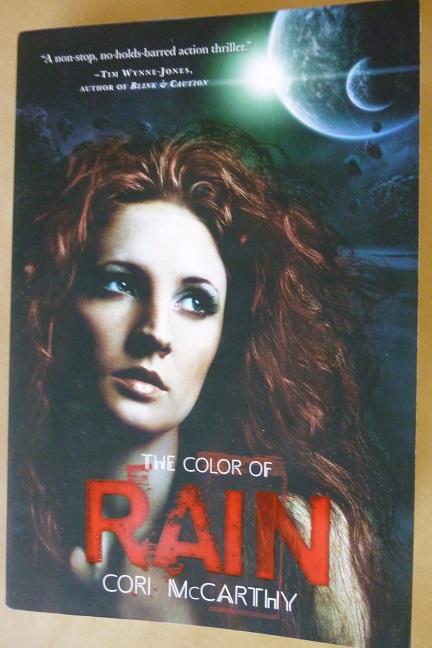
The Color of Rain by Cori McCarthy

Color of RainThe cover of The Color of Rain by Cori McCarthy describes it as “non-stop, no-holds-barred,” and they’re really not kidding.

Rain White lives in Earth City, a crumbling, future factory town with no prospects and very little hope.  Rain is desperate to escape on a spaceship traveling to the Edge.  There, she might be able to find a cure for her little brother, one of the Touched–a terrifying disease that strikes without known cause and steals a person’s memory and sanity.  Rain will do anything to save him, including turning to prostitution (not unlike Fantine, in fact).  Johnny, a dashing spaceship captain, seems like the perfect answer.  Despite some ominous indications, Rain agrees to be “his girl” in exchange for passage for herself and her brother.

Once in space, however, Rain learns that Johnny has many girls–he’s a pimp and a slaver, and runs his business ruthlessly and without morals.  Now Rain’s survival (and her brother’s) depends on doing anything necessary.

This is marketed as YA, but as should be clear just from the plot, it’s a very upper, very dark YA.  Don’t be fooled into imagining that it will pull any punches.  Frankly, the only thing that makes it YA, I think, is that Rain is seventeen.  From the movie rating system, I’d call it an R, for sex, language and violence.  It would have been possible to be more graphic–but I wouldn’t describe this as discreet either.

I think it’s worth comparing this to what it’s not.  In Edgar Rice Burroughs’ books, the worst is frequently threatened–but never actually happens.  Here, the worst happens…again and again, because every time I thought we’d seen the worst, the specter of something even worse loomed up.  A few of those specters don’t materialize–but most do.

This is a much darker book than I usually read, and it goes place I’d rather not go.  However, I do acknowledge that for this story, it’s not gratuitous.  I’m reminded of something my writing group’s resident horror writer has said–that he writes about horrific things in order to write about how people overcome them.  And that is ultimately  what this book is about, about holding onto that last piece of humanity and identity when it seems as though everything has been stripped away.

Part of that uplifting strand is inside Rain herself.  She’s stubborn and tough, and while she may at times be beaten, she’s never defeated.  After every worst happens, she finds a way to keep going.

The other bright spark in the otherwise almost unrelenting darkness is Ben, Johnny’s assistant and slave.  Ben is a Mec, genetically and mechanically enhanced, but still the most human person on Johnny’s ship.  Ben still believes in morals and the value of human life, and his treatment of Rain is in marked contrast to pretty much everyone else she meets.  It’s a slight spoiler to say that there’s an eventual romantic relationship, but that becomes obvious very quickly.  In fact, if I have one real critique of the book, it’s that Ben and Rain connect a little too deeply too quickly; there are a few points very early on when she clearly feels this connection, and there doesn’t seem to be a basis for it.  However, there is more grounding as the book progresses, and the relationship evolves into something really lovely.

The book is obviously sci fi, although I feel like that takes a very backseat compared to the human drama.  It’s an aspect of the book, but not that much a focus, and there isn’t a lot of worldbuilding.  For the most part we’re thrown in without explanations, and for the most part that works…though there were a few explanations I would have liked and never ended up getting.

Final assessment…excellent written, this book was too dark for my taste, and I think many (most?) readers would find it challenging at times.  But for what it is, it’s gripping, compelling, suspenseful, non-stop and no-holds-barred.  If you like dark thrillers, you may want to consider reading this in one sitting!

Disclaimer: I received this book for free from the publishers, in exchange for an honest review.

Author’s Site: www.corimccarthy.com

Other reviews:
Finding Wonderland
The Compulsive Reader
Wild About Words
Books Without Any Pictures
Anyone else?

Buy it here: The Color of Rain