What Are You Reading?

itsmondayI’m moving into a new phase of reading, so it’s the perfect time for another What Are You Reading post?  And by “new phase,” I mean “not centered around Lord of the Rings!”  I finished reading Return of the King, so after two months of all my other books orbiting Tolkien’s big challenges, I’m back to more open territory.

My immediate plans are to continue on with a number of series I’m midway through.  That means Children of the Mind by Orson Scott Card (Ender series), The Garden Intrigue by Lauren Willig (Pink Carnation series), Seer of Sevenwaters by Juliet Marillier (Sevenwaters series) and Gryphon in Glory by Andre Norton (…I don’t think the series has a name).  That’s a lot of series reading, but I’m close to the end on all of these, and eager to tie things up!

No picture of a book stack this time, because most of these books are still on their way from the library.  No matter–in the meantime, I’m reading Lucy Maud Montgomery: The Gift of Wings by Mary Rubio, an enormous biography of my favorite author.  It’s crazy-detailed, and is giving me all the cultural context and alternate-sides-to-the-story that Montgomery’s journals (which are lovely) don’t include.

Once I finish off a few more series, then I’m thinking I’ll get to the very long To Be Read list that has rather got away from me in the last several months…

What are you reading this week?

Favorites Friday: Authors I’d Like to Meet (Time Travel Edition)

Last week I wrote about living authors I’d love to meet–and since they’re living, it’s at least somewhat possible.  Many of my favorite authors, however, lived several generations ago, putting meeting them out of the question.  Unless, of course, I had the ability to travel in time–using a TARDIS, perhaps!  If the Doctor ever showed up and asked me what time I wanted to visit, I’d know exactly what to tell him…

L. M. Montgomery would be the first person to meet, probably to no one’s surprise!  I’ve read every scrap of writing by her I can get my hands on, letters and private journals included, so more than any other author she already feels like a friend.  I know exactly when and where I would like to go–June of 1908, when Montgomery was still living in Cavendish, on Prince Edward Island.  According to her journal, her copy of Anne of Green Gables arrived on June 20th.  Besides that excitement, it seems to have been a cheerful period (not always the case).  Her journal also mentions that it was the most beautiful June she could recall–and I’m sure she said somewhere else that nothing is more beautiful than Prince Edward Island in June.  If I had a TARDIS, my first stop would be to go pick strawberries and ramble through woods with Maud Montgomery.

William Shakespeare would be my next trip (following the Doctor’s footsteps, in this case) because, I mean, Shakespeare!  I have to wonder if he sounded out loud like his plays, or not (probably not…)  And then there’s that authorship question to explore.  I’d visit Shakespeare in autumn of 1599, when my favorite comedy, Much Ado About Nothing, was debuting at the recently-opened Globe Theatre.

Brenda Ueland is a far less famous choice.  She wrote my favorite book on writing, If You Want to Write.  She also taught writing classes, and if they were anything like the book, they must have been wonderful.  If I could, I’d visit long enough to take some of her classes–perhaps in 1938, the year her book was published.

Diana Wynne Jones wrote so many amazing fantasy books, and by all accounts (and the evidence in her own semi-memoir, Reflections on the Magic of Writing) she was a fascinating woman full of extraordinarily colorful anecdotes.  I don’t know precisely when I’d like to meet her…unless possibly when she was at university, so that I could join her attending lectures by C. S. Lewis and J. R. R. Tolkien.

J. M. Barrie is probably no surprise either.  Like Montgomery, I feel as though I know him, because all of his books (and plays, somehow) feature a most charming narrator.  I can’t help feeling like that narrator is Barrie himself.  I’d like to meet Barrie and the Davies boys (the inspiration for Peter Pan) in April of 1904–in Kensington Gardens, of course.  George, the oldest boy, was twelve, and Barrie had just finished writing the play version of Peter.  The other advantage to April is that the daffodils would be blooming in the Gardens, and I love daffodils.

So if the Doctor came to your door and invited you for a literary spin in the TARDIS, what authors would you go to meet?

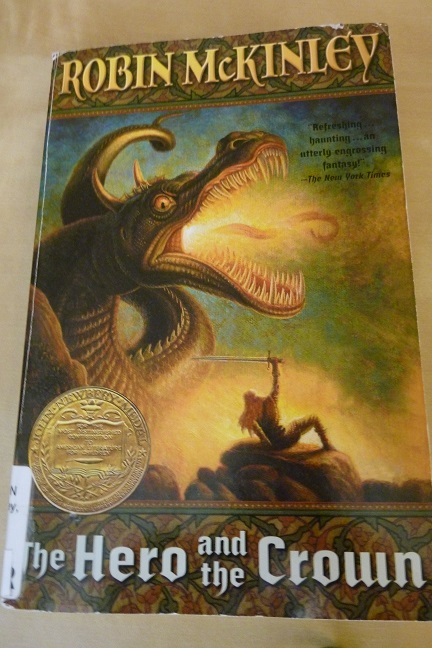
The Hero and the Crown by Robin McKinley

Hero and the CrownI recently followed up my reading of The Blue Sword with its prequel/companion, The Hero and the Crown by Robin McKinley, another book for Once Upon a Time.  The books are separated by a few centuries and feature (nearly) all different characters, so either could be read independently.  I read them in publishing order, but I almost wish I had read them chronologically, as I think The Hero and the Crown provides more depth to The Blue Sword, more so than happens the other way around.

I enjoyed the book in a lot of ways, and I feel like I could see McKinley’s development as a writer even between these two books.  There are strong characters, awesome magic, and really interesting dragons.  And…there are problems.  But I’ll get to that in a bit.

The Hero and the Crown focuses on characters who featured as legends in The Blue Sword, particularly Aerin.  The daughter of the King of Damar and his foreign wife, Aerin is viewed with mistrust and disdain by her father’s court.  She’s hot-tempered and impetuous, and strives to prove her worth by killing dragons–who in this world, are a kind of pest, like wild dogs or wolves.  Bigger events surface when a Great Dragon comes out of the hills, and when war threatens with the demonic forces of the North.

I loved Aerin.  She’s likable even when she charges into foolish actions, and I find myself so wanting her to come into her own.  I love that even when she begins killing dragons (which seems like a traditional route to being a hero) she still has to struggle.  I love how she gradually grows throughout the first half of the book, growing in her relationships with others and in her acceptance of herself.  The one reason I’m glad I read The Blue Sword first is that I love having met her as a mythical figure, and now meeting her as a very real girl–it’s never as neat and simple as the myths.

Aerin is surrounded by solid characters as well, from her father who means well but doesn’t know what to do with his daughter; Tor, her dearest and sometimes only friend; Teka, her somewhat fussy nursemaid and surrogate mother; Galanna and Perlith, representatives of the hostile court.

The best character, though, is Talat, Aerin’s horse.  Once the king’s warhorse, Talat was lamed in battle and put out to pasture.  Aerin and Talat lean on each other to find their path, and form a beautiful bond.  A-girl-and-her-horse is an oft-told tale, but this one is really lovely.

I touched on the dragons a bit already, and I just have to say that I love it that they’re not the big bad fearsome and impressive dragons of most stories.  They’re about the size of dogs and treated like any other dangerous wild animal–but not as anything more impressive than that.  In fact, in this country, there’s very little honor in killing dragons.  The Great Dragons are more traditional, but most people consider them only myths…until one arrives, at least.

I don’t want to get into the second half of the book too much, to avoid spoilers, but I have to talk about it to discuss my chief problems with the book.  There’s a clear shift about midway through, as Aerin begins to deal with forces on a larger stage.  The plot shifts, and that’s fine–but I feel like the character shifts too, and that’s not.

It’s hard to pinpoint the exact problem or exactly what was missing, but it feels like Aerin stops making decisions for herself.  While she decided to fight dragons or to befriend Talat, later in the book it feels like she’s being moved around by circumstances.  She goes to fight a magician because of a prophecy; she goes through a battle using a sword that seems to move on its own; she climbs endless, endless, endless stairs and never once thinks about turning around.

I wouldn’t say that Aerin behaves out of character in the later parts of the book–but I don’t get a sense of her anymore being an active force in her own path (which, in its own way, is out of character…)  The actions she takes do make sense for her, but there’s a piece missing in the motivations behind the actions.  And that, I find frustrating.

The second half also introduces a new romantic interest, which turned out to be the worst of both worlds.  I didn’t hate that romance, but it never resonated with me either–and yet it was able to disrupt the development of the earlier romance which I had been enjoying.

I didn’t hate the entire second half of the book, by any means.  It was actually still a pretty good story–but it was just a bit off too, and it didn’t live up to the brilliant first half.

I read a review by Memory on Stella Matutina that describes all of this very well and raises some excellent points, if you want to explore the subject further.

I have to wonder if McKinley herself may have realized the issue here.  I’m reminded very much of Rose Daughter, one of her later books.  The heroine is also being pushed around by prophecies and expectations and even the usual format of “Beauty and the Beast”–but she ultimately makes decisions that turn everything on its head.  Choice is very heavily emphasized…so perhaps McKinley knows what happened in The Hero and the Crown.

There’s about half of a really amazing book here–and then a pretty good second half.  So in the end I do recommend it, but I wish I could recommend it more whole-heartedly!

Author’s Site: http://www.robinmckinley.com/

Other reviews:
Beyond Books
The Sleepless Reader
The Book Stop
Dab of Darkness
Anyone else?

Buy it here: The Hero and the Crown
The Phantom of the Opera by Gaston Leroux

Leroux PhantomI think we all know I have kind of a thing about the Phantom of the Opera…  I recently did a reread of Gaston Leroux’s original novel–and since I can never keep straight what was in Leroux compared to other versions, even the third time through felt in some ways like a new experience.

The basic story is the same across most versions, and Leroux set the original pattern.  A masked man with a genius for music lives under the Paris Opera House.  In the guise of the Angel of Music, he trains Christine Daae in singing.  When Christine falls for Raoul, the handsome Viscomte de Chagny, the Phantom wreaks havoc in his jealousy.

Leroux was originally in French, so if you’re reading a translation I highly recommend Leonard Wolf’s.  Really, I can’t stress this enough–I’ve read two versions, both “unabridged,” and Wolf’s somehow has significantly more detail and better writing.

It’s always been the characters that really fascinate me in any version of Phantom–and mostly it’s Erik, the Phantom, himself.  Retellings in the last century have been on a nearly-consistent quest to make the Phantom a more sympathetic, romantic figure.  In the original, however, he’s a complete raving madman.  Truly, the man is unhinged.  He has a violent temper and (probably) kills at least three people over the course of the book.  I say “probably” because he denies it himself and we don’t actually see those moments, but I think his denial is a symptom of insanity, not innocence.

There’s nothing romantic about Leroux’s Phantom.  However, he does garner a certain amount of sympathy–or perhaps I should say pity.  I began feeling more sad for him when the Persian (a mysterious figure rarely appearing in films) took over the narration.  That’s not because the Persian portrayed Erik sympathetically, but just the opposite.  He’s the closest thing the Phantom has to a friend, and even the Persian still routinely refers to him as “the monster.”  We also learn from the Perisan that Erik really believed Christine loved him; the Persian himself doesn’t believe it…because Erik is so ugly.  Not because he’s a raving madman with violent tendencies–but because he’s so ugly.  There’s something wrong in that.

The final scene, in which Erik tells the Persian about how he parted from Christine, is absolutely wrenching.  And how can you not feel sad for a man whose mother always refused to kiss him?  Susan Kay does wonderful, devastating things with the idea, but it’s there in Leroux too.

The Phantom as a violent madman casts Christine in a different light too.  I’m not a Christine fan as a rule.  Often she’s an idiot or decidedly callous.  However, it occured to me rereading Leroux that Christine and the Phantom are sympathetic in inverse relation to each other.  The more rational and likable the Phantom is, the more blameworthy Christine seems for any lies and betrayals, and for ultimately choosing Raoul.  The more villainous the Phantom is, the more justifiable Christine’s actions are.  In Leroux, she’s still an idiot at times, but is pretty much justifiable too.

As for Leroux’s Raoul–I have to say I find it downright amusing how frequently he weeps, faints, raves or goes into a sulk.  I understand what Christine doesn’t see in Leroux’s Erik, but I don’t know what she sees in Leroux’s Raoul (his bank account, possibly…)

So much for characters.  The other aspect that struck me most in the novel was the structure.  So much of the story happens “off-screen.”  Many of the most iconic moments, including Christine ripping off the Phantom’s mask and their final parting, are only conveyed in conversations after the fact.  They’re almost detailed enough to be flashbacks–but aren’t really.

We get a lot of Raoul wandering about and wondering what’s going on with Christine.  We get very little of the Phantom actually present in the story.  I think Leroux is one of these classic writers who didn’t really know what he had created–or didn’t know quite what to do with it.  Nearly everyone retelling it has realized that the most interesting one in the story is the Phantom, and has been skewing the story his direction ever since.  Leroux…not so much.

Riding solely on its own merits, I have to say that I don’t think Leroux’s Phantom is all that great of a book.  It pains me to say it.  And I don’t think it’s a terrible book!  But it’s middling at best.  It’s far more interesting from a historical perspective, from the angle of “oh, that’s how Webber changed this” or “I love how Susan Kay took this one line and wrote six chapters from it.”  For me, at the end of the day, I far prefer Webber’s and Susan Kay’s versions.  But it is fascinating to see where they came from.

Other reviews:
ANZ LitLovers LitBlog
The Book Mine Set
In Which I Read Vintage Novels
Anyone else?

Buy it here: The Phantom of the Opera

Favorites Friday: Authors I’d Like to Meet

Book Expo America is going on this weekend, and lots of lucky, lucky bloggers (or ones who planned carefully and put effort in to make it happen…) are attending.  I’m not attending (maybe one of these years!) but reading everyone else’s updates has me thinking about which authors I’d most like to meet.

Oddly enough, they aren’t necessarily my top favorite authors.  Some, like Robin McKinley, would horribly intimidate me, and others, like Susan Kay, would just send me into spinning babbles about how much I love their book(s).  But here are a few I would love to meet, and imagine that I could live to tell the tale without too much embarrassment!

Geraldine McCaughrean tops the list, because I once wrote her a letter and got the most amazing, personal letter back.  She obviously read and valued my letter, and wrote a genunine response in reply–if any part of it was a form, I couldn’t tell.  So I almost feel as though we’ve already met.

Tamora Pierce probably would send me into babbles about how her books changed my life, but they were so very life-changing that I think it would be worth any resulting embarrassment.  Besides, I have a really good story to tell her.  I met one of my best friends because we were both reading Pierce’s books in a high school class, and that gave us the courage to start talking to each other.  I feel like gushing babbles are a bit more okay when you actually have something unique to say…

Neil Gaiman is never likely to top any favorite authors lists for me–I like his books quite a bit, but…we all have our favorites.  However, everything I hear, and as far as I can tell from his Twitter, is that he’s just the coolest of authors to meet.  Very nice, very friendly, graciously poses for pictures…  He is at BEA this year.  Ah well.

Gail Carson Levine writes a lovely blog with writing advice, and on the whole just seems so friendly and pleasant that I don’t think she’d scare me a bit in person (unlike some blogging authors!)   I consider her Ella Enchanted to be a literary ancestor to some of my own writing, and if I can get an accurate judge from her blog, I think she’d like hearing that.

Nicholas Meyer is the most random one here–but he directed Star Trek: The Wrath of Khan, AND wrote The Canary Trainer, a Phantom of the Opera/Sherlock Holmes crossover.  What other author is going to hit on so many of my interests?  His Phantom retelling is the only one I’ve found that makes the Phantom less sympathetic than Leroux and, given the opportunity, I’d quite like to ask about the thought process behind that…

At the moment I don’t have any plans of meeting any of these authors, but I do keep my eye out for signings.  If it ever happens, you’ll hear about it!  In the meantime, what living authors would you like to meet?  We’ll get to the dead ones another week!