The Master of Heathcrest Hall by Galen Beckett

Master of Heathcrest HallI had insomnia one night last week, and the one silver lining was that I got to finish The Master of Heathcrest Hall at four that morning.  I’ve been working on this trilogy for both Once Upon a Time and my Finish-the-Series goal, and I’m so very glad I did–because I loved it.

If you like, you can jump back and read my reviews of the first two books, The Magicians and Mrs. Quent and The House on Durrow Street.  To give very quick context: the trilogy is set in an alternate England (Altania), where some men are magicians, others can craft illusions, and certain women can speak to the Wyrdwood–Old Trees that are self-aware and capable of movement.  Oh, and the day and the night are of uneven lengths, which fascinates me, and the whole writing style and society has a strong Austen feel.

The third installment brings us back to our three major characters.  Ivy is living on Durrow Street with her two sisters and her beloved husband, Mr. Quent, and still trying to puzzle out messages left her by her father.  Rafferdy has become fully involved in the Assembly, as well as a clandestine group of magicians, working to protect the Wyrdwood.  Eldyn is performing as an illusionist, and learning how to make impressions (a kind of magical photo).  All their lives are going along pretty well…but there are political rumblings, a revolutionary army on the march, and a red planet coming ever closer and bringing with it the Ashen, terrifying enemies set to destroy all life in their path.

All these bigger issues were largely in the background in the second book, which worked surprisingly well.  I was hoping they would become more central in the third book and (eventually) they did.  Beckett does very nicely gradually building up to the larger crises, while somehow never losing the feel of ordinary people who (mostly) are trying to go about ordinary lives.

I also hoped for more of Mr. Quent (he is, after all, the title character) but only partially got that.  There was a bit of a facepalm moment when, at the very beginning of the book, we find out Mr. Quent is out of town.  Again.  As usual.  He was perpetually out of town or working late in the second book.  He actually does end up being in this one a bit more, and I just love it whenever he and Ivy are together.  There’s such a Bronte feel to the two of them.  Bronte actually gives us those sweet conversations Austen likes to skim past.

Mr. Quent also gave me the most heart-wrenching moment of the book…which I can’t explain without spoilers, though those who’ve read it probably know.  It wasn’t actually when horrible things happened–it was when I realized horrible thing were going to happen, and how, and why.  Sigh.

These books are all around 700 pages each, so by the end of the third, I had spent a lot of time with our three main characters.  I loved how they grew and developed.  Ivy was always wonderful, but she found new strengths and confidence over the course of the trilogy.  There were a few moments in this book, however, when I felt like she did some really stupid things, which felt like they only happened to keep the plot moving.  I tried not to get too irked, and the book and Ivy both did get back on track…

Eldyn had some interesting growth, as he always wanted to do great things but had to learn his own right path.  Rafferdy grew the most, from a dandy with interest in nothing, to an honorable, caring man willing to sacrifice for a greater cause.

There’s a love triangle in here that I really liked, because it felt like a genuine conflict (though I guessed how it would ultimately resolve) while at the same time all three were so honorable, and respectful of everyone else involved.  It struck me as such a contradiction to the (false) idea that you can’t write a book about genuinely good people.

As noted, this is a long book and, considering it’s written in an Austenish style, it’s not usually in much of a hurry.  It works though–don’t expect fast paced action (except now and then) but there is a very satisfying slow unrolling of events and revealing of mysteries.  Without getting into spoiler specifics, I’ll also mention that, in the end, everything ties up happily, in a way that’s almost too convenient.   I know that bugs some people, so be aware…although personally, I like neatly happy endings.

I’ve been recommending this one to all of my friends who like Austen and fantasy.  I think you really do have to like both, but if you do, this trilogy is one not to be missed!

Author’s Site: http://wyrdwood.net/

Other reviews:
Stella Matutina
Fyrefly’s Book Blog
Just Book Reading
Anyone else?

Buy it here: The Master of Heathcrest Hall

The Secret Adversary by Agatha Christie

I’ve been meaning to read more Agatha Christie (which may or may not have something to do with her appearance in Doctor Who…) and saw a review on Stella Matutina a few months ago for The Secret Adversary.  I got the audiobook from the library–and absolutely loved it.

The Secret Adversary is a “Tommy and Tuppence” novel, about two friends who, hard-up for employment after World War I, form the Young Adventurers Ltd.  Tuppence’s idea is to be criminals-for-hire, but instead they become enmeshed in an international spy thriller involving the Lusitania, a missing girl, vital documents, and the elusive criminal mastermind, “Mr. Brown.”

This was a delight of a book, which played to all my Anglophile tendencies.  It’s so very, very British–or rather, a certain stereotype of Britishness.  The dialogue is all full of “old thing, old bean, isn’t it all just ripping?”  Much of the book takes place in London, so between ridiculous slang and wanderings through Hyde Park and Trafalgar Square, I was having a wonderful time with that angle.

It’s great fun (or terribly jolly?) from other angles too.  Tommy and Tuppence are splendid characters.  Tuppence (a nickname) is clever, saucy and altogether too sure of herself, and prone to flights of inspiration of varying value.  She’s in many ways the driving force of the book, and I have to love an extravagant yet effective heroine.  Tommy is much steadier and slower to think things out, but more likely to be right once he comes to a conclusion.  Both are very likable, and they provide a nice balance for each other besides.

The mystery becomes somewhat convoluted in spots (not to mention coincidental!), but the essential notion of the mysterious (secret) adversary and international disaster is sound.  I never quite followed all the political ramifications of how it would spell disaster if these vital documents fell into the wrong hands…something about the Labor party and a general strike and I’m not sure what.  But I just accepted that it would mean the fall of the British Empire and went from there without worrying about the details.

There are some nicely tense moments and unexpected twists.  I was sure I saw one twist coming that turned out to be a red herring.  Well-played, Dame Agatha.  Even better, once the final reveal came, it did make sense–it wasn’t one of those annoying bait-and-switch jobs.

The story, of course, revolves around two friends of opposite gender, so at least one aspect of the story isn’t much of a twist…  The romantic moments are brief and mostly backdrop, but still fun and rather sweet.

The CDs I listened to were the “Audio Editions Mystery Masters” series.  The narrator’s British accent contributed a good deal to the fun of the Britishisms, and he did make me jump at least once at a tense moment.  I thought he struggled a bit with some of the other accents though; the American accent especially sounded forced.  Not everyone can be Katherine Kellgren, though, and overall I’d recommend the audio.

There was just one thing I didn’t understand.  On at least two occasions, probably more, a character named Jane Finn is referred to as having a wildly outlandish and unusual name.  Um.  Really?  Jane Finn is outlandish?  As opposed to, say, Tuppence?  Maybe there’s some reference re: “Jane Finn” that made sense in 1922 and doesn’t anymore, because on that one, Christie lost me.

But with everything else, I was right along with her and her delightful characters.  I enjoyed Murder on the Orient Express but didn’t feel obliged to rush out for more Hercule Poirot.  On this one, I’ve already been hunting my library’s catalog for more of Tommy and Tuppence.

Other reviews:
Strange and Random Happenstance
Here There Be Books
Fell From Fiction
The Agatha Christie Project
Anyone else?

Buy it here: The Secret Adversary

Saturday Snapshot: Lord of the Rings Nostalgia

I’ve been working my way through the Lord of the Rings novels, and as part of the very elaborate process, I’ve also been rewatching the movies.  I saw them all when they originally came out, but never read the books then.  I did, however, collect bookmarks.  I think they were available at my school’s library–the memory has gone a little vague.  But I collected them some ten years ago, and haven’t much thought about them since.

However.  While I had never read the books, my dad had them, so they were in my house.  And in my typical, over-organized fashion, where else would I store LOTR bookmarks…but in copies of LOTR?  So in the course of reading the books (those same copies that were sitting there all along) I’ve also unearthed the bookmarks.

I somehow don’t have the set from Fellowship, but I do have Two Towers and Return of the King

Lord of the Rings Bookmarks (2)Lord of the Rings Bookmarks (3)The bookmarks are two-sided, and I’ve kept them in the same order so you can see which characters were paired.  Some make sense…others don’t.

Lord of the Rings Bookmarks (1)Lord of the Rings Bookmarks (4)My one regret here…no Faramir bookmark.  He gets more screentime in the Extended Edition and…I just love him (this scene!)  Ah well…aside from that, I’ve quite enjoyed rediscovering a collection I all but forgot I had. 🙂

Visit At Home with Books for more Saturday Snapshots!

Favorites Friday: Nonfiction Edition

If you pay any attention to the books that get reviewed around here, you’ll know that I rarely read nonfiction (although I did make efforts to branch out last year).  However, there are at least a few nonfiction books that have made a big impression on me…

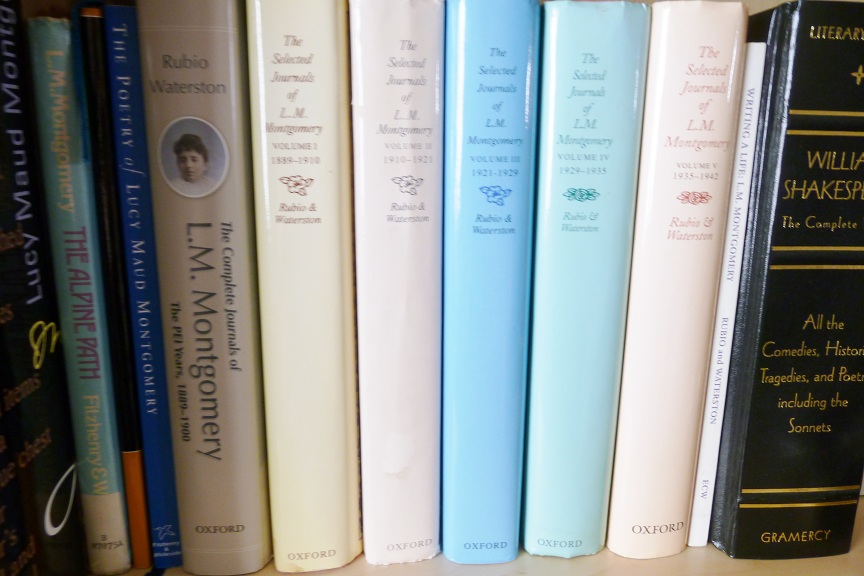
LM Montgomery (3)The Journals of L. M. Montgomery – This has to be closing in on 2,000 pages, putting all the volumes together, and forms a powerful account of one woman’s life.  Montgomery had such a flair for character and description in her fiction, and that comes into her journal as well.  It is nonfiction, and she wrote it over the span of 50 years, but it often reads like the most fascinating (and at times, heart-wrenching) of stories.  I know that Montgomery died over 70 years ago, but after reading her journals, I can’t feel it.

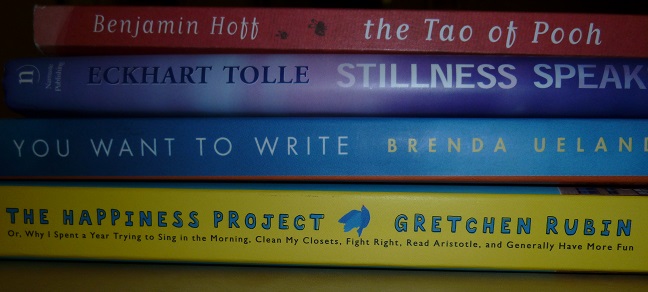
Nonfiction BooksIf You Want to Write by Brenda Ueland – Ueland doesn’t discuss the practical side of writing, and certainly not the publishing side, but she beautifully explores the spirit of writing.  Encouraging, uplifting, almost spiritual, she explores the meaning and the inspiration of writing.  If you have a passion for writing (or any creative pursuit), let no one ever tell you that it isn’t important.

The Tao of Pooh by Benjamin Hoff – This one has a bit more fiction in it than the others, considering it’s an exploration of Taoism through the characters in Winnie the Pooh, and Hoff includes conversations with the characters.  An odd but very appealing blend of Winnie the Pooh and philosophy, it’s charming, sweet and will actually make you think in very serious ways.  Anecdotally, I knew a girl in college who was Taoist, and she recommended this book.

The Happiness Project by Gretchen Rubin – Somewhat story-like, somewhat a how-to, Gretchen describes her year of exploring ways to be happier.  It wasn’t that she was unhappy, precisely, or that there was anything truly wrong with her life–but she decided to seek out ways to appreciate, value and improve her daily life.  It may make you want to start your own happiness project, trying different ways to make life better–everything from making your bed in the morning to making new friends.

Stillness Speaks by Eckhart Tolle – This is a lovely book with very small snippets of wisdom.  Few pieces go on for a full page, so it’s easy to dip in and out, and I never lose the thread of a theory.  Tolle offers insights on mindfulness, getting over your own thoughts, and learning to really know yourself.

I have a general sense that most of you reading this are also fiction fans…but do you have any favorite nonfiction books to share?

Heart’s Blood by Juliet Marillier

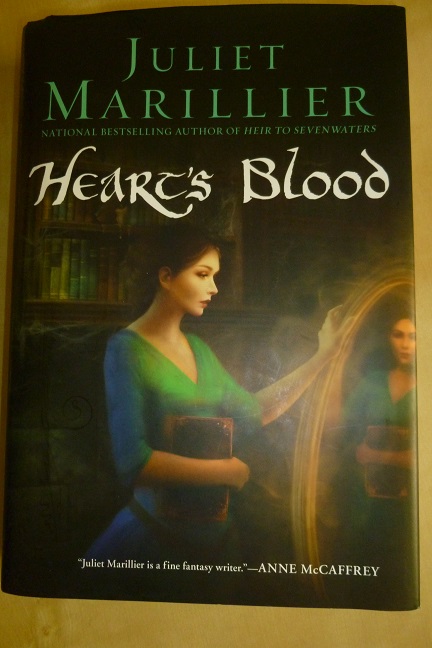
Heart's BloodI’d just like to say, when Juliet Marillier is good, she’s really good, and I’ve been having a nice run with her books lately.  After recently reading Heir to Sevenwaters, I jumped into a reread of Heart‘s Blood, in part so that I could try to actually notice sooner this time that it’s a “Beauty and the Beast” retelling…  It took me far too long to figure that out on the first go-around.

The heroine of the story is Caitrin, who flees an abusive situation and, in desperation, seeks refuge and work as a scribe at Whistling Tor.  There are strange rumors about monstrous spectres in the woods around the Tor, and about Anluan, the chieftain.  Anluan proves to be bad-tempered and unfriendly; he was stricken by illness as a child and it left him semi-paralyzed on his right side.  He nearly runs Caitrin off at once, but instead she stays, becoming part of his very unusual household and delving into the myserious curse afflicting the Tor.

You probably already see some “Beauty and the Beast” parallels, and there are also enchanted mirrors scattered throughout.  It’s really only “Beauty and the Beast” in the broad strokes, though, and most of the story focuses on deducing the origin of the curse, as well as on an outside threat from foreign invasion.

I was also struck by Jane Eyre parallels, particularly in the second half of the book, so I don’t want to get into details too much.  Even at the beginning, though: a talented young woman sets off from a difficult situation, and finds work with a gruff employer at a big house on a misty moor (or Tor…)  He’s unfriendly but secretly attracted to her, while she comes to see the value behind his unattractive exterior.  (Although no, there’s no first wife locked in a tower.)

This was an interesting one to read right after Heir to Sevenwaters, because it was once again two of my favorite archetype characters: a heroine who has to find her own strength and worth, and a dark hero with a heart of gold.  That’s not to say, however, that Caitrin and Anluan are the same characters as Clodagh and Cathal.  They have their own unique characteristics and paths to walk.

Caitrin has a particularly difficult journey, overcoming abuse in her past.  Marillier focuses less on the bruises and more on the psychological damage, which is deeper and far more complex.  I ultimately found Caitrin’s path to be immensely satisfying.  Anluan has different internal demons to overcome, and though we get less of his internal thoughts (Caitrin narrates, but we do get into Anluan’s journal) his development is intriguing too.

The magic is spooky at times, creepy at others, and delves into questions of good and evil and the hazard of judging too quickly whether someone is one or the other.  There’s a nice balance of character growth with unraveling mysteries and, as is usual for Marillier, the last hundred pages are breathless and hard to put down.

Highly recommended. 🙂

Author’s Site: http://www.julietmarillier.com/

Other reviews:
Ivy Book Bindings
Academics Go Clunk
The Book Rat
Anyone else?

Buy it here: Heart’s Blood