DragonFlight Group-Read, Week One

As part of the fun for the Sci Fi Experience, I’m participating in the group-read of DragonFlight by Anne McCaffrey.  This was just the push I needed to revisit Pern…which I’ve been meaning to do for far too long.

First, a little context for those not reading along: DragonFlight is set on the planet Pern, where society is centered around small holds, traditionally guarded by the Weyrs, where the dragonriders live.  The dragonriders are a race apart, each one bound for life to his or her dragon.  The dragons’ mission is to protect Pern from deadly Threads, parasites which fall from the neighboring planet of the Red Star and burn everything in their path.  They’ve fallen at regular intervals for millenia, but 400 years ago the last pass of the Red Star ended, leading to a Long Interval; five Weyrs of dragonriders mysteriously disappeared, leaving only Benden Weyr to survive to the present.  Now the Red Star is looming in the sky again, and F’lar of Benden is looking for a woman to Impress the new queen dragon about to hatch.  Meanwhile, Lessa of Ruatha has been hiding in her ancestral hold, the only one of her family to survive slaughter ten years before when Fax invaded and took control–and her long quest for revenge is coming to a head.

DragonFlight is one of those books that I read several times as a kid or young teenager, but somehow haven’t touched in the last ten years.  It was very interesting coming back to it again.  Like my experience with The Giver, there’s a lot more to be disturbed by than I remember…  There are some undertones and details that are more worrying than my younger self perceived.  On the other hand, it’s still an exciting adventure on a fascinating world, with deeply engaging characters.

But perhaps I ought to get into Carl’s questions for the discussion…

1.   What are your thoughts on McCaffrey’s handling of the male and female characters in Dragonflight?

2.  F’Lar and Lessa are an interesting pair of protagonists.  What do you like and/or dislike about their interactions thus far?  What things stand out for you as particularly engaging about each character (if anything)?

I want to take these first two questions together, because they feel very interrelated–and related to my complex feelings mentioned above.  It’s an odd thing about women in this book.  There’s a definite feeling that women don’t have much power in society, that there’s a clear delineation between the genders, and that women cook and have babies.

In the Weyrs, the Weyrleader is the man whose dragon mates with the queen dragon.  First, that is a strange way to choose a leader for society.  Second, it is a far more disturbing prospect to consider that the queen rider’s mate is based on which dragon flies the fastest.  I’ve read many other Pern books and I know others end up suggesting that the rider’s preference has a lot to do with which dragon has a successful flight.  But that’s not in this book, so I’m not sure it’s a valid defense…

So all in all…not really liking the treatment of women.

But on the other hand–Lessa is amazing!  The one major female character is certainly as smart as any of the men, and stronger and more determined too.  But–she also spends a lot of the book trapped in a role, and when she breaks out there’s some sense that she’s declaring her independence…but there’s also a sense that she’s an impetuous child who’s rebelling.

In some ways F’lar acknowledges Lessa’s intellect and strength–he certainly sees it.  But he doesn’t treat her as an equal, and there are some very troubling aspects to their relationship.  I feel like if I really wrap my head around some of it, I’m going to end up hating F’lar and I don’t want to do that–so I am very curious to see how other people respond to this question!

3.  How do you feel about Pern to this point in the story?  What are your thoughts on McCaffrey’s world-building?

I already covered some disturbing aspects of Pernese society, but really I’m fascinated by it.  I actually don’t feel like this is a very good book to analyze Pern and McCaffrey’s world-building, because in large ways Pern here is in a crisis of society.  They’re going to figure things out in subsequent books.  I find Pern a more interesting place when it’s thriving, because then you get to find out more about different craft halls, how the Holds interrelate, how dragons fit into the mix…and women don’t seem quite as marginalized in other books.  All in all, a picture emerges of a society that is quite different from our own, marvelously intricate, and just seems to work and fit together in a wonderful fashion.

4.  For those who have already read Dragonflight how do you feel about  your return to Pern?  What stands out in your revisit?

I felt SO nostalgic when I opened to the Introduction and found “Rukbat, in the Sagittarian sector, was a golden G-type star.”  I think every Pern book has the paragraph that follows, and at the height of my Pern-fandom, I could have recited it.

It’s true that sometimes we can go back to books and find them different–although we’re the ones who changed.  I already touched on some of the parts that disturb me, that went right past me before.

But on the other hand, some parts are still the same.  Lessa is such a strong figure.  Dragons–I mean, they’re awesome.  That goes without saying.  I’m fascinated by…I guess I have to call it the shape of the world.  Pern is just an interesting place.

I think that wraps up a discussion of the first half of the book.  More to come next week!  In the meantime, read everyone else’s thoughts.
The Gift of The Giver Series

When I found out that Lois Lowry had released a fourth and final book in her Giver series, I had it on reserve at the library within five minutes.  Apparently everyone felt the same way, as I was about #25 in line.  That actually worked out perfectly, because it gave me time to reread the first three books!  Which also seemed to be in high demand…so perhaps other people felt the same on that too.  Today I want to talk about those three–and then discuss Son in its own review next week.

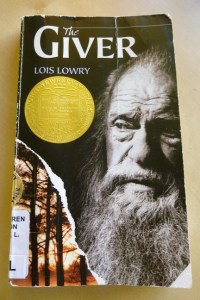
Lowry Giver The most famous, I believe, is the first book, The Giver.  I remember a teacher read it to us in sixth grade, which is the same age Jonas is in the book (probably not a coincidence).  Until I picked it up again, I would have guessed that I had reread it more recently–but I don’t think so anymore, because it felt so different reading it as an adult.

Jonas lives in a very carefully regulated community, where a council of elders decide how each person’s life will be lived.  Everyone is assigned a career at age twelve.  Later on they’re assigned a spouse, and then given children.  When Jonas turns twelve, he is assigned the mysterious role of Receiver, the keeper of the community’s memories from a time before.  As he gradually receives memories from the old Receiver, now called the Giver, Jonas begins to question the world around him.

As far as I can remember when I was twelve, I didn’t find this book disturbing until most of the way through, when I found out what it really means to be “released” from the community.  Reading it as an adult, I was disturbed by page one, when a plane flies over the community unexpectedly and everyone, children and adults alike, stop in their tracks, paralyzed by uncertainty and fear in the face of anything different.  There is something really wrong with this society.

The more you read and the more you find out, the worse it gets.  Lowry has created an incredibly chilling book that is deceptive in its simplicity.  The language is simple, the book is short (I read it in a day) and it’s very much about a child–but it is so powerful.  Part of the chilling nature is Jonas’ easy acceptance of the world as it’s been presented to him.  I think when I was twelve I accepted it right along with him.  As an adult, I’m horrified immediately, while the narrator goes along without seeing a problem for most of the book.

This is not a flashy dystopia–no one’s bleeding, no one’s starving or forced to fight to the death in an arena.  The community is designed to prevent pain.  But it is nevertheless a terrifying vision of a future with no independence, where the individual is completely subjugated to the “good” of the community, and the goal of eliminating pain has eliminated all positive emotions too.

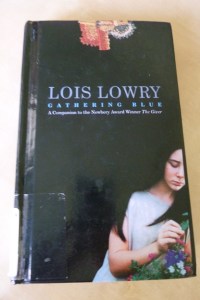
Lowry Gathering BlueNow how do you follow that book?  Book two is Gathering Blue, which does not really seem to have any connection to The Giver (more on that in a bit).  This is set in a different future community.  Kira’s community is not neat and ordered like Jonas’.  Her village lives a subsistence life with no room for warmer emotions in the fight merely to survive.  Anyone who can’t contribute is killed.  Kira, born with one bad foot, was saved in childhood by her caring mother.  Now that her mother has died, Kira saves her own life through her talent for embroidery; the village elders choose her to repair the Robe that records the history of their world.

Kira’s people are as much dehumanized as Jonas’, albeit in a different way, and the governing body has no more concern for people.  It’s fascinating to watch more and more be revealed about her community.  Kira is a particularly good character, and there are good mysteries to unravel in her world.  I remember the first time I read this, I was so frustrated by where it ended!

Lowry MessengerSo it’s a good thing there’s book three, Messenger, which ties the first two books together and gives us answers to their inconclusive endings–if not a final ending yet.  This book focuses on Matty, a young friend of Kira’s.  He’s living in a new village, a warm and welcoming place founded by outcasts from other, harsher communities.  But something is changing.  A mysterious figure known as the Trademaster has been inviting people to trade away parts of themselves–honor, kindness, strength–for whatever they most want, and the attitude of the whole community is hardening.

This is the first directly fantastical book.  There are fantasy elements in the first two, but they don’t feel like fantasy.  Jonas’ receiving of memories feels like a kind of hypnosis, and Kira’s embroidery abilities seem like they could be magic, or could be only inspiration.  This book features the Trademaster and his abilities, as well as a sentient, hostile forest, and a special ability Matty is learning to use.  Kira and Jonas both return, so we find out more about the next few years of their lives, and about their clearly magical abilities too.

We again see a theme of dehumanizing.  Jonas’ people lost their humanity trying to escape their pain.  Kira’s people are ground down by poverty and self-interest.  Matty’s people are sacrificing the best of themselves in the interest of greed.

Messenger is in some ways the weakest book, with its primary value bridging the two stronger ones.  I don’t feel like Matty is as effective a character as Jonas and Kira, and while Trademaster is terrifying, he’s also flashier–and we lose the subtle horror of the first two books that was so much more chilling.

However–I also think Messenger gets some criticism because it’s been perceived as the final book of the series.  It does part of that job, tying some things up, but it doesn’t give a strong finish.  Seeing it only as a bridge book leading to book four, I think it lives up to that role very well.

And book four, Son, gave me that stronger finish I was looking for.  But that will be the next review…

Author’s Site: http://loislowry.com/

Other reviews:
Annette’s Book Spot
Stephanie Early Green
Becky’s Book Reviews
Anyone else?

Buy it here:
The Giver
Gathering Blue
Messenger

A Familiar Story at the Earth’s Core

At the Earth's CoreI’m exploring Sci Fi worlds in January, and my first review for the Sci Fi Experience and the Vintage Science Fiction month is At the Earth’s Core by Edgar Rice Burroughs.  First published in hardback in 1922, it’s definitely vintage–and it’s also quintessential Burroughs.

I usually try to avoid spoilers in plot summaries, but…for people who know Burroughs, you really can’t give spoilers.  At the Earth’s Core is about an unusually strong, gray-eyed Earthman who unexpectedly finds himself in a strange other world, where he meets bizarre creatures and multiple intelligent races.  He also meets mostly naked yet noble savages and of course a beautiful princess, who has been captured by a monster race.  He falls in love with the princess, but they’re separated–first because he accidentally offends her, and second by circumstances.  He fights his way through the landscape, succeeds to a place of high esteem in society and wins the princess, only to wind up at the end of the book back on Earth–and all we know at the end is that he may, or may not, have successfully returned to the other world.

Sound kind of familiar?  That’s because this is a faithful description in every particular of BOTH At the Earth’s Core and A Princess of Mars.  I love Burroughs–I always enjoy his books–but with very few exceptions, the man only had one story.  That’s okay, though.  You don’t read Burroughs in breathless suspense about whether the hero will win the girl.  You read it for the strange landscapes, the bizarre creatures and the beautiful prose.  I do, anyway.

This first book in the Pellucidar series follows David Innes on an adventure into the depths of the Earth, where hundreds of miles down his mole-like vehicle breaks out into a strange landscape.  The premise is that the entire inside of the Earth is hollow, presenting a vast expanse of land functioning with reverse gravity to what we know on the outside.  Rather than the horizon dipping down in the distance, it curves up forever.  Pellucidar is lit by a miniature sun at the very center of the planet, so that the world exists in perpetual noon.  All in all, it’s a great example of Burroughs’ wild and intriguing landscapes, be they on the moon, Mars, or the center of the planet.

David meets two different semi-intelligent species that resemble apes, as well as the required race of noble savages, primitive but immensely good-looking.  This race is treated as cattle by the most interesting race, the Mahar.  This is a race of lizard-like people who communicate by a kind of telepathy (but not quite) and have no concept of sound.  The Mahar, I am sorry to say, are at the center of what is probably the most disturbing scene I’ve ever encountered in Burroughs.  Remember I said the human-like race is treated as cattle?  There’s a pretty horrible incident relating to that, unusually horrible for Burroughs.

Besides the intelligent species, David encounters a wide variety of monsters.  He comes to the Earth’s core along with a helpful amateur paleontologist, who frequently recognizes species–although I suspect Burroughs made most of them up.

The positives of the book are definitely the weird landscape and creatures, along with plenty of action.  This book doesn’t share the problem of most of Burroughs’ other first-books-in-a-series, of starting slowly.  We get straight into the adventure.  This one also has an interesting concept about time not existing in a world with no celestial bodies and no clocks.  It frankly doesn’t make a bit of sense, but it’s interesting to think about.

On the negative side, there is a slightly disquieting element here of the noble white man bringing civilization to the savages–though to be fair, there’s no clear ethnicity among the savages, and the truth is that they aren’t fending all that well for themselves.  Still, David throws himself into changing a world that he really knows very little about.  And I’m not sure teaching weaponry is really the way to advance a people.

I can’t put my finger on why, but David didn’t appeal to me as much as his obvious counterpart, John Carter.  It sounds silly to say, when typical Burroughs heroes are nearly interchangable…but there was still something different.  David is upstanding and brave, as all Burroughs heroes are, but he maybe wasn’t quite as noble, or quite as capable.  Or he just didn’t come with that fascinating opening paragraph, about always being a young man, always a fighting man.  While I wouldn’t have said that Burroughs heroes were distinctive, David still didn’t have as strong a voice.

That may about sum up the book.  I liked it.  I enjoyed it.  It is, as all Burroughs novels are, a grand adventure in the finest tradition of pulp science fiction.  At the same time, it didn’t grab me quite the way other Burroughs books have.  I don’t know if that’s a flaw of the book, or if that’s just me–if maybe after forty-odd books, the usual Burroughs story is finally starting to feel old.

I’ll be going on to read the rest of the Pellucidar series…and perhaps it’ll grow on me!  Even if it doesn’t get any better than the first one, I still expect to have a perfectly rollicking time with it.

Author’s Site: http://www.edgarriceburroughs.ca/

Other reviews:
Luke Reviews
Book Addiction
Anyone else?

Buy At the Earth’s Core here, though I’d recommend buying A Princess of Mars instead.

Bloody Jack–at School, at Sea, and on the River

Mississippi Jack
Book 5, which has 14 discs in all

I have been continuing through the audio adventures of Jacky Faber by L. A. Meyer, read by Katherine Kellgren, and am now halfway through the series.  They continue enormous fun, and are great to listen to one after another, as they tend to directly follow each other chronologically–though I’ve decided to take a break for a while after the fifth one.

I reviewed the first audiobook here, Bloody Jack, about how a London street urchin disguises herself as a boy to join a Royal Navy ship, hoping to “better her condition.”  Along the way, she meets close comrades and gains the nickname “Bloody Jack”–which, as Jacky likes to say, is not her fault.  Mostly.

I’ll try to refrain from spoilers, but I will tell you that her deception is found out by the end of the book.  Book Two, Curse of the Blue Tattoo, picks up with Jacky being dropped off in Boston at The Lawson Peabody School for Young Girls, where the formidable Mistress Pimm will try–with mixed success–to turn her into a proper lady.  We get to meet two of my favorite characters in this volume.  First, Amy Trevelyne, Jacky’s dearest friend, who comes out of her shell under Jacky’s influence, and who tries–with mixed success!–to rein in Jacky’s wilder impulses.  Second, we meet Jacky’s nemesis, Miss Clarissa Worthington Howe (of the Virginia Howes), who is very much the fine lady–but can hold her in a fight too, with words or claws.  This book also has an element of mystery to it, as Jacky gets involved exploring the death of a serving girl, and the very creepy minister who lives next door.

Book Three, Under the Jolly Roger, sees Jacky at sea again.  Through a series of mishaps, she ends up on the H.M.S. Wolverine, commanded by mad Captain Blodgett.  Jacky’s gender is discovered and her virtue is sorely threatened, but as usual she carries on with aplomb.  This book is really two plots, and Part Two sees Jacky setting up as a privateer–and fighting at the Battle of Trafalgar in the climax.  I remember when I read this one the first time, I had to stop reading it before I went to bed.  Too exciting!

We meet another favorite character here, Higgins, Jacky’s ever faithful man servant.  I can’t tell you how delighted I was listening when Higgins first turned up!  It’s been a long time and I’d forgotten exactly how he got into the story.  Higgins is a prim and proper gentleman’s gentleman, who nevertheless has a taste for adventure.  He faithfully follows Jacky through her madcap adventures, always ready to offer a wise word, a tut of disapproval, a cup of tea or a hot bath.  Just to clarify here, it becomes quickly apparent (though never said in so many words) that Higgins is gay, which makes him one of the few men Jacky doesn’t flirt with.

Book Four, In the Belly of the Bloodhound, sends Jacky back to Boston and school, trying to lay low and avoid the British intelligence officers pursuing her for piracy.  The plan to stay out of trouble goes awry when Jacky and the girls of the school are abducted by slavers, and carried towards South Africa aboard the Bloodhound.  This is my favorite book in the series to date.  Jacky is certainly not going to take slavery lying down, and she martials the girls into a fighting force.  I love the girls of The Lawson Peabody School, and I love watching them grow ever stronger and more confident.  We get a lot of Clarissa, as well as little Rebecca Adams (granddaughter of John Adams) and Dolly Fraser–who later marries Mr. Madison.  Along with getting a wonderful cast of brave girls in this book, Jacky doesn’t meet any pretty boys–meaning for once she has to curtail her sparking.

Jacky lights out West in Book Five, Mississippi Jack, commanding a showboat down the river along with Higgins and a host of familiar and new characters.  Jacky meets Native Americans (including this unnamed Indian woman who went west with that expedition…) and the delightful, hilarious, roaring river man Mike Fink.

As I think about my plot summaries, I realize I’ve left off a major character–Mr. Jaimy Fletcher, who is doomed throughout this series to chase along always a few steps behind Jacky, his fiancee.  Meyer often intersperses Jacky’s adventures with letters (literal or mental) from Jaimy to Jacky, updating what’s occurring with him.  And here I come to my biggest criticism of the series.  On my first read-through, I recall being pretty neutral about Jaimy.  On this second pass, I have to say I think he’s all wrong for her.  They meet as children in the first book and are faithful to each other (mostly) for nine subsequent books…but honestly, I’m not convinced of their relationship’s validity because they’re so rarely actually together.

A bigger problem–Jaimy keeps wanting Jacky to settle down.  And that’s just not who she is.  I don’t have a problem with Higgins or Amy, who clearly value Jacky for her high spirits and just wish she would restrain some of her more dangerous impulses.  Jaimy wants to marry Jacky and install her in a cottage somewhere while he goes to sea and she…I don’t know, raises babies?  I don’t believe Jaimy loves Jacky for who she is; he’s imagined the girl he thinks he wants, and for some inexplicable reason has given her Jacky’s face.  I’d like to believe Meyer will eventually break the two of them up…but I just don’t see it happening.  So I have to hope Jaimy will mature a bit.  As of book ten, he’s still working on it.

As I mentioned, I’ve been listening to the audiobooks on this pass through–the books are great as paper novels, and they’re also wonderful on audio, thanks to the delightful talents of Katherine Kellgren.  She gives us Jacky’s Cockney accent, brings believability to her melodrama, and makes me like Jacky’s singing much more than I ever did on paper.  She also gives us excellent voices for a vast cast of characters, with accents from British to American to deep South to Irish to French, with characters who are male, female, young, old–or even bellowing Mike Fink.  She even makes different characters sound different while singing.  All in all, I’m a big fan.

But I’m a fan of the whole series.  On paper or audio, I highly recommend following the adventures of Bloody Jack!

Author’s Site: http://www.jackyfaber.com

Other reviews:
Gallivanting Girl Books
The Lostent Wife
The Magic of Ink
Anyone else?

What Are You Reading…in 2013?

itsmondayWe’re about to turn the calendar to January, making this the perfect time to look ahead at reading plans for the beginning of the new year.  So here’s a new installment of the What Are You Reading meme from Book Journey!

I have been on a mad quest to clear up final reading plans before the end of the year, and so far, it’s going pretty well.  I read Superior Saturday and am midway through Lord Sunday by Garth Nix, to finish off one last series.

I reread Mischief of the Mistletoe by Lauren Willig over Christmas, and I just madly, madly love this book.  It’s so sweet and adorable and witty and funny and the characters are so good and…well, I just madly love it.

I’m still working on Reflections by Diana Wynne Jones, but since it’s a series of essays, it’ll be an easy one to intersperse among new reading plans…because I start new reading challenges on January 1st and look forward to diving in.

P1020254First of all, I’m joining the Sci Fi Experience, so that should tell you the general trend of my reading for the next couple of weeks.  I think I’ll start with the Pellucidar series, reading At the Earth’s Core by Edgar Rice Burroughs, followed by Children of the Jedi by Barbara Hambly, then maybe whichever Star Trek book is appealing to me.  Somewhere in there I also plan to read Dragonflight by Anne McCaffrey for the readalong, but I haven’t quite decided where yet.  Then I might circle back to the next Pellucidar book, or else I’ll take a break for something completely different…and read Pat of Silver Bush by L. M. Montgomery.

Pat BooksYou see, all against my better judgment, I have also decided to join in with the L. M. Montgomery Reading Challenge at Reading to Know.  It only runs for the month of January which is terrible timing…but it’s an L. M. Montgomery reading challenge!  To paraphrase one of her characters, her writing is in the very core of my heart.  I can’t resist.  So, I’ll definitely be fitting in some LMM short stories and poetry in the next month, and hopefully the Pat books in there somewhere too.

WaldenWhile all of that is going on, I also want to get started on my Chunkster Challenge…because if I don’t start in the first month, I’ll never reach my goal there!  The thought of fitting a 1,000 page book into January is making me feel faint (sorry, Les Mis) so I got an audiobook of Walden instead.  I can’t see listening to Thoreau while I’m driving (it just doesn’t feel right…) but while I’m taking a morning walk…yeah, I think that’ll work.

Whew.  If I didn’t enjoy all of this so much, reading plans would be exhausting to contemplate!  But since I very often feel like I want to read all of the books right now, it’s actually quite exciting to have a big stack to pounce on.  I know how I’m spending January 1st!

Addendum: apologies for sending you two posts in one day!  This one accidentally got scheduled a day early.  Oh well…I guess I’m really looking forward to the new year!