Tag: Books
Blog Hop: Long Languishing Books
 Today’s blog hop is hosted by The Fake Steph, and the question is:
Is there a book that has been languishing on your TBR pile even though you spent months anticipating its release?
I can honestly say I don’t–technically–do this. People who have seen my bookcases probably won’t believe me when I say this, but I am extremely selective about what books I buy. Unless I really trust an author, I rarely ever buy a book that I haven’t already read. So I rarely end up with much anticipated books actually in my house that I don’t get to for ages. I get unread ones sometimes, but they tend to be gifts or ridiculously cheap impulse buys, or something from a book swap.
But I am guilty of the spirit of this. I see a book, or hear of a book that’s coming out, get deeply excited…and then don’t actually read it for months or even years. I don’t know why that is, so if someone has a theory, I’d love to hear it! My best guess is that there are just too many books, and I get sidetracked. Or I’m somehow waiting for the “right” moment.
And then sometimes I’m not sure about reading a book…but it just stays in the back of my mind as one I ought to read some time. Pirates! by Celia Rees was one of those. I saw it in bookstores and the library for years, and kept thinking I ought to read it (because, I mean–pirates!) This was one that languished on my pile. I saw it at a book swap, got quite excited, brought it home…and didn’t actually read it for months. When I finally did, it was good, although I didn’t love it enough to keep it.
I do think a factor may be that there’s just always another book. So the To Be Read list is not so much a pile, as a line…and it takes some time for books to get to the front!
Anyone else see this in their own reading? Anyone with a theory on why we don’t just read the books we get excited about?
A Gothic Parody from Miss Austen
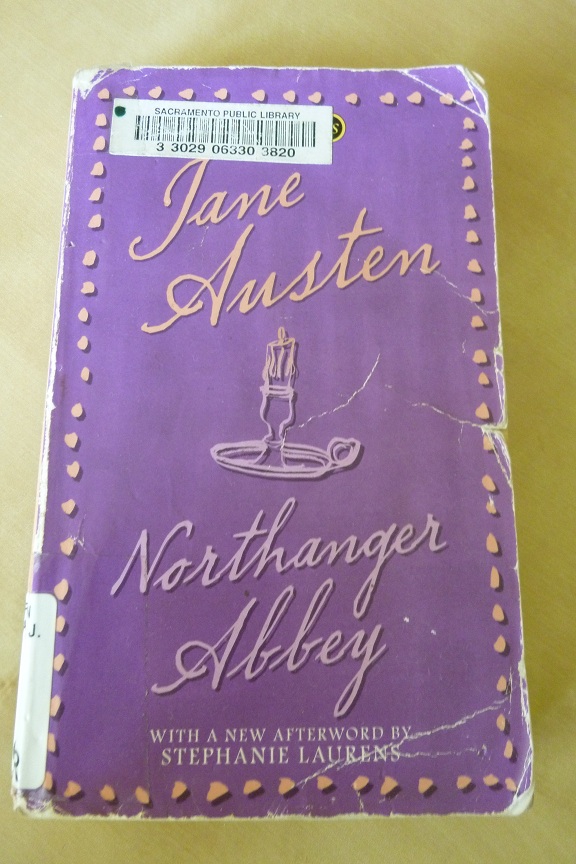
I finally got to my last goal-book for R. I. P. – Northanger Abbey
Northanger Abbey is a spoof on gothic novels. I haven’t actually read many, but it doesn’t seem to matter. A lot of the concepts have slipped into the cultural awareness, and it always seemed pretty clear what Jane was poking fun at.
The book is about Catherine Morland who, the narrator tells us, doesn’t seem at all suitable to be a heroine–for instance, her father “is not in the least addicted to locking up his daughters.” Catherine loves reading about heroines, and simply adores gothic novels. Her opportunity for adventure comes when she’s invited to accompany some family friends to Bath. There she makes the acquaintance of the charming Mr. Tilney and his sister, who eventually invite her to their family home of Northanger Abbey. It’s the perfect setting for a gothic novel and Catherine’s imagination runs wild.
This book has the most delightful feel to it. It’s the lightest Austen I’ve read, with a wonderful sense of humor throughout. It’s frequently meta, with a narrator who comments on the ongoing story, noting at times how it does and doesn’t fit a gothic novel, with some lovely tongue-in-cheek observations. Austen herself feels much more present here than in her other novels that I’ve read.
The characters are vivid, and the cast is a little smaller than usual, so the characters don’t get lost among the crowd. Catherine is rather silly at times, but she’s also very honorable and good-hearted. I don’t admire her as much as Elizabeth Bennet, but I like her very much. She shows good character development as well, maturing through the novel.
And Mr. Tilney–well, with all due respect to Mr. Darcy, it takes Colin Firth five hours to crack a smile in the BBC miniseries. It’s so nice here to meet an Austen hero with a perpetual smile. Mr. Tilney makes jokes and is charming and fun. I was talking about this book with two friends, and the opinion was unanimous in appreciation of Mr. Tilney. Another note: even though I’m calling him “Mr. Tilney,” the narration actually refers to him as Henry at times, and you can’t imagine how much more human that makes him seem than the perpetual Mr. This and Mr. That we usually see in Austen.
The other major characters are Isabella Thorpe and her brother John who…well, I hate to give things away about them. But Catherine learns something about real and imagined intrigue, and the difference between books and life.
Which reminds me–there’s a splendid rant from Austen at the end of chapter five, about the poor regard for novels and how wonderful they really are. Bravi.
I think I’ll be recommending Northanger Abbey next time I’m talking to someone thinking about picking up Austen. It’s a good gateway book, distinctly Austen but lighter and a less dense read. And my new favorite!
Other reviews:
The Librarian Next Door
Allegraphy
Lost Generation Reader
All Things Bright and Beautiful
Any other Austen fans?
Dodging Through Victorian London
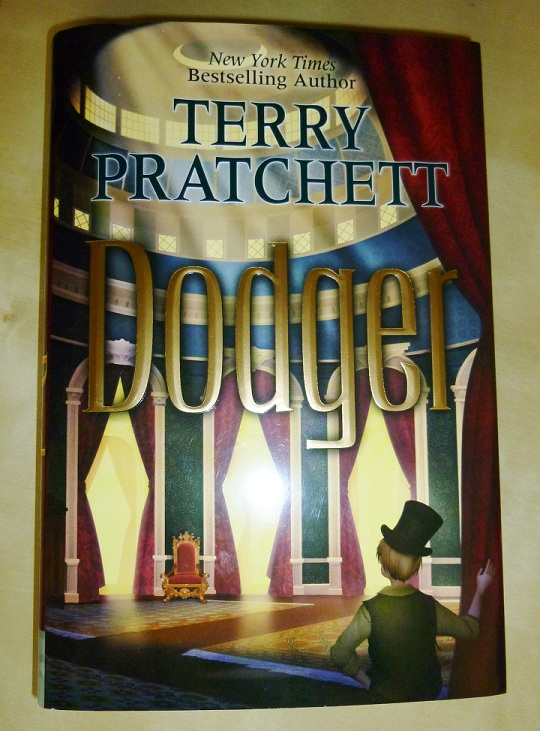 Considering how much I love Terry Pratchett’s Discworld books, I have been impatiently awaiting his latest book–even if it isn’t Discworld. Dodger
To clarify one thing at the beginning, the book is not really about the Artful Dodger from Oliver Twist–at least, not exactly. Say rather it’s a young man who could be the inspiration for the Artful Dodger–considering his connections to Charlie Dickens, and all.
Dodger is a tosher by trade, a seventeen year old boy who makes his living searching through the sewers of Victorian London in search of lost coins, jewelry and other treasure. And if occasionally things happen to fall out of their owner’s possession and into Dodger’s hands, well, who is he to dispute with a bit of good fortune? Everyone knows Dodger, and everyone knows Dodger never gets caught.
There’s no Fagin, but there is Solomon, a wise old Jewish watchmaker who gives Dodger a place to sleep and helps him stay on the straightish and somewhat narrow path. There’s no Oliver Twist, but there is Simplicity, a young woman Dodger rescues from a couple of thugs–a young woman who turns out to have crowned heads of Europe intensely interested in her. His efforts to help her will take Dodger into a whole new part of society and bring big changes into his life.
All in all, I didn’t love the book, but there is a great deal here to like very much. There’s enormous fun in the various historical figures Dodger’s path crosses–from Fleet Street journalist Charlie Dickens to up-and-coming politican Benjamin Disraeli, and a host of others I didn’t have enough historical grounding to recognize (but there’s a helpful afterword). We also wander into fictional territory when Dodger meets Sweeney Todd, more sad than demonic and a powerful lesson about the tendency of the world to create the story they want to hear.
Dodger’s character growth throughout the book is excellent. At first, he seems a little too noble (in the character sense) for a boy on the streets, but as the book develops and his character does too, it fits more easily. It’s not an easy growth, and Dodger finds a certain loss of identity (or at least uncertainty) in his sudden rise in standing and character.
My favorite things are a couple of character quirks. First, especially near the beginning, Dickens has a tendency to make a remark, get a look in his eye, and hastily jot something down–as when he made a reference to “our mutual friend.” I would have loved even more Dickens quotes sprinkled throughout–though there may have been more that I just missed. Second, I love Solomon’s religious life. He frequently explains situations to God, perhaps when someone is doing something a bit, well, dodgy. But Solomon will make matters clear to Him, in a lightly humorous and never offensive way. It has much the same feel as the beginning of the song “If I Were a Rich Man” in Fiddler on the Roof.
My least favorite thing…well, I found out a bit more than I really needed to know about Victorian sewers, and I could have lived with far fewer references to, shall we say, Victorian waste, human and animal, in and out of sewers. The most recent Discworld book featured an interest in bathroom humor, and I sincerely hope this is a short-lived trend in Pratchett’s writing. It’s more often nasty than funny, and frankly, I know he’s more clever than to need to resort to that.
Still, this is a fun trip through Victorian London with solid characters and a plot with a few good twists. Don’t come here expecting the high hilarity of Discworld, but it is an enjoyable historical novel.
Author’s Site: http://terrypratchettbooks.com/
Other reviews:
Things Mean a Lot
Katie’s Book Blog
Wickersham’s Conscience
Book Aunt
Fyrefly’s Book Blog
Yours?
The Graveyard Book Read-Along, Week Three
 This month, I’m participating in a read-along of Neil Gaiman’s The Graveyard Book
So much to love in these last two chapters–and so much to be desperately sad about! Since we’re talking about the end, there will be spoilers… Warning duly noted, let’s jump in!
Chapter seven is practically a novella, and right from the title, “Every Man Jack,” it promises us resolutions to the arching plot of the book. I love how this chapter ties bits and pieces together from almost every earlier, disparate chapter. A teenage Scarlett (chapter two) comes back to town, and finds her way to the graveyard and to Bod. She also meets Mr. Frost, a soft-spoken academic…who in a brilliant twist turns out to be the man Jack. I love that too–and you’d think I’d remember it! But I didn’t, so I got to be surprised again. This is why I enjoy rereading.
Meanwhile, Silas has disappeared from the graveyard on mysterious business. We find out that he’s with Miss Lupescu (chapter three) and other comrades in a desperate fight against a group of enemies. And I love that we have a last stand featuring a mummy, a werewolf and (though it’s never said, it’s pretty obvious) a vampire. I love that we get all the classic horror monsters, and in this case they get to band together and be the heroes. Love that. I do have to admit, though, that parts of this confused me. It eventually becomes clear they’re fighting the Jacks, but exactly where and how…I found that muddled.
Back at the graveyard, Bod finally has to confront not only the man Jack but several of his associates, the creepy men from that rather creepy convention we saw in the Interlude. I love their names: Jack Dandy, Jack Nimble, Jack Tar. I don’t get Jack Ketch–is that a reference I don’t know? I love that Bod has to use all his knowledge and friendships from growing up in the graveyard to protect himself and Scarlett–he makes use of the ghoul gate (chapter three), gets help from Liza the witch (chapter four) and ultimately uses his experience of the Sleer (chapter two) to defeat the man Jack.
I love that Bod has to really embrace who he is as a child of the graveyard–realizing that he doesn’t need to “learn” his name. He is Nobody Owens. He uses all that he’s learned to protect himself and his friend. And I love that Gaiman manages to handle all the men Jack without Bod actually killing any of them. As a writer, I know that requires much more creativity than just killing the villain.
I am desperately, desperately sad about Scarlett. Bod felt so drawn to her, and she was his only human friend…and then she becomes afraid of him…! It’s such a tragic twist, that in the process of embracing his own identity and vanquishing his enemy, Bod ends up losing his friend. He protected her, and then she rejects him for it. I love the emotional tug of it–brilliant storytelling–while being so sad for him, and so disappointed that Scarlett couldn’t make the leap to accept him.
Chapter eight is very bittersweet as well. Almost an epilogue chapter, Bod is growing up and that means leaving the graveyard. It’s so sad that he can no longer see this community that he’s grown up in, while at the same time it’s exciting that he’s going to go explore the world beyond the graveyard. The ghosts and the graveyard become a metaphor for childhood as he has to leave it behind to become an adult.
I get the metaphor, and it’s effective. But I do wish the graveyard could still be there for him to go back to, the way some of the joys and wonder of childhood can still be found by adults. And also, the idea of a sixteen year old boy with scarcely any experience of the world going out into the world alone–it sets off all kinds of screaming alarms in my head. Silas, this is not responsible guardianship! At least take him on a Grand Tour before sending him off by himself!
Though on the other hand…Bod set off into the world alone as a toddler, and made his way to the graveyard. Now, at sixteen, he’s continuing that journey.
And I love his last exchange with Silas. Love.
And I love to think that someday, after a long life full of lots of adventures and meeting people who won’t run away, I love to think that Bod comes back to the graveyard.
I’d also love to see a sequel about Bod’s adventures in the world. Such potential for so much more.
In the meantime, I have thoroughly enjoyed taking a leisurely trip through this book again, and loved all the thought-provoking discussion on everyone’s blogs. Big thank you to Carl for hosting, and to everyone for all your wonderful thoughts!

