Blog Hop: Goal-Oriented Reading

book-blogger-hop-finalToday’s Book Blogger Hop question is: Do you participate in readathons and/or reading challenges?

I think we all know I do reading challenges. 🙂  I’ve had annual challenges every year since starting this blog, though some years have been more intensive than others. I really enjoy reading challenges, partially because of how I use them.  I don’t ever set challenges to get myself to read books I don’t want to read (well, except maybe for the “read long books I’ve been avoiding” challenge I did one year–and I ended up liking most of those book anyway).  I use challenges to focus my reading, to remind myself to read books (or book types) I actually do want to read, but wouldn’t necessarily think about all the time.

I’ve never done a readathon.  I read a LOT, but in small snatches.  I rarely read for more than a half-hour stretch.  Partially that’s a product of how my life is structured, but I’m also really used to that.  I don’t often want to read for a lot longer than that.  Well, I often think I do in theory…but I’m also pretty sure that really I’m a quick stop reader, and will get antsy most of the time if I read for a lot longer.  Once in a while I’m genuinely in the mood to read all afternoon–but it’s unusual.

Are readathons or challenges a part of your reading?

Book Review: All Our Wrong Todays

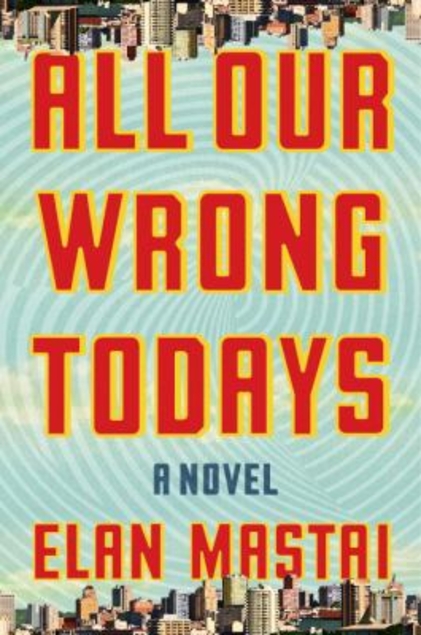
What if the world you and I are living in is, in fact, a dystopia?  That could (tragically) be the beginning of a review of a nonfiction book, but instead today I’m talking about another parallel universe book: All Our Wrong Todays by Elan Mastai.  What if the world we think is real is actually the product of meddling with time travel, and we’re living in the universe gone wrong?

Tom Barren lives in a 2016 that looks a lot like the future envisaged in the 1950s.  Flying cars, high-tech medicine, an endless supply of free, non-polluting energy, universal peace.  It’s all because of a new, energy-generating technology discovered in 1966.  When Tom travels back 50 years to the dawn of his age, he inadvertently meddles in that key point in time–and wakes up to find himself in our 2016.  But then he has a dilemma–because while the world might be happier in his original universe, his life is significantly better over here.

This is one of those books I picked up because it had such an interesting premise–and it largely delivered on the promise, even if it didn’t turn out to be exactly what I expected.  I was so fascinated by Tom’s world and the events that led to its creation.  There was quite a bit of that, although the world is presented more through contrast with ours then by spending a lot of time in it–which kind of makes sense.  For Tom, replicators (or the equivalent) are normal, so they probably aren’t going to come up until he’s trying to make sense of a microwave.  We saw the alternate path of history and how a small shift could change it much more clearly, and that was very cool to explore. Continue reading “Book Review: All Our Wrong Todays”

Blog Hop: A Long Time Ago…

book-blogger-hop-finalToday’s Book Blogger Hop question is: Do you ever go “way back” to when you first started blogging and look at your old review posts? Do you see any differences from then to now?


My earliest posts really are pretty far back by now–since I’ve been writing this blog for almost seven years!  I look back occasionally, when I want to see what I said about something that comes to mind again, to reference with a link back if a topic comes up now, or to choose a Classic Review to repost.

I don’t think my taste has changed hugely since I started blogging.  It may have become broader–I read less YA and more nonfiction, and the various challenges I’ve had over the years have influenced the more specific topics I may have covered (like fairy tales or parallel universes).  But overall, if I liked a book way back when, I still like it now–and if I disliked one, well, I probably haven’t reread it, but I usually still think I had good points.

My reviewing has become more immediate.  In early blog days I did more reviewing of favorite books I hadn’t reread recently.  It didn’t take long, though, to realize that it’s a lot easier reviewing a book I just read, so that shifted pretty fast.

The biggest difference to me may be subtle to other people.  I think I’m more confident in my reviews now.  At first I think I felt a need to defend my opinion–now, I still will tell you why I like or dislike something, but it doesn’t feel like an assertion so much as a statement.  That may not look very different to anyone else, but I can see it!

Readers who are also book bloggers, do you ever go back farther?  How has your reviewing change?

Blog Hop: From Screen to Page

book-blogger-hop-finalToday’s Book Blogger Hop question is: Do you read tie-in novels to movies or television series? If so, which ones?


I have been known to read books based upon the universes of TV shows or movies–I put it that way deliberately, because I only read ones that are novels in their own right.  I’ve never been very interested in companion books that are only retelling or commenting upon the screen story.

I’ve read great swathes of books in the Star Trek universe (almost exclusively TOS) and the Star Wars Expanded Universe.  To large extent, my mental conception of those worlds and their major characters are actually shaped more by the books than by the screen versions.  Separated from the sometimes cheesy acting of the TV show, or the complete disruption of the recent movies, it’s the Captain Kirk of the books that I really love.  And I’m deeply invested in the romance of Leia and Han as portrayed in the Expanded Universe (stable and supportive), and particularly in the later lives of Leia (Jedi, diplomat, leader of the New Republic, wife, mother of three) and Luke (founder of the New Jedi Order).  The seeds are on the screen, but all this is so much more developed in the books.

This creates some complications, of course, when the powers that be go back to the screen and disregard the books.  This happened rather famously recently with Star Wars, but has happened with Star Trek too, contradicting specific books (like Federation and Prime Directive, both disrupted at one go through First Contact).  I’m very comfortable, however, keeping the book version in my head as the “proper” story (for me, at least) and the screen version as an alternate universe.

Outside of those two particularly vigorous book tie-in series, I’ve also read a few Doctor Who novels…but those tend to be a bit simpler than I want in books, so my preference here is very specific–audiobooks only, and only the ones about the 10th Doctor read by David Tennant.  Because…David Tennant!  Reading the Doctor!  It’s kind of halfway to a TV episode right there.

I’ve also held onto two Smallville novels from my high school fondness for the show, and I have the complete Hercules: The Legendary Journeys novel series…which is only four books–but they’re good ones.  I also read a lot of Sabrina: The Teenage Witch novels in high school.  I can’t claim those are mostly high quality (not bad for the target age, but not great literature) but though I’ve culled that collection dramatically over the years, I still have several on my shelf for sentimental fondness.

I think that covers it.  Star Trek and Star Wars are the big ones…but those are the big powerhouse fandoms, so it’s not too surprising!
Book Review: Rainbow Valley by L. M. Montgomery

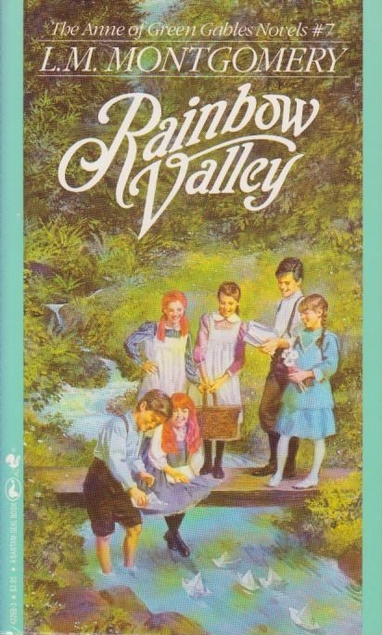
I’m continuing my way through a reread of the Anne of Green Gables series, and continue to have more thoughts.  This time I’m thinking about Book 7, Rainbow Valley.  Rather like certain Oz books, this is the Anne book that isn’t an Anne book.  But it’s very much a Montgomery book, with certain of her attitudes on full display.

By the time Montgomery wrote Rainbow Valley, I really don’t think she wanted to write about the Blythes anymore.  This was her fifth book (4 and 6 were written later), and because she wrote it before Anne of Ingleside, it was the first with Anne and Gilbert’s children.  With the partial exception of Walter, Montgomery doesn’t seem very interested in the Blythe children.  She gave Anne a happy ending, Anne’s children grow up in the midst of said-happy ending, and Montgomery was not yet at a point in her life when taking refuge in that happy ending was welcome to her (as in Anne of Ingleside).

So she did what other authors have done–billed the book as next in a popular series, then proceeded to write an almost original novel.  We get about two chapters of Anne and her family, then the focus shifts irrevocably to elsewhere in the neighborhood, to tell the story of the less fortunate and more interesting (to Montgomery, and by narrative convention) Meredith family.  I have to admit, the bait and switch has taken me many reads to get over.  I think this is the first time I’ve managed to really accept that this is not and was never going to be a Blythe novel, rather than feeling that we somehow got cheated out of the story that was meant to be here in the series.  And you know, after getting past that, this is a good novel! Continue reading “Book Review: Rainbow Valley by L. M. Montgomery”