Favorites Friday: (Un)forgotten Childhood Reads

Looking for a bookish topic for this week, I went to see what the Broke and the Bookish have proposed in the past–and found Childhood Favorites right at the top of their list.  I’ve written about a number of childhood favorites (like Monday’s Classic Review), but I thought there had to be many I’d never mentioned.  So of course I went to my bookshelf for some slightly more obscure favorites.  It wasn’t hard–I’ve made a habit for years of buying childhood favorites from the library’s (extremely cheap!) warehouse sale, in part so I won’t forget them!

1) The Mystery of the Cupboard by Lynne Reid Banks – The Indian in the Cupboard is one of those well-known classics, and I liked that one…but I liked the later Mystery of the Cupboard better, with its story of how the cupboard became magical.

2) Caddie Woodlawn by Carol Ryrie Brink – Not unlike Little House on the Prairie, this is a story of a child out on the frontier…although somehow Caddie seemed to have more fun and lead a less lonely life than Laura!  Funnily enough, long before I ever went to England, I didn’t feel quite the way I was obviously supposed to when the Woodlawn family must decide whether to go take up an English estate or to stay on the frontier…  I think I’ve always been in favor of civilization though!

3) The Wednesday Witch by Ruth Chew – A very charming little story of a girl who meets a witch, whose spells only work reliably on Wednesdays.  It’s funny and cute and, come to think of it, features a talking cat…

4) Beverly Cleary, en masse – I haven’t written much on this very well-known author, but I think I’ve read just about all of her canon.  I certainly read the entire Henry Huggins series, and the related Ramona series.  My favorite was Ribsy, from the dog’s point of view.

5) Morning Girl by Michael Dorris – The story of a girl and her brother growing up in the Bahamas in 1492, it brings a very foreign culture vividly to life.  I suspect that the sinister undertones to the arrival of Christopher Columbus in the Epilogue went completely past me as a child…  Randomly enough, this is the first book I can remember reading with alternating first person points of view.

6) The Music of Dolphins by Karen Hesse – I love the way this one is written.  A girl who grew up with dolphins is “rescued” and taken to a research center for education (and study, though the people do seem benevolent).  Written from the girl’s point of view, the language and sentences grow increasingly complex as she learns.  It’s not unlike Flowers for Algernon, I suppose (though the ending is happier, if rather implausible).

7) Howliday Inn by James Howe – This series is better known for Bunnicula, but my library had Howliday Inn so it was the one I read first.  The character of Bunnicula is almost completely absent–so in my mind, this series was always primarily about well-meaning Harold the dog, and suspicious, scheming Chester the cat.  They’re funny and absurd and wonderful characters.

8) Mrs. Piggle Wiggle’s Magic by Betty MacDonald – I read this entire series, about clever Mrs. Piggle Wiggle who solves behavior problems for all the neighborhood children…but this is the best one.  In the first book her solutions are purely practical and a bit heavy-handed.  Magical solutions are so much more fun, when tattle-talers have clouds with tails hang above them and a “heedless breaker” finds herself moving in slow-motion.

9) Island of the Blue Dolphins by Scott O’Dell – Somewhat like Morning Girl but in the opposite ocean, this invites us into Native American life on a small Pacific island.  This becomes a castaway story when a girl ends up living on the island alone for years.  This also contains a rather sad ending…but I remember the sadness did hit me as a kid for this one!

10) Yesterday’s Doll by Cora Taylor – I’m not sure if I was more fascinated by the doll handed down through generations, or the fact that she’s the key to time travel…but either way this one captured my imagination too.

What were your childhood favorite books?  Maybe not the very top of the list ones, but the ones that still hold fond memories for you too?
Classic Review: Abel’s Island

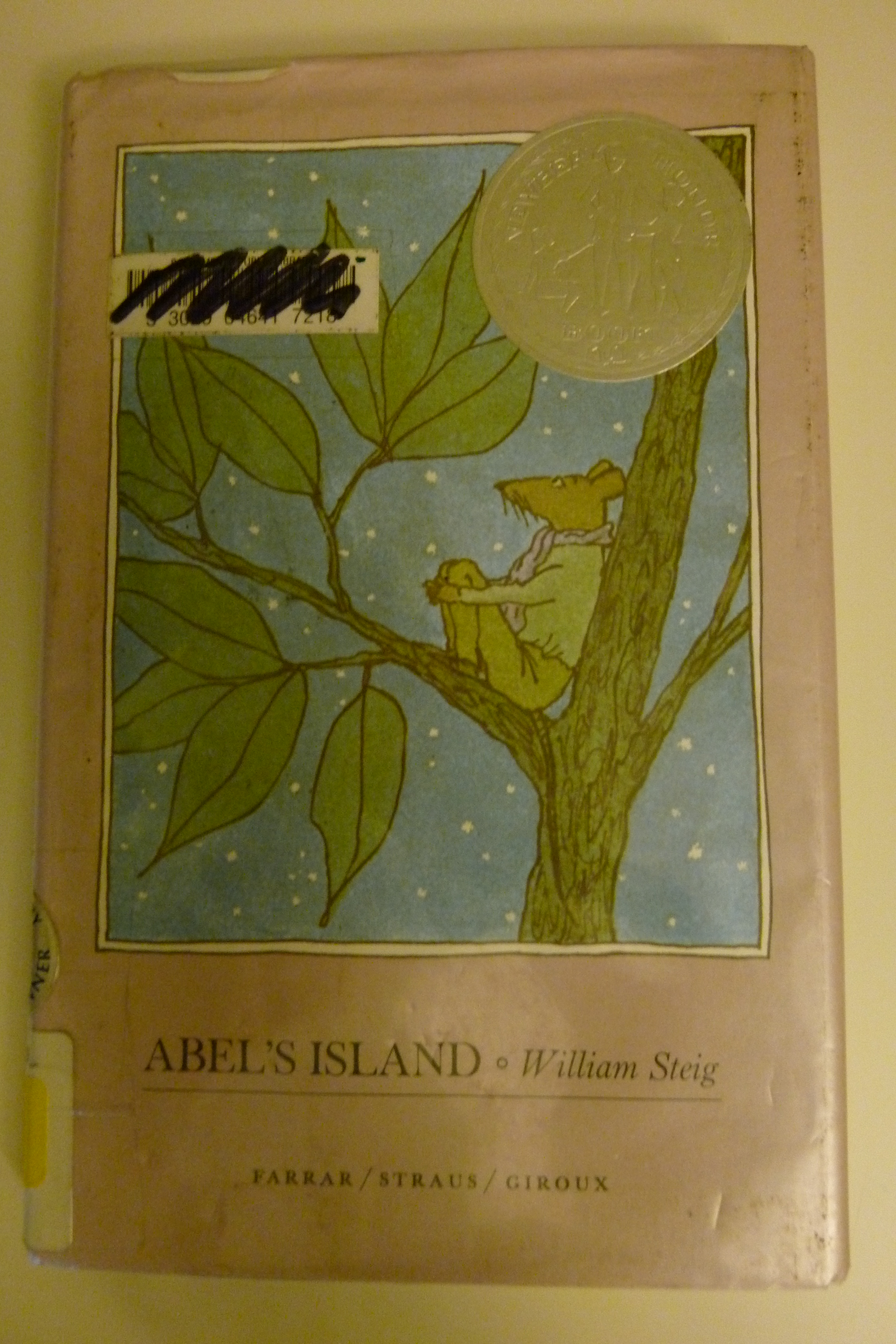
Today a look back at a long-time, if quiet, favorite.  This isn’t a book that shows up on my favorite lists usually, but it stuck with me more than most…and it’s my go-to when discussing whether deep and complex subjects can be appropriately portrayed in children’s stories!

***************

It’s funny the books that stay with you.  I remember around about third grade (maybe, I don’t remember that part for sure) we had to do a certain number of book reports during the school year, maybe per month.  I don’t remember if I found that challenging, but I doubt it.  🙂  I also don’t remember any of the books I did for this, except one: Abel’s Island by William Steig.  For whatever reason, that one stuck.

Although I don’t think it was until I reread it recently that I made the connection–William Steig!  The one who did a bunch of picture books!  You know, Doctor De Soto and Sylvester and the Magic Pebble (and he also has the happy good fortune of being alphabetically near James Stevenson, my favorite picture book author).  Yet another advantage of revisiting childhood favorites. Continue reading “Classic Review: Abel’s Island”

Blog Hop: …And We’re Off!

book-blogger-hop-finalToday’s Book Blogger Hop question is: When you start reading a novel, do you prefer to be plunged right into the action, or do you prefer a slower, more descriptive introduction to the plot and characters?

Typically I suppose I prefer something in between.  I like a chance to get to know a world and characters before too much action is happening, but I want something happening in the opening chapters.  I don’t want to be plunged directly into the Battle of Helm’s Deep with a lot of people I don’t yet care about, but I also don’t really need to go strolling through the Shire, listening to an extended history of Elvish linguistics for the first three chapters.  So to speak.

Mostly, though, I think this is not unlike my thoughts about multiple narrators—it’s all fine, if done well.  A book can start mid-action and reveal plot and character while a lot is happening, or it can start with less action but still hold interest.  It all depends on what’s right for the story, and how skillful the author is.

Book Reviews: Good Masters, Sweet Ladies and Crispin

I accidentally paired two Newberys lately, and found myself reading two books about small medieval villages in a row.  Which actually worked out well, as a lot of historical elements paralleled and supported each other.

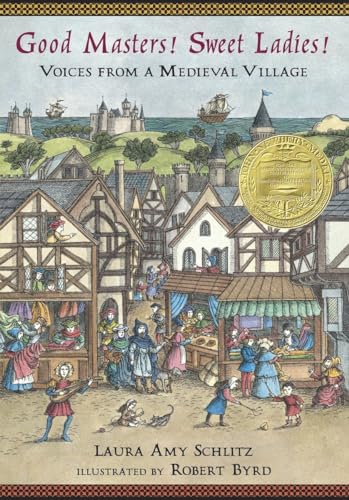
First I read Good Masters, Sweet Ladies: Voices from a Medieval Village by Laura Amy Schlitz.  An unusual format, this is a collection of monologues (and two dialogues).  Each speaker is a different character from the same village, each speaking about his/her life.

Considering the presentation, I was impressed by how vividly the characters and world came to life.  Originally written for a school pageant (giving each child a good part), all the characters are children.  They’re a wide range of classes and life situations, from the Lord’s son to the beggar boy.  Altogether they depict the society, its rules and hierarchies throughout the village.

I liked best the monologues that built on each other, as when the Lord’s daughter spoke about having a clod of mud thrown at her and her confusion…followed by the monologue of the girl who threw it, and her hard home life, envy of the Lord’s daughter, and ultimate remorse. Continue reading “Book Reviews: Good Masters, Sweet Ladies and Crispin”

Blog Hop: Many-Headed Stories

book-blogger-hop-finalToday’s Book Blogger Hop question is: How do you feel about books with multiple narrators?

Ah, now this feels like the kind of question that might come up at my writing group!  I frequently enjoy (and often write) at least two point of view characters (or narrators).  It’s a common practice to write a novel from the alternating points of view of the two romantic leads (I knew immediately how a triangle would turn out in a romance once, just because of this).  Sometimes that’s been the case in my own books, though not always.  I guess it always has been the case that my two point of view characters are the pair that forms the most significant relationship in the book, romantic or otherwise.

Huh, I actually never thought about that before…

Three narrators is perfectly reasonable too, and maybe four…though the more you add, the more complex it becomes and the harder it gets for the reader to keep track.  That can go badly sometimes in ensemble cast novels, with six, eight, ten narrators.

That higher complexity is definitely something we’d warn about in my writing group, if someone was thinking about how many POV characters to write (the question has come up often).  Two other things: it’s crucial to make it very clear to the reader when a POV is switching.  I generally do chapter breaks, sometimes just a scene break (but a clear one).  It’s equally crucial that different POV characters have different voices.  If they all sound the same, the reader will have a much harder time keeping track (and possibly grow bored besides).

But if those pitfalls are avoided, and if all is written well, then I like multiple POVs just fine.  But I like most storytelling choices, if they’re done well!