Riding Towards Narnia

After listening to The Magician’s Nephew on audiobook, I continued my adventures through Narnia with The Horse and His Boy.  It’s the third book, chronologically, but I reread The Lion, the Witch and the Wardrobe relatively recently, so I jumped on ahead.

The Horse and His Boy is set during The Lion, the Witch and the Wardrobe–or during the reign of High King Peter, in in-universe timeline.  This book centers on new characters, with the characters from the previous book only in supporting roles.  This is the story of Shasta and talking horse Bree, who flee the oppressive empire of Calormen, trying to reach the free kingdom of Narnia.  They join forces with Aravis, a Calormene aristocrat fleeing an arranged marriage, and her talking horse, Hwin.  Their mission takes on new urgency when they overhear Calormene plans to conquer Narnia and neighboring Archenland.

This one started a little slow for me, though I’m not sure why.  It may have just been me, but it took me a while to get involved with the characters.  I found it picked up right around the same time the Narnians first arrived in the story.  I don’t know if that was because of them, or because the threats from Calormen became more pronounced then, or if I’d just been listening long enough to get engaged.  After that, the book has more momentum as it becomes a desperate race to warn Archenland and Narnia before invading forces arrive.

As in The Magician’s Nephew, I found the supporting characters highly engaging.  The talking horses were particularly good, as Narnian exiles both eager and anxious about going home again.  Bree is decidedly arrogant, while Hwin is sweet and altogether too self-effacing.  I also liked the glimpses of Lucy, Edmund and Susan as adults…although it adds hugely to the tragedy of the previous book, when they’re pulled out of Narnia and sent home to be children again!!  They had amazing lives in Narnia–how do you go home after that?  But that’s classic children’s fantasy for you…

I liked Shasta and Aravis well enough too, if not extraordinarily.  Perhaps a little context on that comment, though…  When I reread The Lion, the Witch and the Wardrobe, it was because I had just read The Magicians by Lev Grossman, which made me desperately want to run back to Narnia.  So now any time I feel at all disengaged from characters in Narnia, all I have to do is remind myself–I could be reading about Quentin and his friends from The Magicians–and then I’m very happy to be with Lewis’ characters instead!  So take “disengaged” as a relative term…

Although I enjoyed the Narnians so much, it was also fun to see a different country in this world.  Calormen has Middle Eastern elements, and was very richly described.  Archenland was less developed, but I really liked the bits in the Epilogue about Archenland’s history.  Seeing multiple countries, with their own governments and cultures, gave a much more grounded feel to the magical country.

All in all, this isn’t my favorite installment of Narnia (so far Magician’s Nephew is still holding title) but it was a good ride!

Author’s Site: https://www.cslewis.com/us

Other reviews:
The Bookworm Chronicles
The Daydreaming, Candy-Eating, Redheaded Bookworm
Here There Be Books
Anyone else?

Buy it here: The Horse and His Boy

The Magician’s Nephew

I have been meaning for ages to reread C. S. Lewis’ Narnia series…in part because Jessica keeps reviewing them!  I have such a stack of other books, though, that I kept not getting to them, until I finally hit on the idea of audiobooks–which should have been obvious to me, considering my first Narnia experience was when my dad read them to me as a kid.  So I just listened to The Magician’s Nephew, read by Kenneth Branagh, and am very happy to say that the story was even more delightful than I remembered.

Set chronologically before The Lion, the Witch and the Wardrobe, this installment gives the origin story for certain elements of the later novels, and provides a Narnia creation story.  That said, it’s largely stand-alone, apart from a few references at the end along the lines of “and so this led to that and much resulted, but that’s quite another story…”  This story is about Digory, his friend Polly, and his Uncle Andrew, a rather nasty man who has been dabbling in magic.  Uncle Andrew has devised magic rings which he believes will send people to another world, and tricks Polly and Digory into taking the trip.  They reach the magical Wood Between the Worlds, and venture first into dying Charn, where they meet the evil Empress Jadis, and then into Narnia, on the day of creation.

Digory and Polly fit in amongst Lewis’ collection of child heroes, imperfect but basically good, generally courageous and honorable though apt to falter at times in a very human and believable way.  They provide a solid center to the story, while the surrounding characters are in some ways more complex.

Uncle Andrew is wonderfully painted in his egotism and cowardice, so sure of his own inherent greatness but so obviously a petty, narcissistic man.  Jadis shares some of Uncle Andrew’s narcissistic tendencies, but is clearly in a class all her own for sheer cruelty and coldness.  Once Jadis arrives on the scene, Uncle Andrew shrinks dramatically as a villain, so obviously upstaged by the real villain.  Lewis does something rather brilliant in that, as soon as Uncle Andrew loses power as a villain, he’s turned into a comedic figure instead, equally effective in that role.

I madly loved the setting of this book–all the settings, actually.  I don’t know how Lewis resisted doing an entire extended series just centered around the Wood Between the Worlds.  I mean, it’s an endless forest full of pools of water, and each pool goes to another world.  And we only went through three pools, counting the one to our world.  The untapped possibilities!

And then Charn was just fascinating.  Lewis has never before reminded me of Tolkien (though I hadn’t read Tolkien before either…) but Charn with its enormous marble edifices, apparently ancient history, and epic battles, reminded me of Middle Earth (less trees, though).  It had a similar quality of existing on an unimaginably epic scale.

I loved the creation of Narnia too.  How lovely to have a world spring into being through a song!

Just when everything was getting very solemn and epic and sweeping, when it might have become a little too much–it didn’t, because there’s a wonderfully funny episode of Narnia’s newly-created animals trying to decide what ought to be done with the raving Uncle Andrew.  They aren’t quite sure if he’s an animal or a tree…

If you’re thinking about starting Narnia, you could begin here (and if you’re thinking about the audio, Branagh was excellent).  It’s listed as #1 in a lot of editions, since it is first chronologically.  However, I think you’d be better off starting with The Lion, the Witch and the Wardrobe, for the sake of all those “and then it led to other adventures” references.  But once you’ve read Lion, I don’t see any need to go through the next several books, in their original publishing order, before reading the very delightful Magician’s Nephew.

Other reviews:
The Bookworm Chronicles
Sonya’s Cannonball Read
Stray Thoughts
Here There Be Books
Kristina Yarn
Anyone else?

Buy it here: The Magician’s Nephew

Rambling Philosophy About Coming of Age

As another companion piece to The Graveyard Book read-along, this week we’re writing about coming of age stories.

I have to admit, I had some initial tripping-up with this topic.  But I think I’ve got my train of thought sorted out–we’ll see as I type!

When I first heard “coming of age stories” as a topic, my brain perversely went to Peter Pan–who is the complete opposite.  He’s the character who flatly refuses to come of age, ever.  However, I do think that’s one part of the story, as it leads me to the question: why does Peter choose not to grow up?

So I turn the pages to the section of the book when Wendy tries to coax Peter to stay in London with her, and I find that he balks because she would send him to school and then to an office and soon he’d be a man, to paraphrase slightly.  Well, if being a grown-up just means going to an office, by all means, fly back to Neverland, Peter!  That’s what it seems to mean for the other boys; we hear about them as adults, and the saddest is John, the bearded man who doesn’t know any stories to tell his children.  It all rather makes me wonder about J. M. Barrie’s life.

To turn this back around again, I think a key part of growing up is realizing that there’s more to being a grown-up than going to an office!  Peter wants to “always be a little boy and to have fun,” but grown-ups can have fun too.  Different fun.  It’s worth remembering, because when life does seem to revolve around going to an office (or any other humdrum parts of grown-up life, like washing dishes and paying bills), it’s easy to start thinking Peter was right.

But he wasn’t.  And he was also wrong that grown-ups can’t go to Neverland–in a metaphorical sense, of course.

To move along in that direction, let’s look at another classic children’s writer, who seemed to have a healthier view on things.  First, I quote St. Paul, who said something to the effect of, “When I became a man, I set aside the things of childhood.”  C. S. Lewis followed that up with, “And one of the things of childhood I set aside was the fear of being thought childish.”

I remember that there was a point in my life when I came to a revelation that I didn’t have to stop reading children’s books.  And that I can still go to Disneyland and ride the Peter Pan ride.  Of course, now I also have a quite different appreciation for the Pirates of the Caribbean ride, and I read books from the grown-ups section too.  But I don’t have to let go of all those children’s things if they still appeal to me.  Neverland might look different to us, but we can still get there.

Or to put it another way, growing up means a bigger library to choose from.

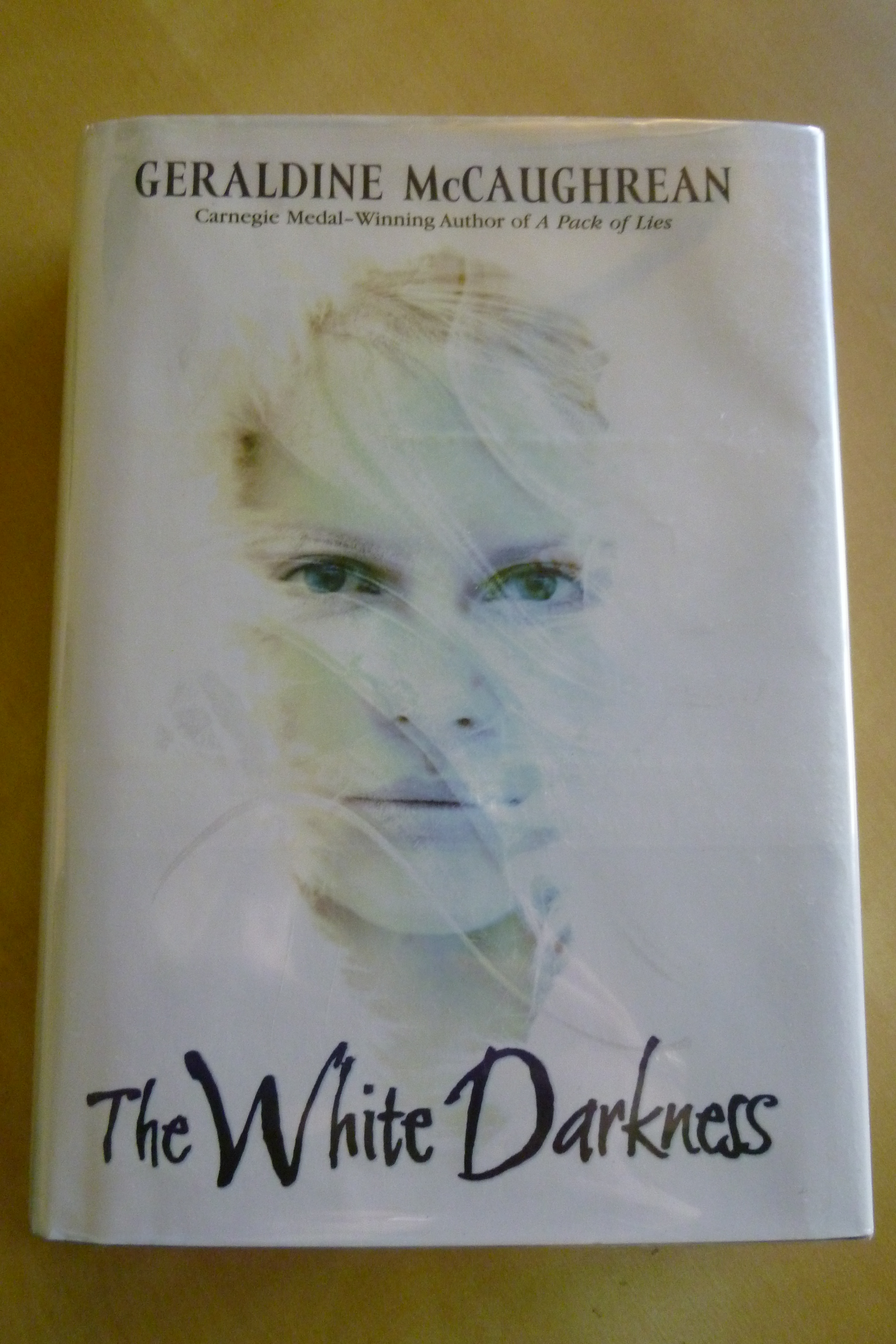
This puts me in mind of what actually is an example of a coming-of-age story, my much-beloved and frequently-referenced The White Darkness by Geraldine McCaughrean.  Spoilers here, so you may want to drop down a paragraph.  For new readers, The White Darkness is about Sym, a fourteen-year-old girl who creates an imaginary friend out of Lawrence “Titus” Oates, the Antarctic explorer.  She gains confidence and self-understanding through a really awful experience in Antarctica.  You could say she grows up.  In the course of that, a couple of times I was afraid she was going to have to give up Titus, as part of growing up–but she never does.  And that makes me immensely happy, possibly because of all those things I was discussing above.

On a side-note, since I brought up the book–I also have to say that I was very sad recently to hear about the death of Richard Morant, the inspiration and audiobook-voice of Titus.  I don’t actually believe in ghosts and I certainly don’t want to confuse the actor and the character…but all the same, I like musing over the idea that maybe he’s off being a supportive shoulder to some girl in great need of a friend.

Back to the topic: another coming-of-age story that comes to mind is, oddly enough, The Mischief of the Mistletoe by Lauren Willig, who would probably be taken-aback to hear her story described that way.  It deals with two adults, Arabella and Turnip (don’t ask about the name), who fall in love while trying to untangle a spy ring.  And you ask how this relates.  But it does, more obviously for Arabella, but really both of them.  Arabella starts out as a shy, mousy wallflower, who finds herself as a strong, capable woman.  Turnip shows up in earlier books in the series, always as the buffoon everyone treats as comical and then disregards.  He stays comical, but he also emerges as having much more worth than it previously appeared.

Which brings me to what I think will be my final point–that coming-of-age stories don’t necessarily have all that much to do with age.  Or if they absolutely must, then I seem to be talking about a different sort of story, though a related one.  I think what it’s really about is figuring out who you want to be.  Not who the world says you are, or who you are when you’re afraid to be something else, but who you want to be.  Often that happens at a certain age–but not necessarily–and to some extent it never really stops happening.

To circle back around to the beginning (because he wouldn’t like dropping out of the post), perhaps that’s another reason there could never be a coming-of-age story about Peter Pan.  He is who he wants to be.  He’s the little boy endlessly having fun.

For the rest of us, who follow Sym and Arabella and Turnip to “come of age,” I think it’s worth listening to C. S. Lewis, and to keep in touch with the Peter Pan and the Titus Oates in us all.

Exploring Space and Philosophy

As part of my ongoing quest to finish more partially-read series, I decided to tackle C. S. Lewis’ Space Trilogy.  I read Out of the Silent Planet upwards of eight years ago, I think I read part of Perelandra, and then I never finished.  Since the first one had gone blurry, I decided I’d better reread it, and go from there.
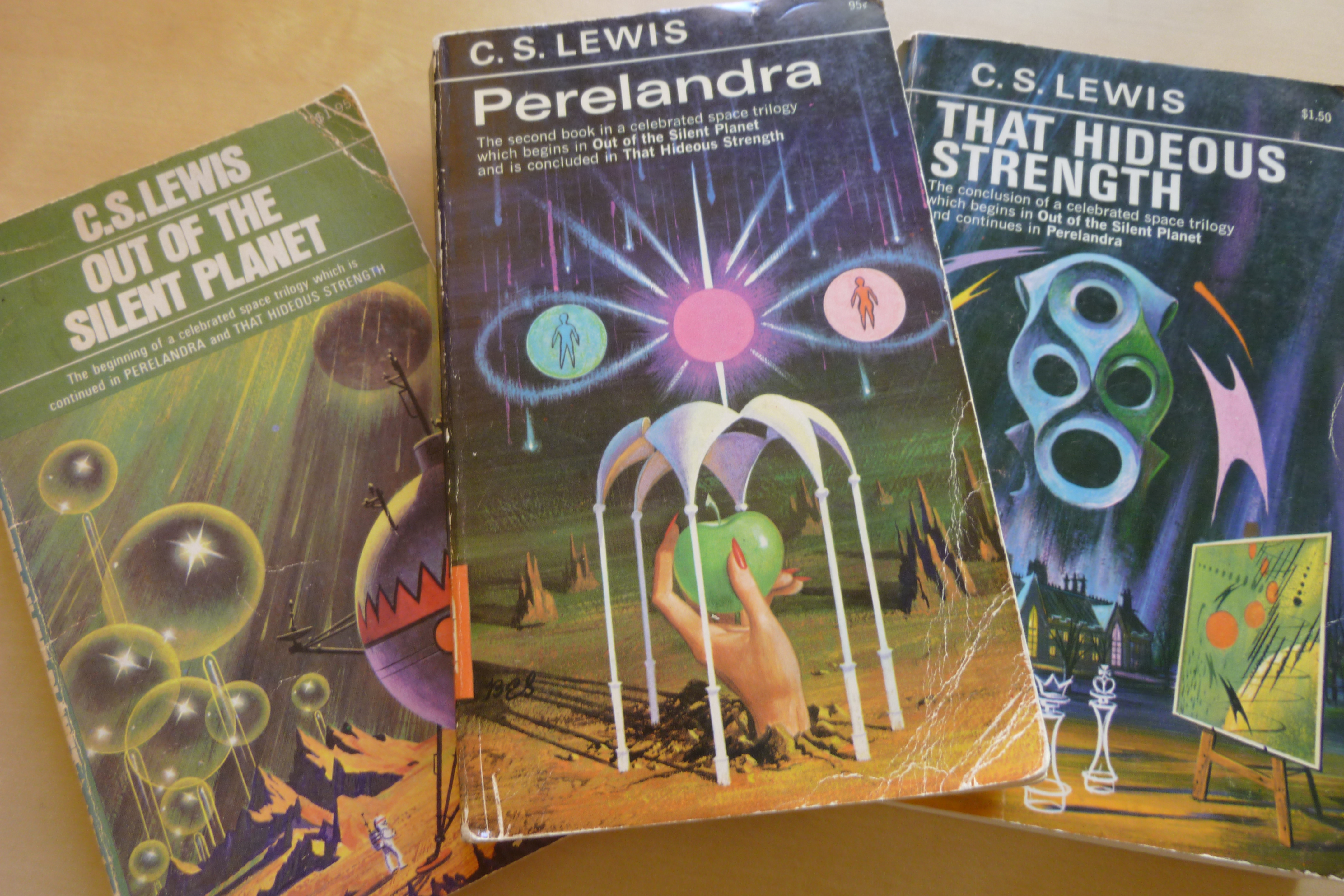
The story centers on Ransom, a scholar who wakes up from a kidnapping to find himself on a spaceship bound for Mars.  He eventually works out that the two men who captured him intend to hand him over as a sacrifice to the Martians.  When they land, Ransom succeeds in escaping his captors.  When he actually meets the people of Mars (or Malacandra, as they call it), he finds them kinder and wiser than he expected, while almost strangely innocent of evil and content with their lives.

While the plot sounds like a sci fi adventure (and it is), the trilogy is largely concerned with philosophy and theology.  Ransom learns that Malacandra is governed by a kind of spirit, the Oyarsa.  Earth is meant to have a guiding spirit as well, but ours turned evil long ago, giving rise to the host of problems on Earth that are unknown on Malacandra.

The second book, Perelandra, sends Ransom to Venus (which the natives call Perelandra).  Here we see a world where Adam and Eve haven’t left the Garden of Eden yet.  Ransom meets this world’s Eve, and engages in a struggle with a devil character who has arrived to tempt Eve to eat the apple–metaphorically speaking.

The third book, That Hideous Strength, moves the struggle between good and evil to Earth.  Ransom is still a significant character, but the book has an ensemble cast of characters who become mixed up with an Institute intent on reshaping society in a horrible fashion.

I enjoyed the first two books in the trilogy quite a bit, and then struggled with the third.  The first two remind me of Burroughs books. though with less action and more philosophy.  The main reason for that is the landscapes and the creatures.  Lewis describes the strange worlds of Mars and Venus extensively.  The surface of Mars is uninhabitable, and all life exists in deep chasms.  There are three co-existing intelligent species, all extremely unique in features and in culture.  Venus is almost entirely covered in liquid, and most “land” is actually floating islands which move with the waves, rising up in hills and dropping down into valleys and changing every moment.  I was fascinated by the worlds, and the philosophy was interesting, if a little lengthy at times.

The third book is set on Earth, so there isn’t a new landscape to explore.  More troublingly, the tone changed.  That Hideous Strength reminded me too much of Kafka in The Trial.  The reader and the characters frequently have no idea what’s going on, no one will give a straight answer to anything, and there’s a lot of stumbling about in confusion.  Many of the characters felt more like caricatures, somehow less human and relatable than the non-human characters of the first two books.  There were also bits of Ransom’s philosophy I didn’t agree with at all–let’s just say Lewis probably wasn’t a feminist.

The third book wasn’t all bad.  It was slow and confusing for the first two-thirds, but picked up and got clearer in the end.  There’s also a fascinating and (I thought) under-developed concept about the Pendragon, England’s guardian through time, and the waking of Merlin.

Overall, I’d have to say it was a great first two books, and then the third feels more distanced from the first two, and, for me, not nearly as good.  I know that’s not a universal opinion, though, so take it as a sign of my particular taste.

It was worth reading to the end of the series, though, and not only because it’s been niggling at me as unfinished business for over eight years!

Other reviews:
Palantir Blog
Tides and Turnings
Unabridged Chick
Tell me about yours!

Quotable C. S. Lewis

“We read to know we are not alone.”

– C. S. Lewis