2012 End of the Year Round-up

We’re coming up on the end of the year, and I think it’s a good time to look back at my reading in 2012! I don’t expect my favorite (and least favorite) books to change too much in the next few days.  My total reads this year comes in at 182, with possibly two more if I finish the books I’m midway through right now.  I’m calling that a good year in reading…

From that list, here are the ups and downs of my last twelve months of books.  Links go to my reviews.

1) Best Book  –  This is in some ways an easy question this year.  My favorite book all year was The Girl Who Circumnavigated Fairyland in a Ship of Her Own Making by Catherynne Valente.  Its only serious competition is its own sequel, The Girl Who Fell Beneath Fairyland and Led the Revels There.  These are both beautifully written books with wonderful characters, vivid worlds, and fun nods back to classic children’s fantasy, which I also love.

This was an easy question because I try to select from new reads.  But I would be remiss if I didn’t also mention that I reread some of my absolute favorite ever (ever) books this year: The Little White Bird by J. M. Barrie, Susan Kay’s Phantom, and The Song of the Lioness quartet by Tamora Pierce.

2) Worst Book  –  I must have had a good year, because I don’t have a clear frontrunner (backrunner?) for this one.  I’m going to have to say Wicked by Gregory Maguire, even though it was a reread.  It was my book club’s selection, and I was hoping to like it better on a second read-through.  I didn’t.  I did have a wonderful time discussing it, though.

3) Most Disappointing Book  –  This one could have been the worst book, but it’s a better fit for this slot instead: Star Trek: The Price of the Phoenix by Sondra Marshak and Myrna Culbreath.  They edited two excellent collections of Star Trek short stories, and the plotline looked good.  I have a weakness for storylines about characters apparently dead then returning, and this centered on Kirk doing exactly that.  But…it wound up feeling like the reader was thrown in mid-story and, a much bigger problem, there was something just off about the portrayal of both Kirk and Spock.  Spock gets upset with the villain and snarls.  I kid you not.  There was one very good McCoy moment when Kirk turns up alive, but otherwise this flopped.

4) Most Surprising (in a Good Way)  –  I’m going to say the Bloody Jack audiobook, by L. A. Meyer and read by Katherine Kellgren.  It wasn’t the book that was surprising, or even how good it was (I expected that) but how much I ended up really liking audiobooks in general, when I’d resisted for a long time!

5) Most Unlikely Read – Now and then I read something quite different than my usual fare.  One possibility is The Paradox of Choice by Barry Schwartz, since I so rarely read nonfiction.  But I think even odder was Pride and Prejudice and Zombies by Seth Grahame-Smith, though that was the fault of my book club.

6) Most Satisfying ReadLegacy by Susan Kay.  Not the best book of the year, not even a contender…but it gives me an immense feeling of satisfaction to know that I’ve finally read the only other book by the author of my favorite book.  And it’s a 600 page, heavily historical novel.  There’s some satisfaction just in finishing!

7) Best Series Discovered – I’ve been fighting very hard not to start series this year…  Fairyland is the obvious answer, but since it was the answer to #1, let’s say The Magicians and Mrs. Quent by Galen Beckett.  Jane Eyre meets Pride and Prejudice meets fantasy!

8) Most Hilarious Read  –  As usual, this goes to Terry Pratchett (for the third year!)  Of the several I read, I’ll give it to Wyrd Sisters, mostly for the scenes involving Death.

9) Can’t Believe I Waited Until 2012 to Read It  –  Since I spent the year trying to finish series, there are a number of candidates here.  I’m giving it to books 2 and 3 of the Lando Calrissian trilogy, considering until I picked them up, I vaguely thought I had already read them!

10) Most Looking Forward To in 2013  –  Easy.  Fairyland 3, which I certainly hope will be out some time in 2013.  🙂

What were your best or worst of 2012?  Or feel free to answer any of the other questions!

Visiting Stonehenge

With my trip to England this month, I thought it would be fun to share again my reflection on a past visit–specifically, to Stonehenge.  I don’t plan to head out that way this time, but here’s a story about the last time I was there.

*******************************

I swear Stonehenge was laughing at us.
Not literally, of course, I don’t mean it like that.  But in a metaphorical, immense, stony kind of way, Stonehenge was definitely laughing.

I think Stonehenge is maybe about an hour or two bus ride outside of London.  I say “bus ride” because I think tour buses are all that go there; tour buses and druids, maybe.  I was on a tour bus when I went there.  Tour buses usually make me sleepy, which is why I’m not so sure about the time length to get there.  I woke up quick when we got there though.  Stonehenge is not something to be slept through.

Continue reading “Visiting Stonehenge”

Another Lady Knight-to-be

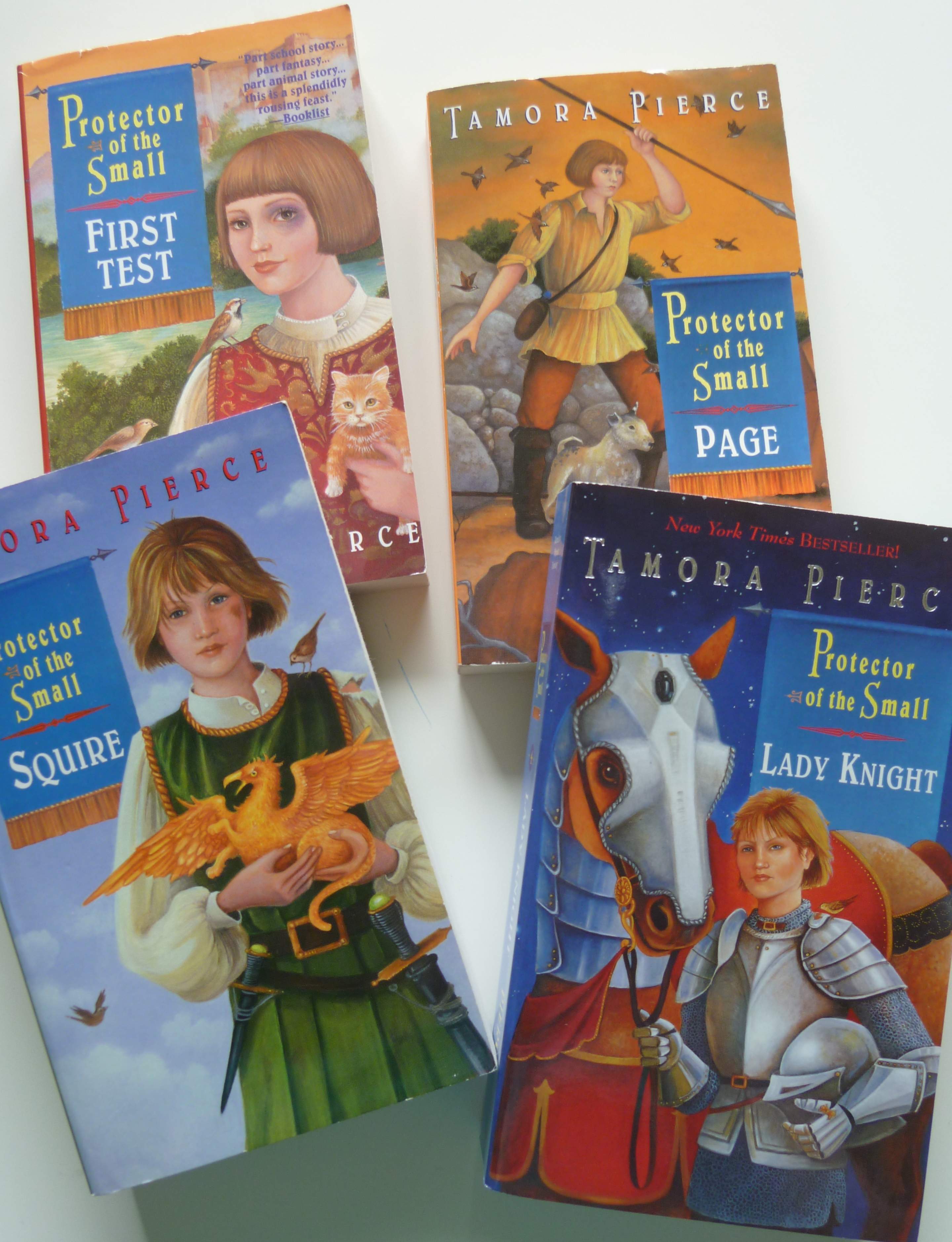
As part of my personal quest to re-read all of Tamora Pierce’s Tortall series (18 books!), I re-read her Protector of the Small quartet during March…then took forever to get to this review!

The heroine of Pierce’s third Tortall quartet is Keladry of Mindelan.  The first time I heard about this series, she was described as a girl with a knack for animals who wants to become a knight.  And I thought…well, isn’t that just a combination of The Song of the Lioness, about Alanna who wants to be a knight, and The Immortals, about Daine with her magical knack for animals?  It kind of is–but in most ways it’s not.

Alanna had to disguise herself as a boy to get her shield, but after her friend Jonathan becomes king, he decrees that girls can become knights.  Then for ten years, no girl ventures to try it.  Finally Keladry comes along, the daughter of a diplomat’s family who has lived most of her life in the Yamani Islands (a very obvious take-off on Japan).  Alanna is her hero (should I say heroine?) and she dreams of becoming a knight so she can protect the defenseless.  She becomes a page, but faces fierce challenges from boys and even instructors who don’t think a girl can be a knight.

The first three books (First Test, Page and Squire) follow Kel through her training, and the fourth book, Lady Knight, is about her first adventure as a knight, mostly commanding a refugee camp during a war.  (Sorry if that was a spoiler to tell you she does eventually get her shield…) In the first book Kel is only ten, but like Alanna, she’s a very OLD ten-year-old.  To diverge slightly, I actually have a theory about this.  Pierce originally envisioned Song of the Lioness as an adult book.  I’m guessing when she decided to make it YA, some editor told her the characters had to be younger, so she dropped five years off their stated ages; all of Alanna’s peers act pretty consistently five years older than they’re supposed to be.  Once Pierce had established that pages start training at ten, she was stuck with that in this quartet too.  I think my actual point here is, don’t be off-put by a quartet that starts out about a ten-year-old.  Kel never feels that young, and she gets older quickly.

The animals turned out to be a relatively minor point; Kel has a bad-tempered horse, a disreputable dog and a flock of very clever sparrows, but the intelligence of the animals is largely chalked up to Daine’s presence at court.  She has powerful magic that sort of seeps into the animals around her.  Kel doesn’t have any magic of her own, the only Pierce heroine not to have some kind of magical ability.

Protector of the Small is in many ways a transition series, both for Pierce’s writing and my personal engagement with the books.  These were written when I was in high school, so I read them later and less frequently than the first two quartets.  I’m not sure, but this may be only my second time through the series.  I like them, but I don’t madly love them the way I do the first two quartets–but I don’t know how much of that is simply my personal history and familiarity with them.  I do know two people who say these are their favorites.

I like Kel, but I don’t love her.  I admire her very much–more than Daine, if I really stop to compare admirability.  Kel is tough and brave and, as the quartet title suggests, constantly trying to protect those around her.  She wages a campaign against bullying among the pages in the first book, and gets into the defense of battered women in the second.  In the fourth, she’s fiercely protective of her refugees.  She’s a great character and a wonderful role model for girls.  And I do like her–but somehow I don’t quite love her.  Maybe she’s a little too serious, or a little too righteous, or maybe I just met her later than I met Alanna and Daine.  She’s inevitably the other lady knight.

Alanna is back in a small supporting role, and I’m always thrilled to see her.  Jonathan, Daine, Numair and a handful of other major characters from earlier books also have roles again, most notably Alanna’s friend Raoul, who if anything has a bigger part here.  As ever, it’s fun to see how characters’ lives are going along.  There are many good new characters here too.  My favorite is Neal, Kel’s very funny best friend (him I love), probably followed by Tobe, an orphan Kel takes under her wing in the fourth book.  There’s also a perfectly dreadful villain, Joren, who matches Duke Roger for charming viciousness.

I mentioned transitions in Pierce’s writing–Protector of the Small is definitely a changing point from the simpler earlier books to the more complex ones she’s writing now.  It’s a little hard for me to explain how they change, because Song of the Lioness has complex characters and complicated plots and good writing…but somehow the more recent books feel denser and grittier and more mature.  They do get darker, especially the fourth book, and the third and fourth are both much longer than earlier ones.  They were written right about when Harry Potter was getting popular, and Pierce directly thanks Rowling for opening the door to longer YA books.

There’s something more realistic about this series, although I’m struggling to put my finger on it.  Tortall has felt like a real, complex world from the beginning, but there is a certain amount of sorcery and legend feel to Song of the LionessProtector of the Small has less magic, and it gets into practical things like politics, diplomacy, the complications of supplying a band of knights, the difficulties of the legal system…  Alanna went through tough training, but Kel seems to keep count of the specific training and the bruises involved much more.  It’s just a bit of a different feeling.

In a way this quartet occupies an unfortunate space–I think I’d be more enthused about Protector of the Small if I didn’t love Song of the Lioness so much.  It really only falls short by comparison–and to be not as good as one of my most favorite quartets ever…well, that’s barely a criticism, really.  So, if it isn’t already clear, let me just say that this really is an excellent set of books, a fantasy series that is nevertheless gritty, with characters that are engaging and very human.  Well-worth reading.

And now I’m down to just two more Tortall books to re-read!  Stay tuned for a review of the Trickster books soon.  🙂

Author’s Site: http://tamorapierce.com/

Other reviews:
Respectable Collection
Young Adult Fiction & Whiskey Sours
The Literary Tally
I found a strange lack of reviews…I know other people are reading Pierce!  Point me to your reviews!  🙂

A Maybe-Monster, and a Monster-To-Be

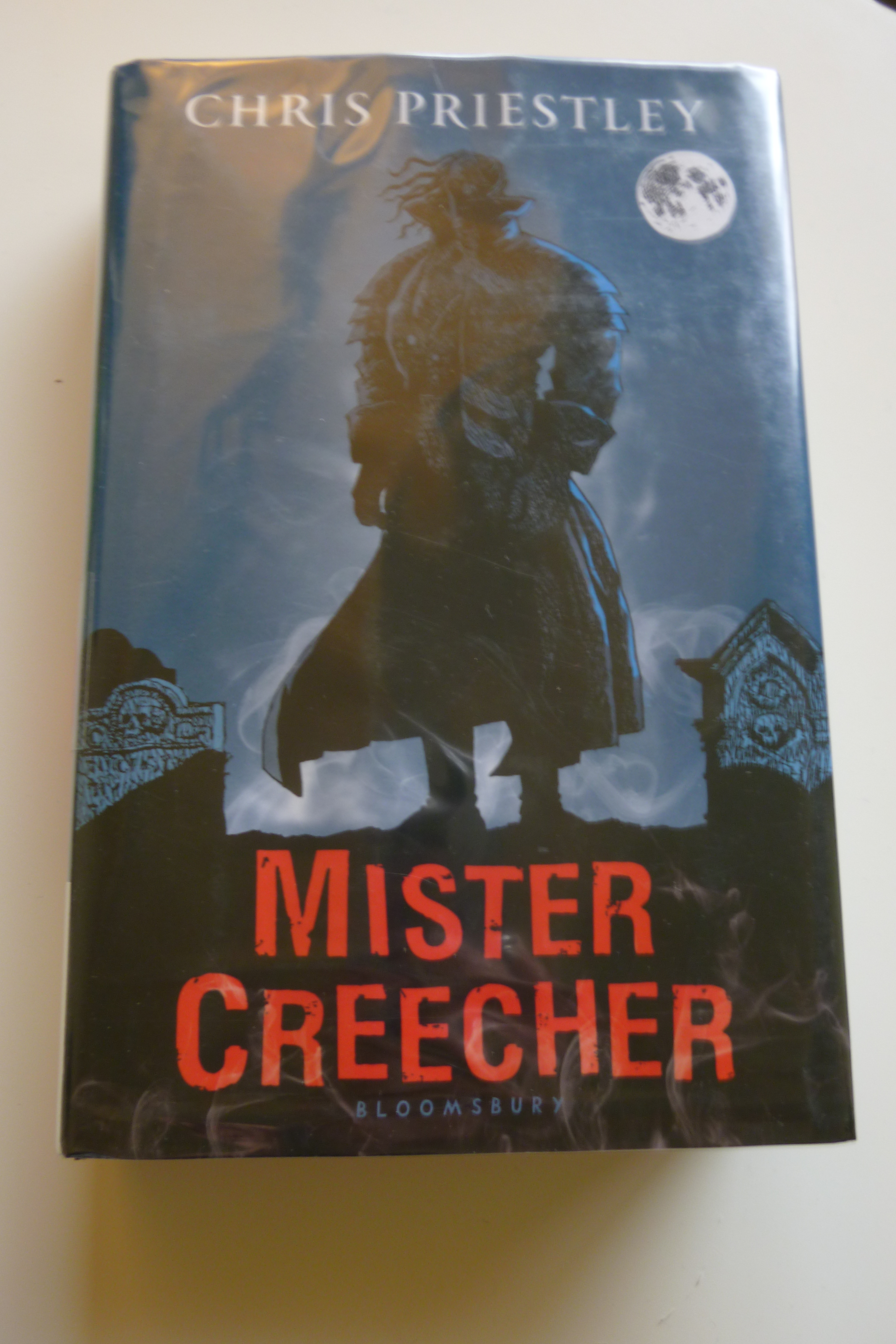
Mister Creecher by Chris Priestley, like Wicked, is another novel that takes characters from a familiar source and reimagines parts of their lives.  I read this one with the Sci Fi Experience in mind, although the library stuck a “Horror” sticker on the spine.  I guess it’s either–or both.

It’s a story about Frankenstein’s creature (see what Priestley did with the title there? 🙂 ), midway through Mary Shelley’s Frankenstein.  The story is from the point of view of Billy, an orphan pickpocket on the streets of London, who one dark night tries to pick the pockets of a dead body–only to have the body get up.  Billy and “Mr. Creecher” are thrown together by circumstances briefly, and then because Creecher wants Billy’s help to follow someone–Victor Frankenstein, who has promised to build Creecher a mate.  Partially through fear and partially through avarice, Billy finds himself pulled into a situation that is far stranger and darker than he expected.

This was an odd reading experience, because I enjoyed it while I was reading it.  And then I thought about it afterwards and decided the whole thing didn’t really work.  Most of the book is about the wary friendship that grows between Billy and Creecher.  It’s about Billy growing out of the scared pickpocket he was, and, we hope, into a better life.  Except…

Slight spoiler here.  I won’t tell you details, but I will tell you that both the friendship and Billy’s growth make an abrupt U-turn in the last portion of the book.  In a way it’s necessary–the creature’s tragedy is that he’s alone.  He has to be alone.  Having a genuine friend just won’t work.  And Billy turns out to be from another piece of classic literature, which is very clever–except that it means I’ve spent a whole book getting to like someone, who eventually grows up to be a character I’ve always hated (and still do).  I just don’t know how to feel about that.  Perhaps it was meant to be a new look at two monsters from literature.

Another problem is that this book is only the middle part of Frankenstein.  Nothing really happens except for following Victor Frankenstein around England.  So if the book isn’t about the creature finding a friend, and if it isn’t about Billy growing into a better person, and if it doesn’t cover any of the major events of Frankenstein…what IS it about?  And that, much as I enjoyed reading it while I was reading it, is the question I can’t answer.

It’s too bad, because I loved the premise.  I’ve read Frankenstein, and even though I really liked it, Victor is one of the few first-person narrators I’ve ever absolutely hated.  Frankenstein from a different point of view, especially one more sympathetic to the creature, sounds great!  I’m just not so sure about where the book actually decided to go.

On the positive side, for most of the book Creecher and Billy were both very good characters.  I’m impressed by how Priestley handled the creature.  I thought it was very true to the original, who was complicated.  It would be easy to either make him nice and purely sympathetic, or to make him the shambling, near-brainless mute of the movies.  Instead, Priestley kept him complicated.  He’s very intelligent, well-spoken, and is even reading Jane Austen at one point.  He’s deeply saddened that everyone rejects him, and he longs for companionship.  At the same time, he has a serious temper that is easily aroused, and when he’s angry, he thinks very little of killing people.  Complicated, and very well-drawn.

Billy is complicated too–he’s had some really, really rotten luck in his life, but he’s also not totally a victim in his circumstances.  He was forced into a thief’s life because he had no other options, but he also enjoys robbing people, and he isn’t too scrupulous about it (he’s really not Robin Hood).  He’s thrilled that Creecher is the perfect thief’s assistant, and actually pushes Creecher into helping him rob people.  One of my favorite moments of the book was when Billy is feeling upset about something, and Creecher asks him if he’d feel better if they robbed someone (answer: yes).  Billy has a complicated relationship with Creecher too, as his feelings fluctuate frequently.  Billy has some cynicism and some darkness, but mostly he’s sympathetic.  I will tell you that the person he turns out to be is NOT.

Maybe this was meant to be a kind of Anakin-Skywalker-to-Darth-Vader story, the birth of a villain instead of the birth of a hero.  But most of the book didn’t seem to have Billy on that trajectory, and when he did finally turn to the Dark Side, so to speak, it felt more contrived than not.

One thing that was fun about this book–Mary and Percy Shelley have cameos, and were probably the happiest people in the novel.  They were a fun little addition.

But really, the whole book was enjoyable–until I try to make any sense out of the wandering plot and the bizarre character turns.  We had a raging debate last month about my issues with Ender’s Game.  I have a feeling less people have read Mister Creecher, but if you have, and if you know what it was about, please let me know!

Author’s Site: http://chrispriestley.blogspot.com/

Other reviews (I actually found a LOT):
Bride of the Book God
The Excelsior File (contains spoilers!)
Becky’s Book Reviews
Shelly’s Book Blog
SisterSpooky
And there are others–let me know if one of them is yours and I’ll add it!

Caught Between a Great Brain and a Money-Loving Heart

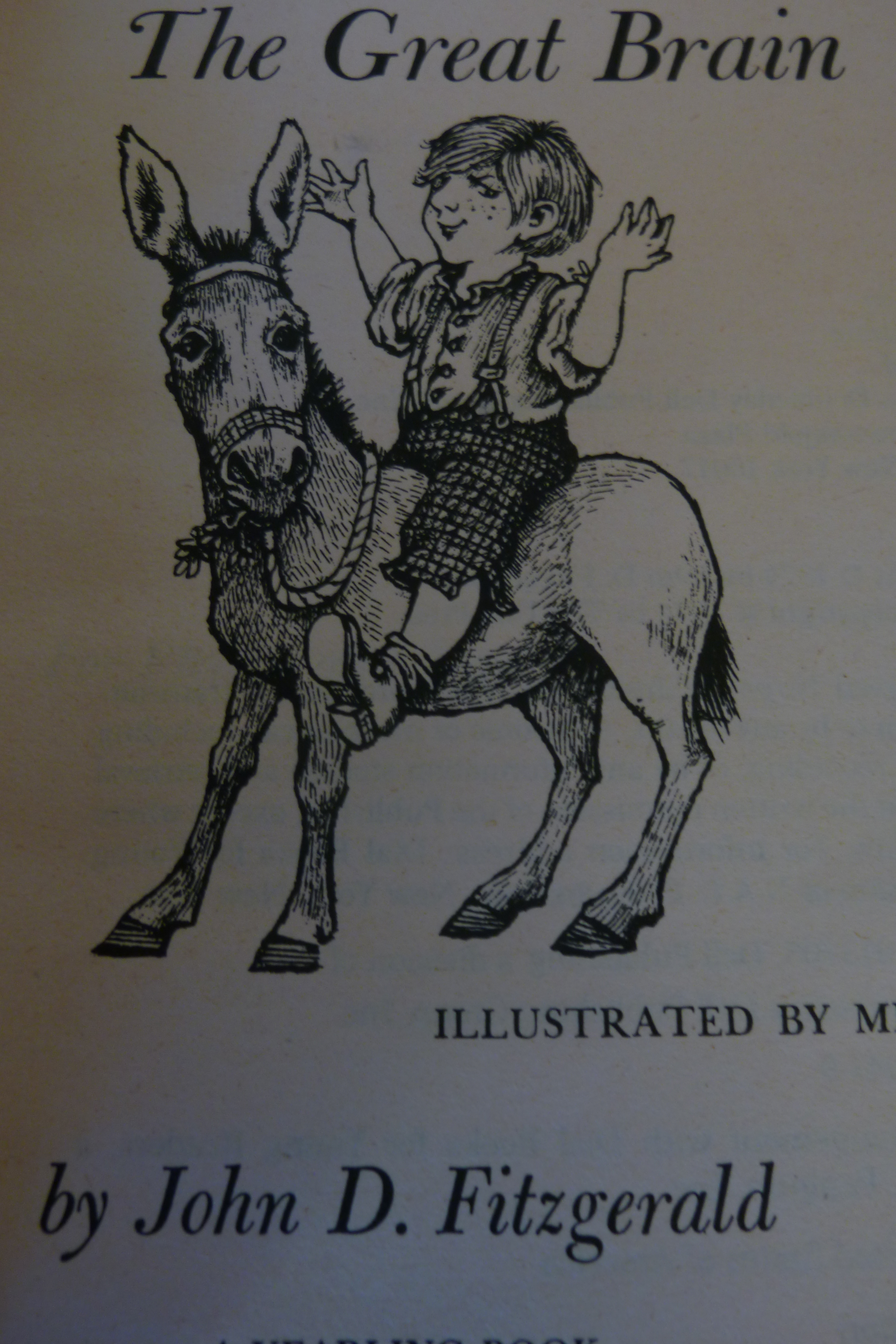
On the subject of funny kids books about boys, another favorite besides Gordon Korman is The Great Brain series by John D. Fitzgerald.  Based loosely on Fitzgerald’s childhood, the books are set in a small town in Utah in the 1890s.  The Great Brain of the title is John’s older brother Tom, who has a brilliant intellect and a “money-loving heart.”

There are seven books in the series, each a string of vignettes.  John narrates in first-person about the adventures of his brother Tom, who always has a scheme going to swindle someone–including John, who never seems to learn that it’s impossible to win a wager against Tom.

Tom is very clever, and it’s always fun to see what scheme he’ll come up with next.  I’ve never been a big reader of mysteries but I like figuring things out, and guessing at what plot Tom is devising, or how he’ll solve some problem, always makes for good puzzles.  Tom is a great character in that he never becomes TOO unlikable.  He’s immensely proud of his Great Brain, and he loves to get money out of people.  He doesn’t cheat, though–he finds ways to trick them, usually exploiting their own gullibility or greed.  He also uses his Great Brain to help people, sometimes saving lives or dramatically changing lives for the better.  He usually gets something for it too…but that’s always the question, of whether he’s acting from compassion or from greed!  Usually I get the sense it’s a little of both.  He’s also not above being humbled at times when greed or pride leads him into a serious mistake.

John is a good character, sweet-natured and modest.  He often refers to his “little brain” in comparison to his brother’s Great Brain.  John is rather eclipsed by Tom, but that aspect of the books seems to work–it’s John’s story about his brother, so it makes sense that he’s giving Tom the center stage.  John’s obvious admiration and love for his brother (no matter how many times Tom swindles him!) also goes a long way to setting Tom up as a likable character.

The stories are mostly light and funny.  They’re not the hilarity of Gordon Korman, but they are very entertaining.  There are some serious ones mixed in too.  Sometimes the situations kids get into have real peril, as when two boys get lost in a network of caves, or when one boy loses his leg to an infection and contemplates killing himself.  The Great Brain series is another example of how deep children’s books can be, addressing very serious issues and subject matter, while being child-appropriate.

And fun, of course.  Even though the stories are sometimes serious and Tom is out to swindle others to satisfy his money-loving heart, these still come across as sweet stories about family, set in a small town in a quieter time.  Well-worth the read.

Other reviews:
The Five Borough Book Review
Books 4 Your Kids
There must be more…tell me about yours?