“She was helping people become whoever they were going to be. Because when you read a book as a child it becomes a part of your identity in a way that no other reading does.”
–Kathleen Kelly, character played by Meg Ryan in You’ve Got Mail, speaking of her mother, who ran a bookstore
Narnia has been coming up a lot for me lately. I went to see The Voyage of the Dawn Treader…my book club book pick was inspired by Narnia…the series was referenced on a blog I follow… I decided the universe was telling me something (and that book club book especially made me want to go back to the original) and I decided to re-read The Lion, the Witch and the Wardrobe by C. S. Lewis.
I say “re-read” because I know I read it before, but I honestly couldn’t tell you how long ago it was. Years and years, although the story is so familiar that in some ways it doesn’t feel that long. For those who somehow don’t know the story (side-note–I once overheard a woman tell a librarian she’d never heard of the series, so it’s possible), it’s the story of four children who go through a wardrobe and find themselves in the magical country of Narnia. There they meet the great lion Aslan and fight an epic battle against the White Witch.
It’s a wonderful story on many levels. It’s a lovely children’s fantasy with dashing heroes, not too much blood, magical creatures like Mr. Tumnus and Mr. and Mrs Badger, and several stern admonitions that it’s very foolish to shut oneself inside of a wardrobe (I honestly think Lewis was worried about this, he repeats it so many times). On a more symbolic level, there’s a clear Christ story enacted. But it works on both levels, for however you want to take it. I’ve always thought that was the mark of the best kind of book–a good story and a good message where neither one gets in the way of the other.
I enjoyed Lewis’ style very much. Things happen so quickly. Lucy, the first child into Narnia, gets there by page six. As the adventures continue, they go on at a tumblingly-quick rate. There’s even a point where Lewis writes, of an unpleasant night journey by sledge, “This lasted longer than I could describe even if I wrote pages and pages about it.” Thankfully, he doesn’t bother, concluding, “But I will skip on to the time when the snow had stopped and the morning had come and they were racing along in the daylight.”
C. S. Lewis and J. R. R. Tolkien were in the same writing group. I’ve heard that Tolkien spent years and years on The Lord of the Rings, and Lewis wrote The Lion, the Witch and the Wardrobe in a matter of weeks (something that I’ve also heard annoyed Tolkien no end). I have to say, it shows for both of them. Different viewpoints on writing could consider that a plus or a minus to either one, but my preference would have to be with Lewis.
Lewis begins the book with a lovely dedication to his goddaughter, the real-life Lucy. In somewhat contradiction to the story that he wrote the book in a few weeks, he says that he wrote it for her but she grew up faster than it did and she’s now too old for it, “but some day you will be old enough to start reading fairy tales again.” Lewis clearly understood about the cross-age appeal of the best children’s stories. We may go through an age where we think we’re too grown-up for “kids books,” but eventually we get old enough to realize we can come back to them.
St. Paul wrote, “When I became a man, I put childish ways behind me” (1 Corinthians 13:11). C. S. Lewis added, “Including the fear of being thought childish.” We don’t have to “think like a child or reason like a child” (paraphrasing Corinthians) to appreciate a story written for children. We can enjoy it with new eyes, new understanding, and hopefully some of the old magic too.
I’ve read several books about ordinary princesses. The danger is that ordinary can sometimes be only half a step from boring, and when you set out to make your heroine ordinary, you sometimes end up with a heroine who is so very ordinary that she’s not at all interesting or distinctive. But, on the other hand, sometimes it works. There’s nothing at all boring about Amy in The Ordinary Princess by M. M. Kaye.
I have to love a book that begins “Long and long ago, when Oberon was king of the fairies, there reigned over the fair country of Phantasmorania a monarch who had six beautiful daughters.”
Amy is born seventh, and is cursed–or blessed?–at her christening by a fairy to be ordinary. Unlike her blonde-haired, blue-eyed and breathtakingly beautiful sisters, Amy has mousy brown-hair and a turned-up nose, is not the least bit graceful, and is, well, ordinary. But she knows how to climb down the wisteria vine growing by her window and go off into the forest to climb trees and make friends with squirrels, and she has a wonderful practical bent. Of one of her sisters’ suitors, she thinks, “He may be very good-looking, but I’m quite sure he has never giggled one good giggle in his life!”
When Amy’s turn comes to get married, the royal family is at an utter loss to find an interested prince, so they decide the solution is to bring in a dragon. That will of course tempt some prince to come kill it, and then he’ll have to marry the princess. Not wanting a dragon to lay waste to the country, Amy decides to run away.
She goes on to have quite ordinary adventures, in the forest and later as a kitchen maid at another castle, where she falls in love with a man-of-all-work. They’re ordinary adventures in the most charming way. The writing is very good, and Amy is a sweet and endearing heroine. She somehow seems utterly unlike a lot of the brown-haired, tom-boyish, clumsy “ordinary princesses” that populate other books of this sort, even though point by point she has a lot in common with them. Maybe it’s simply better writing.
I love practical, pragmatic, humorous stories loosely inspired by fairy tales, and this one’s a favorite.
Looking for Marco Polo by Alan Armstrong was a fascinating read, but not for the reasons the author was hoping, I’m sure. Mostly, I was trying to figure out exactly why it just wasn’t working for me.
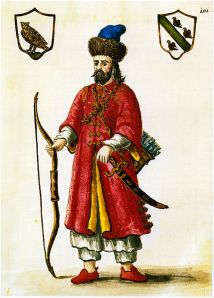
Marco Polo
First reason: faulty advertising. Or maybe, an unclear metaphor. I picked this up at the library, and from reading the description on the inside of the front jacket (does that description have an official name?) here’s what I gathered: Mark’s father “has disappeared in the Gobi Desert while tracing the path of Marco Polo.” Mark and his mother go to Venice to talk to the agency that sent his father to the desert, trying to find him. Mark meets Dr. Hornaday, who starts telling him the story of Marco Polo and “before he knows it, Mark–like his father–is on the trail with Marco Polo as he travels the Road of Silk.”
So what am I expecting: that Mark’s father is on some kind of special expedition specifically focused on Marco Polo–it says that, right? Probably the mystery of his disappearance has something to do with that. Mark, in turn, will find himself fascinated by whatever his father’s Marco Polo-related mission was, and end up traveling through the desert, either in the modern day or, even better, somehow going back in time. If I’m crazy to draw those conclusions, someone tell me.
What is the book actually about? First, Mark’s father is in the Gobi Desert, but he’s studying the people. It’s the same place Marco Polo was in, and Mark’s father does mention that when he gives him a copy of Polo’s book, but otherwise, his expedition has no connection to Polo. Second, and much more importantly, Mark doesn’t go anywhere beyond Venice. “On the trail” and “looking for Marco Polo,” are metaphors.
What this really is, is Mark and Dr. Hornaday sitting in a cafe and occasionally walking around Venice, while the doctor talks about Marco Polo’s trip. It’s not that the stories aren’t interesting–but it’s not what I was expecting. Problem one: failed expectations.
Once I was about 150 pages in and realized this was all there was, and I should stop waiting for Mark to go anywhere, I tried to readjust to the new trajectory of the book. And to figure out, beyond the failed expectations, why it wasn’t working. I like the story of Marco Polo. I chose to do a report on him in high school. I like Venice. The stories Dr. Hornaday is telling are good ones.
But. Mark and Dr. Hornaday are ultimately a frame story for Marco Polo. The trouble is, they’re a frame story that won’t go away: problem two. Once in a while Dr. Hornaday talks for so long and in such detail that you almost forget you’re still sitting in a cafe. Most of the time, that doesn’t happen. I would much rather be in Marco Polo’s story, with the level of immersion and detail that would allow, rather than sitting at a surface level where it’s limited by what Dr. Hornaday can say out loud, and where every so often Mark asks a question and pulls me out of Kublai Khan’s court entirely.
I think I would have liked this book better if Armstrong had given Mark a couple of chapters to set up his world, and then Dr. Hornaday had said, “Let me tell you about Marco Polo…” and launched on a 200 page narration of Marco Polo’s life without another reference to Mark or the doctor. That’s how a frame story should work. That’s how The Time Machine does it, or how Burroughs wrote a lot of his books. This telling of the two stories at once never let me really get into either one.
It was actually fascinating to observe from a literary standpoint. It made me think a lot about frame stories and how they function–or not. And if you want to know about Marco Polo, this does that. There’s even a bibliography at the end. But if you look at the description, be warned–all is not as it seems, and I don’t mean what’s going on in the Gobi Desert.
I’m going to try–I really am–not to wax too enthusiastic today. But it’s hard when I’m talking about a favorite series–when it would actually not be inaccurate to use phrases like “changed my life” and “favorite character ever.”
Am I talking about some great inspirational work? Well…not a traditional one. I’m talking about the Song of the Lioness Quartetby Tamora Pierce.
The first book is Alanna: The First Adventure. Alanna is a girl who wants to become a knight, except that girls aren’t allowed to become knights. So she disguises herself as a boy and sets out to become one anyway. Alanna is an incredible character. When I was younger, I basically wanted to be her when I grew up. She’s stubborn, determined, and incredibly brave, but also human–she makes mistakes, she has struggles, and she’s not always sure of herself. She was my favorite character when I was a kid, out of any book I’d read.
The series has a host of memorable characters, with new ones arriving in later books as well. A couple of favorites include Prince Jonathan, every girl’s dream of a handsome and charming prince, and George Cooper, the roguish and equally charming King of Thieves.
They all live in a world of swordplay and tournaments that is nevertheless grounded and believable–swing a sword around too long and you’ll have sore muscles. They also live in a world of magic. Alanna possesses the Gift, which she can use for various spells, some practical and some dramatic. There is also an entire pantheon of gods who occasionally step into mortal affairs.
The books are funny, exciting, engaging…amazing.
And they changed my life. I’m a firm believer that a girl can do anything a boy can do, that women have the same rights as men, and that we all ought to be equal, whether in pay rates or in who cleans the house. I’m sure a lot of that belief comes from my parents, especially my mom, but I think reading about Alanna at a young age helped.
I also met one of my best friends because of Tamora Pierce. We were freshmen in high school, and were both shy book-lovers. We were in a class together, but hadn’t talked. She was reading a Tamora Pierce book, and so was I. I can’t remember now who talked first, but we’ve later admitted that we each noticed the other one’s book, and each took out our own book before class started in the hopes that the other one would notice and use it as an excuse to start a conversation. She’s still one of my best friends; we’re both eagerly awaiting Tamora Pierce’s next book, promised for this February.
You may also be recalling right now that in Fiction Friday, I’ve featured some of my writing about a girl who disguised herself as a boy so that she could become a pirate. It’s not a coincidence that my character’s name is Tamara.
Song of the Lioness is my favorite quartet by Tamora Pierce. She’s written other books set in the same world, and many characters, Alanna included, turn up in those books. I recommend those as well.
Much as I still love her, I don’t think I want to be Alanna anymore. Now, I think that when I grow up, I want to be Tamora Pierce. I don’t know anything about her personal life, but I’d like to be her from a writing perspective, at least. 🙂


 by Tamora Pierce.

 Tales of the Marvelous