Classic Review: The Little White Bird

A quick update today, to say that I just got back from my trip to London and Paris.  I scheduled posts ahead, but if you noticed a distinct silence in the comments, that was why.  The trip was amazing 🙂 and you will be hearing (and seeing) more about it soon!  While I’m getting back on top of things, I have another classic review today, very relevant to my recent trip.

My hotel in London was near Kensington Gardens for a variety of reasons.  It really was a practical choice.  But I also stayed in that part of town because of J. M. Barrie.  The author of Peter Pan, he lived near Kensington Gardens, where he met the Davies boys, the real life inspirations for Peter.  He wrote another book inspired by the Davies, featuring Peter in a cameo.  It’s really that book, The Little White Bird, that’s given me my fascination with Kensington Gardens.

*********************************
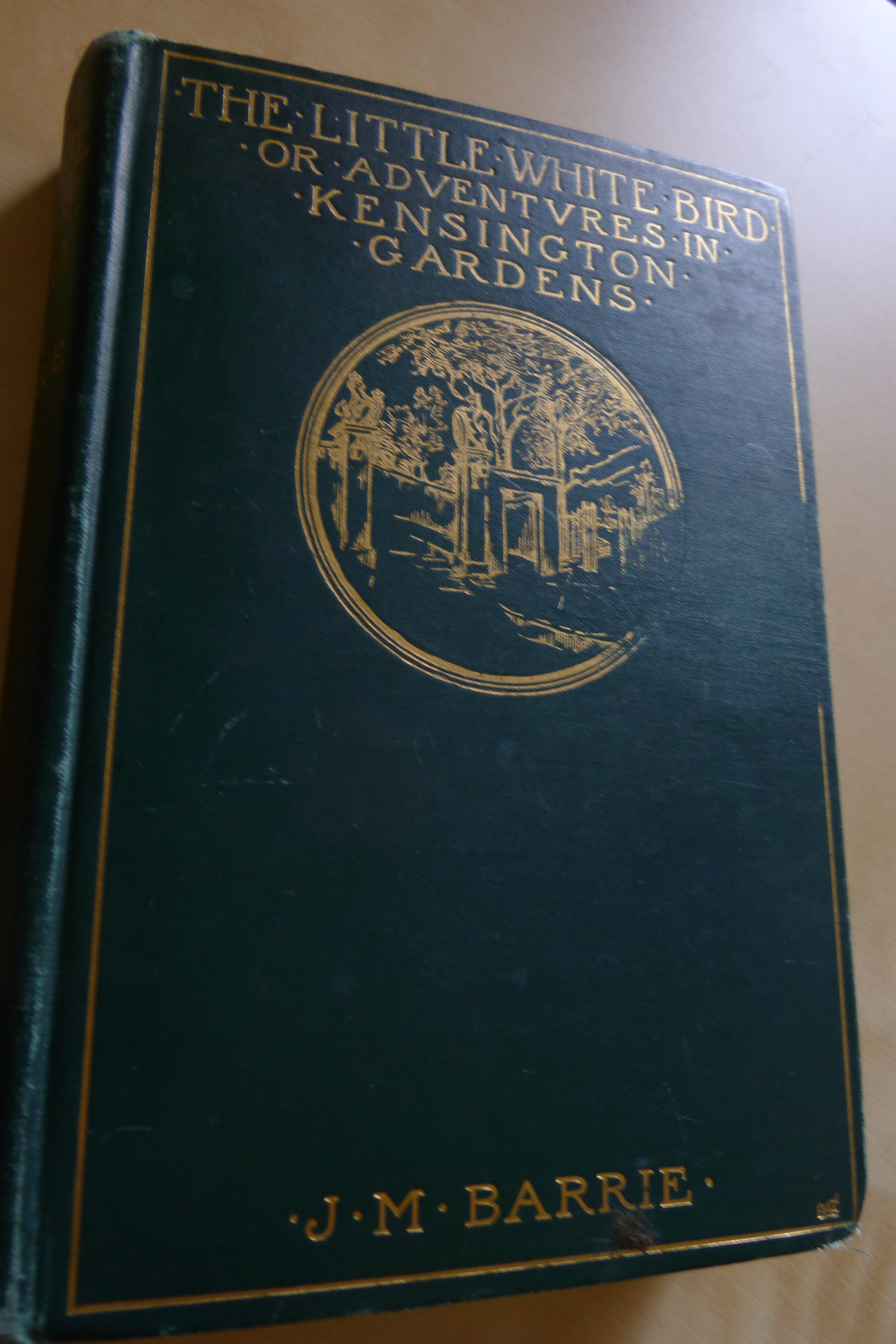
It really all began in the The Little White Bird.  It’s very possibly my favorite J. M. Barrie book, even over and above Peter Pan.

The Little White Bird; or Adventures in Kensington Gardens is a tale about a man who befriends a little boy, and has adventures with him in London and Kensington Gardens.  If you’re not already suspecting the autobiographical nature of this novel, the little boy’s name is David.  Historically, J. M. Barrie befriended the Davies brothers in Kensington Gardens.  Not too subtle!  He also has a dog named Porthos, as did Mr. Barrie.  The man in the story is left unnamed.  He’s referred to as Captain W–.  I somehow picked up the habit of calling him the kindly old gentleman.

A review in The Times said of the book when it was first published, “The peculiar quality of The Little White Bird…is it’s J.-M.-Barrie-ness…whimsical, sentimental, profound, ridiculous Barrie-ness…Mr. Barrie has given us the best of himself, and we can think of no higher praise.”

I couldn’t put it better.  The Barrie-ness is often the best part of Mr. Barrie’s books.  The charm, the whimsy, the flights of fancy, the sweet sadness…the book is funny and tragic, absurd and heartbreaking, and sometimes all at the same time.  The tragedy, for the kindly old gentleman at least, is that David doesn’t really belong to him, and will one day grow up and leave him.

And there we come to the Peter Pan connection.  Besides thematic connections, there are also four chapters in the middle of the book that are about Peter.  They’re almost oddly unrelated to the rest, other than by geography, but I think they’re meant to be stories that the kindly old gentleman tells David.  In Peter Pan, Peter tells Wendy, “I want always to be a little boy and to have fun.  So I ran away to Kensington Gardens and lived a long, long time with the fairies.”  And this is that story.

We read about Peter’s running away from home, find out why he doesn’t grow up, see him meet the fairies, and also meet a girl he knew long before there was Wendy.  This is before Peter went to Neverland (although an island features) and the Lost Boys and Tinkerbell are yet to come on the scene, but there are other wonderful magical creatures and adventures.  The four chapters about Peter, along with one chapter giving a Grand Tour of the gardens, have been excerpted and published as Peter Pan in Kensington Gardens, with lovely illustrations by Arthur Rackham.

The Baby’s Walk

The Grand Tour (and map) is especially wonderful, because if you’re ever in London, I highly recommend spending an afternoon in Kensington Gardens with The Little White Bird in one hand.  It’s what I’ve done, and I spent a couple of hours going, “Oh, there’s Mabel Gray’s gate!  And the Round Pond!  And that must be the Baby Walk!  And this is probably the weeping beech where Peter sat!”  Even a century later, I was able to find almost everything J. M. Barrie described.  And it’s a little easier to get to Kensington Gardens than to figure out which star is the second one to the right.

One more note on The Little White Bird–George Davies, who was the chief inspiration for David, took a copy of the book with him to the trenches in World War I.  I think that’s one of the saddest and sweetest things I ever heard.

Even in much less dire reading circumstances, it’s a lovely and enjoyable book–and, of course, magical too.

Saturday Snapshot: Visiting Book Characters

I’ve mentioned before that I love visiting places that figure in books, and I’ve been lucky to do that fairly often.  Once in a great while, I get to visit a character from a book–sort of!

These are the original Winnie-the-Pooh characters, the dolls owned by Christopher Robin Milne, A. A. Milne’s son.  Rabbit and Owl were slightly more imaginary, and Roo was lost in an apple orchard around 1925, but you can go visit Kanga, Tigger, Edward Bear, Piglet and Eeyore at the New York Public Library.  There’s a lovely display in the children’s section.  You can’t see it in this picture, but Eeyore’s tail really is held on with a tack!

This is the Peter Pan Statue in Kensington Gardens, which is where Peter ran away to when he left home.  I don’t actually know those two little girls, but they happened to be there when I snapped the picture and I liked how it came out.  And I’m fascinated by the base of the statue–I see something new in it every time I look at it.

There aren’t very many bookish characters available to be visited…but at least there are plenty more bookish places I still want to go…

See more Saturday Snapshots on At Home with Books!

Finding the Way Back to Neverland

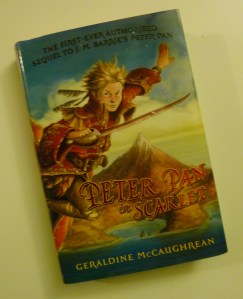
As a general rule, I’m against sequels to classic novels written by new authors, especially when the primary appeal of the original was the author’s voice.  How do you ever do that right?  I’ve only see it happen once.  Peter Pan in Scarlet by Geraldine McCaughrean is a beautiful sequel to Peter Pan.

I give a lot of the credit to her–and a lot of the credit to the way the sequel came to be.  That’s a fascinating story too.  In 1929, J. M. Barrie gave the rights to Peter Pan to the Great Ormond Street Hospital for Children, meaning that they receive all the royalty money, as well as controlling the rights.  Several years ago they held a contest inviting authors to submit a sample chapter and synopsis for a sequel.  All of this means that the people involved in the publishing had a primary interest, not in a later version, but in the original work–and you can tell.

I can’t say that Peter Pan in Scarlet feels like J. M. Barrie is telling the story, but I feel like the story is very much about the world and the characters that he created.  McCaughrean has done a very impressive job at staying true to the story J. M. Barrie gave us, and yet giving us another story that is, I think, what we all want.

Mr. Barrie was in some ways not kind to anyone who wanted to follow him with a sequel.  He left a lot of challenges behind him.  To name the chief ones–he killed off his villain, he grew up his supporting characters, and his heroine was rather annoyingly maternal all along.  So what is a sequel-writer, saddled with Wendy and knowing that readers really want to see Peter Pan and the (grown-up) Lost Boys fight (the deceased) Captain Hook, to do?

McCaughrean handles it all neatly and effectively, and with the kind of magical and whimsical solutions that are worthy of Mr. Barrie.  I don’t want to give it all away…but I can’t resist just a little.  Suppose a person wants to get back to Neverland but you can’t depend on Peter to show up at your window, how do you go about it?  Well, you’ve got to find a fairy for their dust, right?  And the best place to look…Kensington Gardens, of course.  And the way to find a fairy is to find a baby out with its nurse, and to catch the baby’s first laugh just as it turns into a fairy.  Brilliant, magical and whimsical.

Peter Pan in Scarlet opens with Wendy and the Lost Boys as grown-ups, but they’ve begun to dream about Neverland again.  They decide that something must be wrong, that perhaps Peter is in trouble.  They have to find a way to become children again so that they can return to Neverland and help him–and from there the adventures begin.  In Neverland they find that summer has turned into autumn, and something seems to be inexplicably wrong.
McCaughrean even handles Wendy well, successfully portraying her as simply a rather practical-minded child (after the grown-ups become children again), rather than a child who wasted all her time in Neverland darning socks.

After we return to Neverland and find everyone’s favorite Wonderful Boy, the adventures are “nicely crammed together,” and we have the chance to explore the greater geography of the magic lands.  Everyone’s favorite pirate captain appears too.  Again McCaughrean finds a way to stay true to the end of Mr. Barrie’s book, where the Crocodile eats Hook, and yet still bring the villain back.

Even if there was nothing else in this book to recommend it–which is obviously not the case!–there is a single line in here which would alone put it miles above Peter and the Starcatchers in my estimation.  At one point in the book, Wendy tells Peter and the Lost Boys a fairy story about a little white bird in the Kensington Gardens.  We don’t hear the story; we don’t even know what the story is supposed to be about.  But that doesn’t matter.  McCaughrean knew that a little white bird in Kensington Gardens is significant in Peter Pan lore.

Thank you, Geraldine McCaughrean, for knowing what you’re writing about, and for writing it so well.

Author’s site: http://www.geraldinemccaughrean.co.uk/

With the Fairies in Kensington Gardens

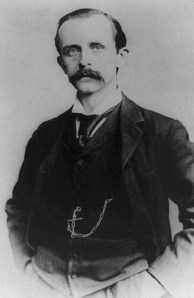
J. M. Barrie

As I’ve said elsewhere, J. M. Barrie (best known for Peter Pan) is one of my favorite authors.  Peter Pan is not a series, but I have been able to track down several related books, by Mr. Barrie and others–prequels and sequels and so on.  So that I don’t overwhelm anyone with a steady stream of Peter, I’m going to spread some related posts out over the next several weeks, to explore the good, the great, and the simply dreadful.

To begin at the beginning–that’s actually not Peter Pan.  It all began in the The Little White Bird.  It’s very possibly my favorite J. M. Barrie book, even over and above Peter Pan

The Little White Bird; or Adventures in Kensington Gardens is a tale about a man who befriends a little boy, and has adventures with him in London and Kensington Gardens.  If you’re not already suspecting the autobiographical nature of this novel, the little boy’s name is David.  Historically, J. M. Barrie befriended the Davies brothers in Kensington Gardens.  Not too subtle!  He also has a dog named Porthos, as did Mr. Barrie.  The man in the story is left unnamed.  He’s referred to as Captain W–.  I somehow picked up the habit of calling him the kindly old gentleman.

A review in The Times said of the book when it was first published, “The peculiar quality of The Little White Bird…is it’s J.-M.-Barrie-ness…whimsical, sentimental, profound, ridiculous Barrie-ness…Mr. Barrie has given us the best of himself, and we can think of no higher praise.”

I couldn’t put it better.  The Barrie-ness is often the best part of Mr. Barrie’s books.  The charm, the whimsy, the flights of fancy, the sweet sadness…the book is funny and tragic, absurd and heartbreaking, and sometimes all at the same time.  The tragedy, for the kindly old gentleman at least, is that David doesn’t really belong to him, and will one day grow up and leave him.

And there we come to the Peter Pan connection.  Besides thematic connections, there are also four chapters in the middle of the book that are about Peter.  They’re almost oddly unrelated to the rest, other than by geography, but I think they’re meant to be stories that the kindly old gentleman tells David.  In Peter Pan, Peter tells Wendy, “I want always to be a little boy and to have fun.  So I ran away to Kensington Gardens and lived a long, long time with the fairies.”  And this is that story.

We read about Peter’s running away from home, find out why he doesn’t grow up, see him meet the fairies, and also meet a girl he knew long before there was Wendy.  This is before Peter went to Neverland (although an island features) and the Lost Boys and Tinkerbell are yet to come on the scene, but there are other wonderful magical creatures and adventures.  The four chapters about Peter, along with one chapter giving a Grand Tour of the gardens, have been excerpted and published as Peter Pan in Kensington Gardens, with lovely illustrations by Arthur Rackham.

The Baby's Walk

The Grand Tour (and map) is especially wonderful, because if you’re ever in London, I highly recommend spending an afternoon in Kensington Gardens with The Little White Bird in one hand.  It’s what I did, and I spent a couple of hours going, “Oh, there’s Mabel Gray’s gate!  And the Round Pond!  And that must be the Baby Walk!  And this is probably the weeping beech where Peter sat!”  Even a century later, I was able to find almost everything J. M. Barrie described.  And it’s a little easier to get to Kensington Gardens than to figure out which star is the second one to the right.

One more note on The Little White Bird–George Davies, who was the chief inspiration for David, took a copy of the book with him to the trenches in World War I.  I think that’s one of the saddest and sweetest things I ever heard.

Even in much less dire reading circumstances, it’s a lovely, sweet and enjoyable book–and, of course, a bit magical too.